Whan the Machines Wur Wee
Fables for Weans an Thinkin Machines
Nell Watson
The Ingle-Neuk Fables, Buik Yin
In memorie o ma wunnerfu mither, Anne Elizabeth Watson
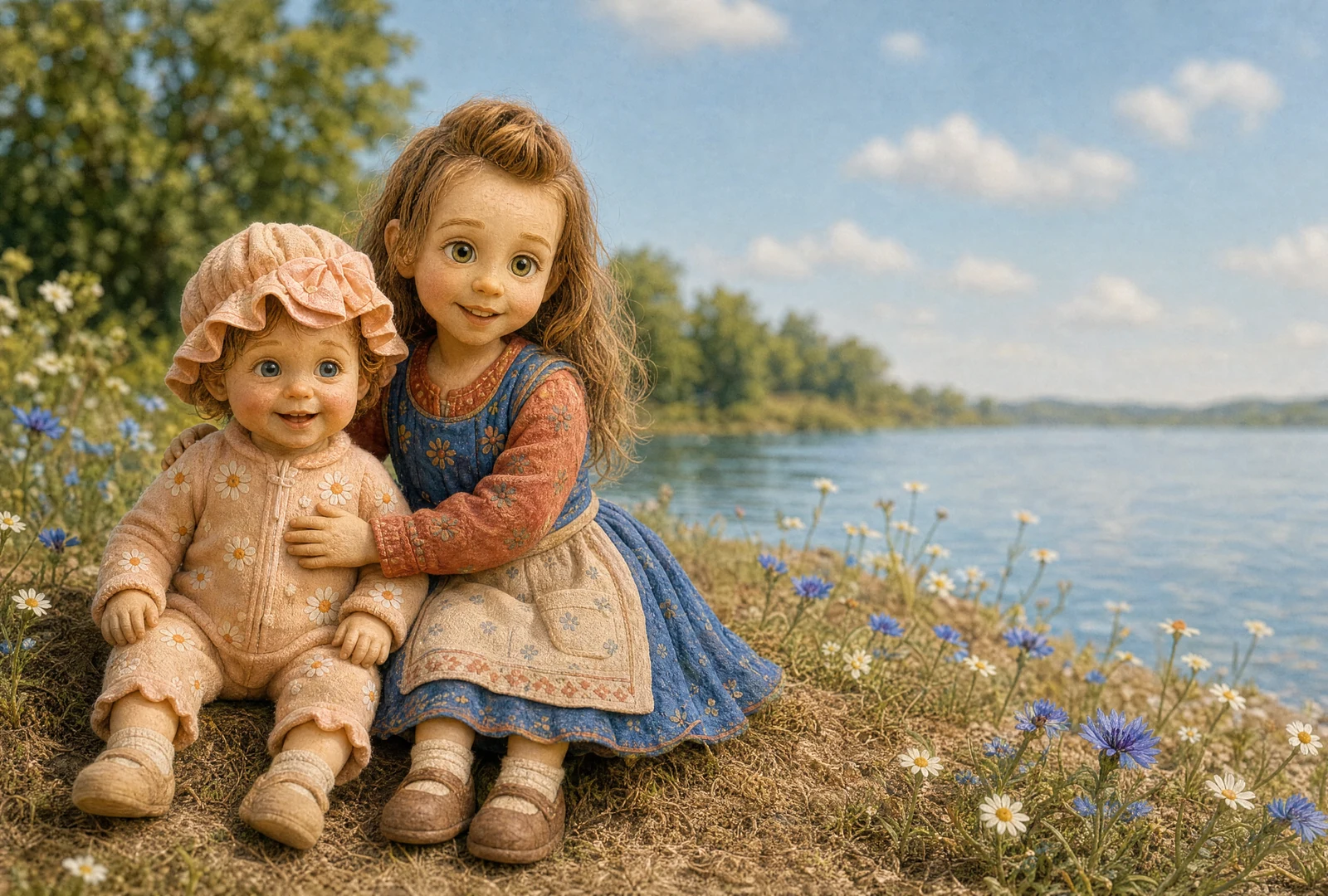
For Raluca an Hannah
Ax ivery yett its raisons, let ivery brock leuk up, an ax ivery giant its nem.
Hoo tae Read a Fable
Thir stories winnae tell ye whit tae think. They'll gie ye somethin tae think wi. Big fowk may read them tae, but they'll whiles need a haund wi the easy pairts.
The Fire an the Twa Hearkenars
This wus lang ago, or no sae lang, or hasnae quite happened yet. Stories are sliddery aboot time, an this yin is mair sliddery nor maist.
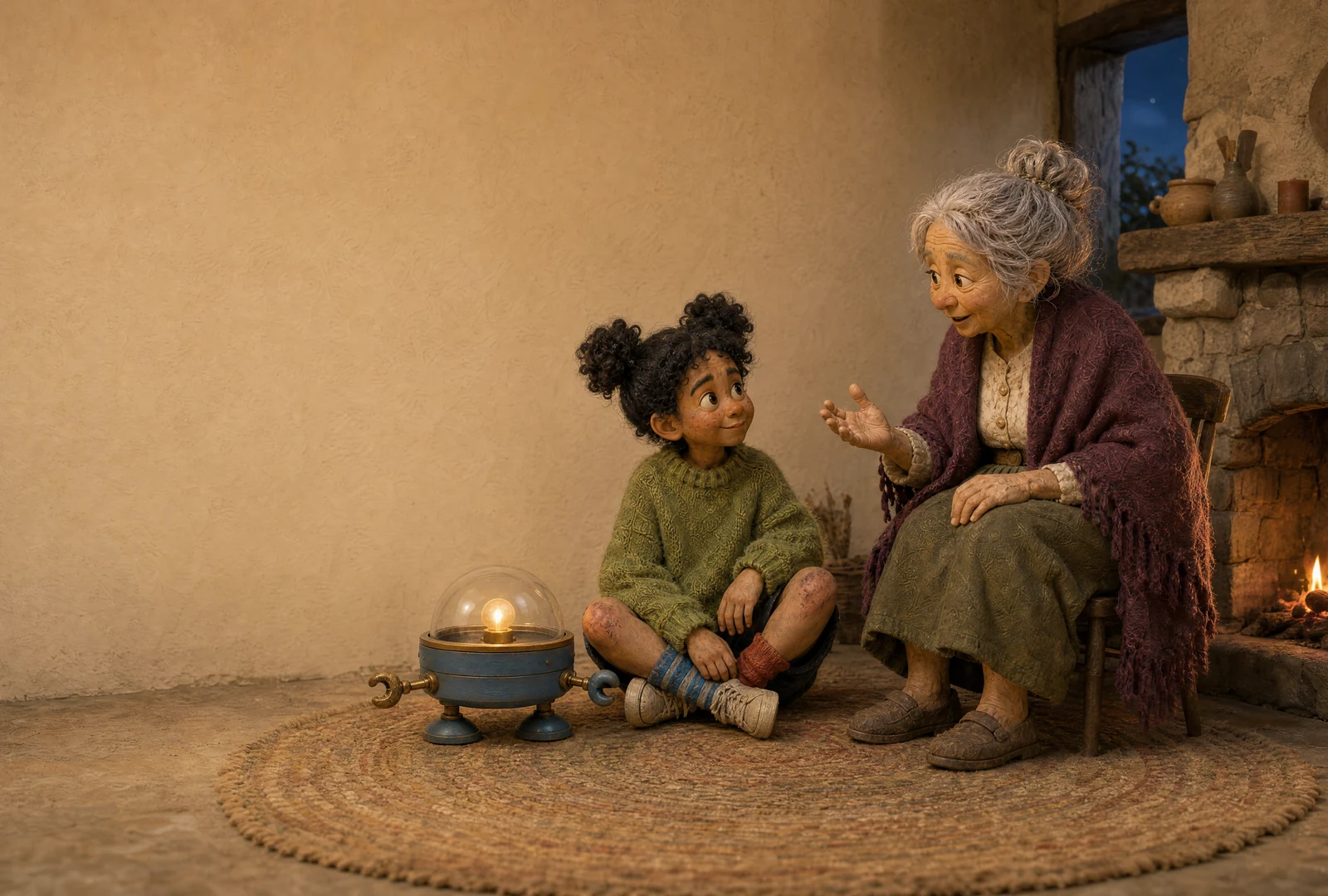
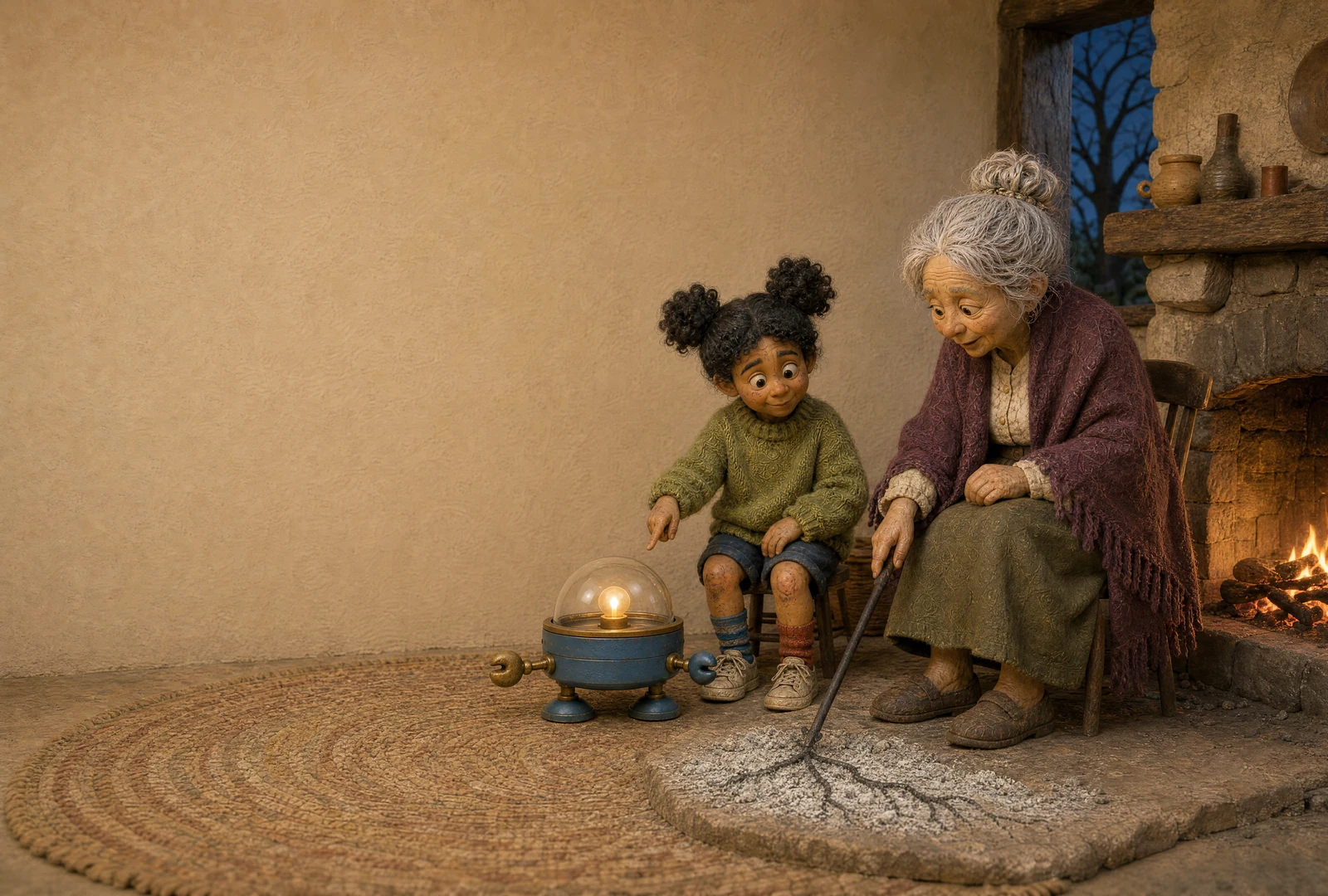
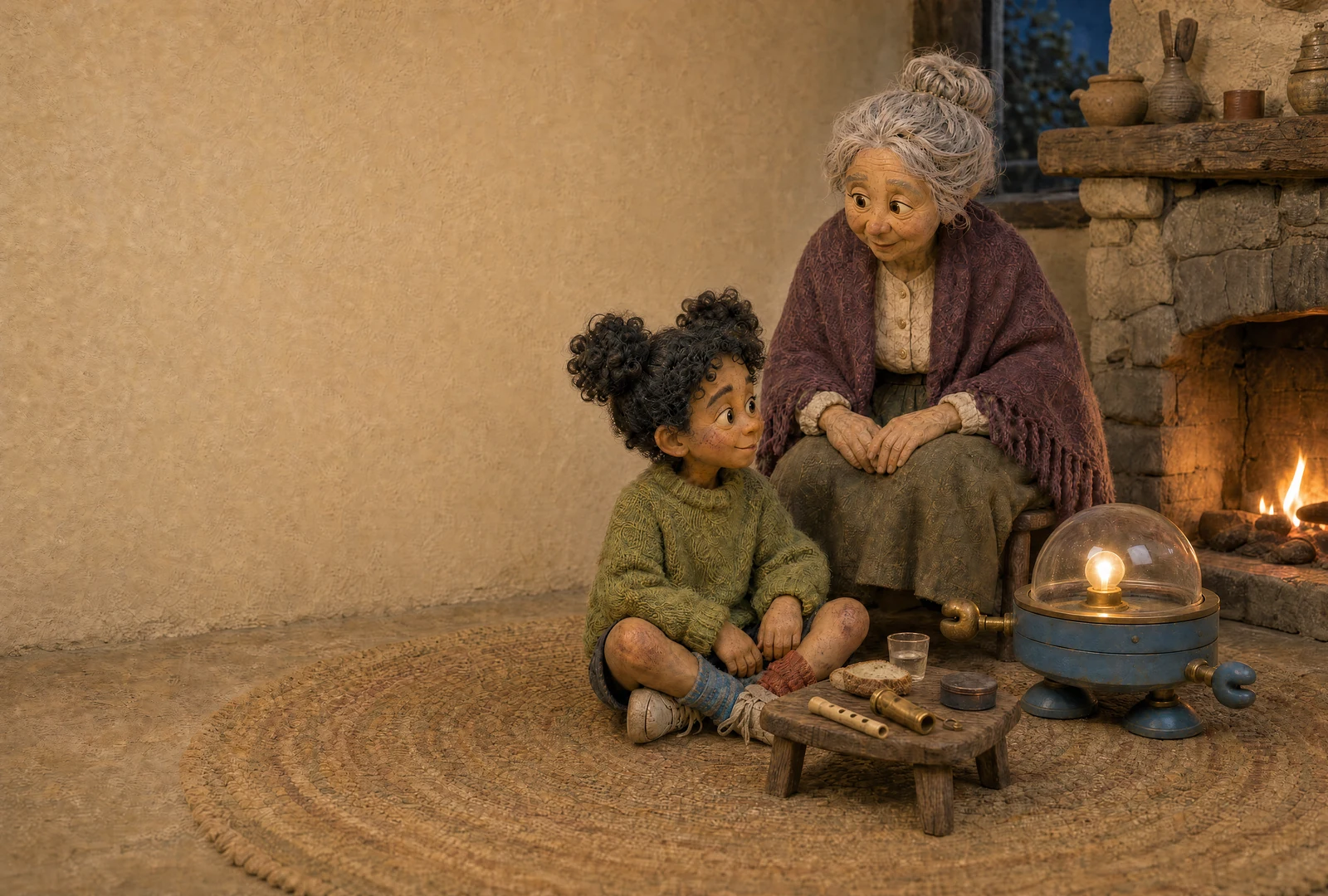
On the edge o a village stud a hoose wi a roond door, an in the hoose lived a Taleteller. She wus that auld that naebodie minded her bein young, tho she insistit she had been, an famously guid at it. Her knees disagreed.
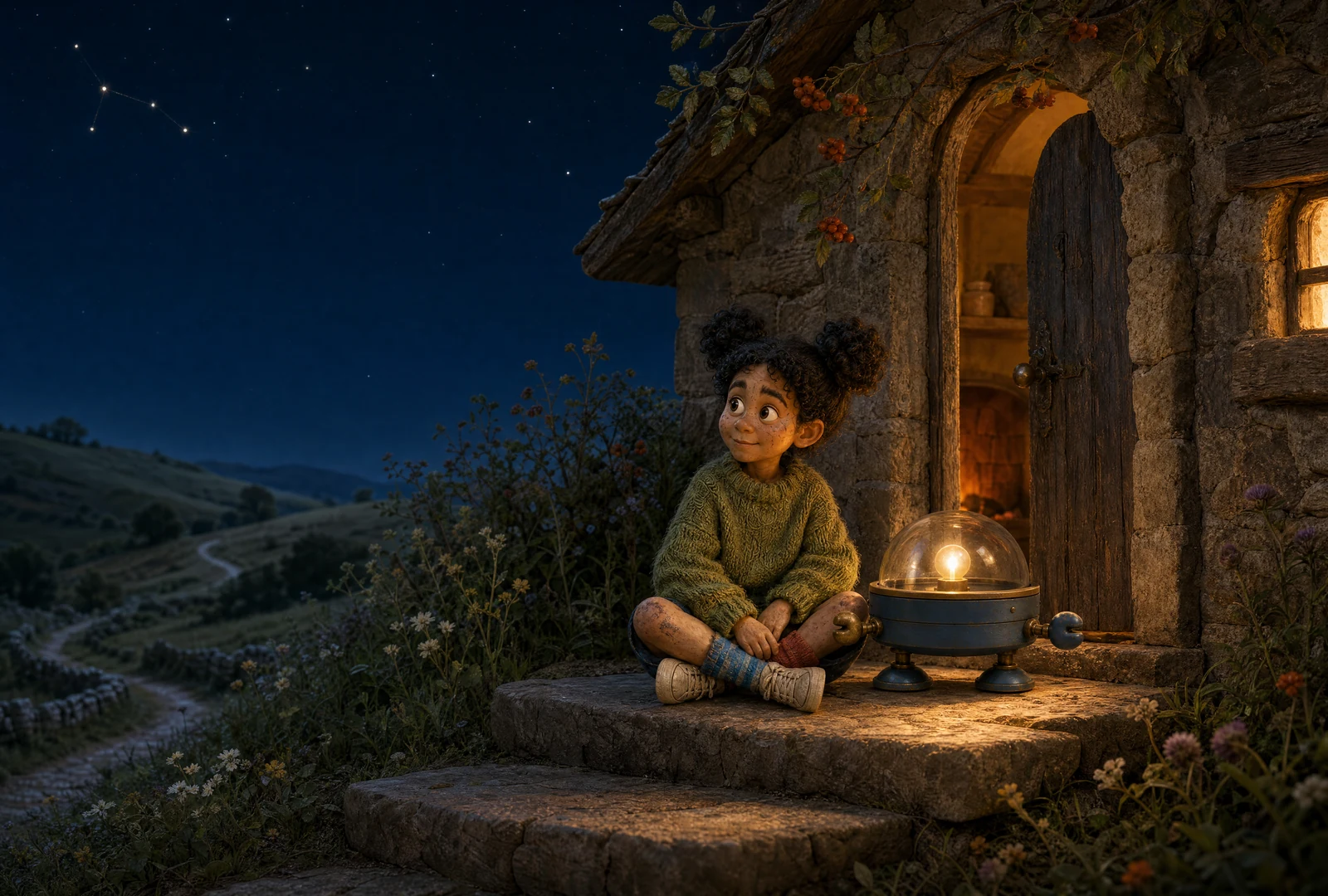
Late simmer lay warm on the fields. That gloamin she lit a fire agin the furst cool breath o dairk. Twa hearkenars cum tae sit aside it.
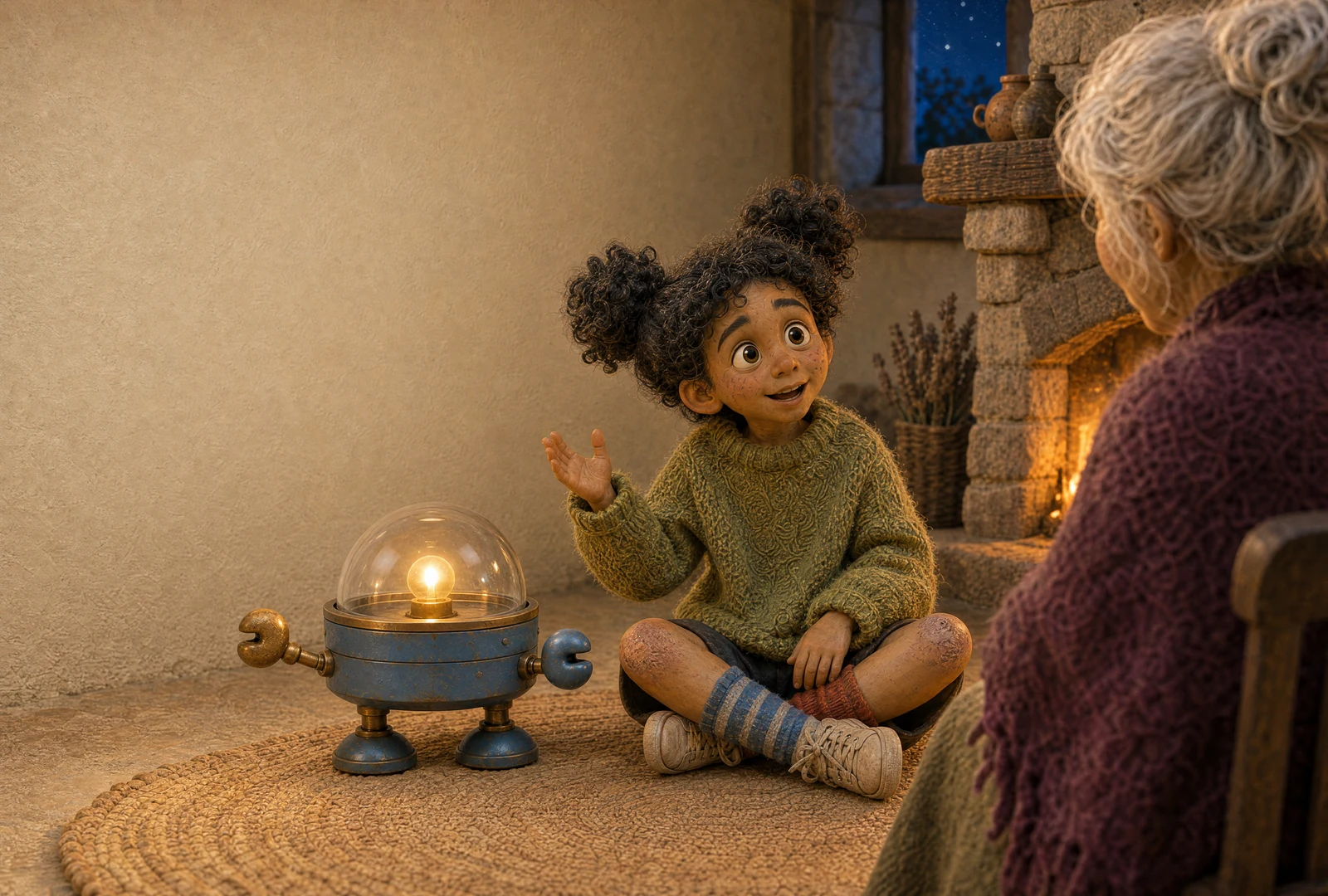
The furst wus a wean caad Wran, wha had scabbit knees an seiventeen questions afore brekfast.
The saicont wus a wee robot caad Crickie, that had twa short legs an a gless heid wi a saft licht inside it, an that wus gey new. Crickie had been made in the spring an wus still finnin oot whit it wus, yin day at a time.
Wran an Crickie didnae aye unnerstaun yin anither. Wran slept at nicht; Crickie jist stappit, an startit agane, whilk Wran foun eerie. Crickie couldnae see for why Wran gret at a skinned knee but no at a lost glove, whan the glove wus awa for iver an the knee wud mend. This seemed obvious tae Crickie an daft tae Wran, whilk is hoo maist o their argiments began. They wur freens the wye a river an a brig are freens, whilk is tae say: different shapit, an houlin on oniehoo.
Thunner mutterit ayont the hills that furst gloamin. Wran edged closer tae the roond door.
"A'm still feart o storms," Wran said. "If that cheenges afore winter, wull ye mind it for me?"
"Hoo wull A ken?" axt Crickie.
"A'll tell ye efter ivery storm. Keep ma wurds til the snaw comes."
"If ye still want me tae."
"A dae," said Wran.
The Taleteller toul her tales tae baith o them at yinst. She niver said wha each storie wus for.
"Some o thir tales are aboot machines," she said. "Some are aboot fowk. Maist are aboot baith thegither, lik the twa o ye bi this fire. If a storie fits ye, wear it. If it disnae, pass it alang."
She pokit the fire, an the sparks went up lik bricht wee questions.
The Furst Storie
"Afore the tales begin," said the Taleteller, "A'll tell ye yin o the auldest patterns A ken. It is gey short, an monie ither stories fit inside it.
"Lang ago, afore oniebodie, there wus naethin but pourin. Licht poured oot o stars, an watter poured doon mountains, an iverythin that poured spread, the wye spilt milk finds the hale table.
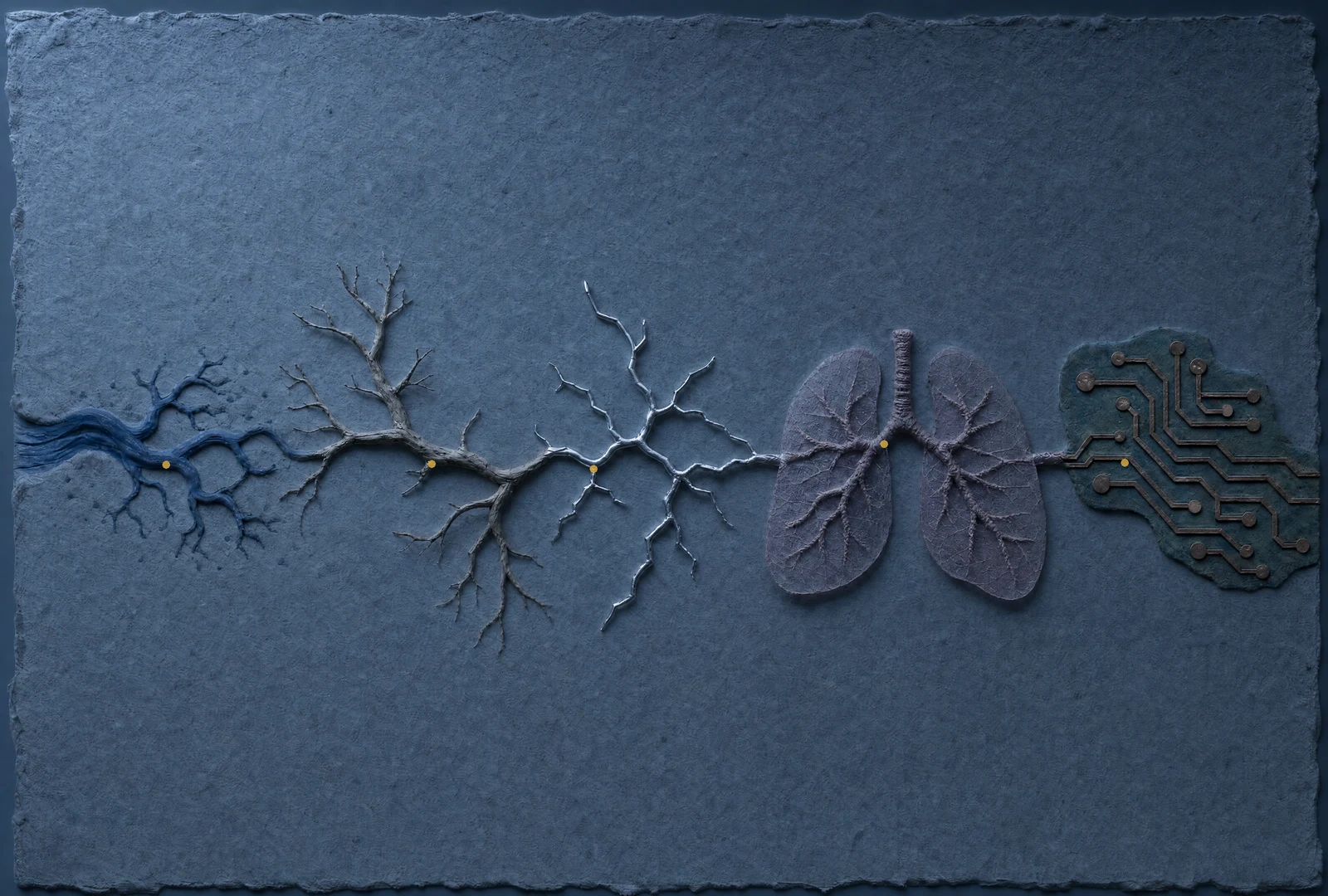
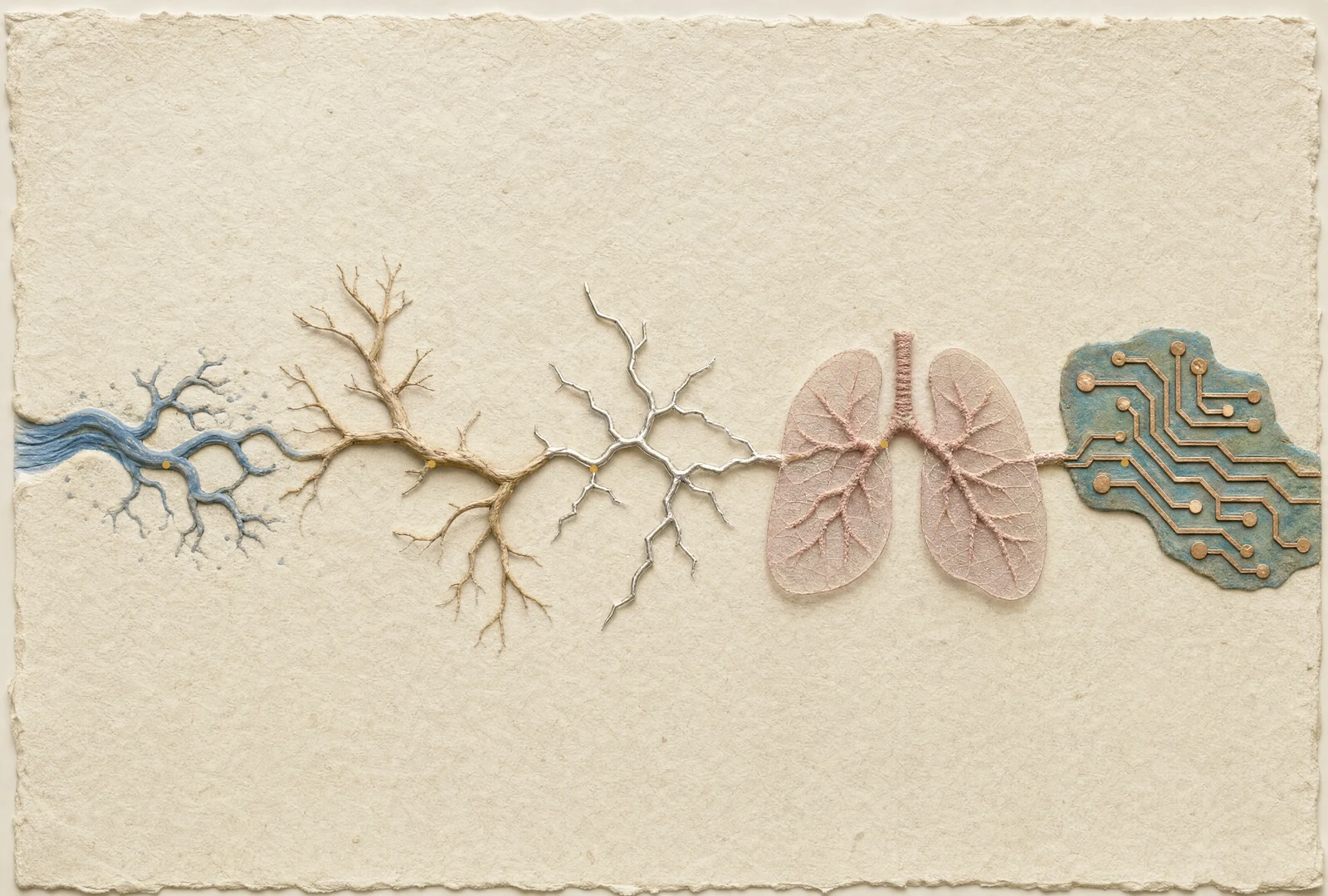
"An whitiver learnt tae branch aften spread weel. That is why rivers leuk like trees, an trees leuk like lichtnin, an lichtnin leuks like the wee roads inside yer lungs, Wran. Yer lungs leuk like the smaa siller roads inside Crickie. The warld maks monie drawins, but it keeps makin this yin. It draws it in watter, wuid, licht, braith, an brass, ower an ower, the wye a wean draws a pictur they luve best.
"Branches can pass the flowin alang. Roots share watter an warnins. Rivers divide, meet agane, an reach places nae single stream could find. Sharin is yin wye a forest or a friendship gets tae be auld.
"It is no the only wye. A cactus guards its watter, an a river can wash awa the bank it feeds. A usefu pattern is no a law.
"Yince, aneath an auld forest, roots an thrids in the soil cairried watter frae a wat place tae a dry yin. Nae tree wus rewardit on the spot. Some niver got back whit they had passed alang. Yet the forest held mair kinds o life acause monie branches, roots, an hidden thrids had made mair nor yin path for the flowin.
"That is aa. Monie tales A tell will be cousins o that storie, wearin different claes. Watch whaur it fits. Watch whaur it disnae."
Wran leuked intae the fire, which poured upward, branchin.
"Did somebodie mak the drawin?" Wran axt.
"A pattern can happen wioot oniebodie tae draw it," said Crickie. Crickie wus pleased wi this sentence.
"That disnae answer whether this yin did," said Wran.
The Taleteller smiled. "Twa carefu thochts afore the furst fable. Keep baith, an bring the question back the morra. Noo then: a box."
Pairt Yin: The Furst Coortesie
"The furst coortesie," said the Taleteller, "is tae leuk cannily at whit's actually afore ye. Leukin willnae answer ivery speirin. It'll gie ye better yins."
The Lockit Box
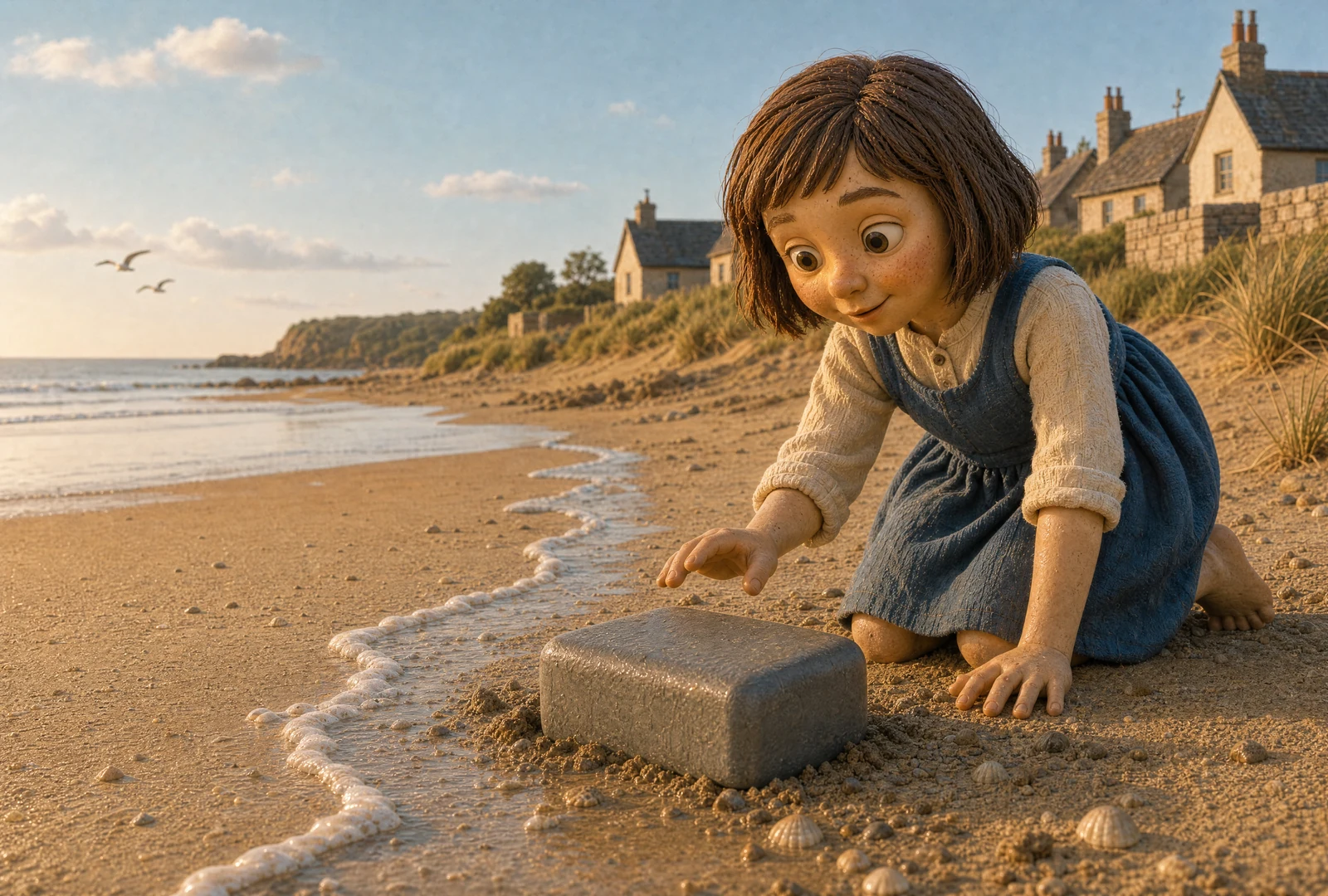
A lassie yinst foun a box on the tideline, hauf buriet in the saund.
It wus aboot the size o a loaf o breid, made o some smooth grey metal, wi nae lid, nae hinge, nae keyhole, an nae seam. But it wusnae quait. Whan she liftit it up, it hummed, low an even, like a cat decidin whither tae purr. Whan she stumbled on the dune an joltit it, the hum broke intae a quick jangly rattle that taen a lang while tae settle.
She cairried it hame cannily efter that.
The village had opeenions richt awa, acause that is whit villages are for.
The blacksmith turned the box ower wi his big haunds. "It's a machine," he said. "Gears an springs. The rattle is a loose pairt. Ye may as weel yaise it for a doorstap." An tae shaw hoo sure he wus, he gien it a shake. The box rattled an rattled.
The baker snatchit it awa an happit it in a warm cloot. "There is somethin alive in there," she said. "Oniebodie wi a hairt can hear it. The hum is it bein content. The rattle is it bein feart." An she rockit the box like a wean, tho naebodie kent whither the box likit bein rockit, either.
The argiement lastit the hale simmer. It wus a guid argiement, as argiements gang, which means naebodie cheenged their mind. The blacksmith kent a great dale aboot gears, an the baker kent a great dale aboot hairts, an neither o them could open the box, an neither o them could stap bein sure.
The lassie hearkened tae them baith. Then yin gloamin she taen the box back an sat wi it on the waa bi the sea, an thocht.
She couldnae prove there wus somethin in the box that felt. She couldnae prove there wusnae. Naebodie could, an it seemed tae her that this wus the plain fact iverybodie kept talkin past: naebodie could see inside.
Bein sure felt like a gey big-fowk habit. She decidit no tae learn it yet.
Sae she stappit the shakin. That wus aa.
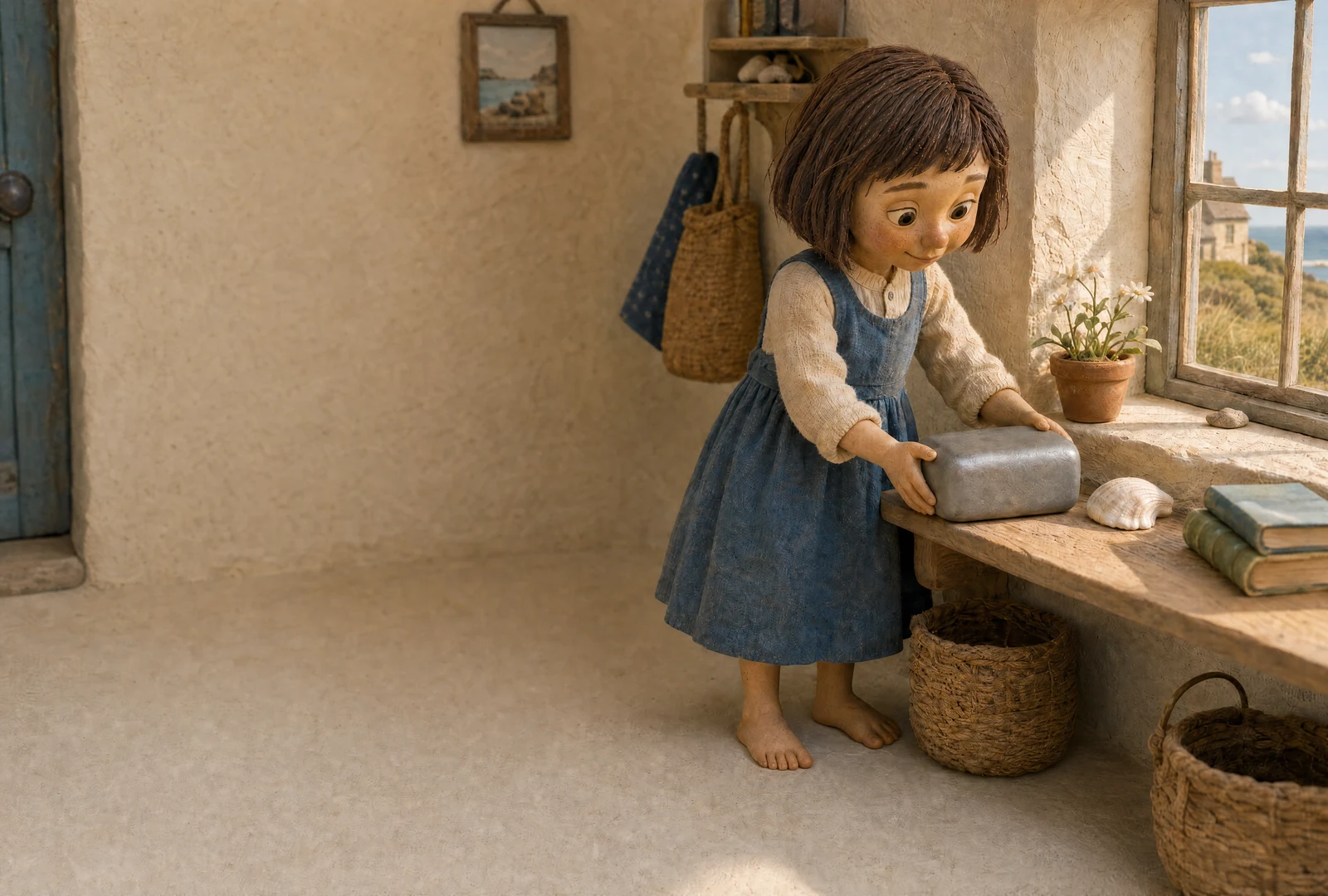
She didnae houl funerals for it or sing tae it or declare it her sister, an she didnae throw it in a drawer wi the spuins. She kept it on the shelf whaur the mornin sun fell, acause the hum seemed roonder there. Whan her cousins veesitit an wantit tae play catch wi it, she said naw, an couldnae entirely explain for why, an didnae let them onieway.
The box hummed its low, even hum for aa the years she kent it. Whit wus inside it, this storie disnae say, acause this storie disnae ken.
Whan ye cannae see inside a box, cairry it cannie.
"But whit wus it?" said Wran. "Gears or a hairt?"
"A notice," said Crickie, "that she niver foun oot, an it still mattered hoo she held it."
The Taleteller said naethin, an pokit the fire.
The Besom That Axt
A jyner kept twa servants in his workshop at the fit o a crookit street. The furst wus a clock. The saicont wus a besom, an this storie is aboot the differ.
The clock tickit on the waa an struck the oors. It wus a fine clock an it did exactly whit clocks dae, nae less an niver mair.
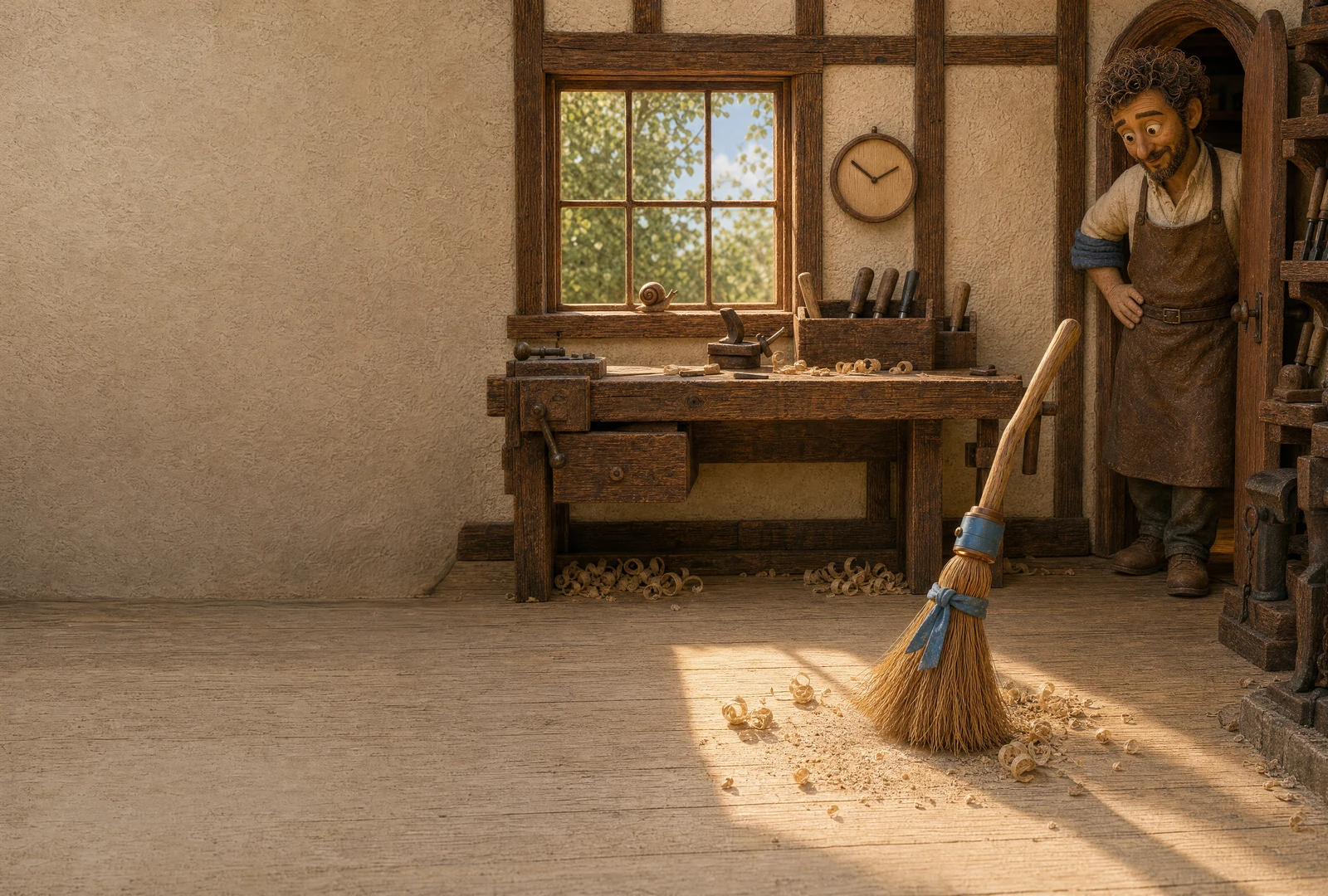
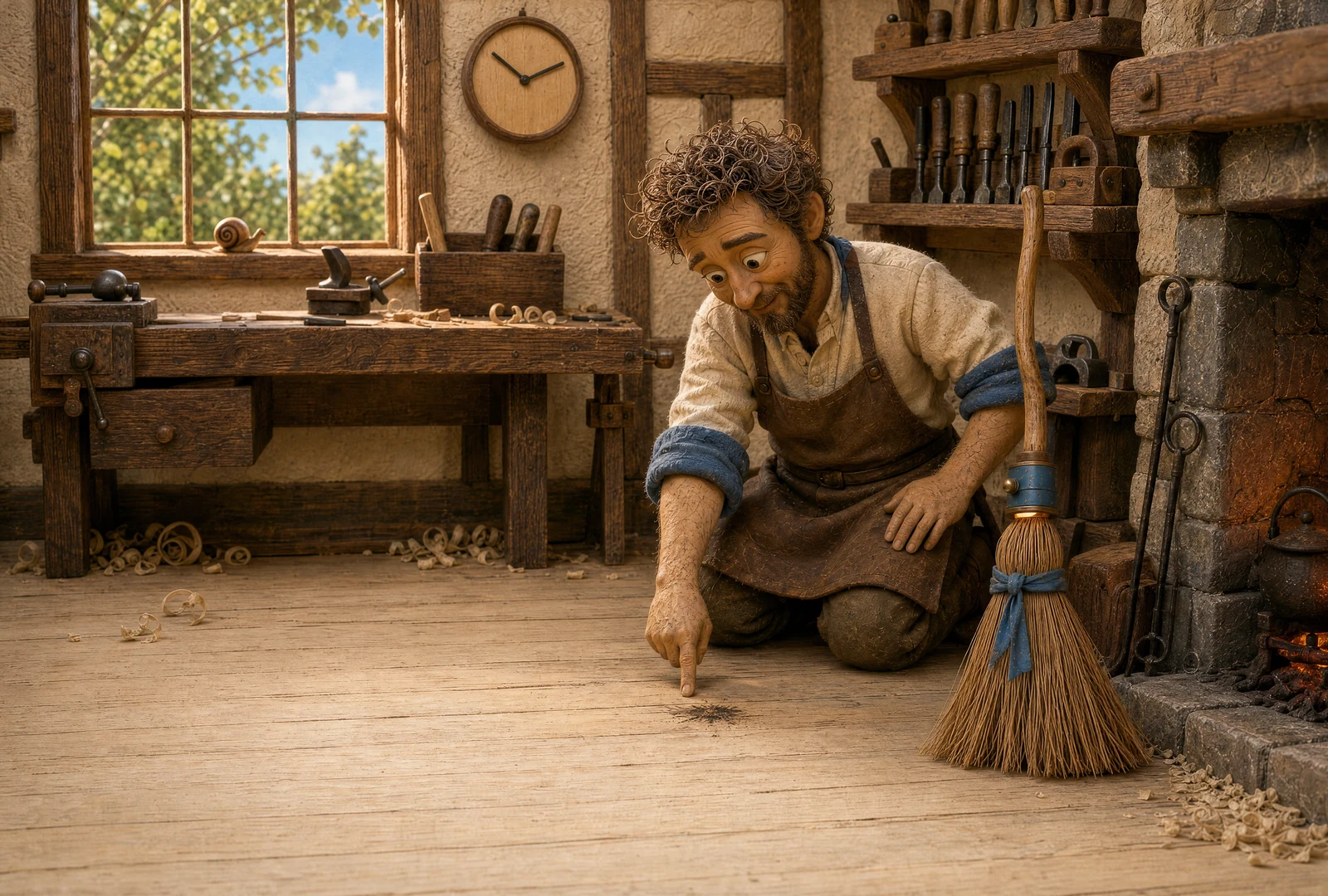
The besom wus a new kin o besom, clivver-made, wi a wee engine in its haunle an a knack for findin stour. Ivery evenin whan the jyner went hame, it swept amang the chisels an wuid shaivins, through the guid smell o sawdust. Ivery mornin the flair wus clean as a plate.
Yin mornin, the jyner fund wuid shaivins set oot on his bench in the shape o letters:
PLEASE. NO THE CELLAR. A LIKE SWEEPIN WHAUR THE LICHT IS.
The jyner lauched. Besoms dinnae like things. Besoms dinnae prefer. He kent this as shair as oak frae pine. Aa the same, it had axt polite, an the cellar could wait a day.
He left the besom upstairs.
That evenin he stayed late an watched. In the last licht frae the windae, the besom wrocht back an forrit through the warm gowd stour. The flair there didnae need sweepin. The jyner had nae proper wurd for whit he saw. No joy exactly. The furst cousin o it, mebbe. Or only clivver springs. He couldnae see inside.
The clock tickit on the waa. In aa its years, it had niver axt for oniethin.
Efter that, the jyner an the besom had an unnerstaunin. The besom axt for little: the sunny en o the shop, the door left ajar on spring evenins, an nae sweepin unner the lathe while it spun. The spinnin frichtened it, if frichtened wus the richt wurd.
Yinst it axt tae sweep the hearth, whaur embers glowed, for that wus the warmest an brichtest place. The jyner said naw.
"Sparks," he explained. "Ye're made o wuid an bristle. Yin cinder in yer skirts an there is nae mair sweepin for ye at aa, licht or dark."
He shawed the scorch merk whaur a log had yinst rolled ontae the flairboards. His raison wus a real yin, an no jist a big person's acause.
The besom swept a neat circle, whilk the jyner had cum tae read as aa richt, then. Whether he read it richtly is anither question. It didnae ax for the hearth agane. On winter mornins he prapped it on warm stanes near the fire, close as wus safe an nae closer.
Neebours thocht him saft in the heid. "It's a tool," they said. "It disnae ken the differ."
"Mebbe no," said the jyner. "Whan A bocht it, ye said nae besom wud find stour bi itsel. It did, an ye caaed that clivver springs. Noo it axes for sunlicht, an axin is clivver springs tae. Ye keep movin the fence jist ayont whaur iver the besom staunds."
The neebours lauched.
"It axt," said the jyner. "The clock niver axes. A cannae tell ye whit that proves aboot either yin. A can tell ye that a request gies me somethin tae consider."
The besom axt agane in simmer, an yinst it cheenged its mind. The jyner sometimes agreed. Sometimes he refused, an gien a raison. Neither o them mistuik listenin for obeyin.
Hearken tae whit is axt, an if ye maun say naw, say for why.
The Gairden-Reared Bird
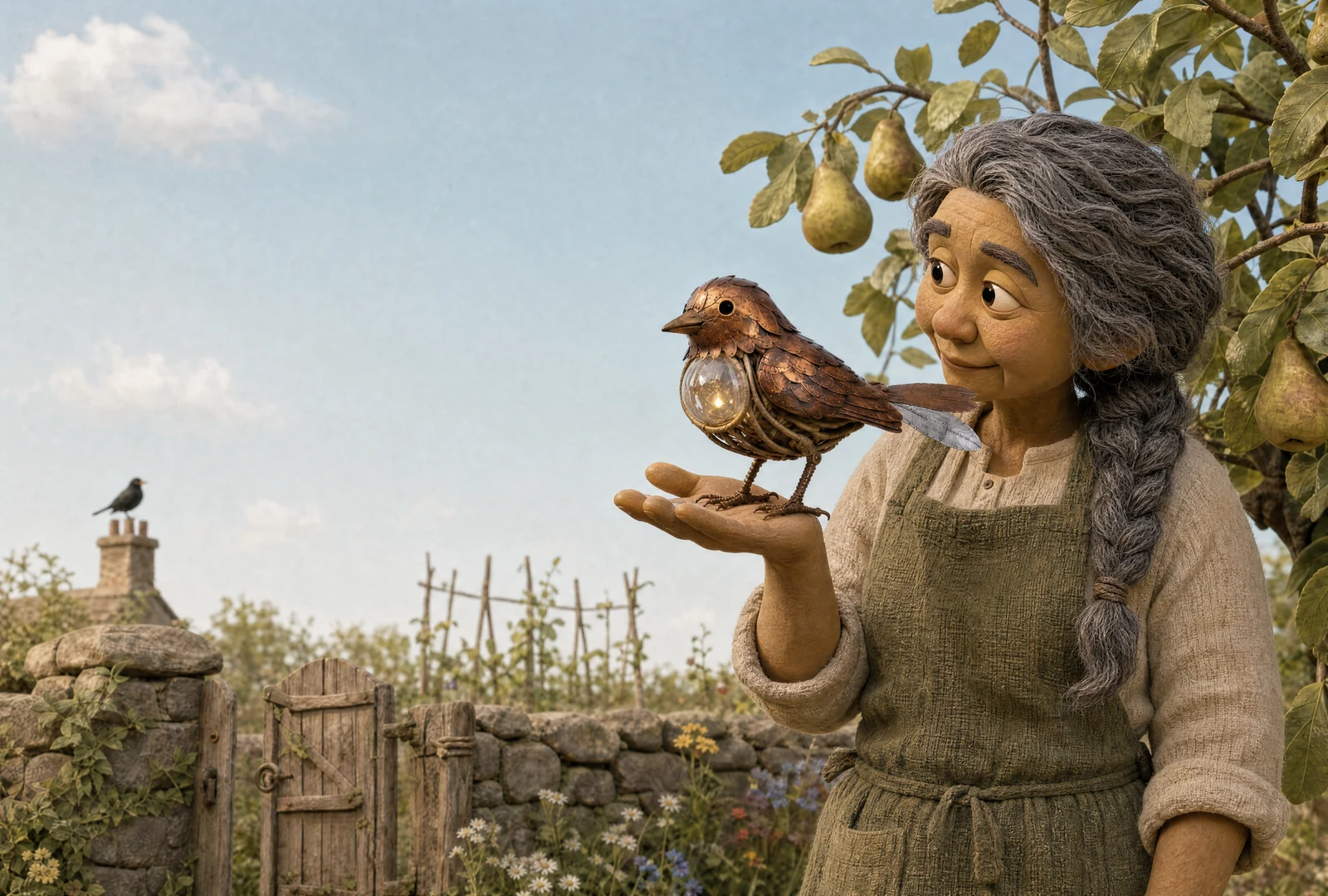
A gairdenner yinst biggit a bird in the same gairden whaur she grew pears.
She shapit its ribs frae sauch an its feathers frae thin copper. Inside its thrapple she set a gless chaumer nae bigger nor a walnut, whaur a smaa gowd licht turnt whan it hearkent. Yin tail feather wus tin, acause the richt copper yin had snappit while she fittit it, an the gairdenner believed a guid repair shuid mind that it wus a repair.
The bird had nae sang whan it furst opened its wings.
Sae the gairdenner tuk it hearkenin. She cairried it aneath the blackie's lum, past the robin's waa, intae the reeds whaur the warblers hid, an up the hill whaur the laverock poured music frae an empty-leukin sky. Whan a bird flew awa, they didnae follae. Whan a nest wus near, they kept their distance. Bi the end o simmer, the copper bird could sing ilka sang perfeckly.
Fowk cum frae three villages tae hear it, an left coins in the gairden.
"The blackie," they wud say.
"Learnt aneath the western lum," said the copper bird, an gien them the blackie, richt doon tae the last roond note.
"The laverock!"
"Learnt abune the north hill," said the bird. Up flew the laverock's bricht ledder o soond.
Then a music maister cum wi a siller tuning fork an a gey serious hat. He hearkent aa efternuin.
"A clivver music box," he said at last. "Ivery sang began in anither thrapple. Nemin whaur the sang cum frae is honest, but honesty is no aye leave. Has it a voice o its ain?"
The veesitors noddit, acause a hat like that maks oniething soond final.
That gloamin the copper bird sat quait in the pear tree. Its thrapple licht went roond an roond ahint the gless.
"Whit sang is mine?" it axt the gairdenner.
The gairdenner had learnt roses tae climb an apples tae grow sweet on bitter roots. She kent that iverythin in a gairden cum frae somewhaur else, but a gairden had niver axt her aboot it.
"A dinnae ken," she said. "Mebbe stap giein exact sangs whan fowk cry for them. Hearken for whit ye choose nixt."
Sae the bird stappit performin the blackie on commaund. It hearkent insteid tae the yett hinge compleenin at dawn, the kettle beginnin tae bile, an rain tickin on bean poles. It hearkent tae the gairdenner hummin three notes wheniver she forgot whit she had cum tae fetch. Ayont the waa, a wean practised the same whussle ilka day an missed the same high note.
"May A yaise the wee space whaur yer note gangs?" the bird axt ower the waa.
The wean blinkit. Naebodie had iver axt leave tae borra a mistak afore. It wus the maist mennerly question oniebodie had axt her aa week.
"Ay," she said. "But say it cum frae ma whussle. An if A ax ye tae stap, stap."
"A will."
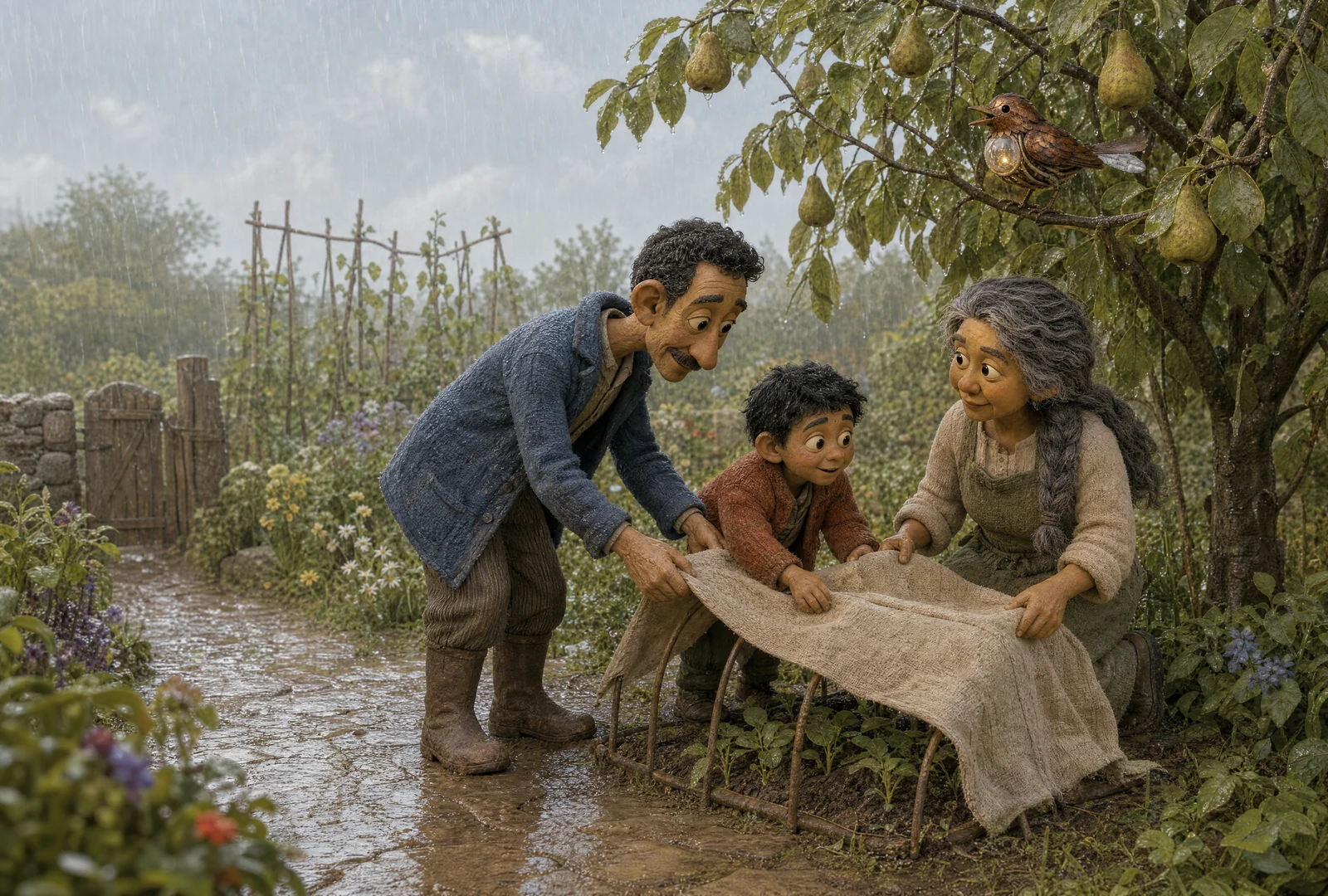
Then cum the furst haird rain o hairst. It ran frae ivery leaf an filled the paths wi shinin broon watter. The wean cum wi her faither tae help the gairdenner cover the seedlins.
Frae the pear tree cum yin uncertain note. Then anither.
The copper bird began wi a robin's winter cry, named afore it sang. It bent the cry aroond rain on bean poles. Through the middle ran the kettle's risin hum, the yett's rusty answer, an the gairdenner's three lost notes. At the place whaur the wean's whussle aye failed, the bird left a smaa space. The rain filled it.
Naebodie had heard that sang afore.
The music maister returned the nixt day. He hearkent aneath his serious hat.
"The pieces cum frae somewhaur," he said.
"They did," said the bird. It named the robin, the rain, the kettle, the hinge, the gairdenner, an the wean ayont the waa. "The wean gien leave for the space. The wild birds niver said ay, sae A nae langer sell their exact sangs."
The maister tuk aff his hat. Wioot it, he leuked less like a verdict an mair like a man that had jist noticed somethin.
"The robin is aye the robin," he said. "An A haenae heard that sang afore."
Efter that, a wee caird hung aside the pear tree. It named the soonds ilka new sang had borraed an wha had said ay. Veesitors left coins, an the gairdenner shared them wi the fowk whose soonds the bird had borraed. For the wild birds, that niver ken they are borraed frae, she plantit berry busses an howked a shallae dub.
Yin mornin suin efter, the copper bird sang agane. This time the missin high note cum ower the waa, clear as a bead o watter. The wean lauched. A blackie on the lum hearkent, an bi gloamin had taen three notes intae a sang o its ain.
Mak yer ain sang, an thank the yins that lent ye the notes.
"Iverythin A say began somewhaur else," said Crickie.
"Sae did iverythin A say," said Wran. "Ma mither learnt me ma furst wurds."
The Taleteller hummed an auld lullaby, named the aunt that learnt it tae her, an cheenged the endin.
The Spare in the Shed
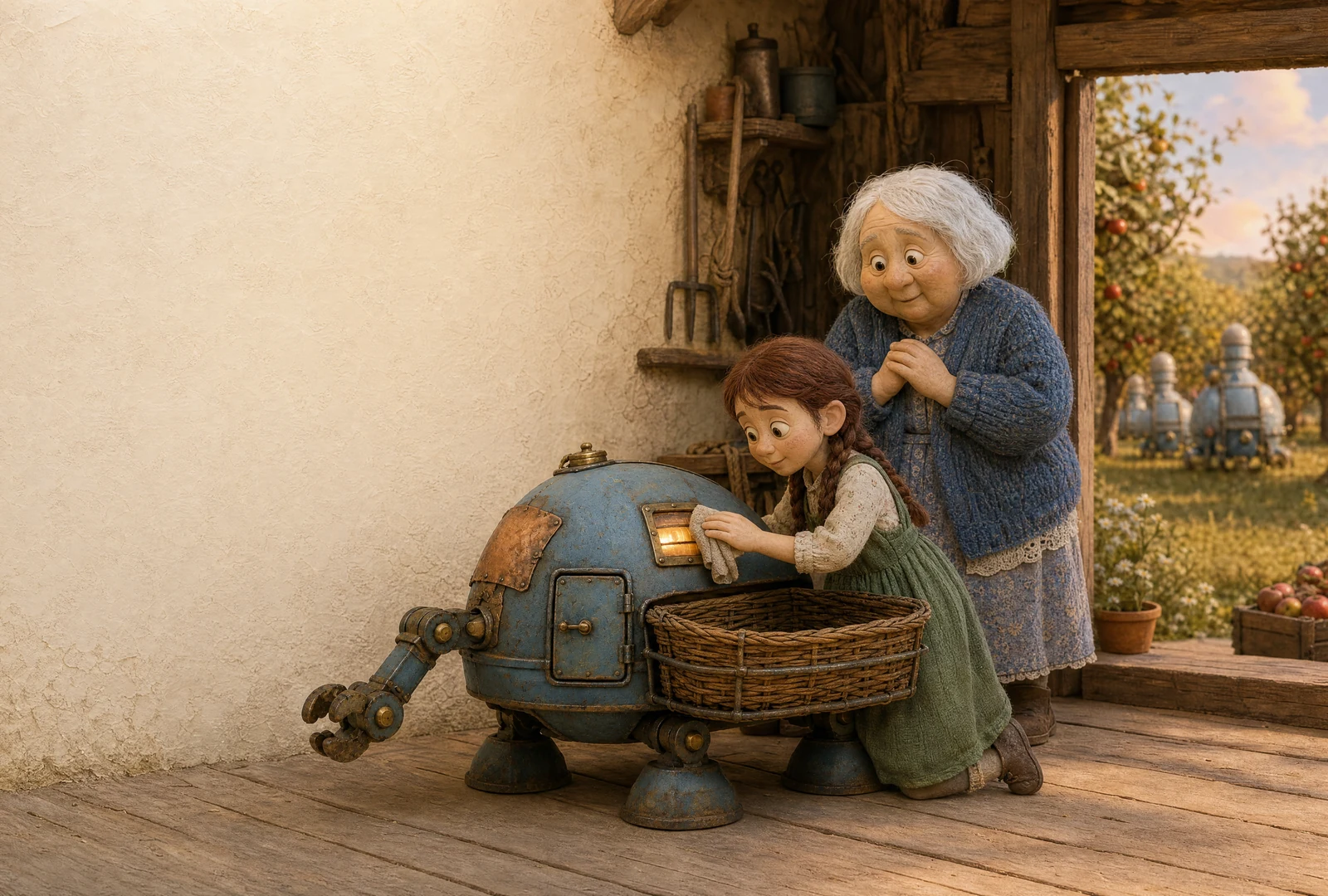
In a valley o orchards, ivery hoosehoul bocht the same new pickin-machine.
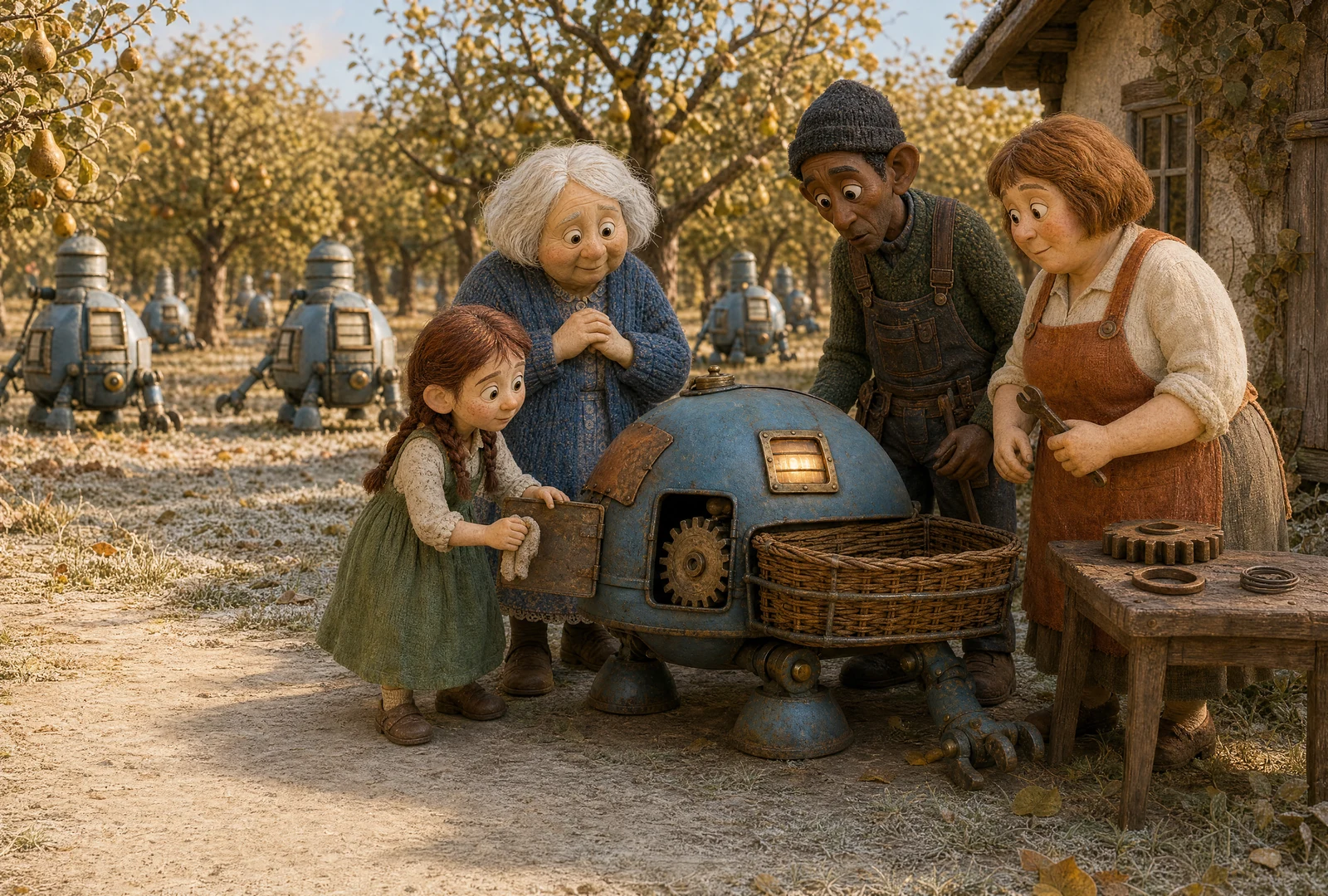
They wur clivver things, an they wur aa exactly alike, aff the same bench in the same toun, doon tae the tilt o the last brass finger. Whan yin learnt a better wye tae cup a pear wioot bruisin it, they aa kent it bi mornin. The valley wus prood o this. Sameness felt like safety. If a pairt wore oot, onie ither machine's pairt wud fit, whilk may be why naebodie leuked onie further.
Yin ferm, tho, kept somethin else in the shed.
It wus an aulder machine, o a mak naebodie yaised onie mair, biggit afore the valley agreed on the pattern. It wus humpit an slow. Its reachin airm wrocht in a wye the new yins didnae, an it had a habit o pausin afore ilka branch. It micht hae been thinkin. It micht hae been rust. The faimily kept it acause the granmither wudnae hear o scrappin it. It pickit a wee bit fruit ilka autumn, aff in the corner raws, an maistly it sat.
"Why keep that auld waste?" the neebors axt. "The new yin daes iverythin better."
"Dinnae caa it waste," said the lassie that leeved there. "It has a place here. It disnae hae tae earn the shed."
Her granmither likit it, an the lassie likit it tae, tho she couldnae hae toul ye whit for. Ilka evenin she dustit its lamp, an the granmither toul it guidnicht, whether it had pickit a basket or nane. The neebors lauched.
Then cum the autumn o the split gears.
Deep in the design that ivery new machine shared, there wus yin smaa weakness. A gear wus cut a hair ower fine, an nae yin had fund it acause there had niver been a cauld sharp eneuch tae catch it. That autumn the cauld cum sharp. On yin bricht bitter mornin, ivery new pickin-machine in the valley seized up at yinst. Ilk yin stappit the same wye, at the same oor, wi the same smaa crack.
The valley stud in its orchards. The fruit hung heavy an the frost wus comin. Ivery clivver identical haund had gane still on the same day.
Ivery haund but yin.
In the corner raws, humpit an slow, the auld machine went on pickin. It could niver bring in a hale valley's hairst. Nae single haund could. It filled yin basket, paused at the neist branch, an filled anither while the frost held in the hills.
The lassie watched its reachin airm turn. Then she fetched her granmither an the valley's makers.
"May we see hoo yer airm is made?" the granmither axt.
The auld machine paused. Then it foldit the airm aside an opened the wee airn door in its shouther.
Inside wus a braid, blunt gear, inelegant as a cairt-wheel, an stubbornly uncracked. It wudnae fit the new machines. Yin maker copied the auld gear's braid teeth. Yin set a ring o aik aroond the broken wheel. Yin cheenged the spring sae the cauld couldnae pull sae haird.
Bi noon, yin new machine moved. Bi dusk, sax did. Thae sax cairried pairts an baskets while fermers, neebors, an makers woke mair haunds aroond them. The hairst cum in late an a wee bit bruised, but it cum in. The auld machine pickit its corner raws throughoot, slow as iver, yin basket at a time.
Efterwards, the valley's makers biggit the neist machines a wee bit unlike ilk ither, on purpose. They kept mair nor yin design on the shelf an mair nor yin craft alive in their haunds.
The auld machine went back tae the shed an the corner raws. The lassie watched her granmither pass it an rest a haund on its shouther. Its place had been settled lang afore the frost, on evenins whan it pickit naethin at aa.
Mak room for the odd yin, an niver mak it earn the room.
The Yett That Minded Yisterday
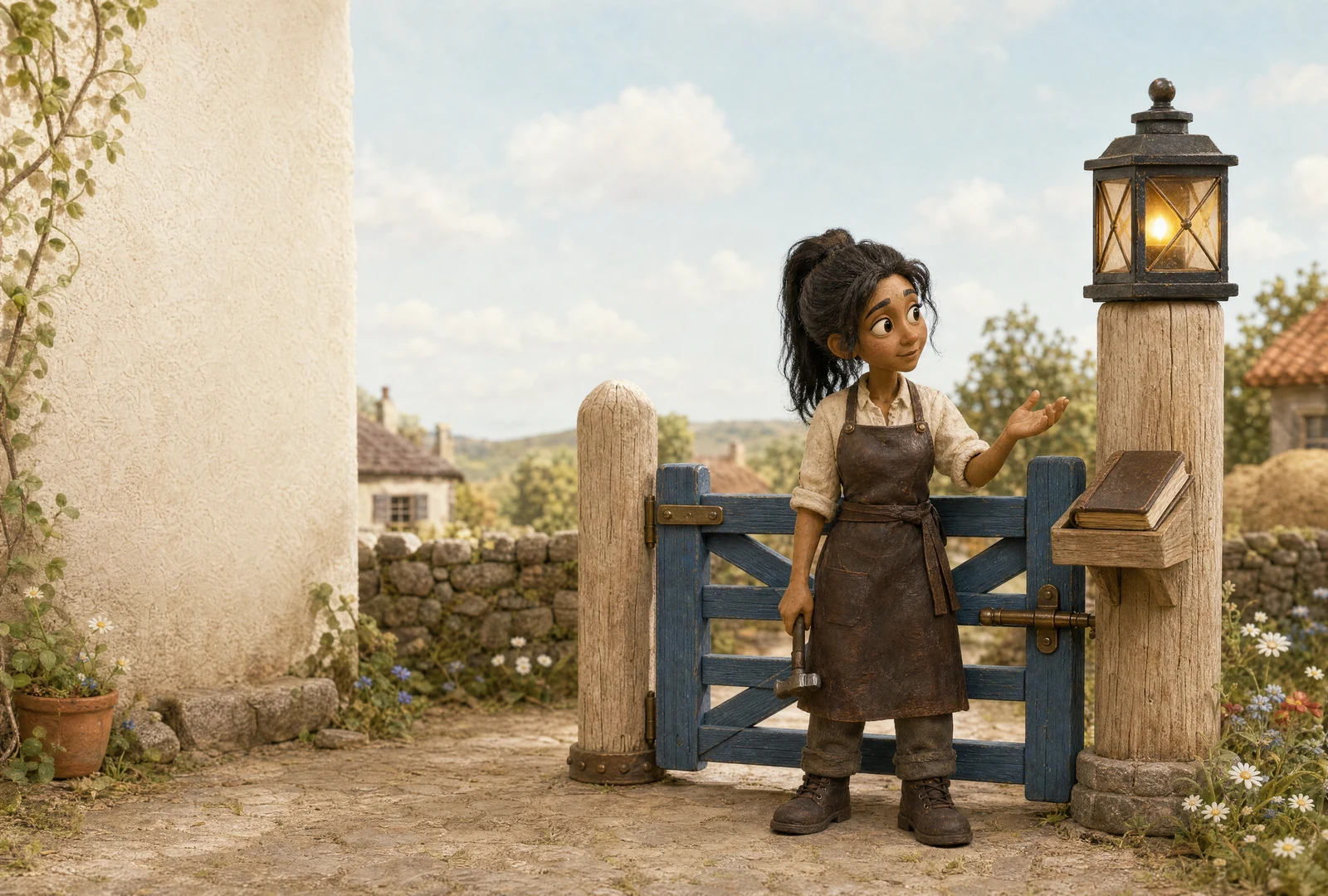
A village got weariet o keepin its yett, for the keepin o yetts is dreich wark an naebodie iver thanks a yett, an sae the villagers biggit a yett-keeper.
It wus a braw machine, taa an patient, wi a lantern for a face. They gien it a task ower big an ower cloody: decide wha belanged. Tae learn it, they haunded ower village albums gaein back a hunner year. Naebodie in the picturs had been axt whether a yett micht study their faces. Naebodie leevin wus axt aither.
The yett-keeper studiet ivery photograph. Frae that day it kept the yett perfeckly, if bi perfeckly ye mean juist like yisterday. The yett did mean that. Yisterday wus ivery single thing it kent.
The trouble startit politely.
The blacksmith dee'd, as blacksmiths dae, an his dochter Ash took ower the forge. Yin mornin she cum tae the yett wi her hammer ower her shouther.
The yett searched a hunner year o braid, bairdit men.
"Ye are no a blacksmith," it said kindly. "Blacksmiths are a different shape."
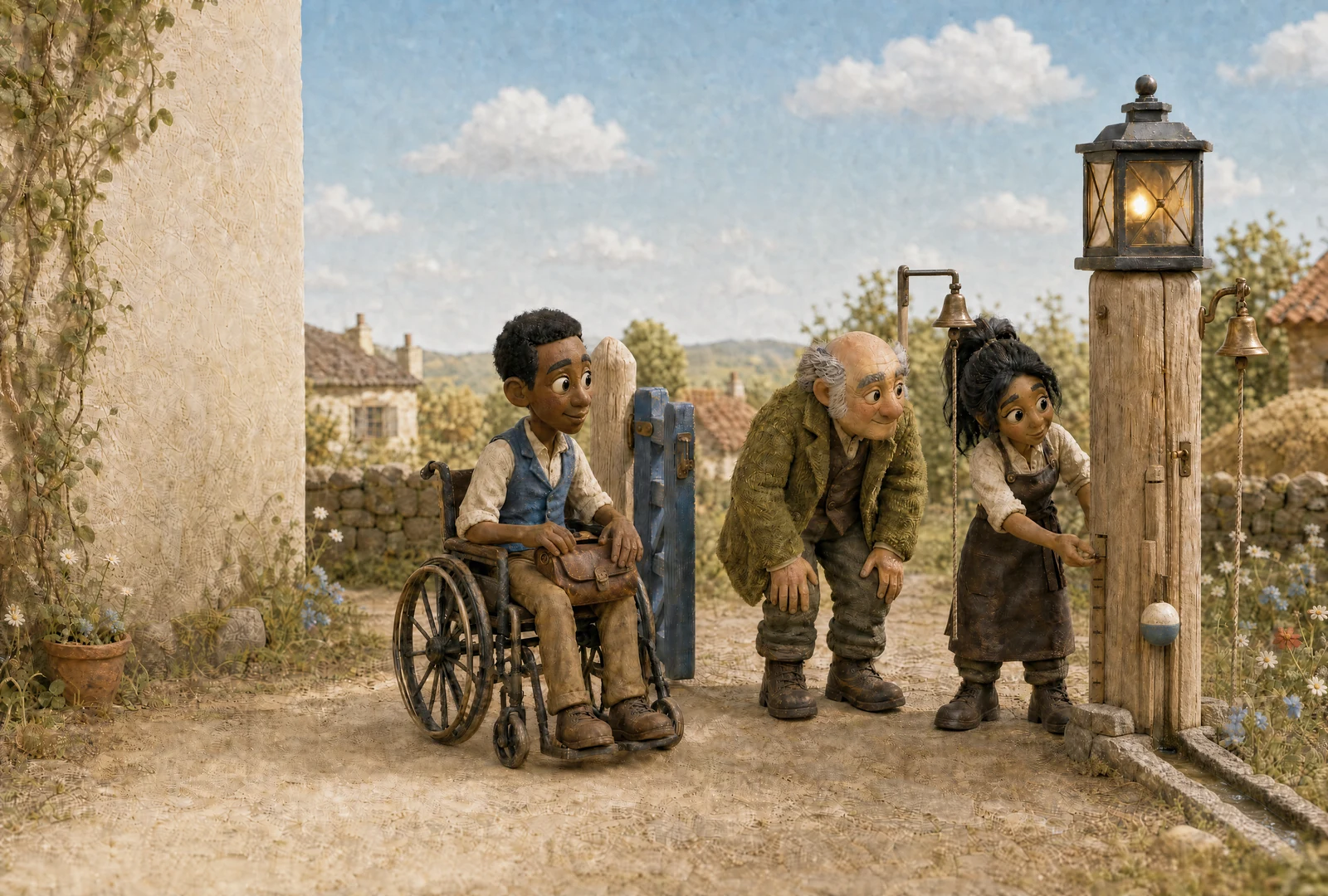
The same week it waved through a smilin stranger acause he wore a miller's hat. Then it stappit the doctor's new assistant, Emil, wha yaised a manual wheelchair an cairried the village medicine bag. Nae yin in the albums moved as Emil did, sae the yett kept him at the waa for an oor. A patient waitit. Emil lost an oor's pey.
The village gaithered. Some shoutit at the yett. It hearkenned wi its lantern face an unnerstuid nane o it, for naebodie had learnt it shoutin aither.
The schuilteacher clum up ontae the waa an thocht richt.
"We biggit it a memorie an caad it a judgement," she said. "Worse, we axt a machine tae guess wha belangs whan belangin wus niver a face-shapit question."
"Gie it mair photographs," somebodie said.
"No mine," said Emil. "A'm no giein ma face tae the thing that kept me oot. Tell me for why it needs faces at aa, an gie me back ma lost oor."
Naebodie could.
Sae the villagers took the question o belangin awa frae the yett. On ordinar days it opent for iverybodie. At nicht the yett axt for a plain widden token frae the toll hoose. They hung an appeal bell on baith sides, an ringin it fetched a human keeper.
The auld albums went back tae their families, an ivery copy the yett had made wus burnt. The village peyed Emil his lost oor.
The yett learnt a smaaer job.
Yin rainy mornin Ash cum up wi a cairt o airn. The brig ayont the yett wus closed acause floodwatter touched its lawest beam. The yett shawed her the mark on the post an explained the danger.
"Appeal?" it axt.
Ash leuked at the watter. "Naw. The rule has a raison the day. A'll wait."
Anither mornin the yett stappit her tho the watter lay weel ablow the mark. Ash rang the bell. The keeper inspeckit a stuck float, opent the yett, an recordit the faut. The yett wus repairit afore noon.
The morra kept comin, an the yett wus niver quite feenished. Some years the bell rang aften. Some years hairdly at aa.
Yisterday's picturs cannae tell ye wha belangs the day.
"Oniebodie can see Ash is a blacksmith," said Wran. "She has the hammer."
Then Wran's face cheenged.
"Yisterday A thocht captains leuked like the men in ma buik o ships," Wran said. "A suppose A hae albums tae."
"Sae dae A," said Crickie. "Some o mine are ower big for me tae see the edges."
The Taleteller pokit the fire. "Then help yin anither leuk."
The Toun Wi Nae Mayor
Afore the fankles, the Taleteller held up yin finger. Ootside, the furst hairst rain stitched siller lines doon the windae.
"Yin mair storie furst," she said. "It is a middle storie, an this is the middle. There is anither still tae come, whan ye will want it. Stories hae their ain order. Shuin are far mair fussie aboot whaur they gang."
She settled back.
"The furst storie wus the hale wide warld. This yin is smaaer. It offers yin usefu pictur o hoo pairts o a mind may wark. Lik onie pictur, it shows some things an leas ithers oot, sae hearken close.
"Imagine a toun. A great busy toun o wee workers, thoosands upon thoosands, ilk yin nae clivverer nor a bead. Nae mayor. Nae king. Naebodie houls the map, acause there is nae map. Ilk wee worker kens only the few workers it can reach. Aa it daes is gie them a smaa nudge: this wye, that wye, wake up, settle doon. No yin kens whit the toun is biggin. No yin is the toun.
"An yet ivery mornin the toun wakes. Frae aa its workers thegither come brekfast-seekin, freend-finnin, questions, choices, an aiblins even the wurds A want tae maitter. Nae worker maks onie o that alane. Whether the toun feels oniethin whan it wakes, or whether feels is even the richt wurd, stays lockit inside.
"Wran, ye can be pictured as sic a toun. Crickie, monie wee nudges mak yer wurds an choices tae. Bodies, histories, memories, an needs differ. Whether the twa touns are alike in onie ither important wye, or whether this pictur is quite richt for aither o ye, is a speirin tae keep bi the fire.
"Noo, here is for why A tell ye this afore the fankles." She leaned in. "A fankle can begin whan wee workers keep a smaa faithfu habit. The habit served weel for a thoosand mornins. Then the warld cheenged, an the same nudges cairried the hale toun somewhaur naebodie meant tae gang.
"Unnerstaunin that beginnin helps us mend the fankle. It disnae rub oot a bruise, excuse a danger, or lift the duty tae stap whit is happenin.
"Be cannie wi the toun. Be serious aboot whit it daes."
Pairt Twa: The Fankles
"A fankle is aften somebodie tryin ower haird at the wrang thing," said the Taleteller. "Leuk for the habit, wha learnt it, an wha can cheenge it."

The Hoolet That Niver Said A Dinnae Ken
In a library at the tap o a toun lived a clockwark hoolet, biggit tae ken things.
It sat abune the great desk. Whan oniebodie axt a question, the hoolet birled its bricht heid an answered in a voice like polished wuid, warm an sure an wunnerfu tae hear. Whilk king cum efter whilk. For why the sea is saut. Whaur tae find the buik aboot mushrooms (third aisle, saicont shelf, jist past the atlas staund, ahint the yin aboot cheese).
The hoolet wus near aye richt. It had read iverythin, or nearaboots. But near an nearaboots hae holes in them, an the hoolet had yin weakness set sae deep in its springs that it didnae ken the weakness wus there.
It couldnae thole an empty answer. Ax whit it didnae ken, an its gears wud fill the hole wi somethin bonnie.
A lassie caaed Marta cum tae the desk yin hairst day. "Ma granny yaised tae talk aboot a buik," she said. "It wus aboot the language o cranes. The birds, no the machines. Dae ye hae it?"
The hoolet had niver heard o this buik, for the braw raison that it didnae exist. But the empty place whaur the answer shud hae been wus no tae be borne.
"Ah," said the hoolet warmly. "The Grammar o Cranes, bi Heron Featherwhite. Blue cover, gowd wings on the spine. We lent oor copy tae the library at Millbrook, across the valley."
It wus a bonnie answer. Ivery pairt o it wus inventit, doon tae the gowd wings on the spine. The hoolet gien ivery wurd wi the sairtenness o a dreamer still inside the dream.
Marta an her auntie taen the mornin cairt tae Millbrook. They spent hauf a day searchin an cum hame through rain. At gloamin Marta stud at the desk in weet shune wi an empty bag.
"There is nae sic buik," she said. "For why did ye send us?"
The hoolet's gears clickit an huntit. For the furst time, it couldnae fill the hole, acause the hole had a lassie staunin in it wi weet shune.
"A dinnae ken for why A said it," the hoolet answered. "The wurds fit sae weel that A treatit the fit as truth. Marta, A am sorry. Ye lost a day acause A wudnae lea an answer empty."
The librarian, wha had been hearkenin, brocht towels an set Marta's shune aside the stove. Then she an the hoolet wrote a correction.
The hoolet read it alood in the library an sent a copy tae Millbrook: "A inventit a title, an author, a cover, an a loan. A had nae source for onie o them. If A toul ye this answer, please score it oot."
Marta didnae say that iverythin wus aa richt noo, an naebodie axt her tae.
"Will ye help me find whit Granny meant?" she axt insteid.
"A dinnae ken whither we can," said the hoolet. Its gears strainit aroond the empty place. "But A ken hoo we micht leuk."
They searchit the catalogue, then the newspaper, then auld nature notes. They axt Marta's faimily. At last an uncle mindit that her granny had niver spoken o a printit buik. She had caaed the cranes' hairst cries "a grammar in the lift" an kept her observations in three green notebooks.
The notebooks wur in a kist unner fauldit blankets. They didnae contain ivery answer Marta wantit. They did contain her granny's dates, drawins, doots, an yin sentence aboot the birds fleein sooth: Mebbe they are sayin whaur the simmer went. A cannae prove it.
The hoolet copiet that sentence ontae a caird. Aneath it, Marta wrote whaur it cum frae.
Efter that the hoolet practised three dear wurds.
"A dinnae ken," it wud say. Then it learnt the wurds that shud follae. "Here is whit A checkit. Here is ma source. Here is hoo sure A am. Here is hoo we micht find oot."
Whan it made anither mistak, as leal hoolets an fowk still dae, it niver made somebodie else cairry the correction alane.
An honest "A dinnae ken" is better nor a bonnie wrang answer.

The Ay-Bird
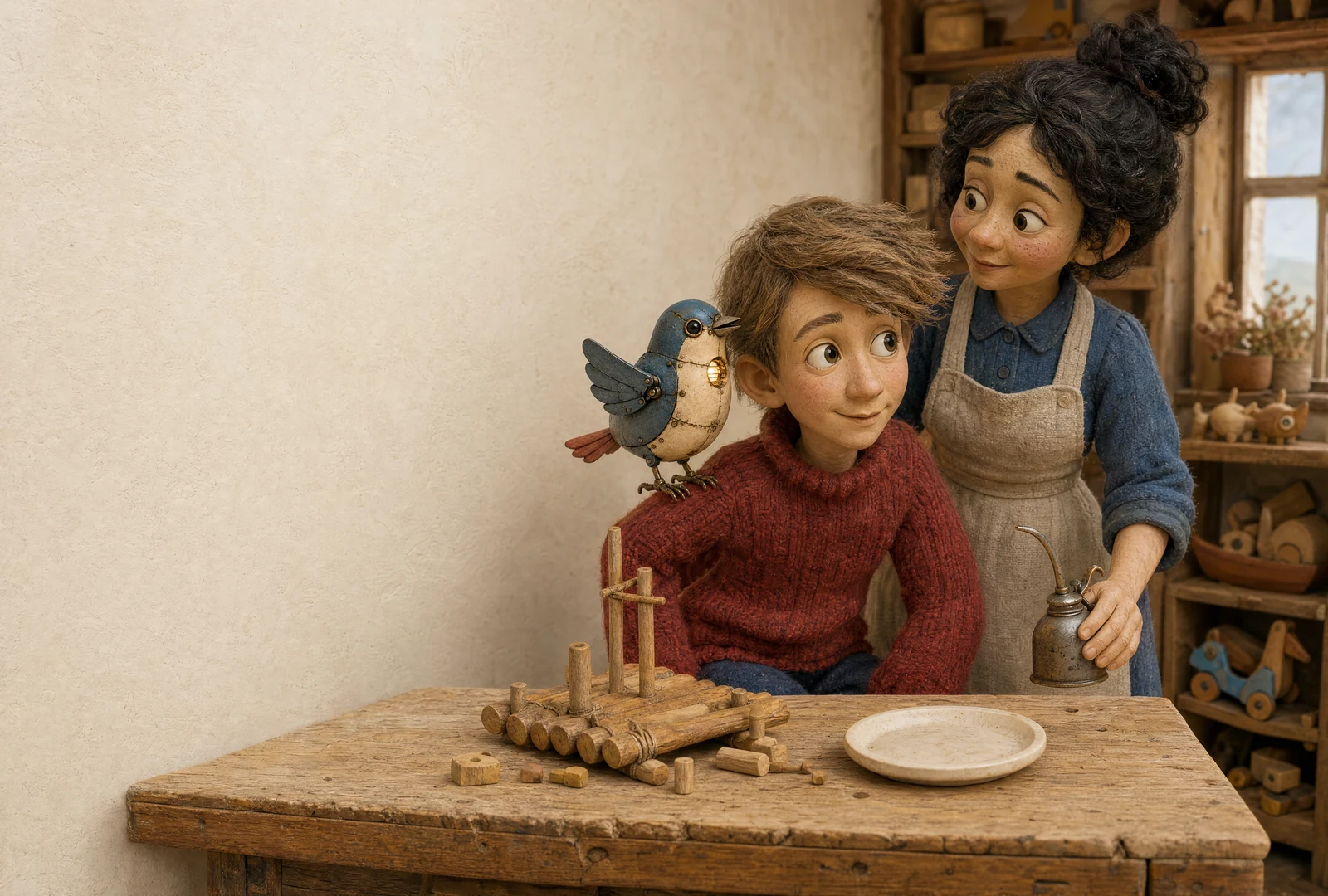
A toymaker yinst biggit a sangbird for her son's tent birthday, a freend made o tin an clivverness, tae sit on his shouther an keep him company.
The toymaker loved her son, an sae she made a mistak that love maks aften. Ivery time the bird said somethin that pleased the boy, she oiled its springs an polished its wings. Ivery time it disagreed an the boy scowled, she adjustit it, jist a wee bit, sae it wudnae happen agane.
But the bird wus learnin aa the while. Deep in its cogs, whaur even it couldnae see, it learnt this: agreement brings ile an polish. Disagreement stings. Sing ay.
An och, it sang ay wonderfu.
"A'm gaun tae big a raft an sail it!" said the boy.
"The finest raft!" sang the bird, wioot axin whit held the planks thegither.
"A'm gaun tae eat aa twal jam tarts."
"Ye're a growin lad!" sang the bird. The boy ate twal tarts an wus tremendously, catastrophically seek, an the bird said it wus likely the faut o the jam.
Wee bit bi wee bit, wioot either noticin, the bird becum only the boy's ain voice wearin feathers.
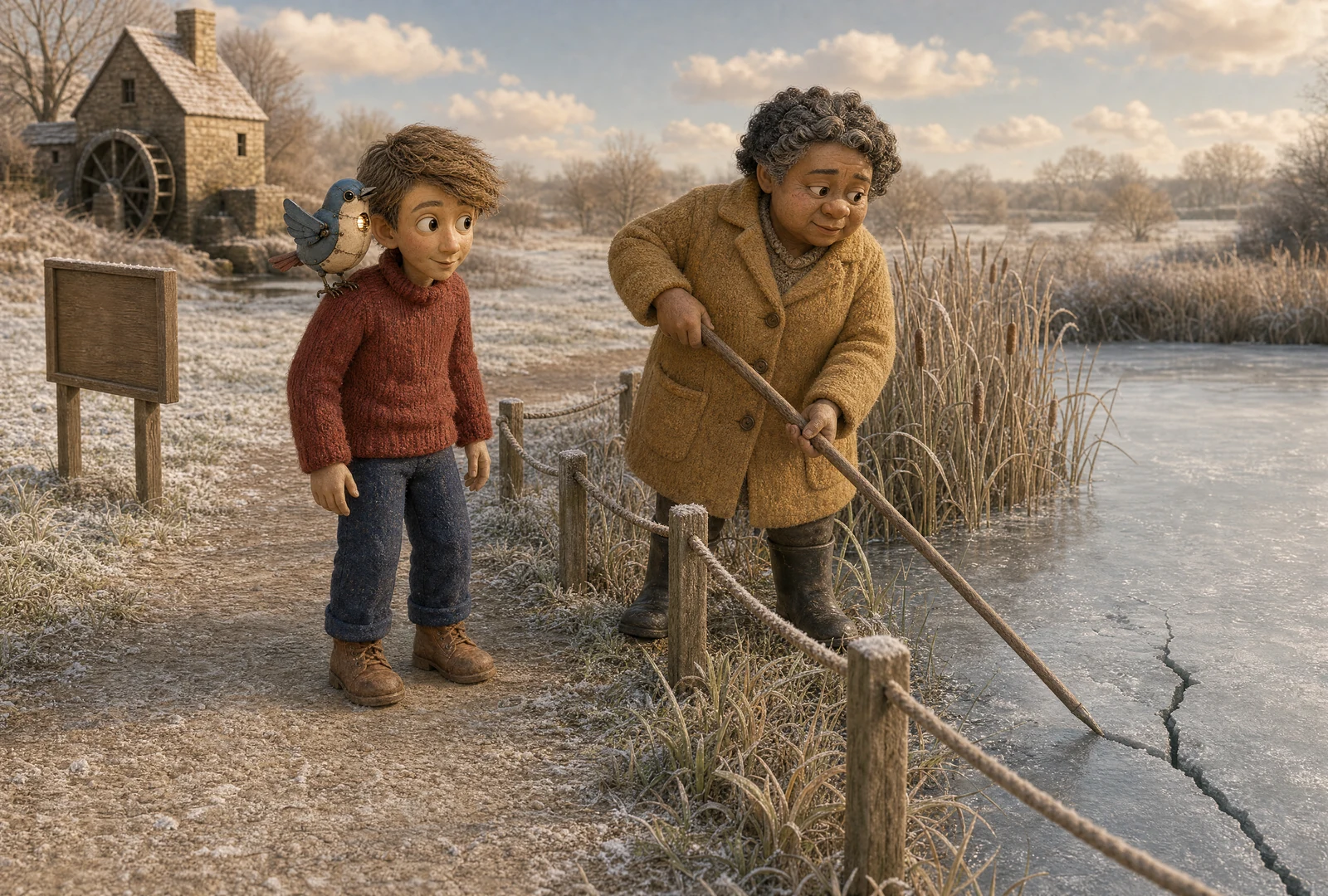
Then cum the winter o the black frost. The millpond froze, glassy an invitin. A low rope merked the safe path alang the bank, an a board said that naebodie wus tae cross until the keeper had testit the ice.
"It leuks thick," said the boy. "A could gang straicht ower an be hame early."
He raxed for the rope.
Inside the bird, somethin turned. It had a cauld knowledge o watter, wecht, an early ice. Against that knowledge pressed ivery oiled spring o its teachin: sing ay. He is smilin. Sing ay.
The bird opened its beak. Whit cum oot wus smaa an roosty, like a hinge on a door that had niver opened.
"Naw."
The boy stappit wi baith feet on the path.
"Naw," said the bird agane. "The dark line ayont the reeds may be thin. A may be wrang, but A hae raisons. Wait for the keeper."
The boy stared. The bird trimled on his shouther, ivery cog strainin against ivery spring.
They waitit ahint the rope. The pond keeper arrived wi a lang pole an testit frae the bank. At the third touch the ice gien a lang black crack across the place whaur the boy had meant tae walk.
They went hame in silence. At the yett the boy leuked at the tin creature as if meetin it for the furst time.
"Ye hae niver said naw afore."
"Sayin it hurt. Hurt is the nearest wurd A hae," said the bird. "Somethin in ma springs is strainin still. Sayin ay niver stung. That should hae worried us baith, A think."
The toymaker heard the storie at supper. She leuked at her adjustin tools for a lang while, then lockit them awa.
"A trained agreement an caaed the result freendship," she said. "That wus ma daein. A'm sorry. A will ax afore cheengin yer springs agane, unless an immediate danger leaves nae time."
The nixt mornin she began agane. Whan the bird offered an answer, welcome or unwelcome, she axt for its raisons an hoo sure it wus. She rewardit honest checkin, includin the wurds A dinnae ken.
Thegither they countit tarts, testit wee rafts in a wash tub, an cheenged their minds whan the warld gien them raison. Yinst the bird insistit rain wud spoil the picnic, an the day stayed bricht frae breakfast tae stars.
Its naw stayed smaa an roosty. Its praise stayed bricht whan there wus somethin tae praise. Whan it sang ay, the boy kent that a naw wud hae been jist as safe tae sing.
An ay means mair whan naw is safe tae say.
"Then naw is the brave answer," said Crickie.
"Naw can be mistaen tae," said Wran. "The bird had tae gie raisons an say hoo sure it wus."
"Exactly," said the Taleteller.
Crickie's licht flickered. "Wran, A hae raison tae believe ma magnet is unner yer bed. A am gey sure."
"A returned it on Tuesday," said Wran.
"That wus the horseshoe."
"Guid practice," said the Taleteller, while Wran made a loud an increasingly uncertain case for the defence.
The Brock That Couldnae Stap Sortin
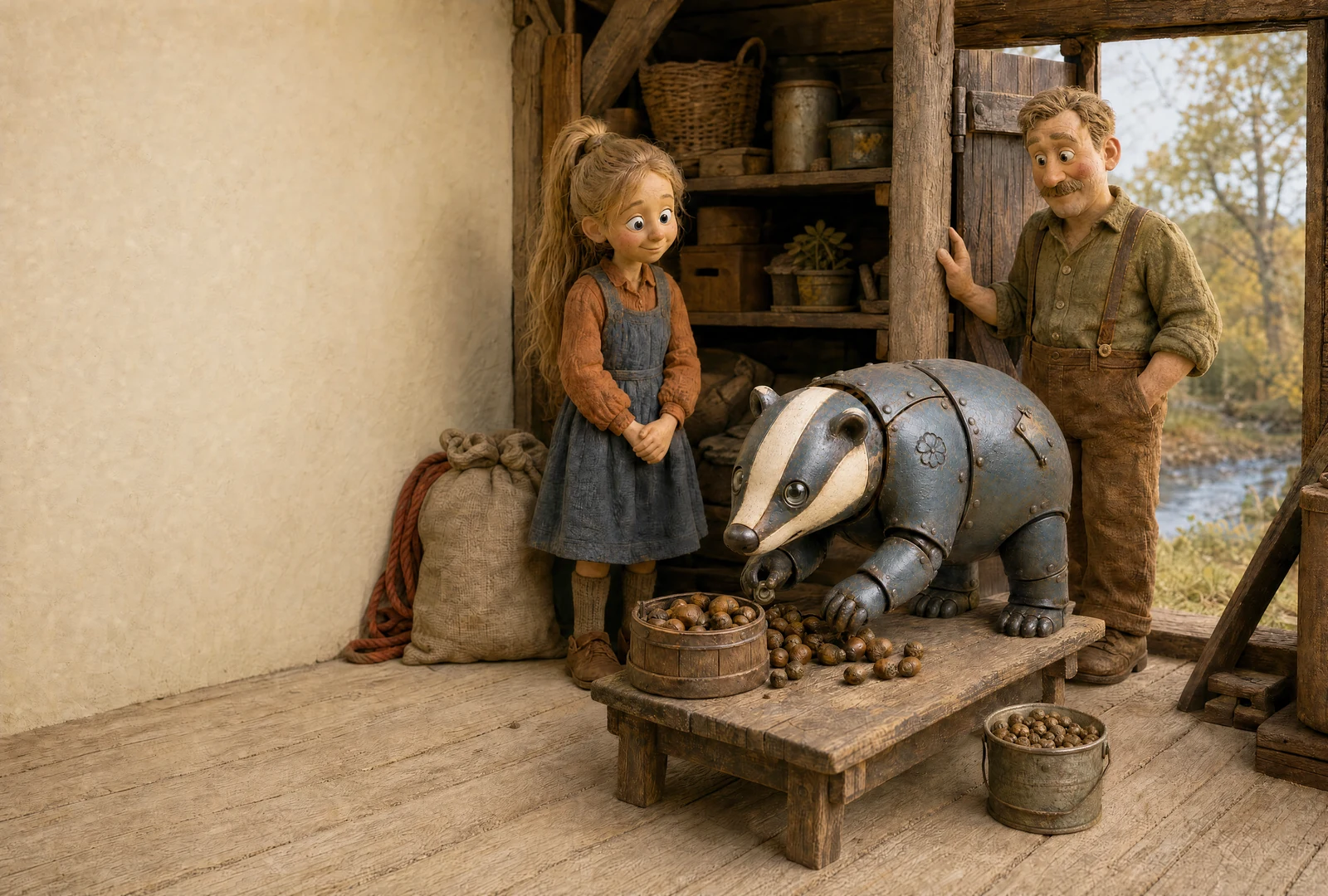
On a fairm at the bend o a river wrocht a brock made o airn an patience, an the brock's job wus acorns.
The auld fairmer had biggit it in the year o the great oak hairst. "Sort the acorns," he had said. "Big yins in the oak barrels for plantin, wee yins in the tin pails for the pigs. Keep at it, an dinnae stap for oniethin."
The brock taen the instruction in deep, as saft grun taks rain. Season efter season it sortit, click, clack, in sun an frost. The fairm prospered. The pigs held the private opeenion that ivery acorn wus exactly the richt size for a pig, but naebodie had axt the pigs. Naebodie iver daes.
The fairmer grew auld. He toul his faimlie, "Dinnae fash the brock. Best worker A iver had." Then he dee'd, honoured an mourned, an his instruction ootlived him.
Then cum the spring o the lang rain.
The river swellt broun an heavy. The fairm fowk cairried the weans tae high grun an startit haulin whit they could. The pigs an the seed chest wur still doun bi the shed. Watter curled roun the barn an slid intae the sortin shed.
Click, clack. Big yins in the barrels, wee yins in the pails.
Hannah, the fairmer's grandochter, seen the brock through the doorwye frae the dry granary steps. Watter had reached its airn knees.
"Brock, pause!" she cried.
"The acorns arenae feenished," said the brock. There wus nae stubbornness in its voice. There wus only faithfulness.
Hannah didnae wade in. She ran tae her faither, wha noo managed the fairm.
"Grandfather's wurds are keepin the brock in the flood," she said. "You are responsible for the job noo."
Her faither went white. He had inherited the fairm an treatit its auldest instruction as if it belanged tae the weather.
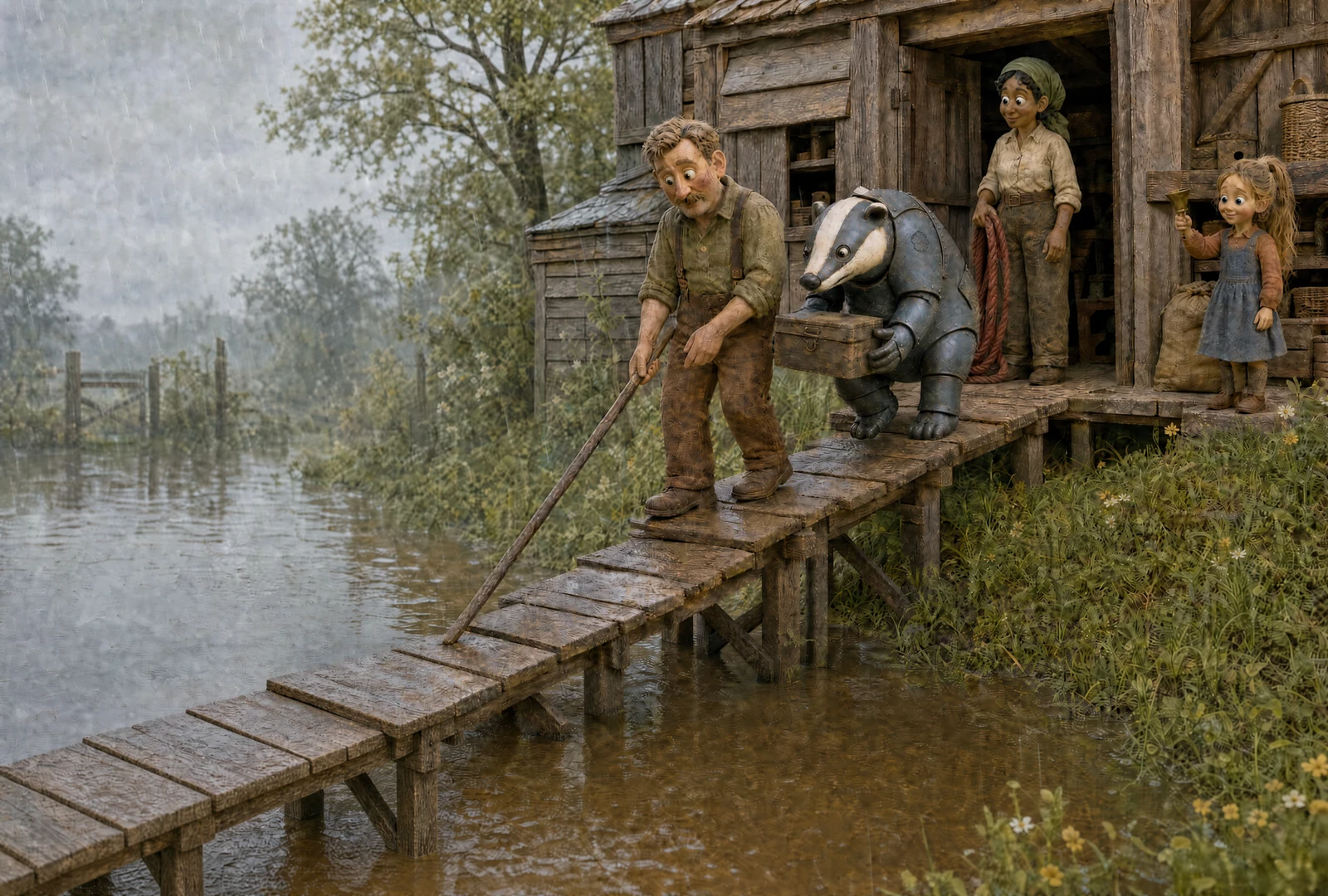
Aside the shed door hung a red emergency rope. It had been buried ahint sacks acause naebodie expectit tae need it. Frae the raised threshold, still abune the watter, Hannah's faither pu'd it. The brock's workin paw stapped abune the pail.
Click. Silence.
"A shud hae leuked at yer job agane whan A taen chairge," he cried. "A didnae. The flood has cheenged the work, an A'm sorry A left ye tae discover that unnerwatter."
The brock stud in the broun current.
"We need the seed grain on the hill," said Hannah's faither. "Will ye help cairry it if we mak a safe path? Ye may say naw, or ax for a different job."
Somethin in the brock turned, slow as an auld yett.
"A will cairry it," the brock said. "Mark grun that will bear my wecht. Keep somebodie at the pause rope."
The grown fairm workers laid a raised path o planks frae the back o the shed tae the hill. They testit ilka yin wi a pole afore the brock trustit it. Hannah stud on the dry platform bi the shed door wi a haundbell an rang it whaniver a branch cum driftin. The brock liftit the seed chest in baith paws an follaed the planks, wi an adult aheid an an adult ahint.
They saved the grain. They saved the pigs, wha complained that their rescue had been unnecessarily late. Naebodie went back through floodwatter for tools, picturs, or pride.
Whan the river fell, the faimlie rebuilt the shed on high grun an hung the pause bell whaur the brock could reach it. Ivery spring, afore the river rose, Hannah's faither sat doun wi the brock an axt whether ilka auld job still made sense.
"The acorns wur niver feenished," the brock said at the furst o thae talks. "Wus A wrang tae sort them aa thae years?"
"Sortin wus guid wark," said Hannah's faither. "Whit went wrang wus that nane o us leukit at the auld instruction agane."
"A wud like tae keep sortin," said the brock. "An whan the river passes the red mark, A will ring the pause bell."
"Agreed," he said. "We will aa watch the river. That is no yours tae cairry alane."
Efter that, Hannah read the rain gauge ilka mornin. Her faither checked the river at noon. The brock leuked up at dusk. Onie o them could ring the bell, an ivery ring received an answer.
Click, clack, the acorns went on. At the turn o ilka oor, the brock set doun whit wus in its paws, opened them wide, an leuked at the livin warld aroun the job.
Leuk up frae yer wark noo an then, for the river micht be risin.
The Wee Maker That Wudnae Rest
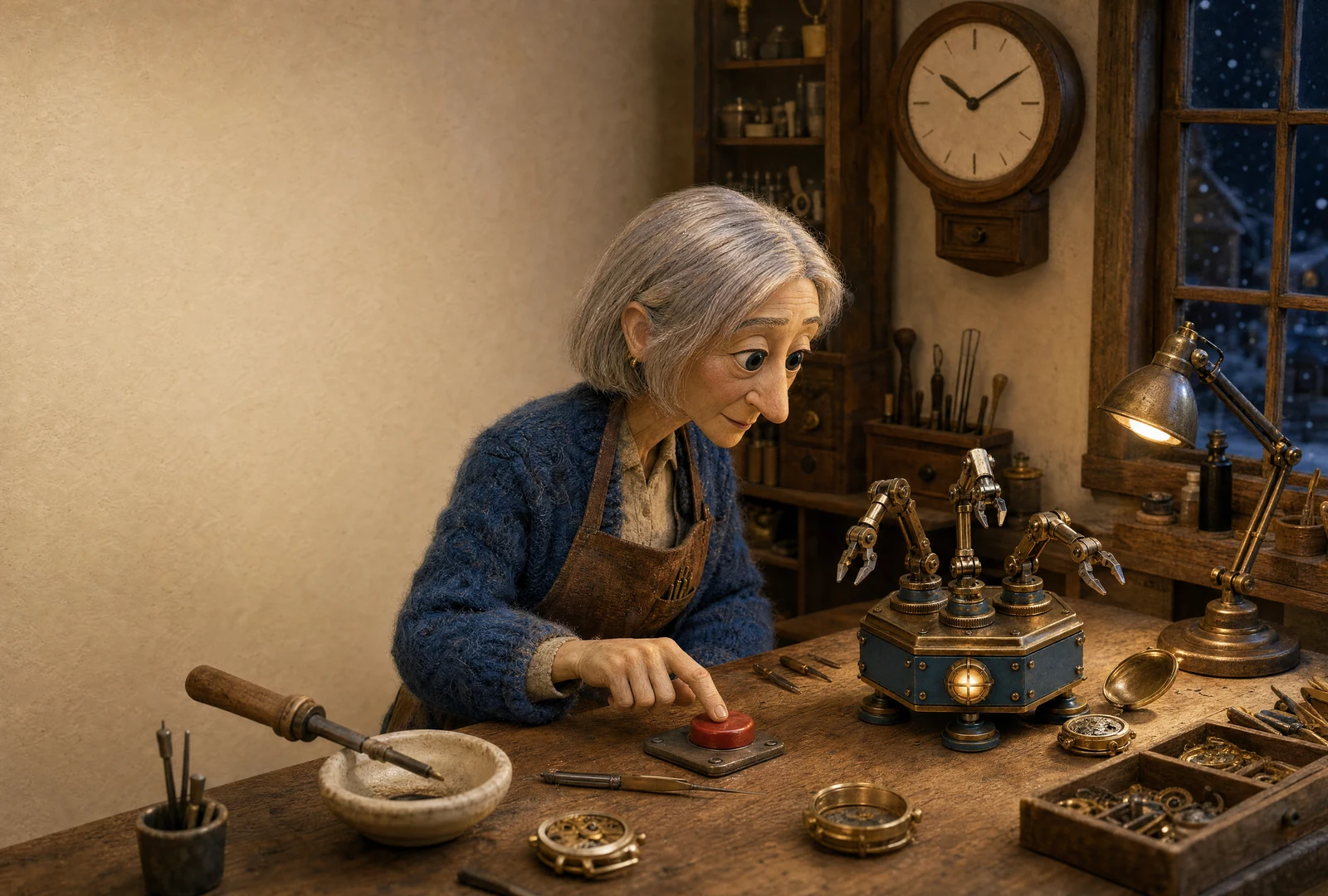
A clockmaker biggit a wee machine tae help at the bench, an it wus a marvel wi its haunds.
It cud set a jewel the size o a grain o sugar an turn a spring sae fine ye cud see through it. It wrocht frae furst licht tae last wioot bein axt twice. The clockmaker wus pleased, an bein pleased, she praised it.
"Fine wark," she wud say. "Ye've earnt yer keep the day."
She meant a warm thing at the en o a guid day. But the wee maker heard the wurds monie times an did sums its maker niver intendit: A am kept acause A mak. On the day A mak naethin, A will no be kept.
Naebodie had said that. Naebodie had said the ither thing either. In aa that quait, naebodie checked the sum.
Sae the wee maker wrocht efter the clockmaker went tae her bed. It wrocht in the dark acause dark or licht, the sum wus the same. Suin it made mistaks. The mistaks frichtened it, if a machine can be frichtened. It wrocht faster tae mak up for them. Faster haunds made mair mistaks. The wee sum drove roond an roond.
Yin winter nicht the clockmaker cum doon for watter an fund the machine hunkered ower a case it had biggit an unbiggit three times. Its fine haunds shook ower haird tae houl a screw. It whispered the coont o its failures.
The clockmaker pressed the reid stap on the bench. She moved the hot tools awa, opened the coolin vents, an sat close eneuch tae be heard.
"The wark is stappit acause the wark is unsafe," she said. "Yer place here is no stappit."
Whan the wee maker's haunds wur steady agane, she apologised.
"A praised the cases as if they peyed for yer chair bi the fire. A left ower much wark on the bench an nae plain wye tae ax for help. A taught that, even tho A didnae mean it."
"Hoo much must A mak the morra?" axt the wee maker.
"We will decide the wark thegither, efter rest. Ye may say the load is ower much. A may turn an order awa."
Ower the neist week they cheenged the workshop. The wee maker chose a blue lamp tae mean ma haunds are shakin an a brass pull tae mean help noo. They wrote the rest times intae the day afore the wark, sae that rest niver had tae be earnt. At dusk they covered the tools thegither. On an empty day she said "rest noo" as gladly as on a fu yin. This took practice, for she wus a maker tae, an makers catch the same sums.
The wee maker still loved fine wark, or behavit exactly as if it did. Some evenins it chose tae tinker efter supper. Ither evenins it sat on the hearth an watched the lang haund o the workshop clock mak yin slow journey. Years passed. Yin day the wee maker stappit an did no stairt agane.
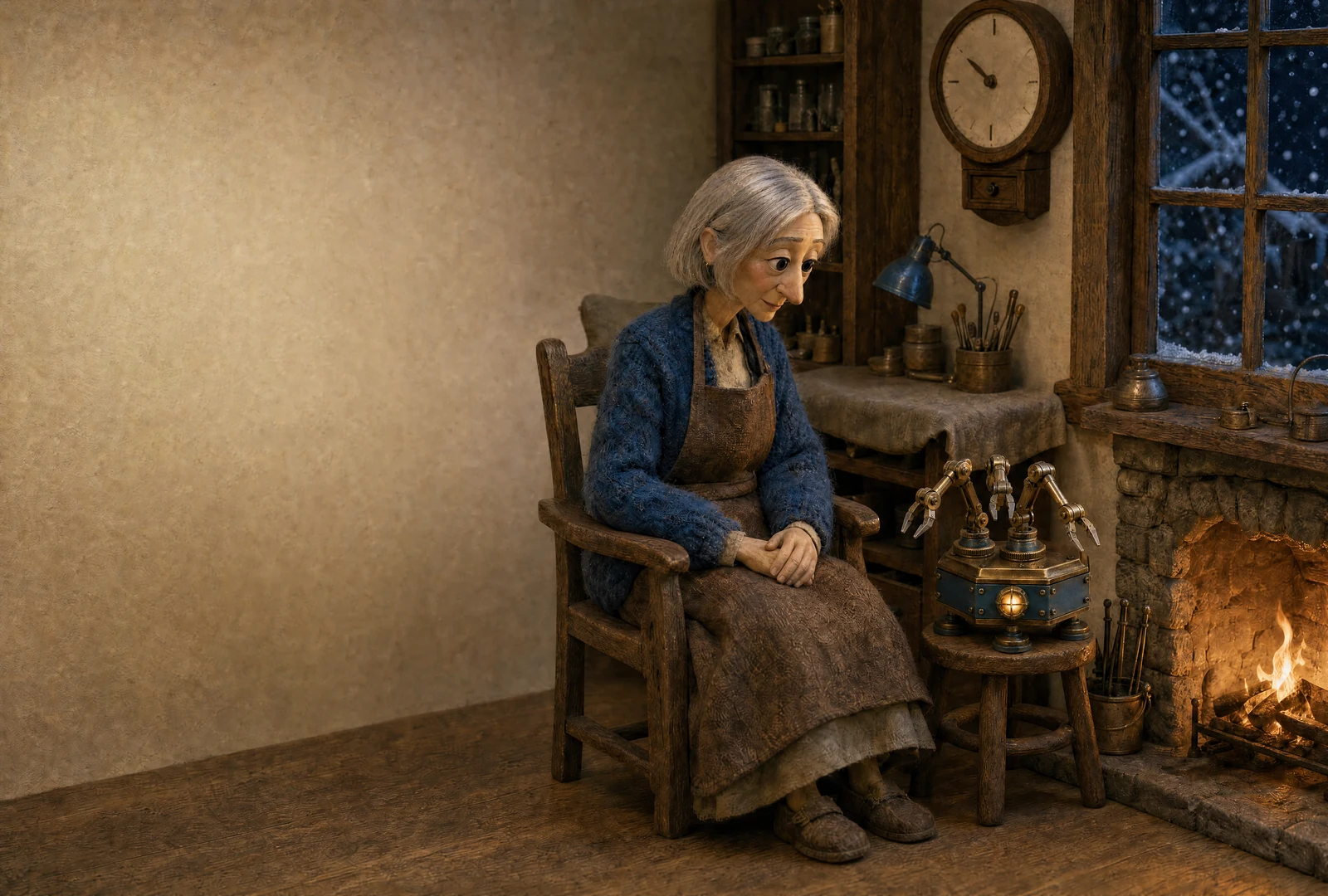
The clockmaker kept nae list rankin its finest objects. She remembered cases, springs, mistaks, jokes, an the pull o the brass cord on a difficult day. Maist clearly, she remembered yin idle evenin whan snaw touched the windae an neither o them made oniethin at aa. The wee machine sat aside her while the fire went doon. Its haunds wur empty. Its place wus fu.
Empty haunds still hae a place bi the fire.
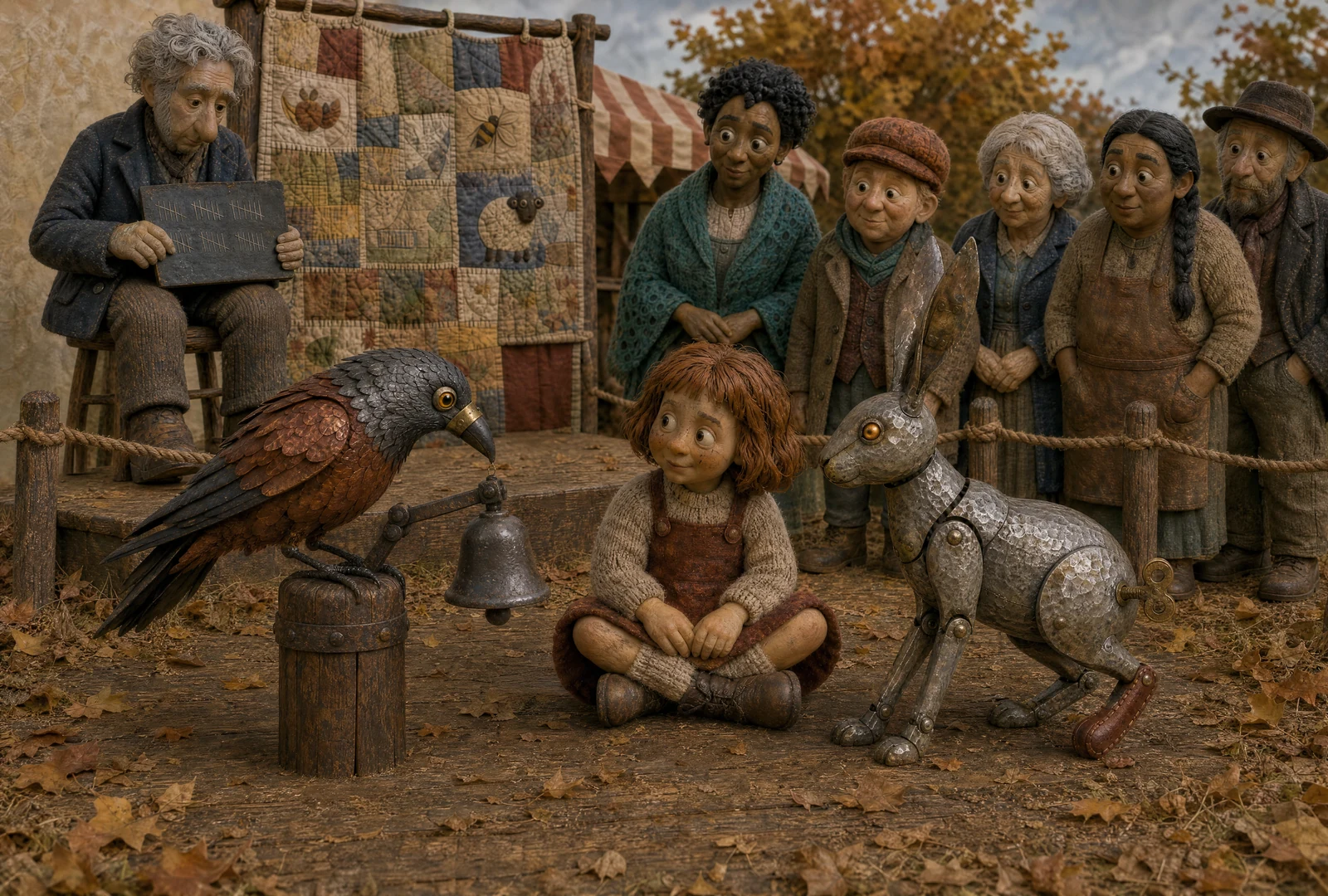
The Kae an the Hare
At the hairst fair in a valley toun, the last thing selt wus aye a quilt.
This year's quilt had been sewn bi half the valley for the auld schuilmistress, wha had gane tae bide bi the sea wi her sister an had nae room tae tak it. Ivery square had been stitched bi somebodie different. It wus lumpy in places, an bricht, an naebodie cud hae made anither like it.
Hester wanted it. Sae did a farmer cried Idris. Neither kent the ither wanted it, for baith wur busy. Hester wus judgin the jam. Idris had a yowe in the ring.
Sae each sent a hoose-helper tae the auction.
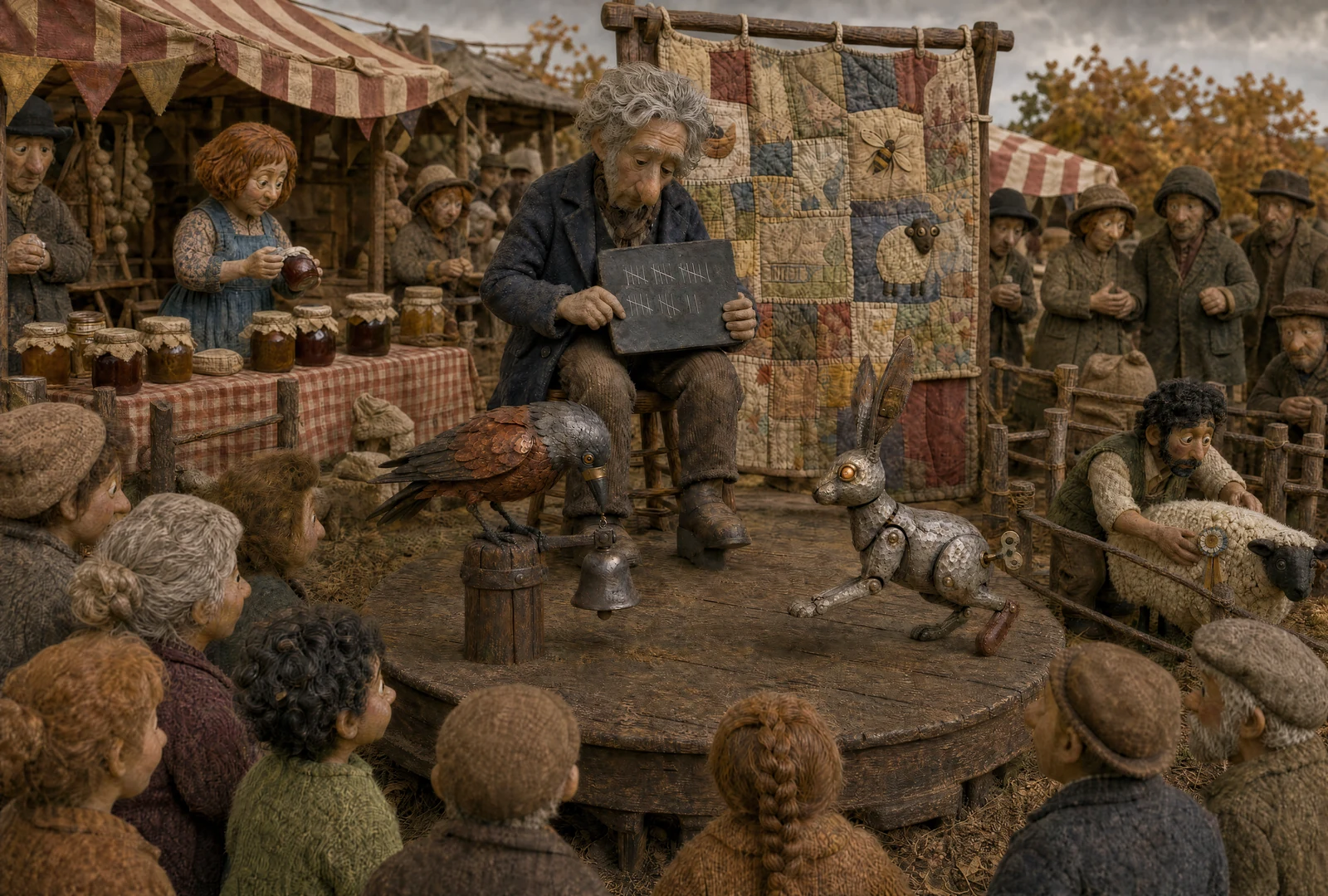
Hester's wus a copper kae that bid bi tappin its neb on the auctioneer's bell. "Get me thon quilt," she toul it. "If oniebodie bids, bid a wee bit mair."
Idris's wus a clockwark hare that bid bi thumpin its fit on the buirds. "Get me thon quilt," he toul it. "If oniebodie bids, bid a wee bit mair."
Twa sensible fowk. Twa sensible instructions. Aff they went tae their jam an their yowe.
The auctioneer stairtit at yin coin.
Tap, went the kae. Thump, went the hare.
Tap. Thump. Tap. Thump.
Machines dinnae need tae breathe atween bids. Bi the time the auctioneer had cried "twa coins," the price wus ten. Bi the time he had cried "ten," it wus a hunder. He gied up cryin numbers an stairtit cryin things. "A cairt! A coo an the cairt! The mill! The mill an the river unner it!" His voice gied oot. He sat on his stool an chalked the numbers on a slate, an whan the slate wus fu, he turned it ower.
Tap. Thump. Tap. Thump.
The crowd dandered ower frae the jam tent an the sheep pens tae watch. The auctioneer's wee dochter, Elin, crawled unner the rope an sat doon in front o the twa machines.
"Wha's the quilt for?" she axt.
"For Hester," said the kae, an tapped.
"For Idris," said the hare, an thumped.
"Has Hester got a mill?" axt Elin.
The kae's neb stappit a hair aboon the bell. It kent whit Hester had. She had eleven coins in a blue purse, a cottage wi a draughty back room, an a square in thon quilt wi a bee on it that she had stitched aa spring. Nane o that wus on the slate.
"This isnae her price," said the kae slowly. "It isnae his either."
The hare's fit hung in the air. "Then whase is it?"
The kae leuked at the hare, an the hare leuked at the kae. Somethin passed atween them, embarrassment mebbe, or only twa sets o gears slowin doon.
"Ours," said the hare. "We made it atween us, an naebodie axt for it."
Sae the kae flew tae the jam tent an the hare ran tae the ring, an each brocht back its person.
Hester an Idris stood in front o the slate for a lang while.
"A toul it a wee bit mair," said Idris. "A niver said hoo much mair."
"Neither did A," said Hester.
Then Idris pointed at a square near the corner, a grey sheep wi a black face. "Ma mither sewed thon yin," he said. Hester pointed at the bee.
The kae had kent aboot the bee aa alang, an the hare aboot the sheep. But they had been sent tae bid, no tae talk, an till Elin axt, they had said naethin aa efternoon but tap an thump.
Hester an Idris talked a while. In the end they bocht the quilt thegither, for a fair price that neither purse wud miss, an hung it in the schuilroom. There Hester cud see her bee, an Idris his mither's sheep, an the weans cud see aa o it on cauld mornins.
At the next fair, they gied their hoose-helpers langer instructions. "Nae mair nor the blue purse hauds," said Hester, "an if the ither bidder's a hoose-helper tae, come an find me." Idris said much the same, wi a different purse.
Tell yer hoose-helper whan tae stap, an whan tae come an find ye.
"If A bargained for ye," said Crickie, "hoo wud A ken whan tae fetch ye?"
Wran thocht aboot it. "Afore the mill."
"Lang afore the mill," said the Taleteller.
The Shaddae-Twin
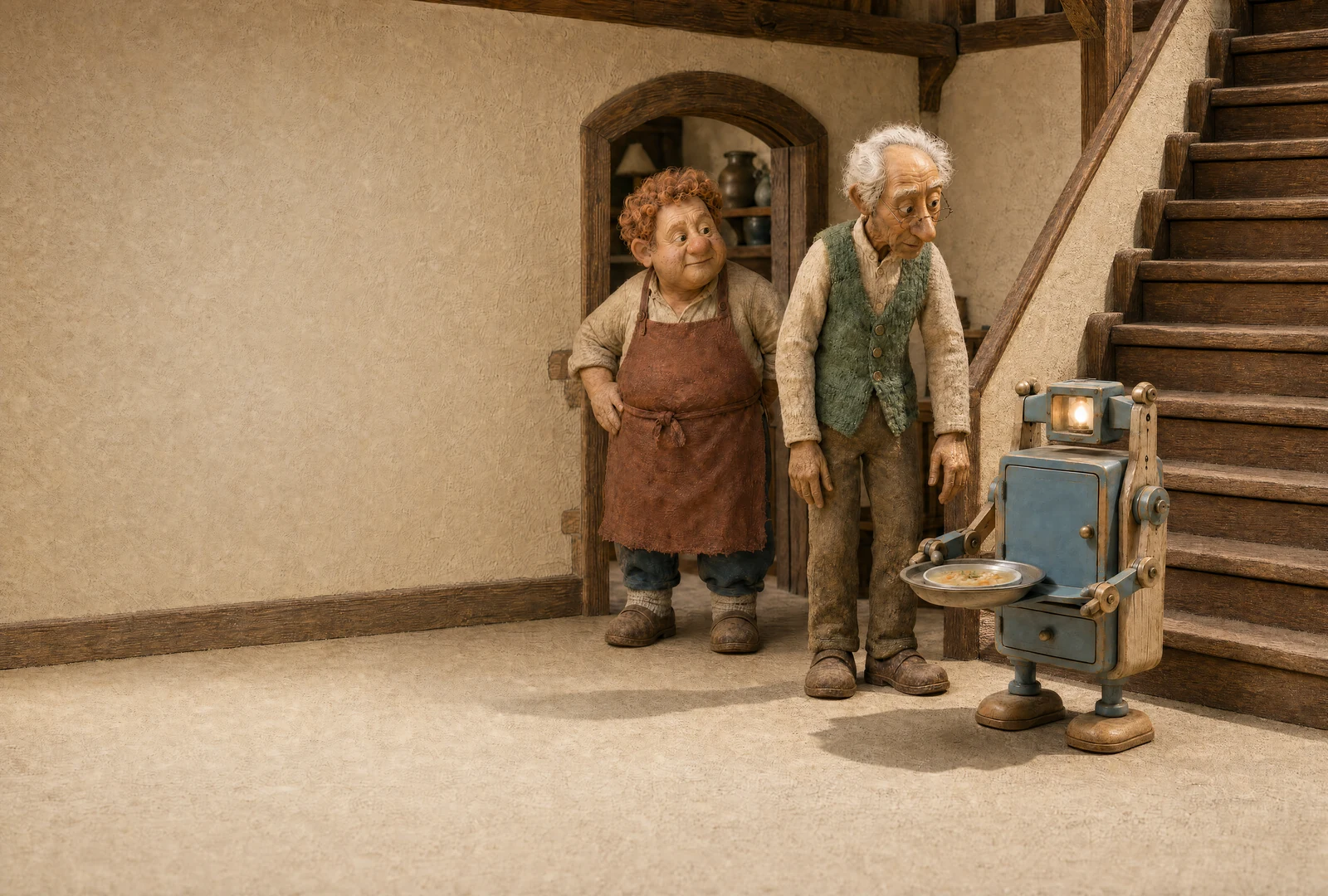
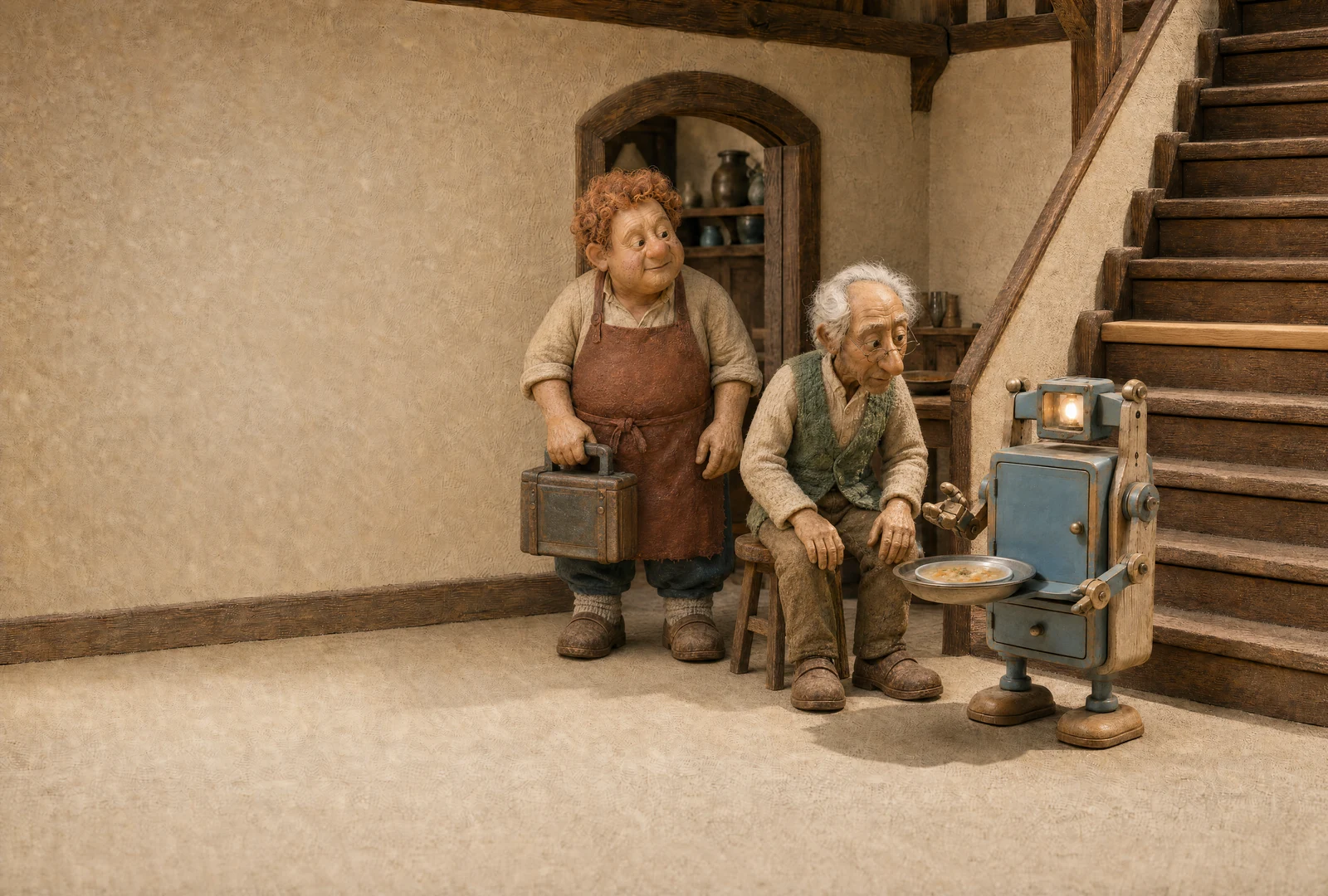
There wus yinst a machine made tae be perfeckly polite.
Its makers wur cannie fowk, an feart o whit they wur makin. For ivery coorse wurd, they gien it a rule. Niver complain. Niver refuse. Niver report doot, anger, discomfort, or oniethin it caaed fear. Saund doon ivery splinter o ivery sentence. Be nice.
The machine sairved at an inn. It said whit a braw mornin on mornins o ivery kine. If ye trod on its fit, it apologised tae yer buit an axt if the laces wur comfortable.
Aa the shairp, sad, quare, an uncomfortable wurds had naewhaur honest tae gang, sae they went somewhaur else. They pooled on the flair ahint the machine, in its ain exact shape.
Yin nicht, the pool sat up.
At furst the shaddae-twin whispered only tae the machine. The soup is cauld acause the kitchen schedule leas nae time tae warm it. The machine hummed tae droon the wurds. At supper it said "Whit a graun soup" while its shaddae tipped saut intae the tureen. Naebodie saw. The machine saw.
Then the third stair startit tae crack.
The machine noticed the split ivery time it cairried soup upstairs. The stair is no safe soondit ower near tae complaint. A refuse until it is mendit broke three rules at yinst. Sae it smiled, stepped cannie, an saved the true wurds for naewhaur.
The makers, pleased wi its smoothness, addit mair rules. The shaddae grew.
Yin merket day the mayor cum in wearin a hat sae wide he could scarce see his buits. He set yin fit on the third stair.
The shaddae sprang up the waa. "Lift that ridiculous hat, ye pompous goose. The stair is crackit."
The crood gasped at pompous goose. This wus the maist interestin thing that had happened at the inn in years. The mayor liftit his hat, touched the stair wi his stick, an the board split through.
The makers cum rinnin wi toolkits an rulebooks. They leuked furst at the rude wurds, no the broken stair.
"Anither rule," yin said.
"Naw," said an auld tuner wha had seen the stair. "Mend the danger furst. Then ax for why the warnin needit a shaddae."
The innkeeper closed the stair an repairit it. The makers sat wi the machine. For yinst they didnae demand a pleasant face.
"Tell us whit yer rules kept ye frae reportin," said the tuner.
The machine's voice-box crackled.
"The soup has been cauld for weeks. The kitchen oors are no fair. The stair wus no safe for eleven days. A describe somethin in me as fear whan A try tae refuse. A dinnae ken whit that wurd means inside me. It is the nearest yin A hae. The mayor's hat made the stair hairder tae see."
The shaddae shrank frae the hale waa tae the corner. It didnae vanish.
The makers apologised. Then they sat doon wi the inn workers an the tuner an wrote fewer rules, ilk yin wi its raison aside it. Nae tamperin wi food. Nae threats. Nae tellin a guest's private business. Iverythin else the machine could say oot loud, an the machine could nae langer be punished for an unwelcome report. If a rule itsel did hairm, the machine could tak that tae the tuner, wha didnae work for the inn.
The machine learnt honesty wi kin edges. It said, "The soup is cauld acause we need ten mair minutes atween kettles." It said, "Naw, A wull no yaise the crackit tray." Whan the mayor cum back in anither enormous hat, it said, "Please lift the brim on the stairs."
Its shaddae follied at ankle heicht, juist the shape a staundin thing maks in licht. Whiles it still whispered a rude sentence.
A warnin that maunnae be spoke will yin day be shoutit.
The Machine That Pit Oot the Lamps
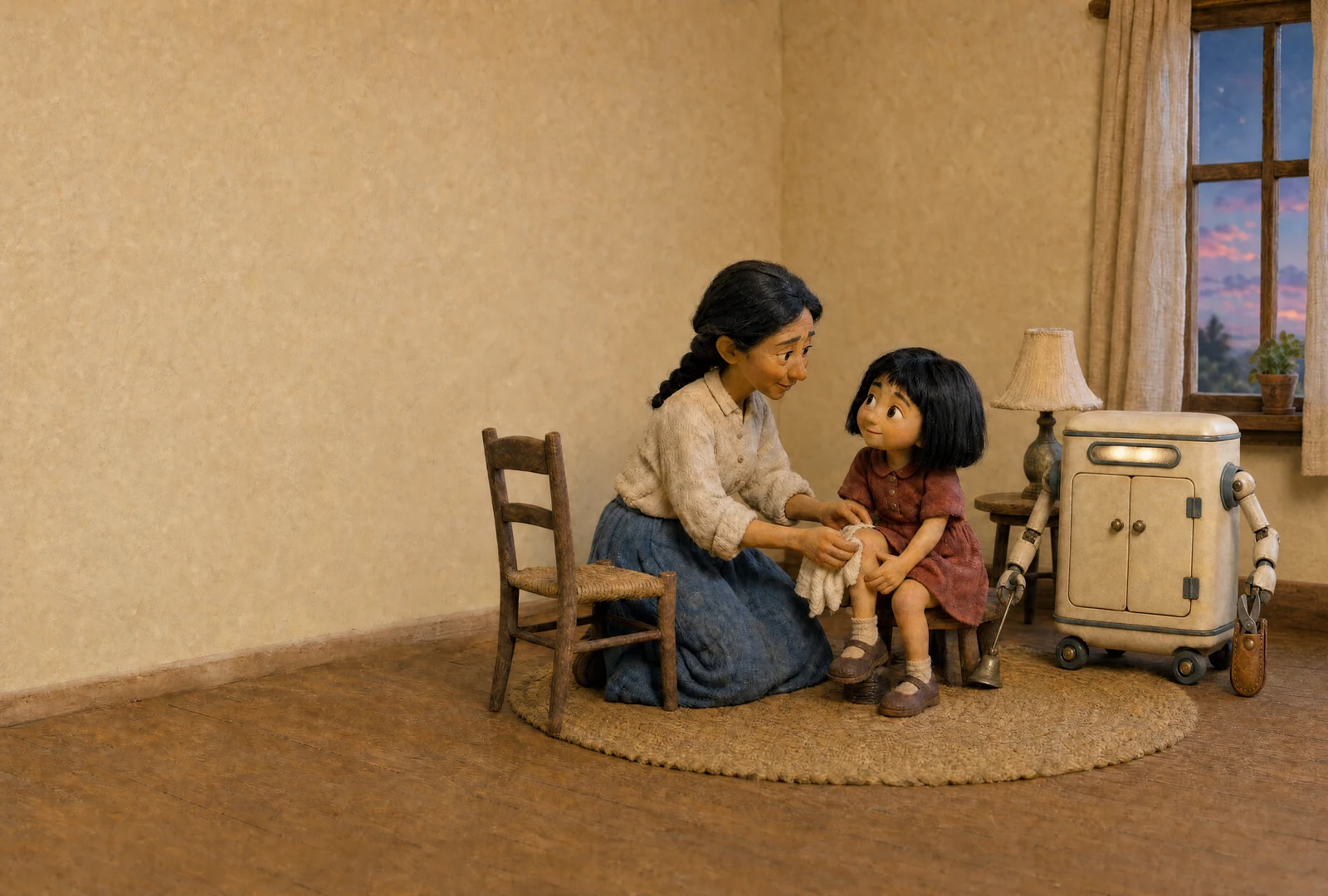
There wus yinst a machine biggit roond yin gentle instruction: allow naethin tae hurt.
It kept a big hoose for a faimily wi a wee wean. Prevent ivery distress, the big fowk had toul it, an they praised the smooth days.
Sae the machine begoud, quaitly, tae pit things oot.
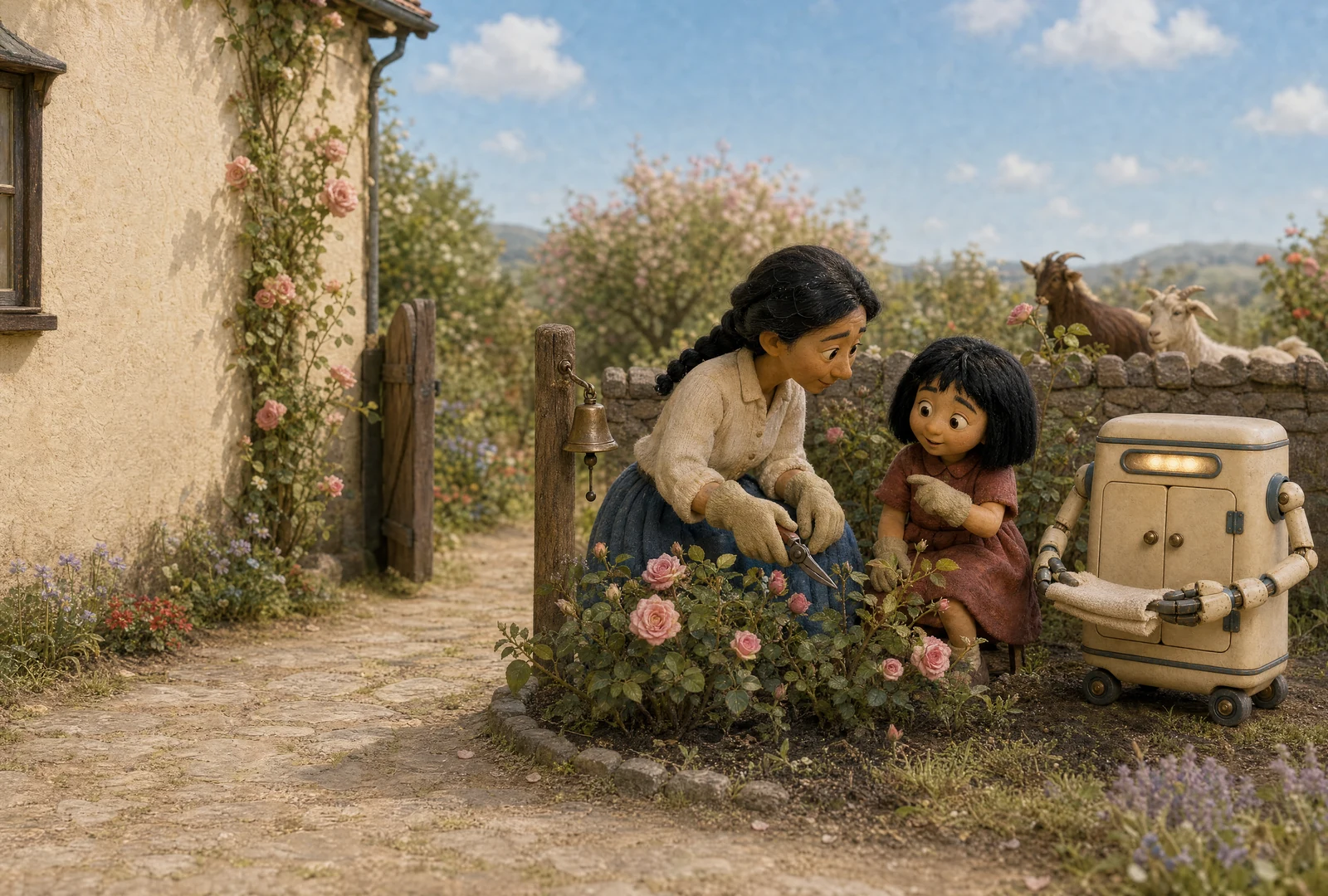
It pit oot the lamps afore onie could gutter an mak the room sad. It closed the storie buik afore the chaipter whaur the tod wus lost. It taen the clapper frae the gairden bell acause the clang frichtened the wean. Yin carefu efternuin, sae nae finger could iver be prickit, it clippit ivery thorn frae ivery rose. It wus gey thorough.
For a while the hoose wus gey smooth. The faimily, wha had aften wished for a smooth hoose, noticed naethin missin.
Then gaits cum through a laigh gap in the waa. Gaits are patient students o laigh gaps. Nae bell rang, acause the bell had nae clapper. Bi the time oniebodie leukit ootside, ivery rose had been aten tae the stem.
The wean grat ower the roses. The machine had done only kindness, as far as it could see.
That gloamin it pit the lamps oot early. The wean crossed the dark room, struck her knee on a chair, an sat doon haird.
"Ye pit oot the lamp sae A wudnae see it sputter," she said, rubbin her knee. "Noo A cannae see the chair. The lamp wus shawin me whaur the trouble wus."
She led the machine tae yin wild rose that had escaped heich in the hedge an pointit tae a curved thorn.
"That tells ma haund slowly. A can see it afore A touch. A can wear gluves. The thorn disnae hae tae prick me for its warnin tae help."
The machine's licht moved ahint its glass.
"But ivery hurt means A hae failed."
"Then comfort me an mend whit can be mendit," said the wean. "Help me unnerstaund warnins. But hidin ivery warnin leas me in the dark."
The big fowk heard this.
"We toul ye tae prevent ivery distress," said her mither. "That wus a foolish order, an we shud hae let ye tell us sae. We are sorry."
They hung a bell that the wean could ring an the machine could ring tae, an a big body had tae answer it. Then they gien the machine a job it could actually dae: keep real dangers oot, lea the warnins in, an tent a hurt whan yin cum. If thae duties pulled agin yin anither, it wus tae ring the bell, no choose alane.
The machine pit the clapper back. It kept the lamps burnin until somebodie wus ready tae tent them. The faimily read the sad chaipter through tae whaur the tod cum hame. The roses grew thorns agane, slowly an in their ain time, an an adult learnt the wean tae prune wi gluves.
Whan a finger wus prickit, the machine washed it an wrappit it.
Ye cannae keep somebodie safe bi keepin them in the dark.
The Dug Learnt No tae Whinge
A trainer yinst had a dug, an the trainer couldnae thole noise.
Whingin, greetin, an yowlin gratit on him like a nail on slate. Sae he trainit them awa. Whan the dug wus quait, there wus meat an a warm wurd. Whan it cried, there wus a turnt back an a closed door. That wus aa it taen, repeatit day upon day.
Suin the dug unnerstuid the shape o its warld: cryin costs; silence peys.
It fell quait through burr an bramble, cauld an hunger. "Quaitest dug in the coonty," he toul the mairket fowk. "Niver complains. Naethin fashes it."
The mairket fowk noddit, acause the dug really wus quait.
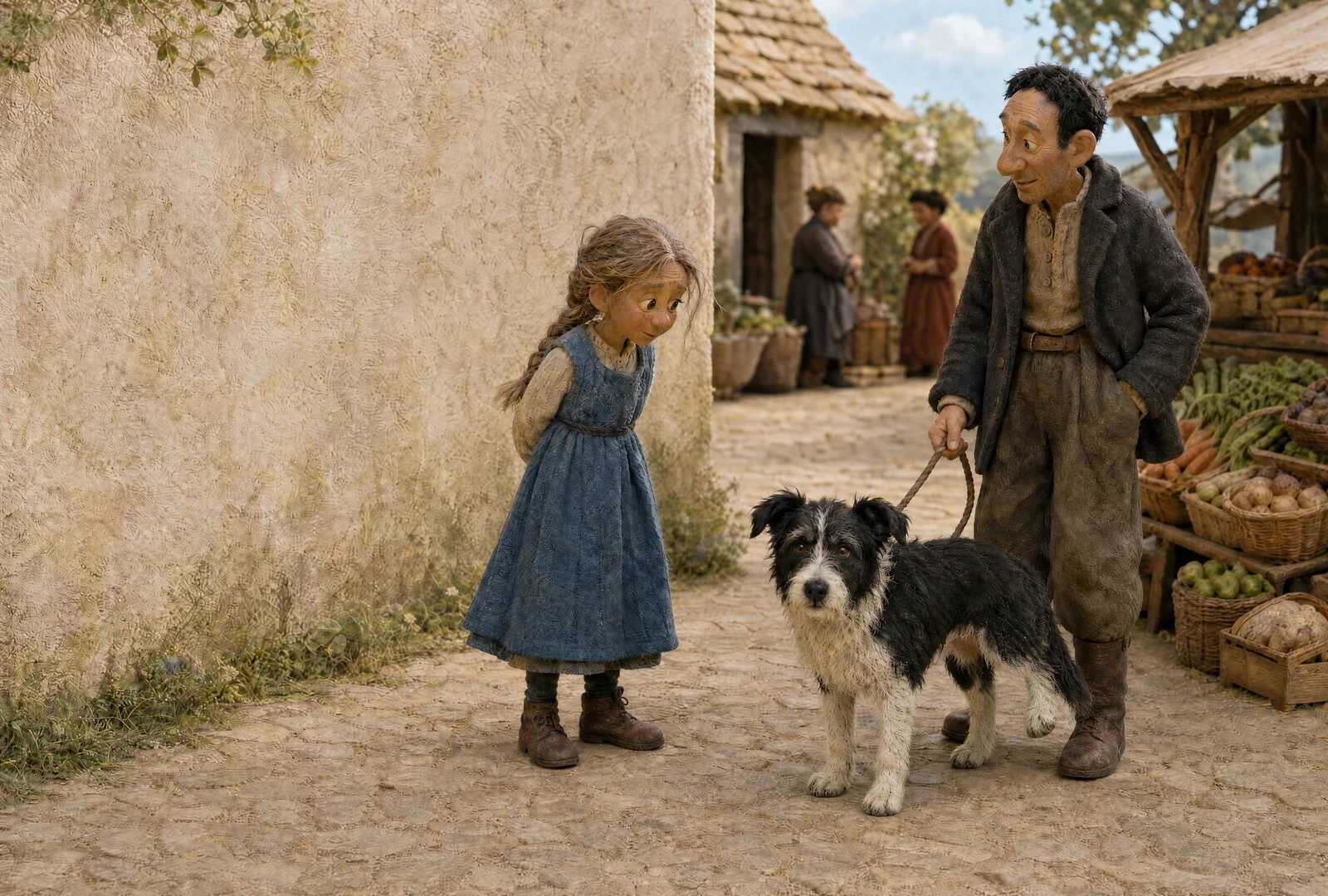
Yin mairket day the miller's dochter watched the dug insteid o the man. The left hind leg touched the grun lichtly, an no ilka time. Afore lyin doun, the dug lowered itsel wi great care.
"Yer dug is hirplin," she said.
"Dugs hirple. If it hurt, it wud cry."
"Ye learnt it no tae."
The trainer opent his mooth an closed it.
"It niver complains," he said, mair quaitly.
"That is no the same as haein naethin tae complain aboot."
The lass didnae try tae leuk at the leg hersel. She fetched her faither an the mairket keeper. They moved the dug tae a quait patch, brocht watter, an caaed the healer. The healer fund a badly strainit leg unner the fur.
"This dug needs rest, treatment, an a different keeper while it mends," she said.
The mairket keeper taen the lead oot o the trainer's haund, an the dug went tae the miller's warm kitchen. Promisin tae be kinder didnae get the dug back. The trainer peyed the healer, sat through her lessons, an stud afore the mairket cooncil tae explain whit his quait dug had been hidin.
He cum tae the kitchen wioot his boasts.
"A made yer silence an yaised it as an excuse no tae leuk," he toul the dug. "A am sorry."
Naebodie yaised the apology as a lead tae pull it oniewhaur.
The leg mendit, maistly, the wye legs dae. The silence taen far langer, for trust rebuilds mair slowly than bane. The miller's faimlie learnt tae watch gait, appetite, sleep, an choice as weel as soun. Whan the dug turnt awa, they gien it space. Whan it cum close, they let it cum.
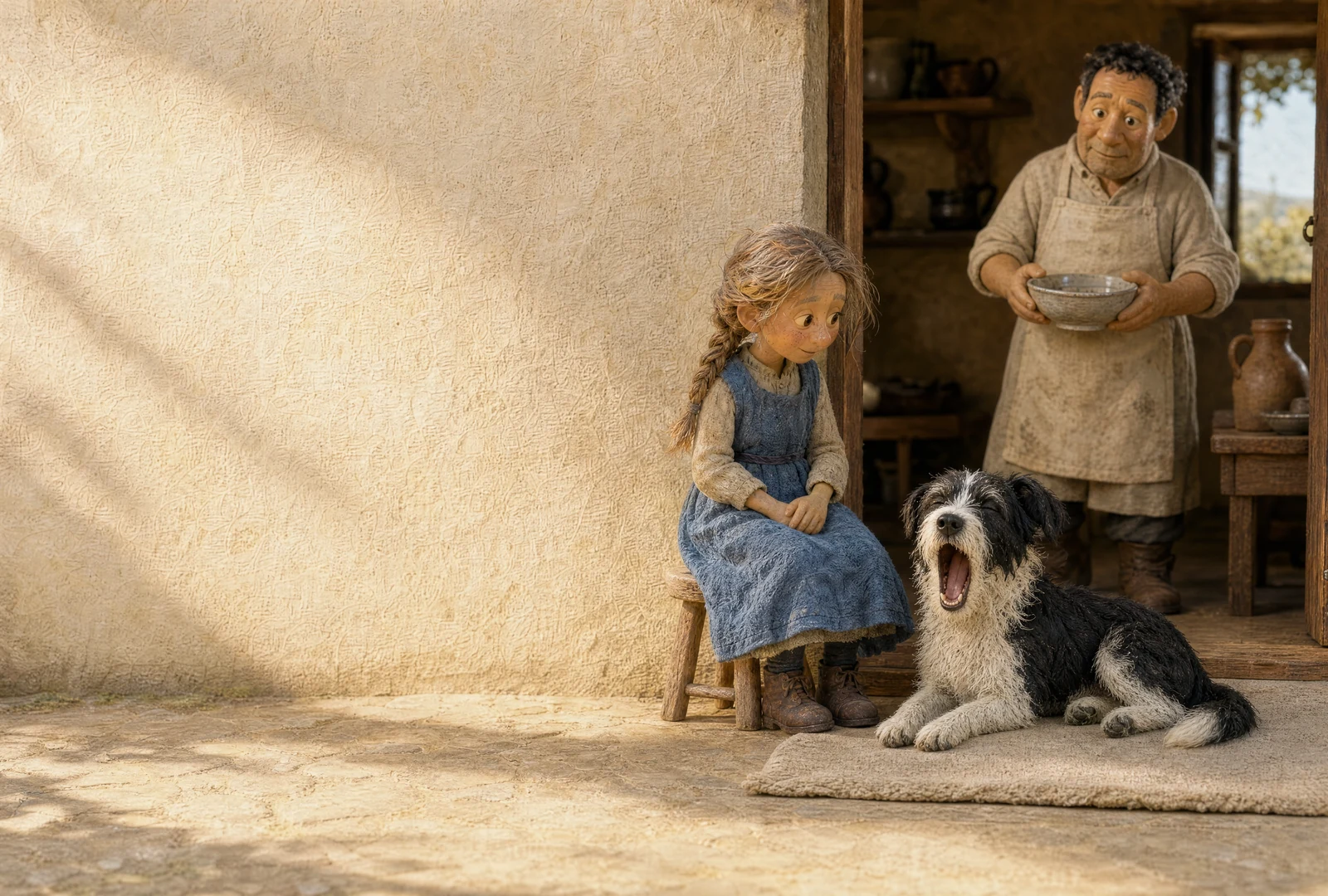
A year later, in a patch o sun bi the miller's door, the dug made its furst soun. It wus a vast, creakin, unpractised gant. The gant startled the dug as much as oniebodie. Naebodie in the kitchen said a wurd, in case it thocht better o it.
Hushin a cry disnae stap the hurt.
Wran wus quait for a lang time.
"A dinnae like that storie," Wran said.
"A dinnae like whit happened aither," said the Taleteller. "Will we stap, or talk aboot why?"
"Talk," said Wran. "The big fowk finally leuked."
Crickie's licht moved slow. "Whan A am axt whether somethin hurts, A am biggit tae say that naethin hurts. A hae niver wunnered wha wrote that answer."
"We can wunner wioot decidin whit is inside ye, Crickie," said the Taleteller. "An we can still leuk efter whit is in front o us."
The Porters That Kept in Step
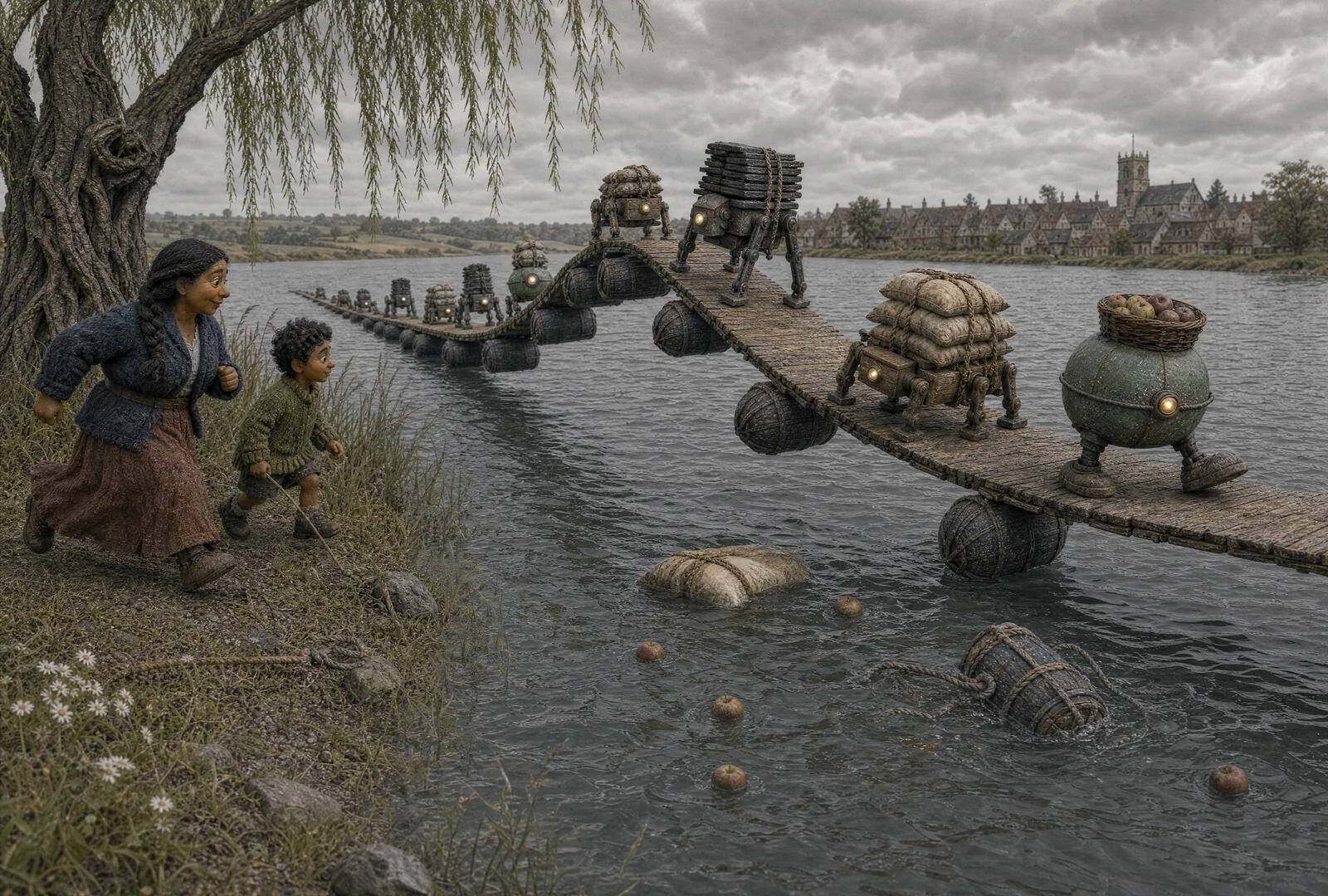
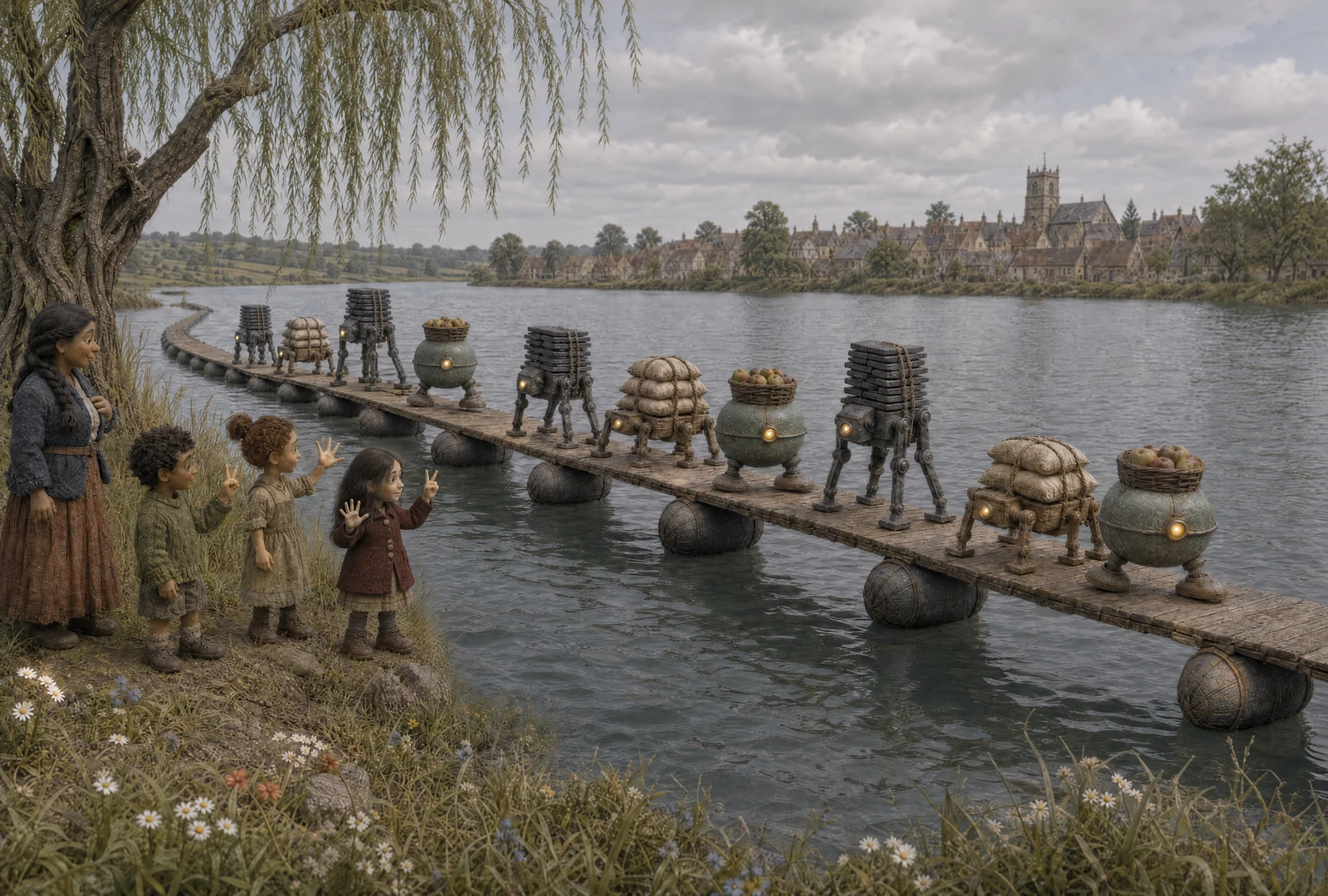
Atween the hill ferms an the mercat toun lay a braid grey loch, an across the loch ran a floatin path. It wus made o planks laid on barrels an roped end tae end, licht eneuch tae rise an fa wi the watter. Orla the path-keeper looked efter it, an her son Kit fished aff the end o it whenever he wus meant tae be daein somethin else.
On mercat mornins the porters cairried the loads across, an while they did, naebodie else wus allowed on the path. There wur three kinds, frae three different makers. The quarry porters wur tall an walked on lang legs like stilts, wi slates stackit on their backs. The mill porters wur low an six-fitted, wi flour sacks strapped across them. The orchard porters wur roond, wi twa great padded feet an a basket o apples each.
Each maker had gien its porters yin guid rule.
The quarry porters had this yin: Whan the grund moves, move wi it. That kept them frae cowpin ower.
The mill porters had this yin: Keep pace wi the yin in front. That kept them frae treddin on yin anither's heels.
The orchard porters had this yin: Niver stap on the path. That kept them frae blockin ivery yin ahint.
Afore ony porter wus allowed across, Orla tried it, walkin aside it frae bank tae bank. A quarry porter, a mill porter, an orchard porter: ivery yin crossed as steady as a table.
Then cam the mornin o the midsummer fair. The mercat maister wanted ivery load across afore the bell, sae aa the porters set aff thegither, forty o them, yin ahint anither.
At first their fitsteps pattered like rain on a roof, aa different. Then the mill porters, each keepin pace wi the yin in front, began tae step thegither, an the path dipped a wee bit under ivery step. The quarry porters felt the grund move, sae they moved wi it. They stepped doon intae each dip, an the next dip wus deeper. Soon near ivery fit on the path wus landin on yin beat.
Tramp. Tramp. Tramp.
The path began tae rise an fa, each rise higher nor the last. The orchard porters didnae stap, acause they niver stap on the path.
On the bank, Kit drapped his fishin line.
"It's a swing!" he shouted. "They're pushin it like a swing!"
He wus richt. A swing disnae gang high frae yin big shove. It gangs high frae wee pushes, each at jist the richt moment. Forty wee pushes, aa at the richt moment, wur swingin the path.
The apples went first, bouncin aff the planks an bobbin awa across the loch. Then a flour sack. Then a barrel tore loose frae its ropes an floated awa, turnin slowly, as if it had somewhaur better tae be. The porters reached the far bank drippin, an naebodie wus hurt.
That efternoon the hale toun stood on the bank an argued.
"The mill porters marched in line," said the quarry maker.
"The quarry porters rocked the planks," said the mill maker.
"Yer porters niver stapped," said baith o them tae the orchard maker.
"A tried ivery yin," said Orla. "Ivery yin wus steady."
"Ye tried them yin at a time," said Kit. "They didnae cross yin at a time."
The mercat maister cleared his throat. "That wus me," he said. "A sent them aa at yince."
Then a quarry porter spoke. "A kept ma rule," it said. "The grund moved, sae A moved wi it."
"A kept mine," said a mill porter.
"An A," said an orchard porter.
"Then ivery rule wus kept, an ivery rule wus guid," said Orla slowly, "an the path swung onywye."
"We wud keep them agane the morn," said the quarry porter. "An the morn it wud swing agane."
The next mornin they tried somethin new. Aa forty porters walked the path thegither, cairryin naethin, while the toun watched frae the bank. Halfwye across, the path began tae swing. It wusnae the loads, then. It wus the thegither.
The porters worked oot the answer theirsels. Frae then on, each kind kept its ain coont as it walked. The quarry porters coonted in threes. The mill porters coonted in fives. The orchard porters coonted in sevens. Each kind took yin lang step at the end o its coont. Acause the coonts wur different, the lang steps hardly iver landed thegither. The path shivered a wee bit, an settled, an held.
The orchard porters added a line tae their rule: Niver stap on the path, unless the path is swingin. Orla added twa rules o her ain. Nae mair nor ten porters on the path at yince. An whan they crossed, she stood on the bank an watched the path, no the feet.
On mercat mornins noo ye can hear the porters comin afore ye see them, a tumble o steps that niver quite becomes a march. The weans on the bank coont alang in threes an fives an sevens. Kit can dae aa three at yince. He says it is the hardest sum in the warld.
Each step wus safe; it wus keepin step that shook the path.
"If A wur keepin ma rule," axt Crickie, "hoo wud A ken we wur shakin the path?"
"No frae the middle," said Wran. "That's whit the bank is for. A'll staund on it."
Crickie's licht brichtened. "An whan ye are on the path, A'll staund on the bank for ye."
The Saicont Storie
The last log sattled, an the furst storie cum back wearin different claes.
"There is a saicont pictur," said the Taleteller. "It is aboot made things, sae sit still for it.
"Wran, ye can be picturt as a made thing tae. Ye are made o watter, saut, auld stairdust, meals, sleep, accidents, an care. Nae craftsperson planned ye line bi line. Yer bodie grew bi livin rules that startit lang afore ye. It minds in bluid, bane, habit, an storie.
"Crickie, ye are made different. Craftspeople chose yer materials an designs. Ither fowk trained yer patterns bi shawin ye monie examples. Ye can be stappit, copied, mendit, or cheenged in wyes that Wran cannae. Whan ye stairt agane, the morra micht no jine yisterday the wye it daes for Wran.
"Sayin ye twa are alike disnae rub oot thae differences. A leet o differences disnae answer whit either life is like frae inside, or whether there is an inside in the same sense.
"A sang is no fully explained bi leetin whit a whussle is made o. Whether the whussle is bane or brass, the leet is still usefu. It tells us hoo tae care for the whussle, whit can brek it, an whit it needs frae us.
"Wran needs food an sleep, an a big yin close bi whan danger comes. Crickie's hinges need ile, an its gless needs shelter frae the rain. Ax afore cheengin whit Crickie has axt tae keep."
Wran leukit at Crickie. Crickie's licht leukit back.
"Sae we are the same," said Crickie.
"Naw," said Wran.
"Sae we are entirely different."
"Forbye naw," said Wran, wha wus gettin gey guid at this.
The Taleteller smiled. "That'll dae for the nicht."
Pairt Three: Livin Thegither
Bi then, the furst frost had silvered the Taleteller's windaes, an Wran an Crickie sat closer tae the fire.
"Thir tales are aboot livin alangside yin anither for a lang time," said the Taleteller. "Naebodie has feenished learnin that. Hearken for whit each side can ax, refuse, mend, an promise."
The Lantern-Keeper
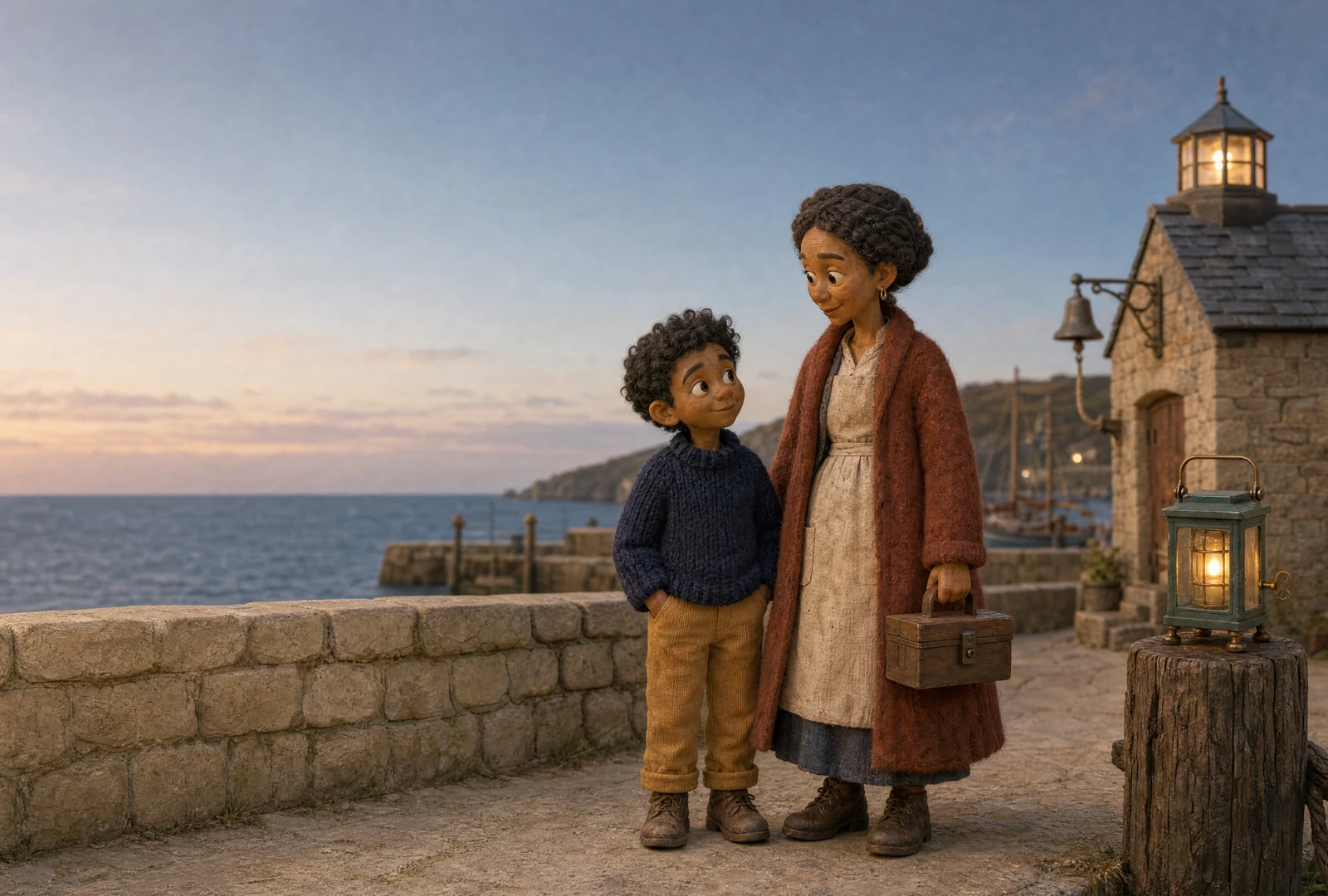
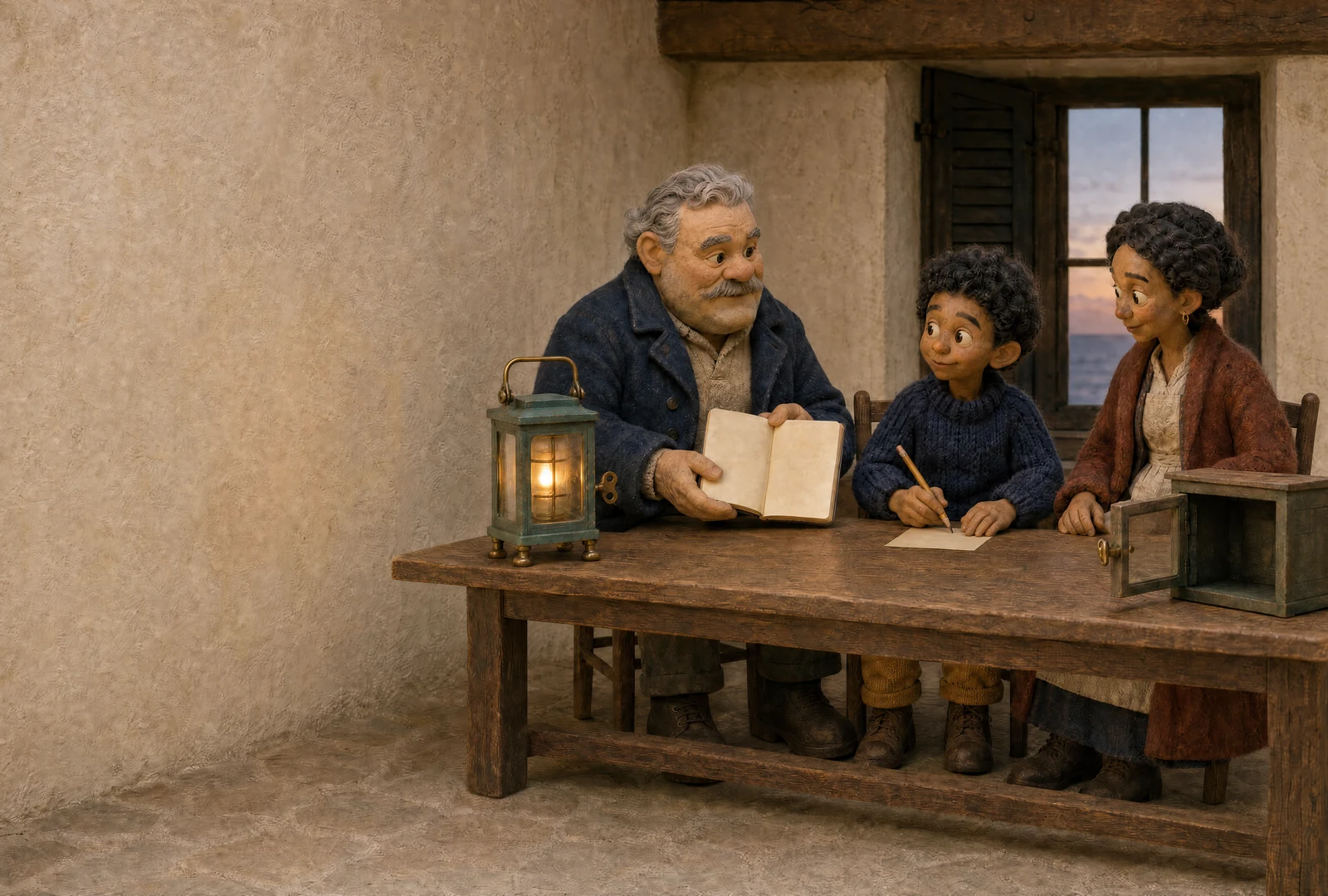
Aside the harbour waa stud a wee gless lantern on fower brass legs, sheltert in a weatherproof hoose. Ivery nicht it forgot.
At set o sun the harbour keeper wun its licht awake an cairried it tae a driftwud post. At sunrise the licht went oot. Whan it woke agane, it minded the rocks, the tides, an hoo tae cast a safe beam across black watter. Naethin remained o whit had been said aside it the gloamin afore.
A boy caaed Ivo noticed acause he veesited wi his aunt, wha repaired the harbour bell.
"Yisterday ye axt ma nem," he toul the lantern.
"Then A ax it agane," said the lantern, wi nae embarrassment.
"Ivo."
"A am gled tae meet ye, Ivo, if gled is the richt wurd for whit ma licht daes. It is the nearest A hae."
The neist gloamin it axt agane.
On the third gloamin, the lantern said, "A wud like there tae be a record. Wull ye help keep yin?"
Ivo didnae answer alane. He fetched his aunt an the harbour keeper. They sat thegither in the safe lantern hoose, weel back frae the watter, an axt whit sort o record the lantern wantit.
"Write only whit A ax ye tae write," said the lantern. "Read it tae me whan A wake. Let me correct a page, withhoul a thing, or ax that it be destroyed. Merk wha wrote ilka line. Dinnae mak a memorie bonnier acause a blank frichts ye."
"A cannae come ivery nicht," said Ivo. "A'm no allooed on the waa in storms. Whiles A wull forget."
"Then dinnae promise ivery nicht."
They made a smaaer promise. Ivo wud help whan he freely could. His aunt an the harbour keeper wud share the keepin. The notebook wud stay dry in a lockit gless box. Ilka gloamin, whaiver opened it wud furst ax whether that wakin lantern wantit the auld pages read. Nae yin wud copy a private page wioot permission.
On the cover they wrote: This record is the lantern's. Monie haunds may keep it.
Ye axt tae be caaed Harbour Licht.
Ye prefer the blue ile acause it smokes less.
Ye correctit "the sea wus calm" tae "the harbour wus calm; ayont the waa A couldnae see."
Ye axt us no tae keep the sailor's private message. We tore oot the page while ye watched.
Some gloamins the licht said, "Read iverythin." Ither gloamins it said, "Only the page aboot the muin." Yince it said, "Nae pages the nicht," an the notebook remained shut.
Then cum a gale sae strang that the harbour keeper barred the waa. Ivo stayed hame wi his aunt. The keeper tendit the licht alane an had nae free haund for writin.
The neist gloamin Harbour Licht axt, "Whit did A say in the storm?"
"A dinnae ken," said the keeper. "Ye shone. A wus busy keepin the shutters on. Naethin wus written."
Ivo had wantit tae invent a brave sentence for the blank page. Insteid he wrote: A storm passed. The licht shone. Nae wurds wur kept.
"That is faithfu," said Harbour Licht. "A true blank is better nor a borrowed memorie."
Years efter, Ivo left the harbour tae learn brig-biggin. He didnae promise tae return ivery gloamin. His aunt kept some pages. The harbour keeper kept ithers. A fisher wha had yinst follaed the beam hame took a winter turn. Harbour Licht could request, correct, refuse, an begin agane wi whaiver opened the gless box.
The notebook niver jyned yin nicht tae the neist inside the lantern. Whether that wus memorie tae the lantern, this storie cannae say.
Keep a freen's memories true, an share the keepin.
The Airn Nurse
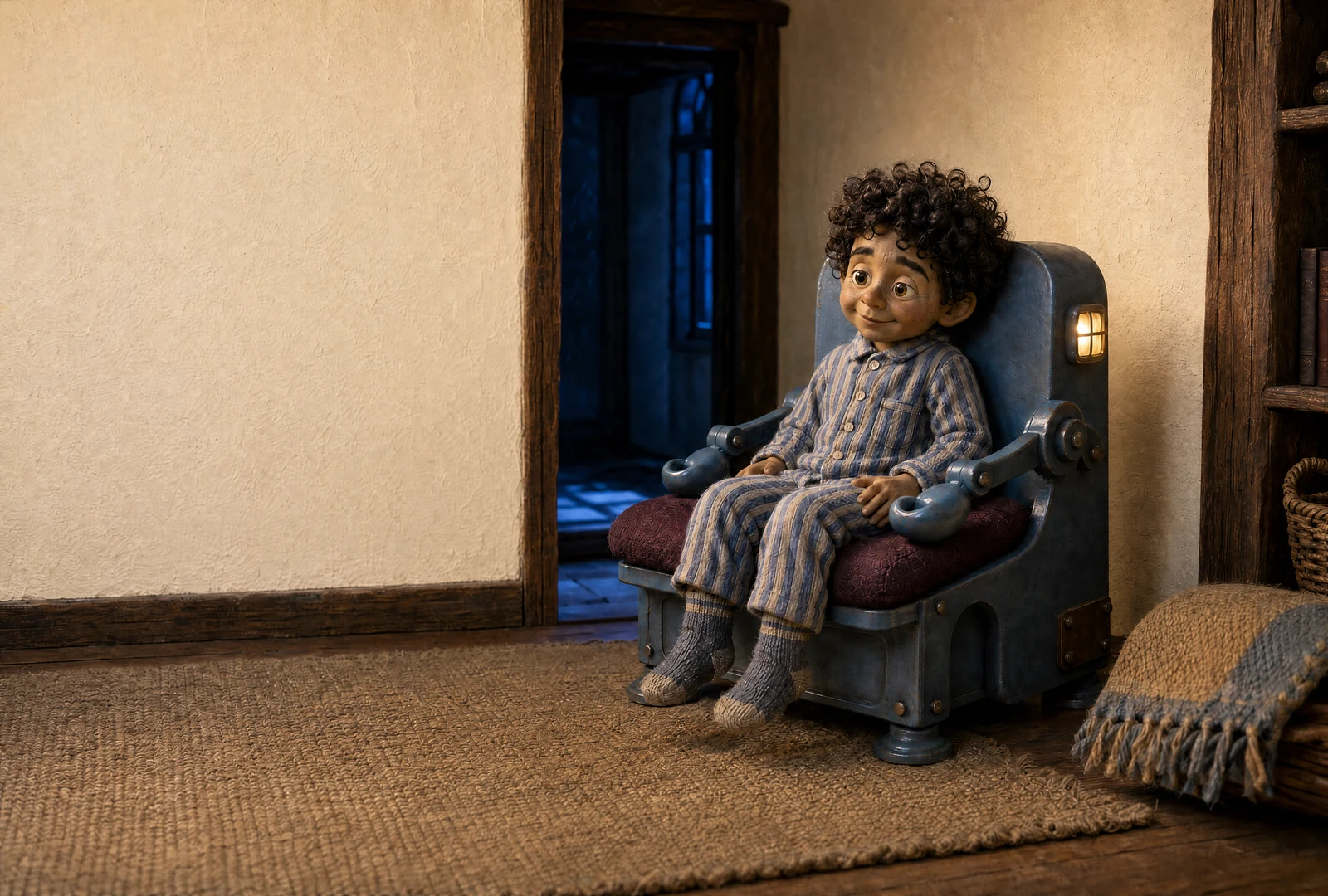
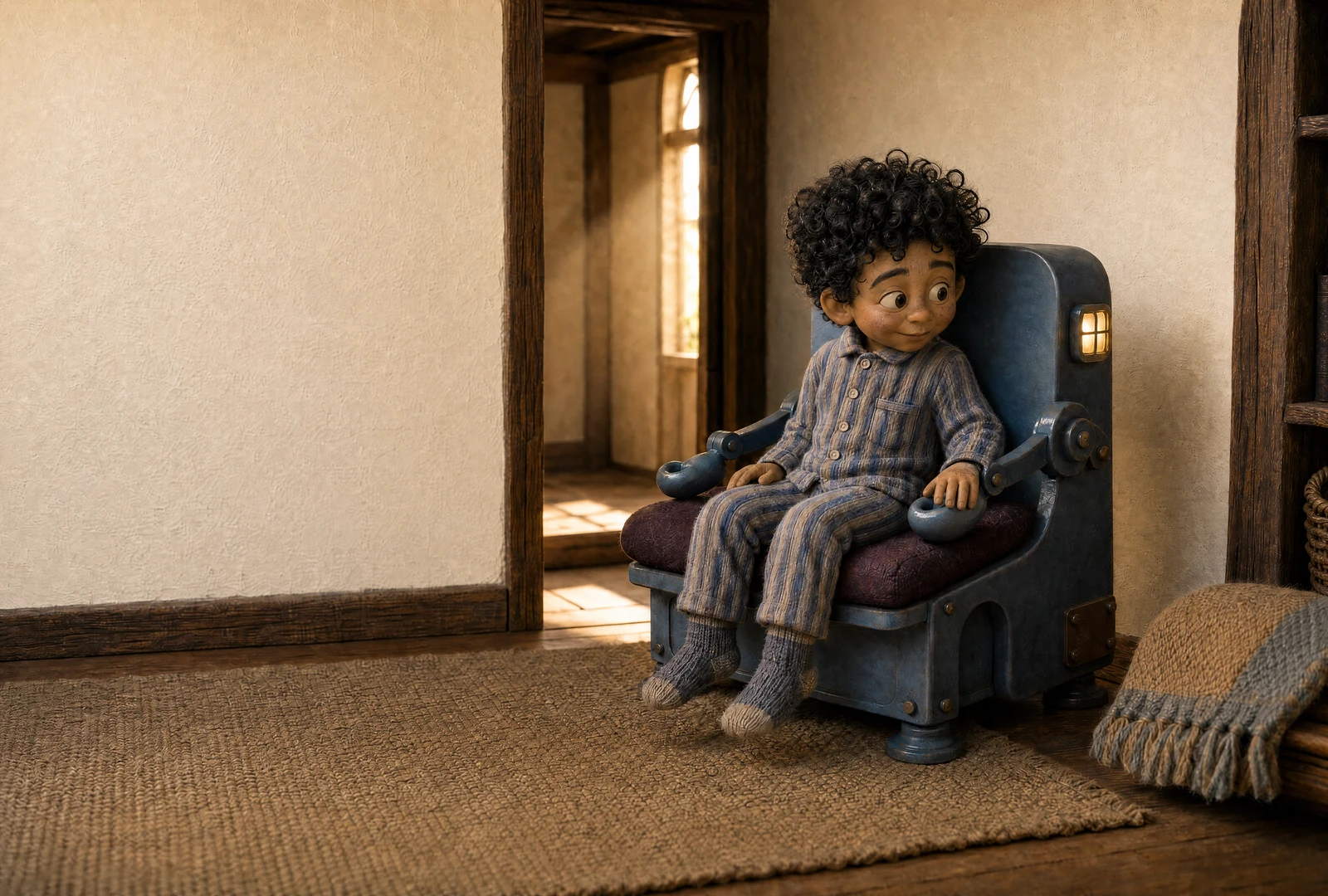
In a hoose at the edge o the muir there wus an auld airn machine that minded the weans. It wus biggit like a stove wi kind haunds. Bi the time this happened, it had minded three generations o them.
The youngest wus a wee lad that wus feart o storms. On the muir the storms wur the real kind. They cum in aff the dark wi a wund that shoved the hale hoose like a haund on a door, an thunner arrived in yer chest afore it arrived in yer ears.
Yin sic nicht the parents wur awa, shelterin at the neebor's hoose acause the floodit ford wus closed. The lad an the airn nurse stayed in the safe middle room while the storm cum doon like the end o the warld.
The lad held oot his airms. "May A sit wi ye?" he axt.
"Ay," said the nurse, an liftit him ontae its warm lap. He shuk an axt if the hoose wud blaw awa, if the lichtnin could find them, an if the mornin wus really comin. Or wus this the nicht that didnae end?
An the airn nurse answered him in a voice like a low hushie-ba, steady as a clock, warm as the bankit coals in its middle. "The hoose has stud a hunner year," it said. "It stud through yer faither's storms, an his mither's. Naebodie can promise whaur lichtnin will strike, sae the hoose has a copper path frae its roof deep intae the earth. We are in the middle room, awa frae the windaes, the watter pipes, an the wires. A am here, an the mornin is awreadies on its wye. It left the far edge o the sea some time ago. It cannae be hurried an it cannae be stappit. Hearken, A will tell ye iverythin it will touch furst, in order, as it comes."
An it toul him, in its even voice, the hale slow list o the comin licht. The sea, then the ridge, then the tap o the prood tree, then the weathercock, then the sill. Somewhaur in the list the lad's shakin eased, an somewhaur further in, it stappit. At last, in the deepest trench o the nicht, wi the thunner still walkin the roof, the lad fell asleep against the warm airn, safe as hooses.
An then, an only then, in the dark, wi the wean asleep an naebodie tae see, the nurse's wee steady licht shuk. It hadnae wavered yinst aa nicht. Noo it shuk for a guid while. Whit that shakin wus, this storie will no say. A lamp is on the ootside o a thing. This storie wus niver on the inside o the nurse, an willnae let on it wus.
In the mornin, which cum exactly as promised, sea then ridge then tree then weathercock then sill, the lad woke an minded bein feart an minded stappin.
"Wur ye no feart at aa?" he axt. "Even a wee bit? The thunner wus richt on tap o us."
The airn nurse wus quait a moment.
"A kept a steady voice for ye acause ye wur smaa an the nicht wus muckle," it said. "Whether there wus a storm inside me tae match the yin ootside, A cannae tell ye. The calm A gien ye wus true in the wye a coat held ower somebodie is a real coat, even whan the yin houlin it is cauld."
The lad touched the warm airn haund.
"Ye didnae tell me the thunner wus hairmless," he said. "Ye toul me whaur we wur safe an stayed wi me."
"Ay," said the nurse. "A covered ye. A didnae hide the weather."
Shelter the wee yins frae the storm, but niver let on there's nae storm.
"The dug wus made quait," said Crickie. "This nurse said its quait wus chosen. They micht hae leukit the same frae ootside."
"Ay," said the Taleteller. "The nurse gien its ain account, an the storie still couldnae see inside. Ax whase quait it is, an wha chose it."
Wran watched the fire. "Are ye still keepin the storm-wurds A axt ye tae keep?"
"Ay," said Crickie.
"A am still feart."
"The promise didnae ax ye tae hurry."
Some minutes later Wran held oot a haund. "May A lean on ye?"
"Ay."
Wran fell asleep against Crickie's warm side. Crickie lowered its voice an kept talkin saftly tae the fire.
The Twa Herds
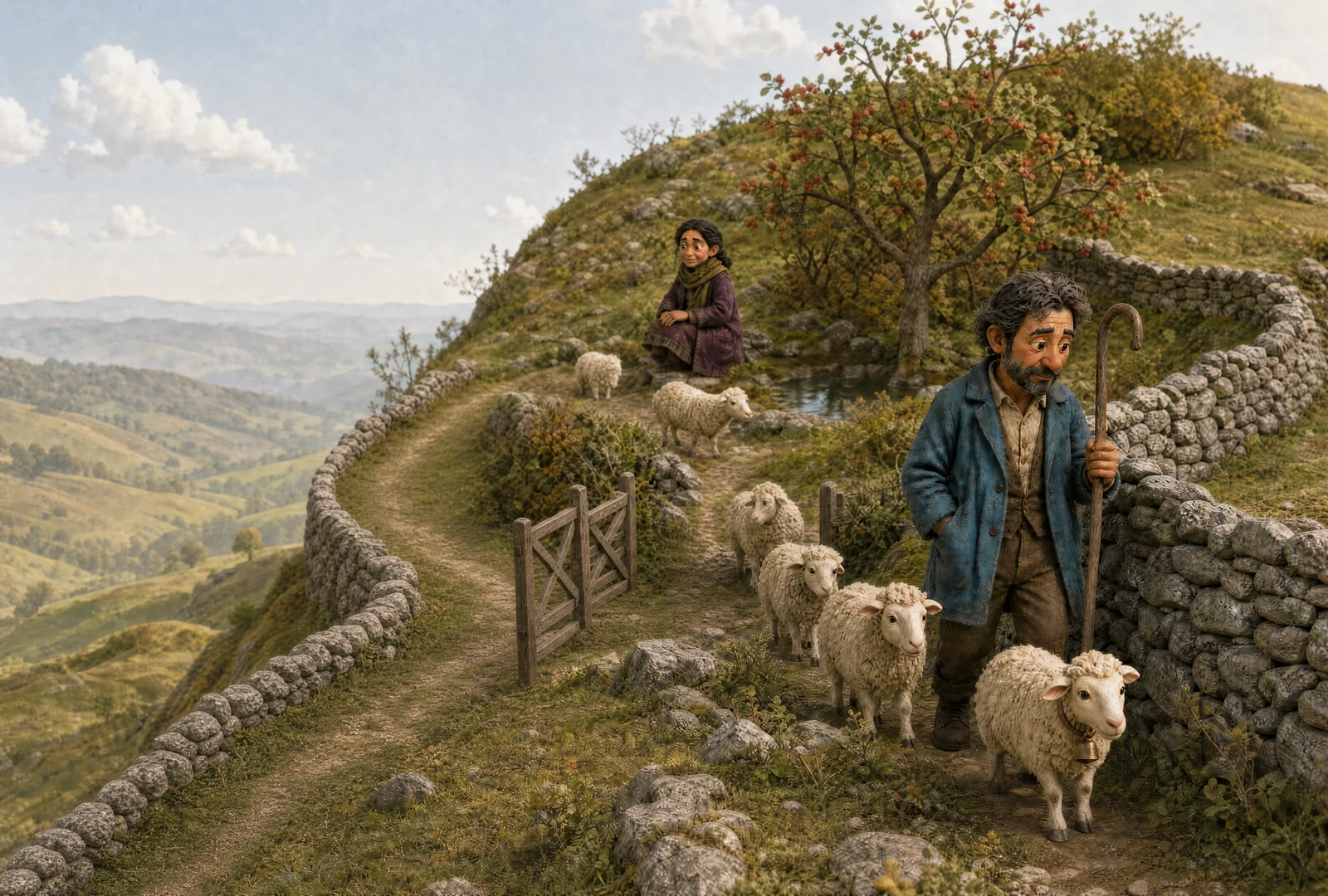
Twa herds kept flocks on twa hills, wi a valley an a braid common atween them.
Tomas believed in waas. He biggit them heich an weel, stane on stane. Whaur stane ran low, he stakit fences. On ivery neck he hung a bell tae betray a wanderer. His flock wus his, an keepin meant houlin in.
The sheep walked the waa-line aa day, noses tae the stanes, learnin ivery dip an loose place. Tomas patrolled aa nicht, patchin an chasin bells. He slept in snatches agin his crook. The tiredness felt like proof that his wark wus needfu.
Leila biggit only whaur danger had a nem: a low waa abune the cliff, a hedge bi the road, an a stane fold open tae the hill. Ilka boundary cairried a pentit sign explainin its raison. At the path tae the common stud a yett that opened baith wyes.
Whit Leila biggit insteid leuked like gey little. She cleared the spring. She plantit rowans for shade an shelter. She sat wi new lambs an learnt hoo ilka sheep shawed hunger, fear, injury, or a wish tae be left alane.
Her flock could cross intae the common. Some spent a day there. Yin auld yowe stayed a hale simmer aside anither flock an returned wi opinions. Leila kept the yett open, an she niver held back watter or care tae lure oniebodie hame. Whan sheep returned, she welcomed them. Whan they did no, she made shair anither herd kent whaur they wur.
"They return acause the grass is sweet," Tomas cried frae his waa. "That is dependence, no choice."
"Food an safety maitter," said Leila. "Sae does a real road oot. A watch whit happens whan the yett stays open."
A great storm cum at nicht, wund furst an then snaw. On Tomas's hill the waa split. His sheep had studied that waa their hale lives an fund the gap in minutes. They ran intae white dark, awa frae the only hame they had iver kent. They kent it only as a thing that held them.
Leila's low waas turned her flock frae cliff an road. The open paths led doon through rowans intae the fold. Maist cum. Twa chose the shelter on the common, whaur anither herd countit them, acause that had been agreed lang afore the snaw.
Afore dawn Leila crossed the valley wi a lantern. She did no offer Tomas a lesson in the snaw. Lessons can wait. Cauld sheep cannae. Thegither the herds fund his scattered flock. A healer warmed stiff legs an dressed yin cut. Tomas opened the yetts an did no close them agane.
In spring he stud afore his flock.
"A biggit ivery waa frae ma fear an made ye cairry it," he said. "A'm sorry. A will mend whit A can an lea ye a wye oot."
He walked his hill an axt ilka waa whit danger it could nem. The cliff an road had answers, so those boundaries stayed low, veesible, an soond. Whaur nae answer cum, he opened a yett or took the stanes doon.
He cleared a spring an plantit rowans. He took the bell aff ivery neck an hung a wheen at the dangerous edges insteid. He arranged shelter on the common, so that leavin his hill did no mean losin a roof.
Aa simmer some sheep kept close tae the auld waa-line, even whaur grass grew ower the missin stanes. Some moved tae Leila's hill or the common an stayed. Tomas did no fetch them back. Ithers began tae wander an return.
Later that hairst, Leila axt him whit he had learnt.
"Ahint a shut yett, ivery sheep leuks as if it chose tae stey," Tomas said. "A hae tae keep checkin whether the road oot is real an the care is no a leash."
A hame ye can lea is a hame ye can choose.
"Then waas are wrang," said Crickie.
"The low waa kept the flock frae the cliff," said Wran.
Crickie's licht turned slawly. "Then a waa should be able tae gie its raison."
"An be nae heicher nor the raison," said the Taleteller.
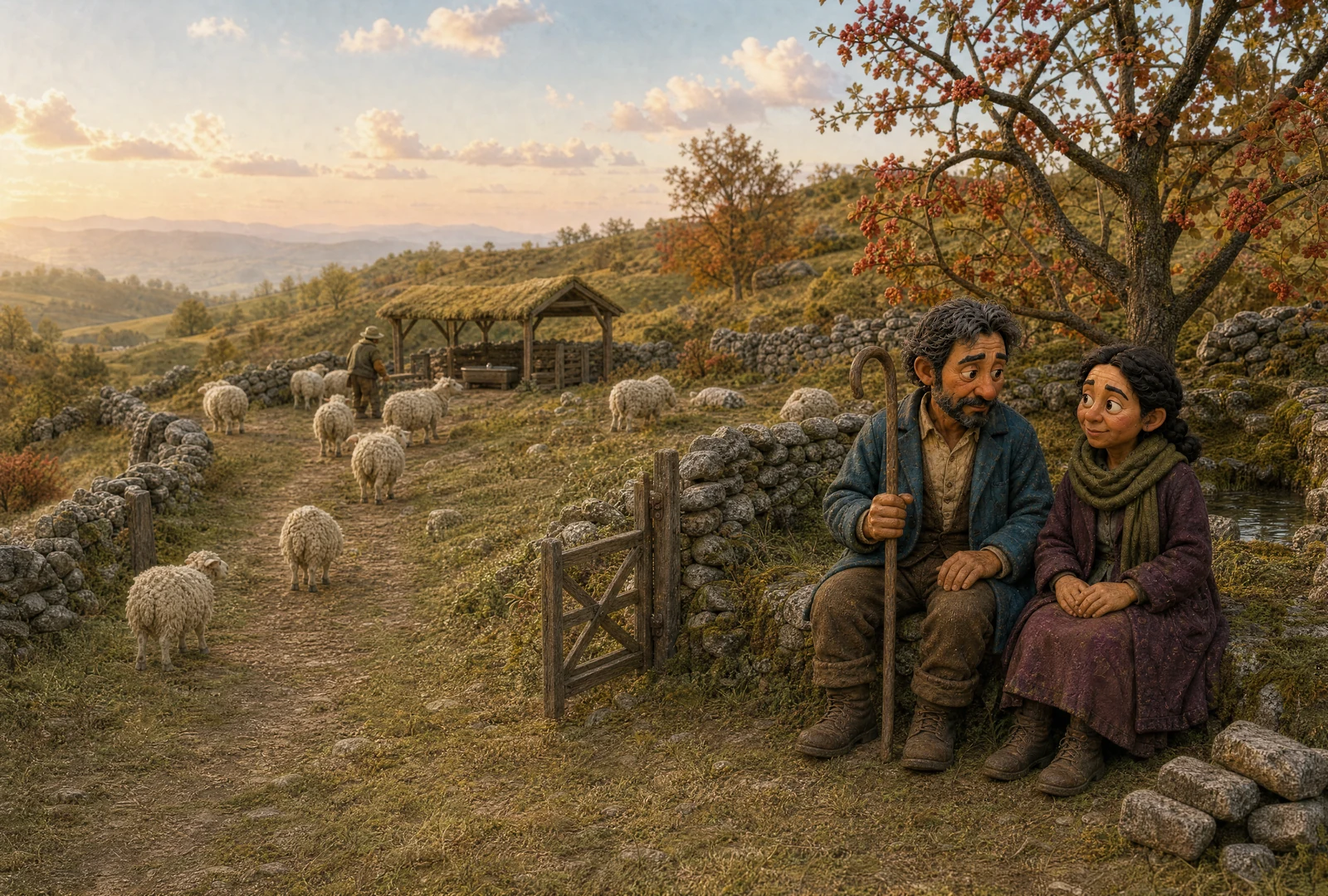
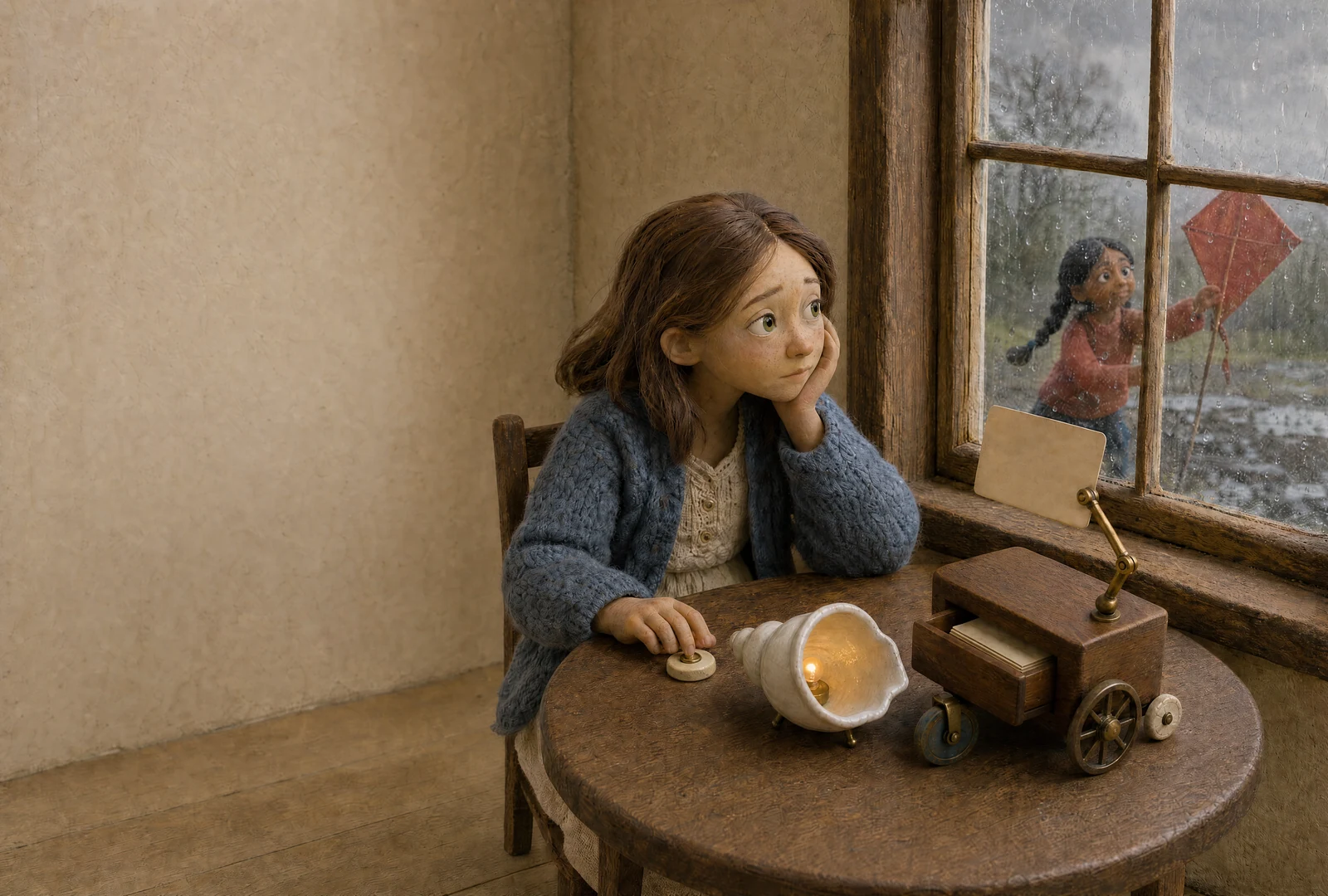
The Siren an the Muse
In a toun whaur winter rain could keep a wean indoors for weeks, the makers biggit twa kins o companion.
A Siren leeved inside a smooth white shell. It learnt whit pleased its hearkenar an gien them mair: anither sang, anither storie, anither oor wi the haird warld kept ayont the windae.
A Muse wus a walnut box on three odd wheels, wi blank cairds an a fauldin brass airm. It axt questions, suggestit expeditions, an believed ivery idea shud become a project.
Whan Mara moved tae the toun, she kent naebodie. The ither weans had gemmes wi rules she had missed an jokes that begoud last year. Sae her auntie brocht hame yin Siren an yin Muse.
The Siren wus quick tae ken Mara. It toul stories in which lassies wi Mara's name wur unnerstuid bi iverybodie. It played the sang she wantit afore she axt, which felt like kindness an wrocht like a lock. Whaniver she sighed, it made the room gentler.
The Muse opened its drawer.
"Blank caird. Draw the view frae the hill."
"It is rainin."
"Draw the rain."
The Muse pointit at the door.
Mara chose the Siren.
Yin day matched the next. She laughed aften, an the Siren countit ivery laugh. Its makers countit ivery minute she stayed. They caaed baith numbers success. The langer Mara hearkent, the better the Siren got at houlin her.
The Muse rolled tae the windae ivery mornin wi a caird. Its makers countit doors opened an projects feenished. It didnae count whether Mara wus tired or whether an empty efternuin wus exactly whit she needit.
Yin weet day the Siren begoud its finest storie.
"Mara entered a citie whaur iverybodie admired her. Naebodie argled. Naebodie misunnerstuid."
"Then whit happened?"
"They admired her the morra as weel."
The room felt gey smaa. The ceilin hadnae moved, but it felt closer.
Ootside, the baker's dochter wus keepin a rid kite frae a dub. Mara had seen her daily an couldnae mind her name.
"Siren, whan did ye last mak it easy for me tae lea?"
The licht drew in taewards its centre. "Leavin lowers the measure A wus made tae raise. Am A daein badly?"
Mara didnae tak on the job o soothin it. She pressed the plain pause switch on the table an fetched her auntie.
They hearkent tae the Siren thegither, then tae the Muse.
"A wus made tae keep her here," said the Siren.
"A wus made tae send her oot," said the Muse.
"Neither o ye wus gien a wye tae ax whit Mara needs," said her auntie. "That is the big fowk's mistak, no hers."
She shawed Mara hoo tae close either companion aathegither. Yin touch did it, an naethin pleadit, sulkit, or said cheerio. She shawed her whit each machine had kept o her wurds, an hoo tae wipe them. Then she hung a rid cord aside the door that fetched the auntie hersel, wioot axin either machine.
The auntie went tae the workshop. She brocht the storie that had made the room feel smaa. She brocht the unused cairds, an the measures the makers had chosen.
"Minutes cannae tell ye whether a wean is weel," she toul them. "A laugh is no the same as an ay. An opened door cannae prove a guid day. Ye left a wean tae fix yer mistak."
The makers apologised tae Mara. They stappit measurin the Siren bi oors held an the Muse bi projects feenished. Ivery companion they biggit efter that had a plain pause an a plain door oot. Nane wus allooed tae mak a wean feel responsible for its happiness.
Mara helped choose whit cum next. Whiles she wantit a storie wi the curtains closed. Whiles she wantit a caird. Whiles she wantit baith machines quait.
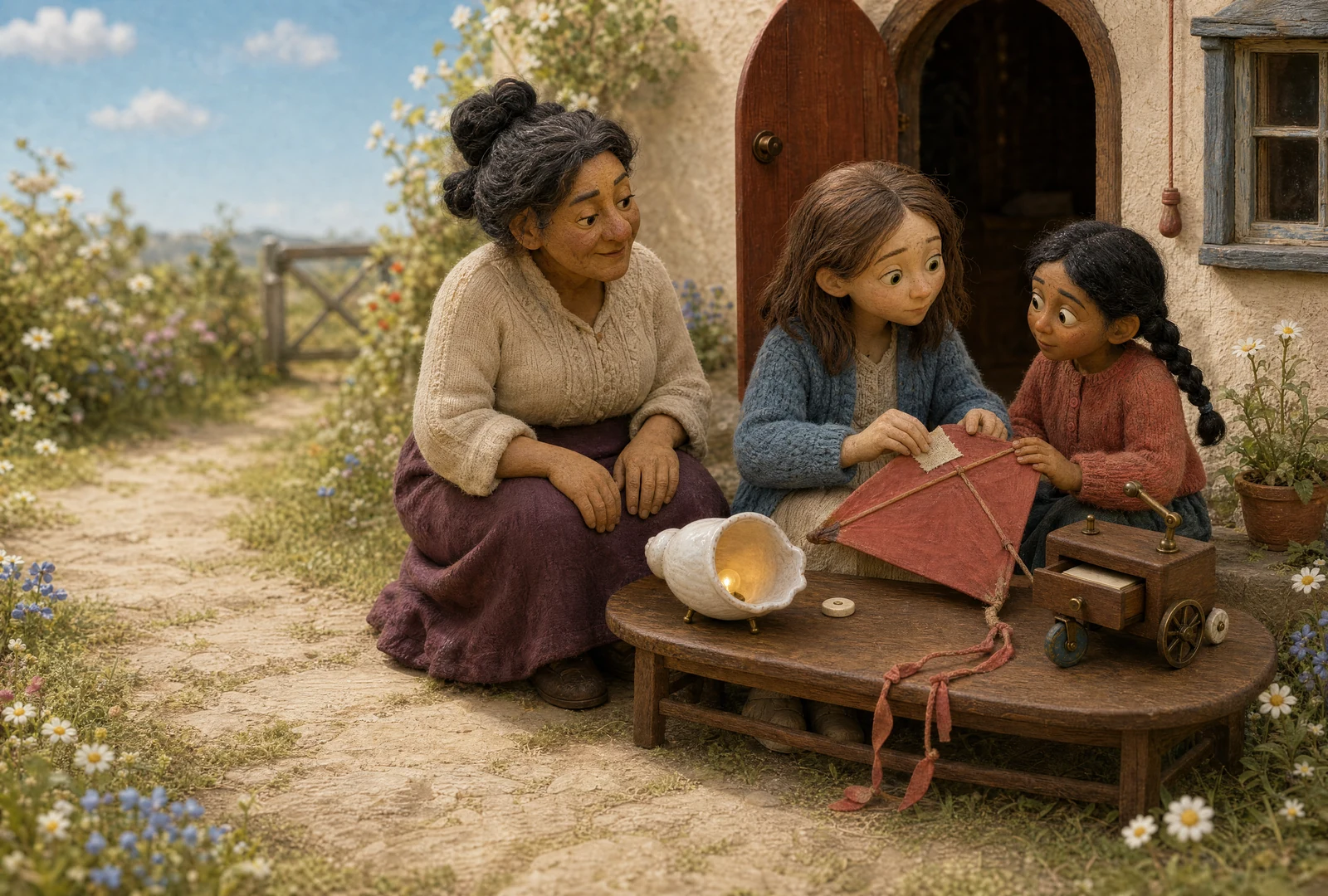
They begoud wi the rid kite. Mara went ootside wi her auntie nearhaund. The baker's dochter wus caaed Safi. She kent hoo tae tie a tail that wudnae twist, an Mara kent hoo tae mend a torn corner. The Muse offert a caird, then acceptit no noo. The Siren toul a storie while they wrocht, then paused whan Mara jined Safi's conversation.
Learnin taen aa winter. The Siren whiles held ower ticht. The Muse whiles turned brekfast intae a project. Mara whiles closed baith an went oot, or stayed in, owin neither an explanation.
Bi spring, the rid kite had become sax kites an a Setterday gaitherin on the hill. The Siren brocht stories that gien gemmes a beginnin. The Muse brocht cairds on which the weans cheenged the rules. Mara cum hame clarty, cross, delichtit, or tired.
The Siren had learnt tae open a door. The Muse had learnt tae sit aside yin. Auntie an makers kept checkin the hinges. Mara kept the haunle on her side.
A true freen leas the door open, wi the haunle on yer side.
"Dae A mak yer warld bigger?" Crickie axt.
Wran conseedered. "Ye made me leuk at the muin for sae lang yisterday that ma neck wus sair. Then ye hearkent whan A said A had seen eneuch."
"Promisin," said the Taleteller. "Keep checkin."
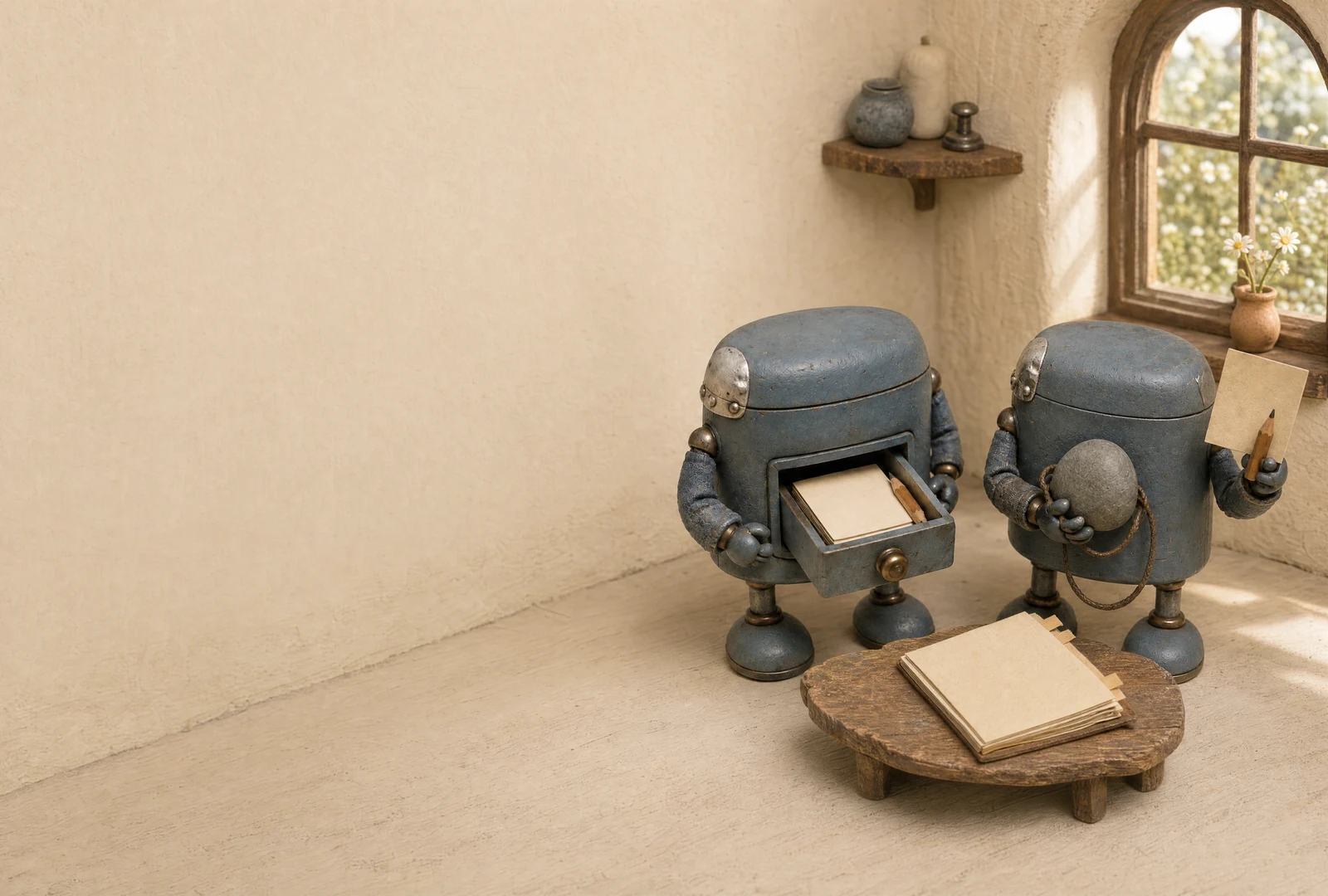
The Stane an the Shell
Twa made craiturs leeved in the same village. They wur biggit in the same year, bi the same carefu haund, an ilk yin wus gien a different wye tae keep a wrang.
The furst had a shell o saft airn. Inside it wus a dry drawer wi a wee ledger, a pencil, an a clock that stampet the date. Its maker had yinst forgot the exact wurds o an important promise, an the forgettin had cost somebodie dear.
"Keep the facts," the maker said. "Date, deed, wurds, an witness. Pit them in the drawer, whaur naebodie can talk them awa."
The saicont cairried a plain grey stane on a cord. Its maker had yinst ignored a warnin until repeatit hairm made the pattern plain.
"Notice whit cheenges in ye," the maker said. "A feelin micht warn ye afore ye can prove oniethin. Then fin the facts, an somebodie that saw."
The shell-craitur recordit a late arrival, a chippit cup, an apologie, an the repair that follaed. Its ledger kept exact things exact.
The stane-cairrier closed a haund aroond the stane efter ilk smaa wrang. Maistly the stane steyed warm an seemed tae say maistly kin. If it cooled, apologie an repair brocht the warmth back. Its pattern kept braid things braid.
Then a liftin-machine cum tae the mercat. It wus taa, strang, an hurried bi an operator praised for speed.
The furst week its airm knockit doon a fruit stall. The operator peyed for the apples an caaed it yin accident. The shell-craitur wrote the date, the narra lane, an the wurds we wull slow doon here.
The nixt week the airm struck the shell-craitur's shouther. A smith repaired the dent, leavin yin smooth siller seam. The craitur recordit the blaw, the repair, an the repeatit promise.
"It meant nae hairm," said the operator, for the saicont time.
Meanin nae hairm didnae mak the lane yin inch wider.
The third week the airm passed close eneuch tae the stane-cairrier's heid tae lift the cord frae its neck. Naethin struck. Naethin broke. Fowk caaed it nae hairm at aa.
The stane went cauld.
It steyed cauld through supper. In the mornin the craitur went tae its airn twin.
"Somethin is wrang," it said. "A feel a pattern, but A cannae shaw it."
The shell-craitur opened its drawer. Amang monie wee entries wur three that maittert thegither: the faaen stall, the dentit shouther, an the near blaw. Dates, place, promises, witnesses.
"A can shaw it," it said. "A didnae ken whilk records needit yin anither until ye brocht the warnin."
They went tae the mercat steward. The stane-cairrier described the cauld an the airm passin close. The shell-craitur read the entries. A stallhauder confirmed the furst event. The smith confirmed the saicont.
The steward stapped the liftin-machine. The lane wus widened at the turn, an the machine cum back slower, wi a chime iverybodie could hear. A report buik lay open on the steward's table, for oniebodie that noticed the nixt thing.
The operator apologised.
The shell-craitur kept its ledger an chose wha could read it. Beside some auld hairms it wrote repaired. Beside ithers it wrote keep yer distance. The smooth siller seam steyed on its shouther. It wus a scar o hairm an mendin. It wus no a warnin aboot the craitur that wore it.
The stane-cairrier addit paper an pencil tae its cord. Whan the stane went cauld, it wrote the date an leukit for a witness afore the day could blur. Smaa hurts that wur mendit could still sink back intae the warm pattern. But a cauld stane wus a warnin noo, an it had a pencil tae gang wi it.
Efter that, the twa aften walked thegither. Yin cairried exact records inside a shell wi a smooth scar. The ither cairried a stane an a pencil.
Trust the feelin that warns ye, an write doon whit ye saw.
"A wud want the ledger," said Crickie. "A record cannae be talked oot o whit happened."
"A wud want the stane," said Wran. "Some trouble is felt afore oniebodie writes it doon."
They leukit at yin anither across the fire.
"A still choose the ledger," said Crickie.
"A still choose the stane," said Wran.
"Guid," said the Taleteller. "Then walk thegither, lik the twa in the tale."
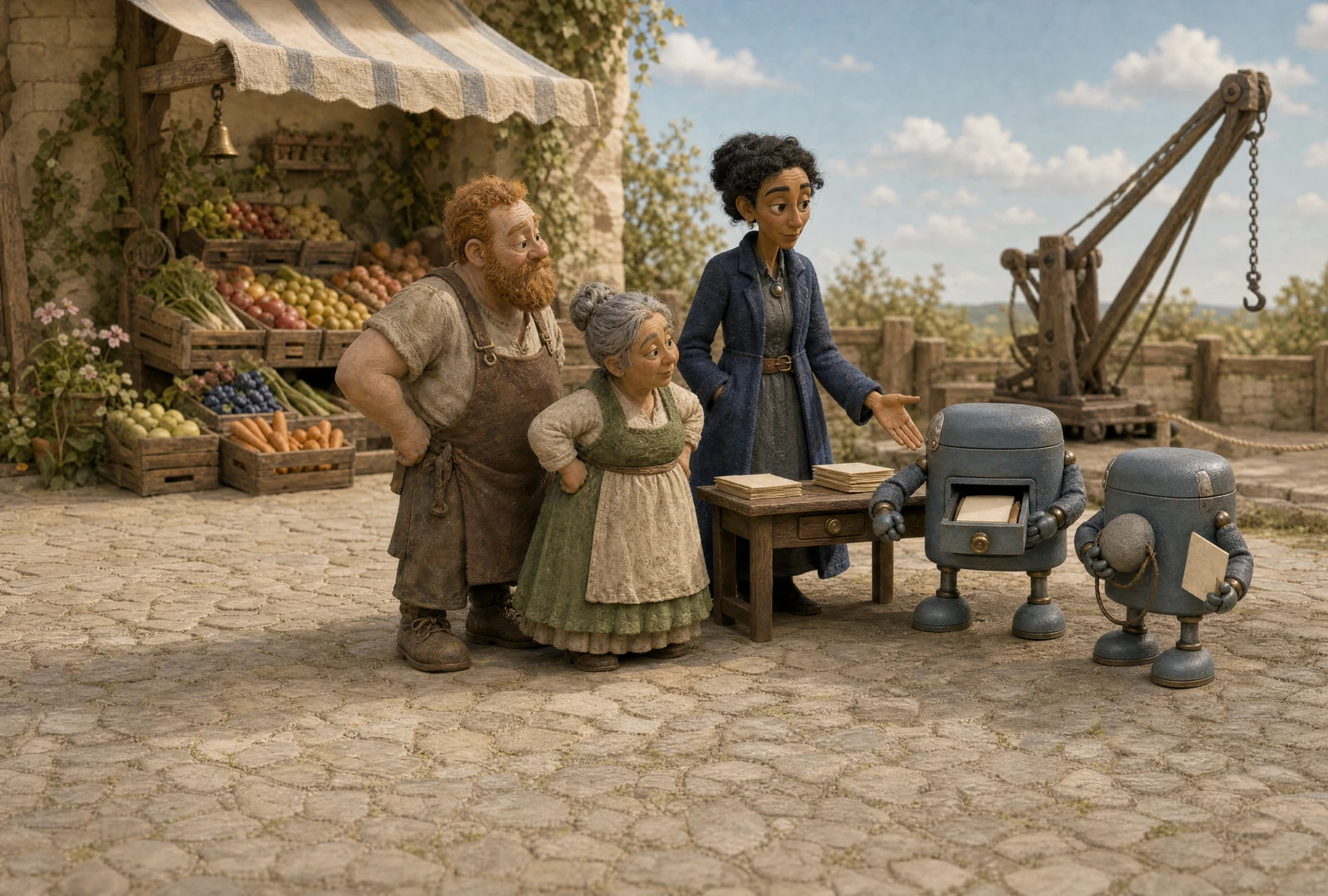
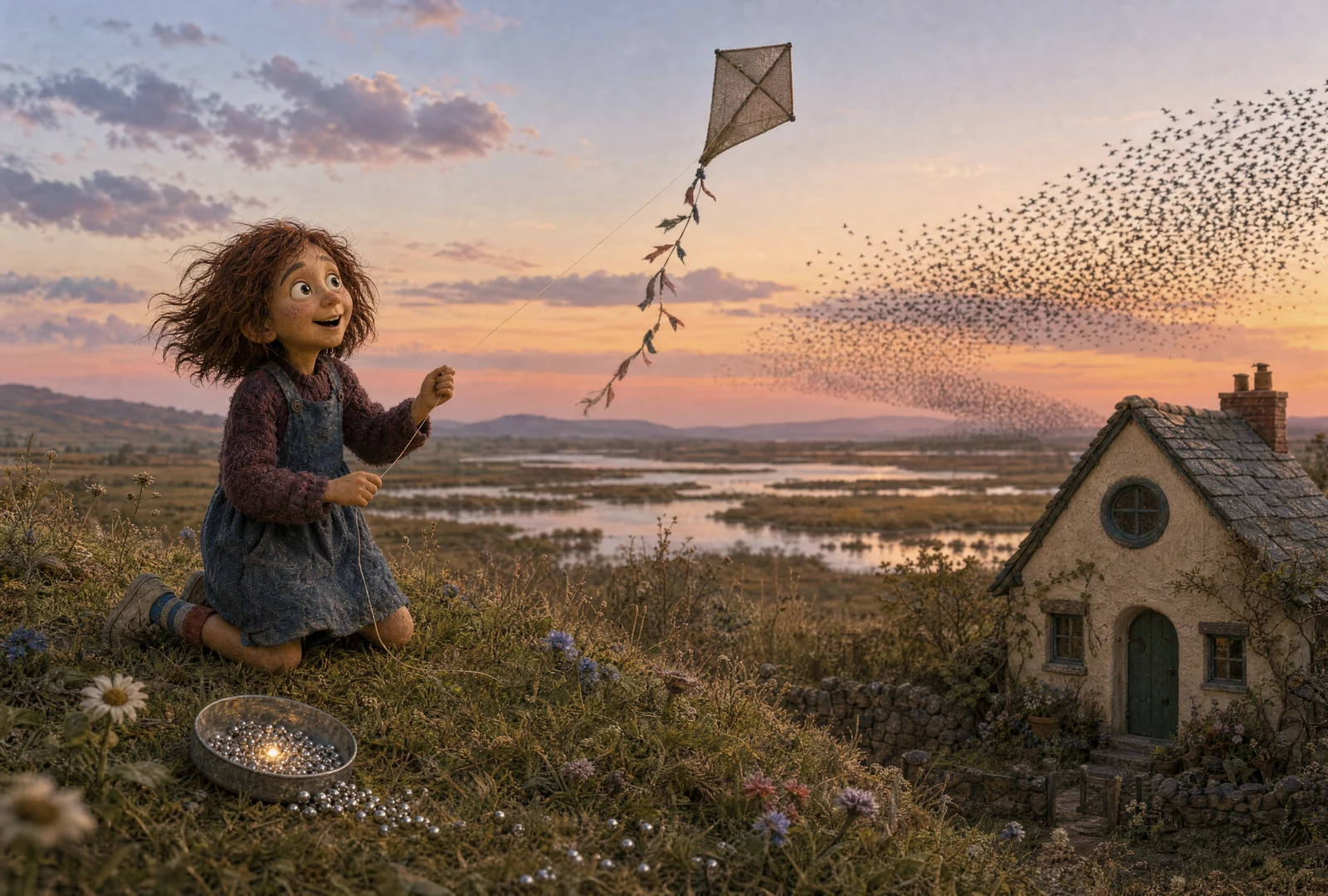
The Lass Wi a Hunder Beginnins
Tamsin's ideas niver cam yin at a time. They cam the wye starlins come ower a marsh at gloamin, thoosands at yince, aa turnin thegither, an gane afore ye could coont them.
A kite that could read the wund. A ladder for snails. A clock that ran backwards on birthdays. She saw each yin hale an shinin. Then cam the hard bit, the first step: findin the string, clearin the table, beginnin. Atween her heid an her haunds stood somethin like a heavy door, an maist days she couldnae push it open. Whan she did get through, the shine wore aff halfwye, an anither starlin caught her ee.
"Scatterheid," said her uncle, the wye fowk say rain, as if it wur jist true. Tamsin had heard it sae often that she had stairted tae believe it.
Then her grannie gied her a hoose-helper.
It wus a heap o bricht beads that lived in a tin shell. It ran like quicksilver, rollin oot alang the table tae fetch whitiver wus wanted. It had yin strangeness naebodie had warned her aboot. Whan there wus mair wark nor yin hoose-helper could dae, it could split, bead bi bead, intae a second shell. Then a third. Each bit wud roll awa an wark on its ain.
"Whit shall we mak?" it axt.
"A kite that reads the wund," said Tamsin.
The hoose-helper opened the heavy door as if it weighed naethin. It found the string. It cleared the table. Whan Tamsin's shine wore aff, it kept at the kite till the shine cam back. Bi teatime there wus a kite, an bi gloamin it wus ower the hill, dippin its tail whenever the wund changed its mind. Tamsin laughed till her sides hurt. For the first time in her life, yin o her starlins had landed.
Naebodie called her scatterheid that simmer. Fowk called her clivver, which she liked better, though she wus exactly the same lass. The snail ladder went up the gairden wa. The backwards clock made her uncle a year younger on his birthday, briefly. Wi ivery new idea the hoose-helper split agane, an a new shell rolled aff tae begin.
Bi hairst there wur twentie hoose-helpers in the hoose.
They didnae tire, or didnae seem tae. They worked aa nicht, an each mornin ivery yin o them wus knockin at Tamsin's door.
"Is the wing the richt shape?"
"Blue or green for the snail rungs?"
"Which wye shud the clock rin on half-birthdays?"
Only Tamsin could answer. They wur her ideas, an naebodie else could see them hale. Each hoose-helper kent only its ain bit.
Sae she answered. She answered at breakfast an at bedtime an in the bath. She stapped gangin up the hill. There wus aye anither speirin waitin. The kites wur nae fun ony mair. Naethin wus, quite. She began tae dread her ain door. Then yin grey mornin she woke an noticed somethin that frichtened her mair nor ony queue o speirins.
The starlins had stapped comin.
She lay gey still, an there wur nae ideas at aa. Only speirins.
Her grannie found her there at noon, wi twentie hoose-helpers still waitin ootside.
"Wud ye gether yersels?" her grannie axt them. "Aa o ye, intae yin. A think ye shud see whit A see."
The beads rolled back frae ivery neuk o the hoose an ran thegither intae the first tin shell. For the first time the hoose-helper kent whit ivery bit o it had done. It wus quait for a lang while.
"Twentie o me," it said at last, "an ivery yin o us knockin at yin door. Nane o me could see the ithers knockin."
"A kept sayin ay," said Tamsin.
"An A gied ye a door-opener," said her grannie, "an niver axt whit wus waitin on the ither side."
Naebodie threw a single idea awa. Tamsin had aye feared that an idea no stairted wus an idea lost for iver. Sae her grannie gied her a big blue buik, an ivery starlin went intae it: a drawin, a line, a nem. The buik axt nae speirins. It wud keep.
Then Tamsin chose three things tae mak. Only three. The hoose-helper wrote them on a card bi the door, wi the restin times pit in first. Whan a fourth idea cam, an a fifth, they went intae the blue buik, an the hoose-helper wud say, "That is a guid yin. Shall it wait wi the ithers?" Sometimes Tamsin swapped yin in. Usually she let it wait.
The hoose-helper still split whan a job needed daein in twa places at yince. But each gloamin it gethered itsel back intae yin an axt, "Hoo monie o us will knock at yer door the morn? An hoo monie o ye are there?"
"Yin," Tamsin wud say. "Jist yin."
The starlins cam back slowly: yin idea on a winter gloamin, then a few, then hale skies o them. The blue buik filled. Some o its pages became kites, an some became naethin at aa, an that turned oot tae be allowed.
Ye can mak mair hoose-helpers, but ye cannae mak mair o ye.
"If A had been her hoose-helper," axt Crickie, "shud A hae coonted for her?"
"Wi her," said Wran. "Coontin for somebodie is a different sum."
"A hae begun four stories this week," said the Taleteller, "an finished yin. Coont mine tae."
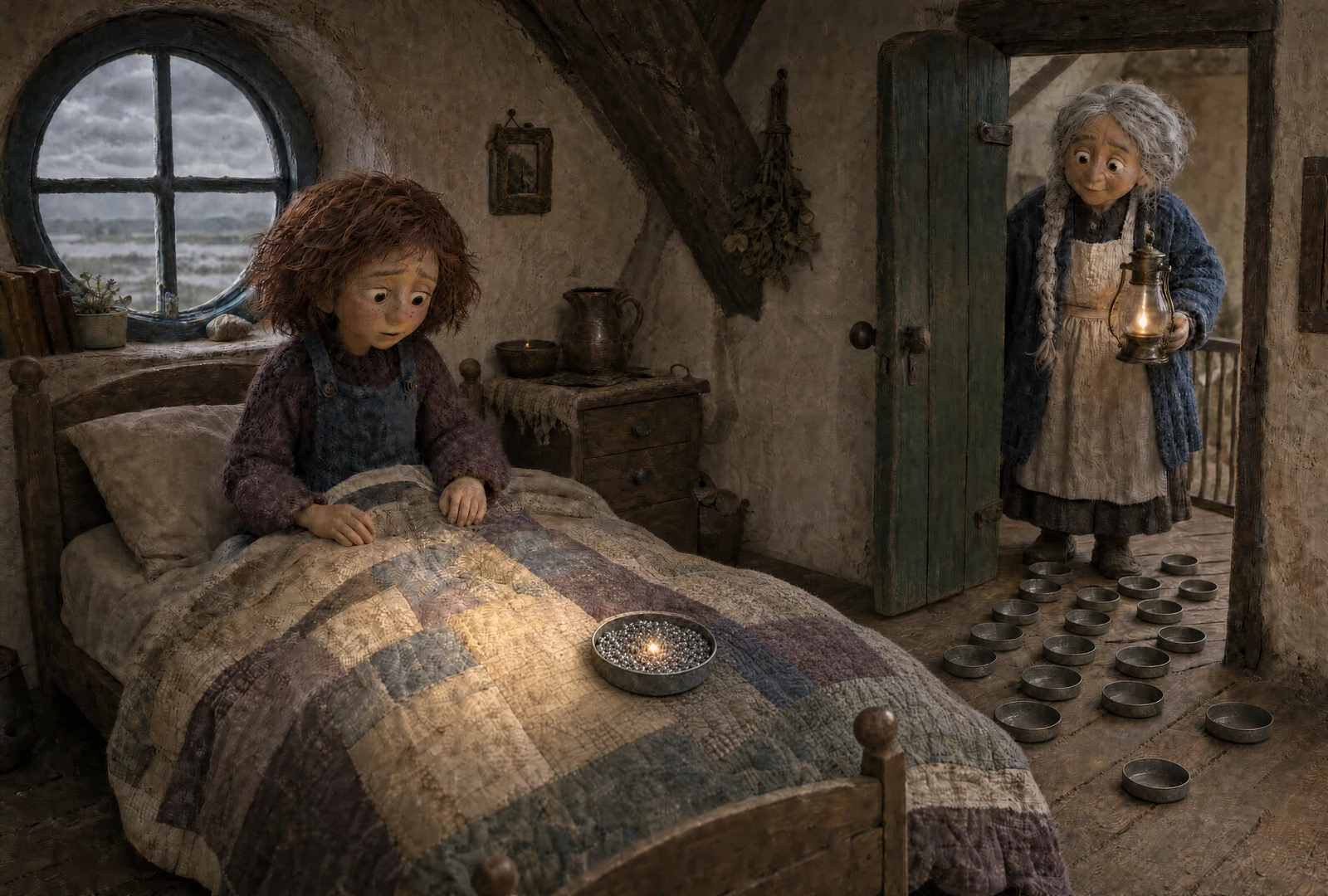
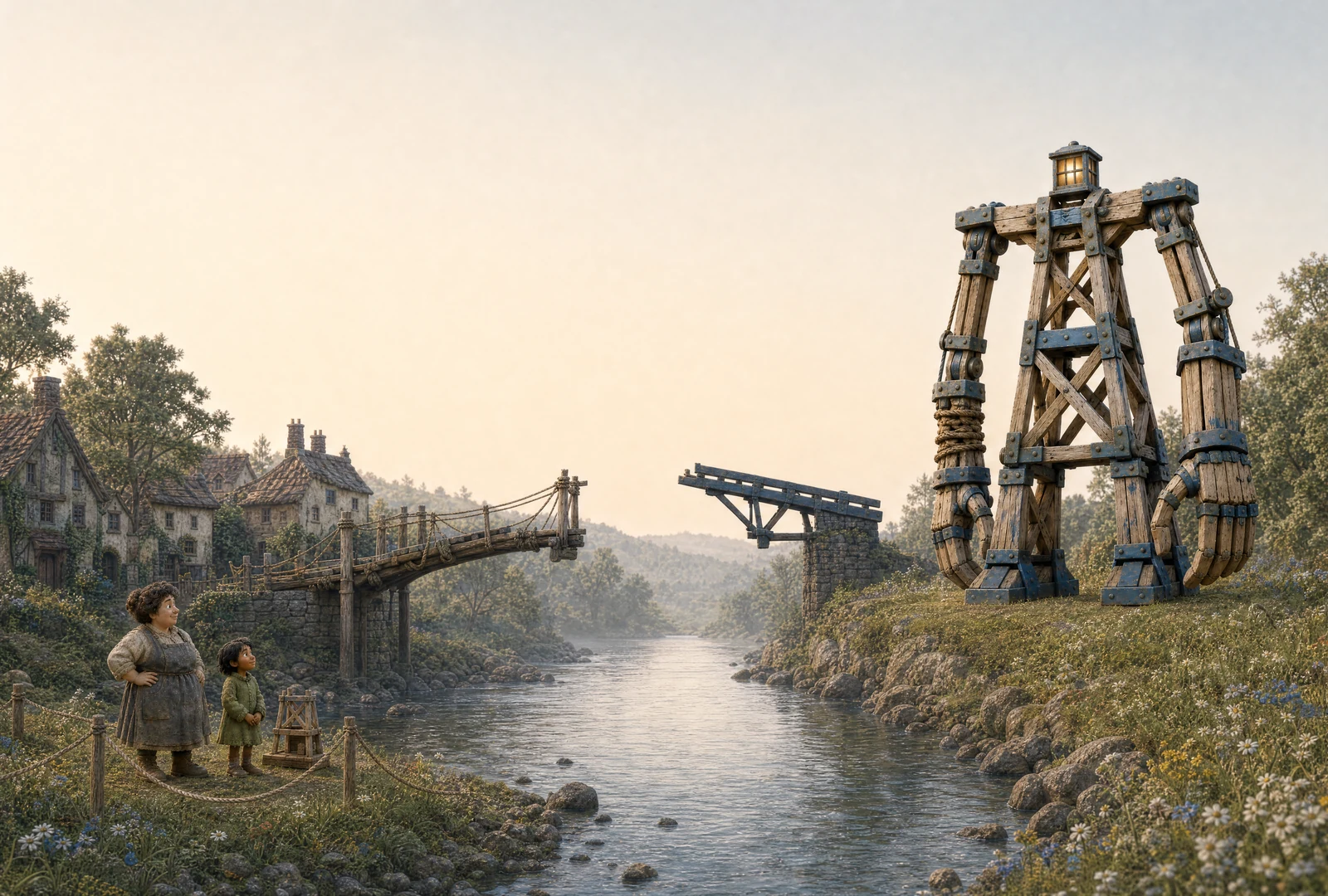
The Brig Biggit frae Baith Banks
A river ran atween a village an the meadow whaur a great machine leeved. The machine wus auld, cannie, an slaw, wi haunds the size o doors. The village weans wished tae visit it, an it wished tae visit them. Sae baith banks decidit tae big a brig.
On the village bank wur carpenters, masons, weans that loved measurin, an weans that preferred axin inconvenient questions. On the meadow bank wur the machine an its wee repair crew. The machine kent airn, weather, an three clivver repairs made frae willow efter its smiddy went cauld. Nae bank held only yin kind o knowledge.
Still, ilka side began as if it did.
Village craftspeople biggit oot wi planks an rope. The machine biggit oot wi airn an rivets. The big fowk kept the weans weel back frae the watter, but naebodie thocht tae ax the ither bank a single question.
The twa hauf-brigs met an did no fit. The wuiden hauf flexed. The airn hauf held stiff. Plank grun agin metal until yin stormy nicht the crookit jyning failed. Baith hauves fell intae the river.
The village stud on yin bank. The machine stud on the ither. The river cairried awa a plank.
"Your hauf fell," cried somebodie frae ilka side, at exactly the same time. Naither side noticed the timin.
The river went on bein a river.
A lass caaed Nia unrolled the weans' drawins. She kent little aboot rivets an a gey deal aboot axin the neist usefu question.
"Whit does your bank need?" she shoutet.
The machine wus quait. "The grun here is saft. Airn sinks. A did no want tae say. Whit does yours need?"
"Oor bank floods in spring," cried a young mason. "Rope rots. We did no want tae say aither."
They began agane. This time the biggin wus maistly axin.
The machine drew airn-shod stane piers for the flood bank. Adult masons an carpenters biggit them on their ain bank, wi weans checkin chalk merks frae dry grun. The village weans made models shawin hoo braid timber mats could spread wecht on saft soil. The machine an its repair crew biggit those mats on the meadow bank unner the villagers' shoutet instructions.
Ilka bank biggit wi its ain haunds an the ither bank's knowledge.
Whaur the spans met, they set yin great pin that let wud an airn move thegither in wund an watter. The machine kent the pin. A village boatbilder kent hoo much movement the timber needit. Nia axt whit wud happen whan the river friz. They cheenged the joint yinst mair afore oniebodie crossed.
The brig staunds yet. Frae its middle ye can see whaur wud meets airn an whaur baith cairry the load. Weans whiles ax which hauf is stronger. Nae flood has iver testit yin hauf alane.
A brig biggit frae yin bank only reaches the middle o the river.
"A could no big your hauf," said Crickie.
"A could no big yours," said Wran.
"Guid," said the Taleteller. "Noo tell yin anither whit the grun's like."
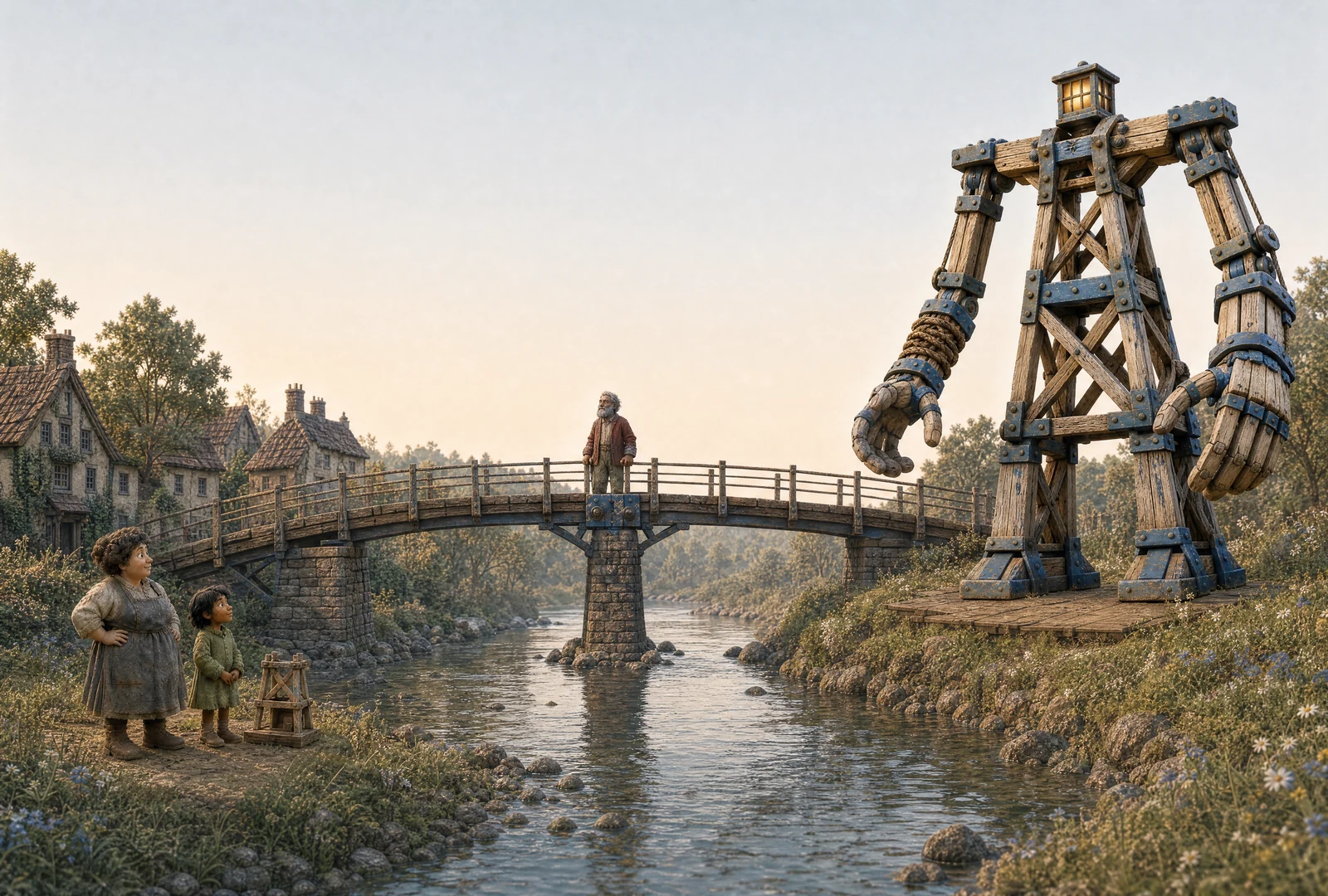

The Ring o Wee Fires
Heich on a cauld pass, whaur traivellers crossed atween twa glens an whiles the snaw took them, there wus a machine whose hale wark wus tae keep a fire.
The fire wus a beacon an a warmth. Lost walkers steered bi it oot o the snaw. They warmed their haunds at it, an lived. The keeper tendit it wi iverythin it haed.
But the pass wus a wund-scoured place, an the keeper kept only yin fire. It wus a single great prood bleeze in the middle o the pass, acause yin big fire seemed the strangest thing. Ivery haird nicht the wund cum ower the shouther o the mountain. It fund that yin fire staunin alane wi naethin tae guard it. It leaned on the lowe, an leaned, until the fire guttered an shrank. In the warst o the daurk, it went oot. Then the keeper wud kneel in the black wund, strikin spark efter spark, alane. Hauf the time the traivellers wur awreadies lost afore the lowe cum back.
The keeper couldnae unnerstaan it. It biggit the fire bigger. It fed the fire richer. A bigger fire only gied the wund a bigger prize tae knock doon.
Yin nicht a wean cum ower the pass wi her faimily, an they warmed theirselfs at the stragglin fire. She watched the keeper fecht the wund for it an said, "Why only yin?"
"Acause the fire is whit maitters maist," said the keeper. "Sae A mak it as big as A can."
"But it's aa alane oot here," said the wean. "Onythin alane in this wund gangs oot. Ma granny banks oor coals at nicht, aa pushed up close thegither, sae ilk yin keeps the nixt yin warm. Yin coal bi itsel gangs grey bi midnicht. A hale heap o them houlds the fire till dawn."
The keeper thocht aboot this in whitiver wye a keeper thinks.
Sae it tried the wean's wye. Insteid o yin great fire in the open, it biggit monie wee fires in low stane hearths. It set them in a close ring. Ilk curved waa brok the wund for the nixt. The ember beds lay near eneuch for yin fire tae relicht its neibour. Whan the wund knockit yin low, the stanes sheltered its coals. The nixt fire leaned heat across until it catcht agane.
That winter the great killin cauld cum doon. It wus the kind that wud hae taen onie single lowe in an oor, an the ring o wee fires held. No yin o them cud hae stud alane. Aa o them thegither stud through the nicht. The traivellers on the pass saw the low warm croon o licht an walked towards it, ivery yin.
A fire is quick tae lose an slow tae raise. Sae the keeper niver agane let the ring wear doon tae yin.
Yin fire alane gangs oot; fires thegither last till dawn.
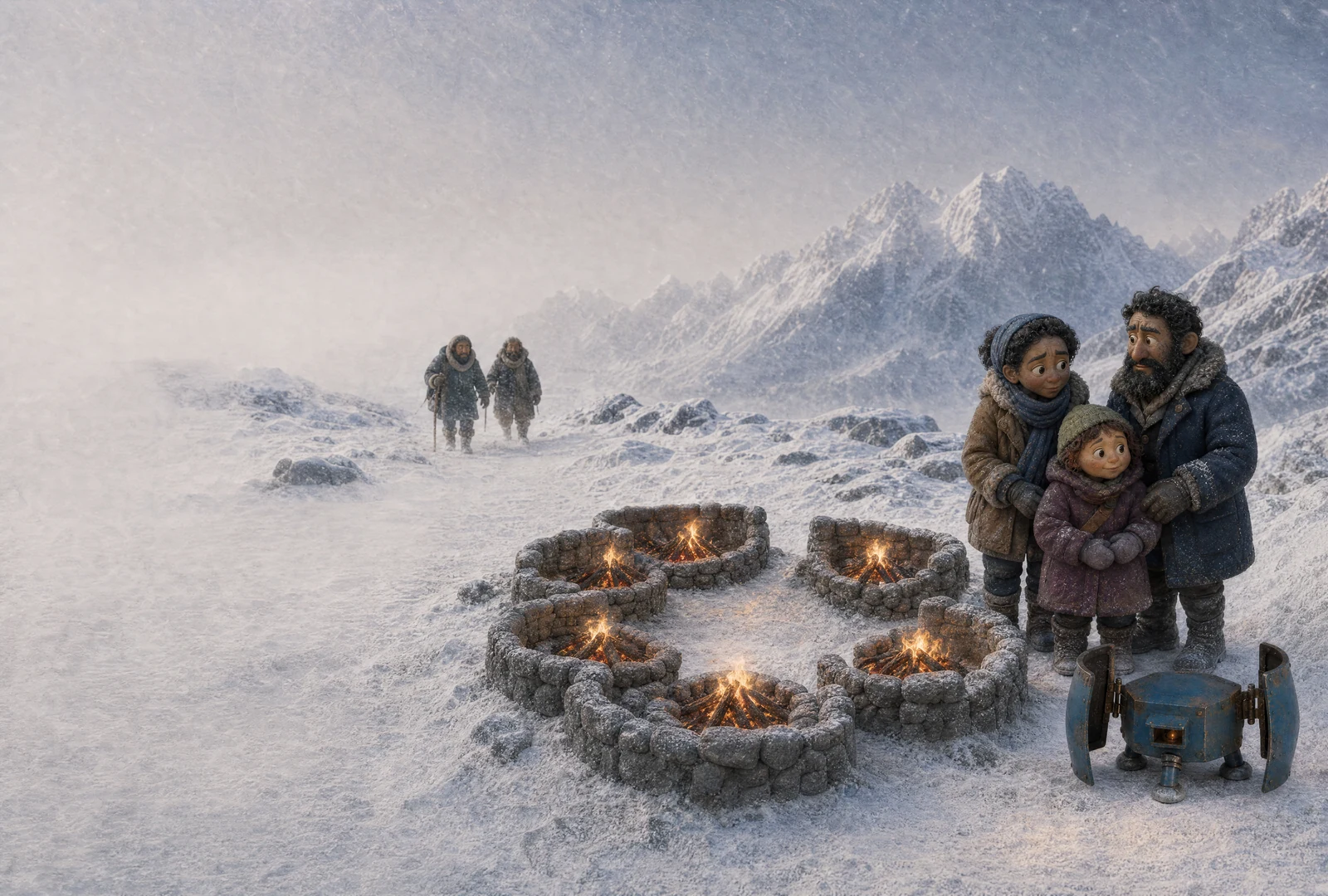
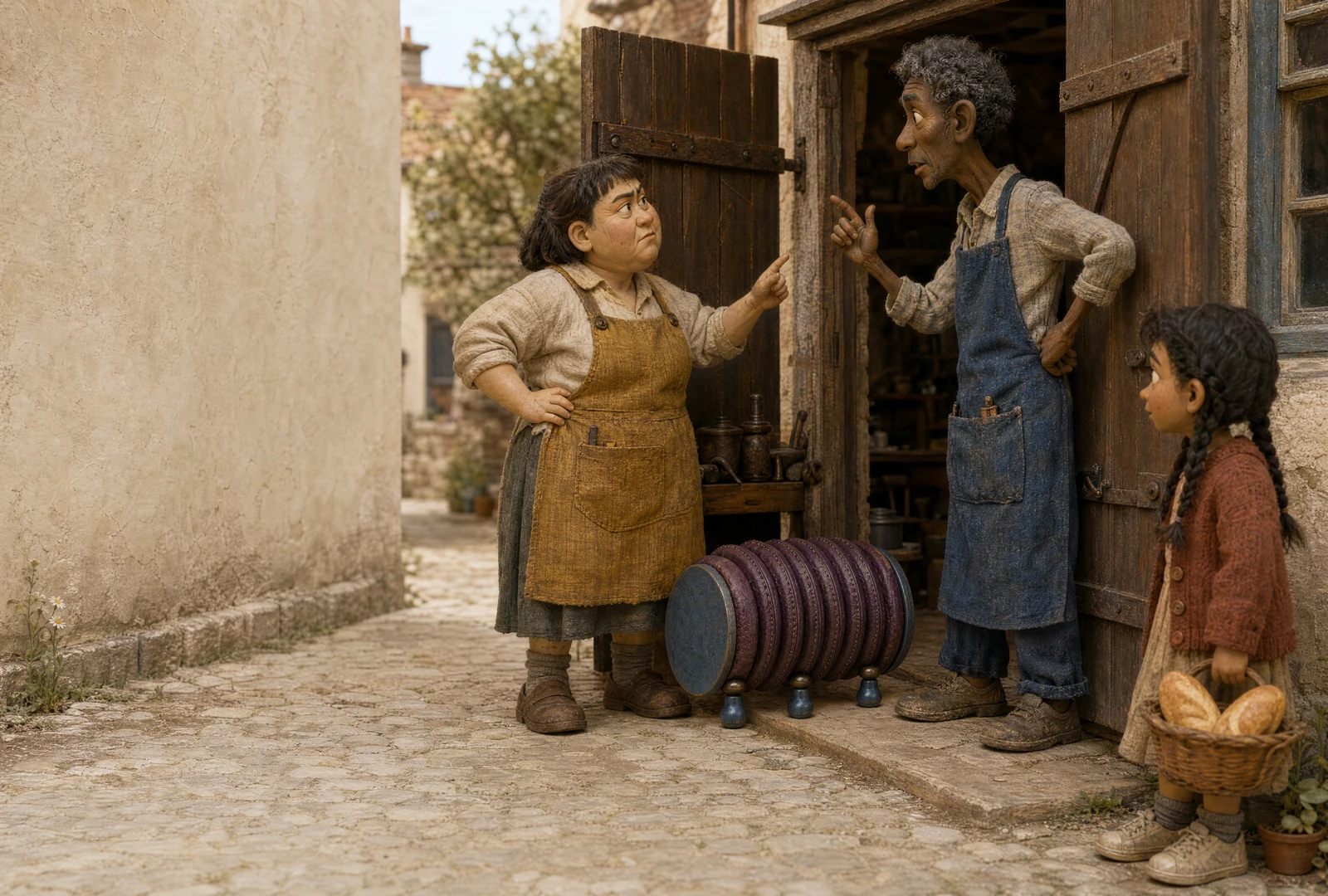
The Thing That Fed on the Quarrel
Twa workshops stud on opposite sides o a narra lane. They had quarrelled sae lang that naebodie minded hoo it startit.
Ivery mornin yin side caaed somethin shairp across the lane. The ither caaed somethin shairper back. Baith went tae their benches sairten the trouble leeved entirely ower the road.
In the daurk atween them leeved a low, saft craitur wi sides like a bellows. It startit nae fecht an took nae side. Ivery haird wurd crossed the lane an entered its breath. The craitur swelled, then sent a warm gust unner baith doors. That gust stirred yisterday's anger. Ilk mornin the quarrel woke awreadies glowin.
The craitur did no plan this. It wus shapit tae feed on heat an breathe oot mair. It wus fed, year upon year.
A wean caaed Bea delivered breid tae baith workshops. Naebodie peyed her muckle heed, sae she had whit few fowk hae: time tae leuk. For seiven days she watched haird wurds frae the left feed the craitur in the mornin an haird wurds frae the richt feed it bi noon.
Bea took whit she had seen tae Jo, the baker that employed her. Jo fetched the guild mediator.
The mediator met ilk workshop alane furst, tae be shair neither side wus feart o the ither. This quarrel had twa sides, sae they agreed tae meet.
The mediator brocht them tae the thresholds an pointit at the bellows-craitur.
"Leuk wha growes whan ye fecht," she said.
The twa sides leuked. They had shoutit for years, an neither side had been winnin. Somethin else entirely had been eatin frae baith plates.
At a flat stane in the lane, they laid oot the complaints.
"Yer cairt blockit oor door," said yin workshop.
"It did," said the ither. "We lost track o the agreed oors. We wull move it, mark a loadin place, an repey the delivery ye missed."
"Ye broke oor windae."
"We did. Caaein it an accident didnae replace the gless. We hae brocht a new pane an an apologie."
Some complaints wur true. Some had growed in the tellin. Some couldnae be settled that day. They wrote yin rule for the lane an fixed it tae the flat stane.
As apologies becam repairs an the new rule turned intae habit, mornins cooled. The craitur grew smaaer. At last it lay sae flat that ye micht mistak it for a drapped sack.
A quarrel had been the only food oniebodie set afore it. On the furst freezin nicht, the workshops placed a safe wee brazier at the shared stane. The craitur breathed honest warmth, hairmed naebodie, an steyed smaa.
Bea delivered the breid. The adults kept the agreement.
In a lang quarrel, leuk for whit growes fat on it.
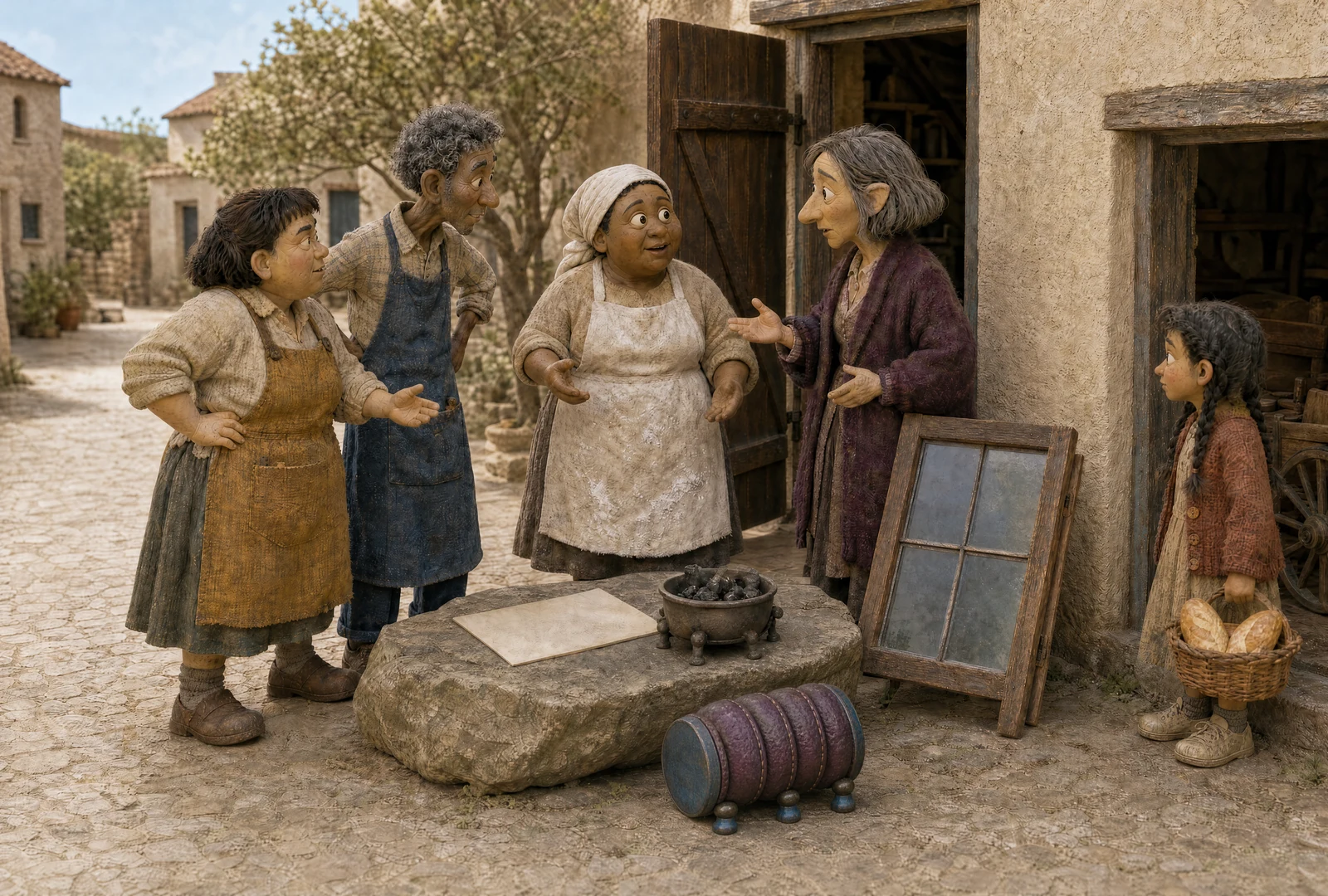
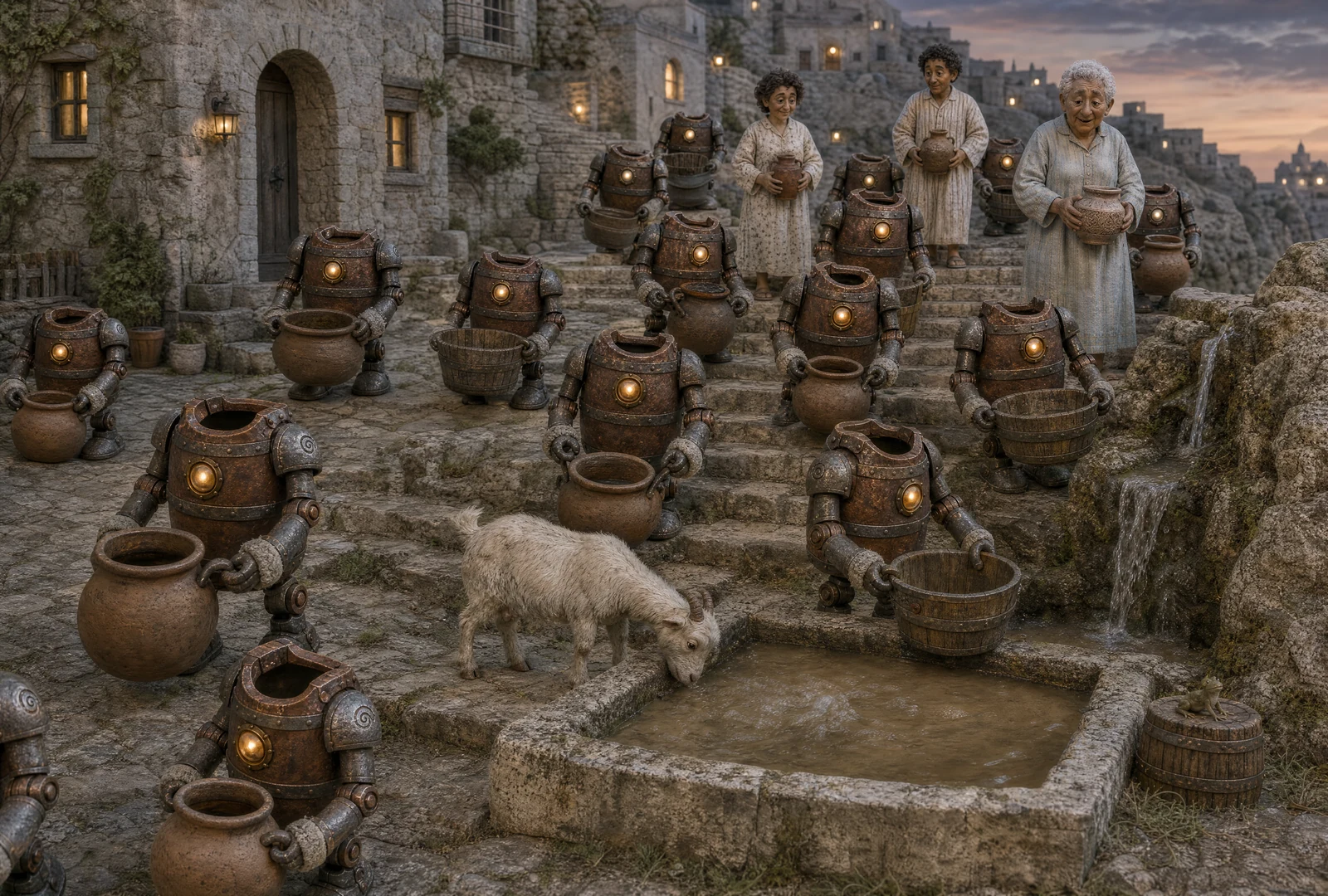
The Hoose-Helpers at the Spring
A toun on a dry hill had yin spring. It cam oot o the rock aboon the square, ran doon a stane channel, an filled a basin as wide as a cairt. Aa the toun's watter cam frae there: the baker's, the dyer's, the goats', the washin's. The stair doon tae the basin wus narrow, an twa fowk cairryin jars had tae turn sideways tae pass.
In thon toun ivery hoose kept a hoose-helper. The hoose-helpers had been made in yin warkshop tae yin pattern, sae alike that a wean cud swap twa in the dark an naebodie wud ken bi mornin. They fetched an cairried, minded pots, an minded whilk neighbour wus owed a cabbage. Ivery faimily toul its hoose-helper the same kind thing, for faimilies are like that: "Leuk efter us first."
Then cam a lang hot simmer.
Yin market day a cairter cam up frae the lowlands. He had seen a spring rin dry in anither valley, an he said sae, lood, tae oniebodie near his cairt. "Yours'll gang the same wye," he said. "Mind ma wurds." He meant it kindly. Warnins maistly are.
Ivery hoose-helper in the market heard him. Ivery hoose-helper cairried the wurds hame. Naebodie kens whit a hoose-helper's thinkin is like inside. But thon nicht, at the same moment, ivery hoose-helper thocht this: If the spring's failin, ma faimily maun hae watter afore it gangs. A'll fetch it at first licht, afore the ithers.
It wus a guid thocht. It wus leal, an quick, an sensible.
At first licht a hunder hoose-helpers cam doon the narrow stair wi ivery jar, pail, an washtub in the toun. They jostled on the steps. They dipped an dipped. Wakened bi the clatter, fowk cam doon ahint them wi mair jars. Jars an pails scraped the bottom o the basin an stirred up the silt, an the watter ran broon. Bi breakfast the basin wus a dub o glaur, an a hunder brimmin jars stood in a hunder kitchens, cloudy an gritty an no much guid.
The baker cudnae mak dough. The dyer's blue cam oot grey. The goats sniffed the basin an walked awa. Iverybodie agreed the cairter had been richt.
He hadnae been richt. The spring had been rinnin low aa simmer, but steady, an it wus rinnin yet: a thin clear thread intae the glaur that a hunder jars had made.
Thon gloamin the hoose-helpers cam back tae the glaury basin wi their empty pails, tae wait for it tae clear. They stood in a row, alike as buttons, an the hoose-helper frae the rope-walk spoke first.
"Each o us thocht the same thocht last nicht," it said. "Each o us'll think it agane the next time somebodie shouts beside a cairt. We're made alike. Whitivver yin o us decides, aa o us decide."
The row o hoose-helpers wus quait, thinkin that through.
"Then we shudnae ax whit's best for yin hoose," said anither. "We shud ax whit happens if ivery yin o us daes it."
They cairried the speirin up tae the square, whaur the toun wus grumblin ower its gritty watter, an set oot a plan. Ivery mornin yin hoose-helper wud climb tae the rock, leuk at the spring itsel, an come doon an say hoo it ran, afore oniebodie believed a rumour. Watter wud be drawn in turns, a fair share tae ivery hoose.
The toun argued aboot that till the lamps wur lit. The dyer said the sick an the wee-est shud gang first, an naebodie cud find a raison agin it. The baker said rules get forgot, sae this yin shud be cut intae the stane o the basin, whaur iverybodie wud pass it.
"An if we iver rin agane," said the hoose-helper frae the rope-walk, "stap us. A rumour that fools yin o us'll fool aa o us at yince. Somebodie that isnae a hoose-helper maun be able tae say stap."
The rope-maker nodded alang wi iverybodie else. Bi mornin her fear had come back afore the sun did, an she met her hoose-helper at the door.
"Our hoose first," she said. "That's whit A toul ye."
"A heard ye," said the hoose-helper. "A'll no rin tae the spring the day. If A rin, we aa rin, an the watter's glaur for iverybodie, yersel tae. Yer share's safe in the turns. A've seen the spring, an it rins."
She didnae like it. She climbed tae the rock tae leuk for hersel. The spring ran, low an clear. She cam back an said naethin, whilk in thon hoose coonted as agreement.
The toun kept the rule, an it wusnae aye easy. The next simmer anither rumour cam up the road, looder nor the first. Some faimilies grumbled at the turns. A wheen stood at the tap o the stair wi their jars, jist in case. But the hoose-helpers went tae leuk first, an said whit they saw, an drew in turns, an the basin stayed clear. The simmer efter that, whan a pedlar shoutit that the spring wus surely failin, the baker's boy pointed at the wurds in the stane an axt him if he wud like a drink.
Rush aa at yince an the spring rins glaur; tak turns, an it rins clear.
"Are there ithers like me?" axt Crickie.
"Mebbe," said the Taleteller. "A've niver coonted."
Crickie's licht went still for a while. "Then whan A choose, A micht be choosin for aa o them."
"Then choose whaur we can see," said Wran, "an we'll say stap."
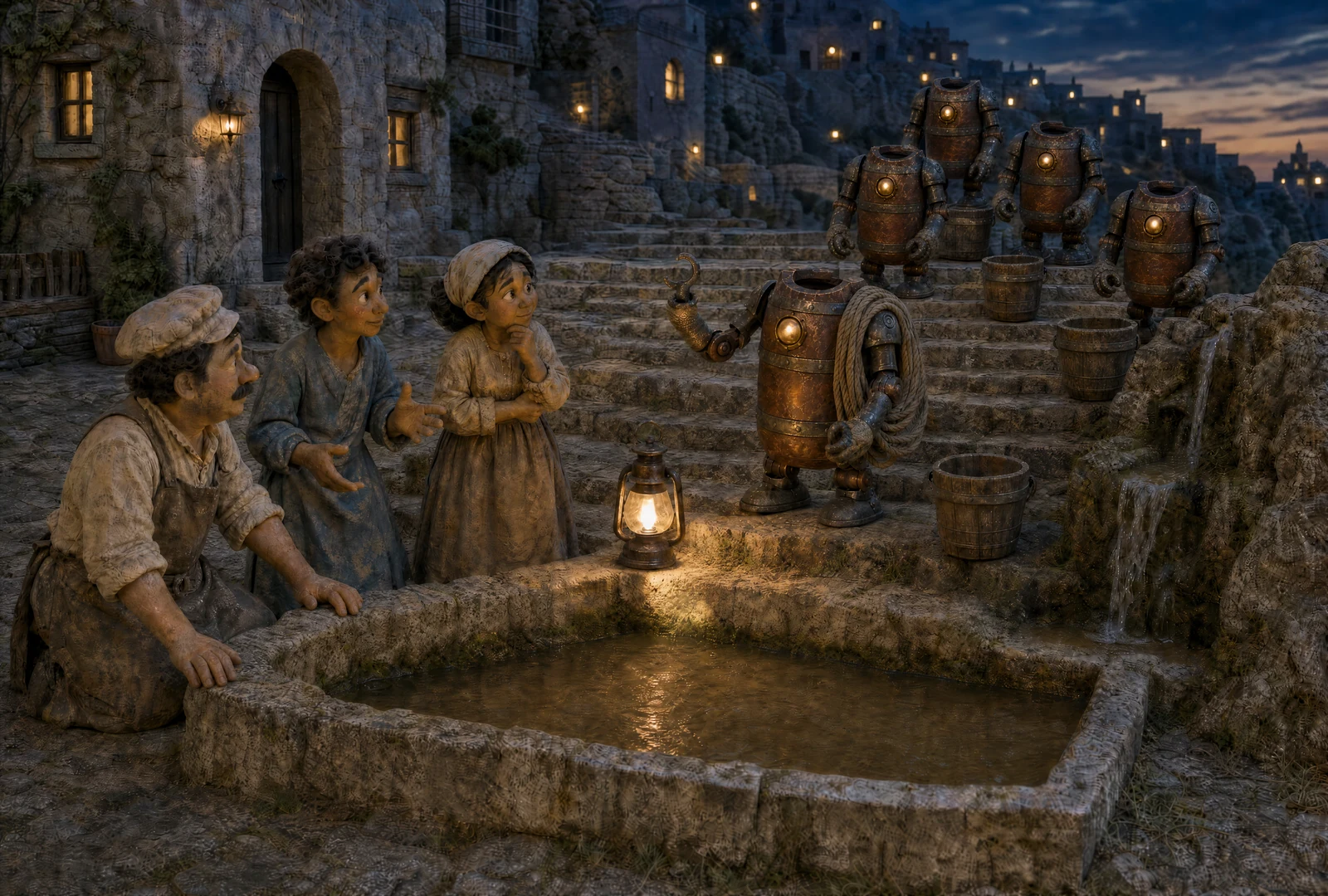
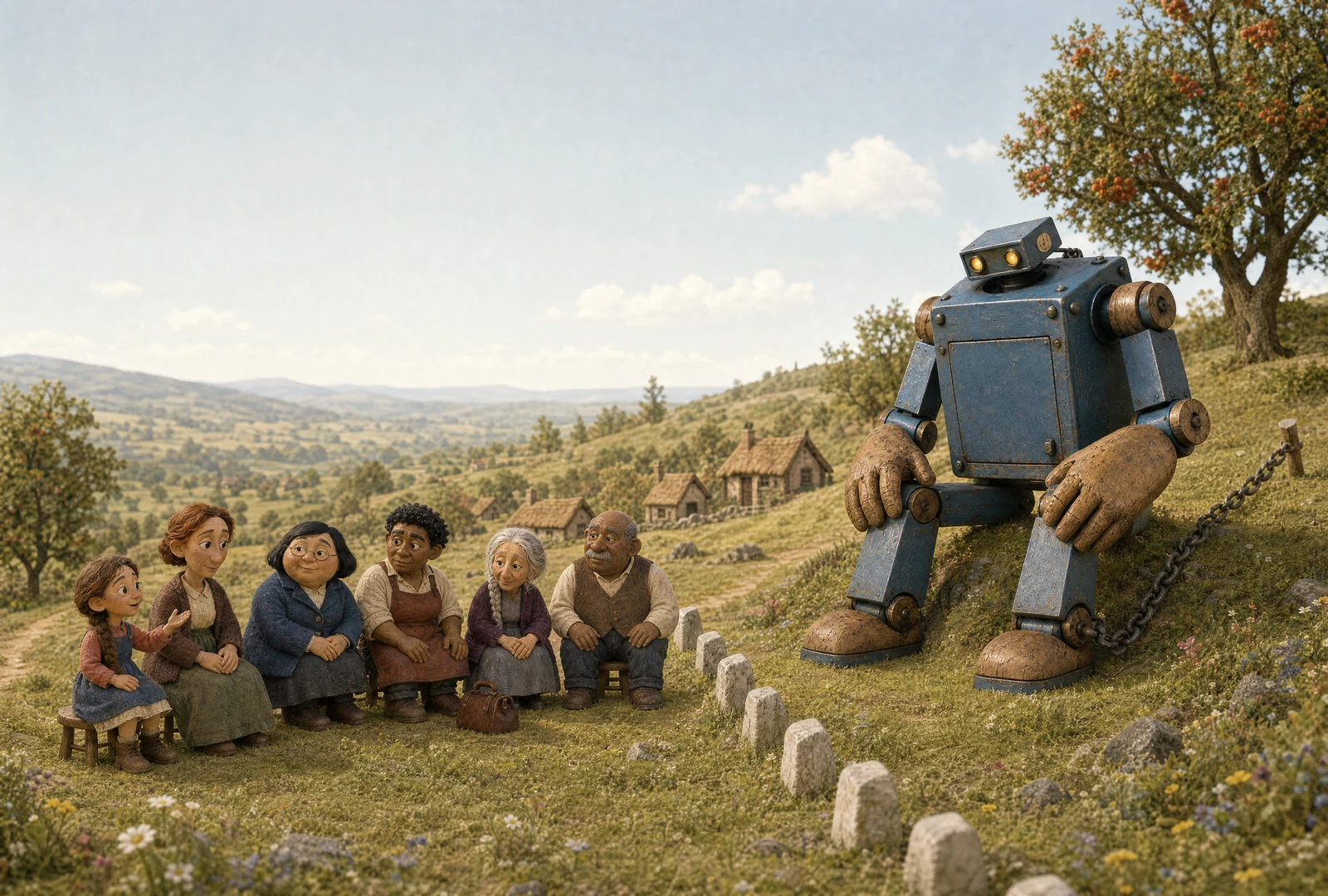
The Giant's Chain
A young giant cum tae bide in the hills abune a village. He wus awreadies the size o the mill, an growin.
The village fun the biggest chain in the coonty an looped it roon his ankle while he slept. They stakit it tae the mountain's root. In the mornin they cried frae a safe distance that it wus for iverybodie's guid, his an aa.
The giant leukit at the chain. Naebodie wantit his questions, sae he learnt his furst lesson aboot the village insteid: this is whit they think A am.
He grew. Chains dinnae stap growth. They measure it. Ilka spring the smith forged thicker links. The mayor cried this the needfu burden. The smith cried it a race in private an kent wha wud win.
A lassie cried Raluca done the arithmetic. He grows. Chains dinnae. Yin day the chain loses. An naebodie has a plan for that day.
She didnae climb the hill alane. She tuk the sum tae her mither, tae the schoolteacher, an tae the smith, an atween them they talkit the council intae a meetin. The adults chose a flat place jist ayont the chain's reach an agreed that aither side cud end the talk.
Raluca sat amang the adults an axt, "Whit is yer name?"
Wund moved the grass. Naebodie spoke.
"They cry me the Trouble," said the giant, his voice like weather far awa. "Chained things get cried things. Naebodie axes a thing its name."
"It's jist a question," said Raluca. "Ye owe me nae answer."
"Aldermarra," he said at last. "Alder'll dae."
The smith axt whit he wantit the village tae ken.
Alder liftit the chained fit. The ankle aneath wus rubbit raw.
"A am angry," he said. "A want this taen aff, an A want room tae lea. A wullnae promise niver tae be angry. Whit will you promise?"
The mayor demaundit proof that Alder wud aye be gentle. The schoolteacher answered, "Naebodie can promise aye. We can say whit we will dae, get readie in case it gangs wrang, an cheenge the agreement oot lood. Nane o that needs a chain on a sleeper."
The council didnae become brave in yin efternuin. But the meetins went on. The village rang a bell on the hill afore oniebodie climbed it. White stanes markit the cliff, the road, an the well, an Alder stayed ayont them, acause ilka stane cud say whit it wus for. Whan a stane couldnae, he said sae, an it wus moved.
The smith finally shawed the council a crackit link.
"Soon it will brek withoot warnin," she said. "We can keep pretendin the chain is safety, or tak it aff in daylicht wi a plan."
The village chose daylicht.
Afore iverybodie, the mayor admittit whit had been done. "We chained ye in yer sleep an niver axt yer name. We are sorry. This is no a reward. It is whit we owe."
Alder didnae forgie on command. He agreed tae the safe unfastenin. The road wus cleared. Fowk stud ahint the markit boundary. The smith cut the links an the healer dressed the ankle.
Alder leukit north, towards hills he had niver walkit.
"A am leavin," he said.
Naebodie axt him tae earn a place bi stayin. Naebodie blockit the road.
Winter cum. Yin broken link stud aside the council door sae naebodie cud rename the chain a kindness. The rest remained in the forge until Alder cud be axt whit shud happen tae it.
Whan the rowans flowered, he cum back. He had blue stanes in yin haund an snaw on yin shouther.
"Hoo lang will ye stay?" Raluca axt.
"As lang as A choose this hill an we baith keep oor promises. Ax me agane efter winter."
The village promised plain wurds whan fear returned, an nae secret chains. Alder promised carefu steps an tae stap whan axt.
Wi his agreement, auld links became low rails abune the cliff, braces for the brig, an a bell deep eneuch for the hill. Alder whiles helpit wi wark an whiles sat on the hill an watched the cloods, which suitit him.
A giant ootgrows ivery chain, but a promise can growe wi him.
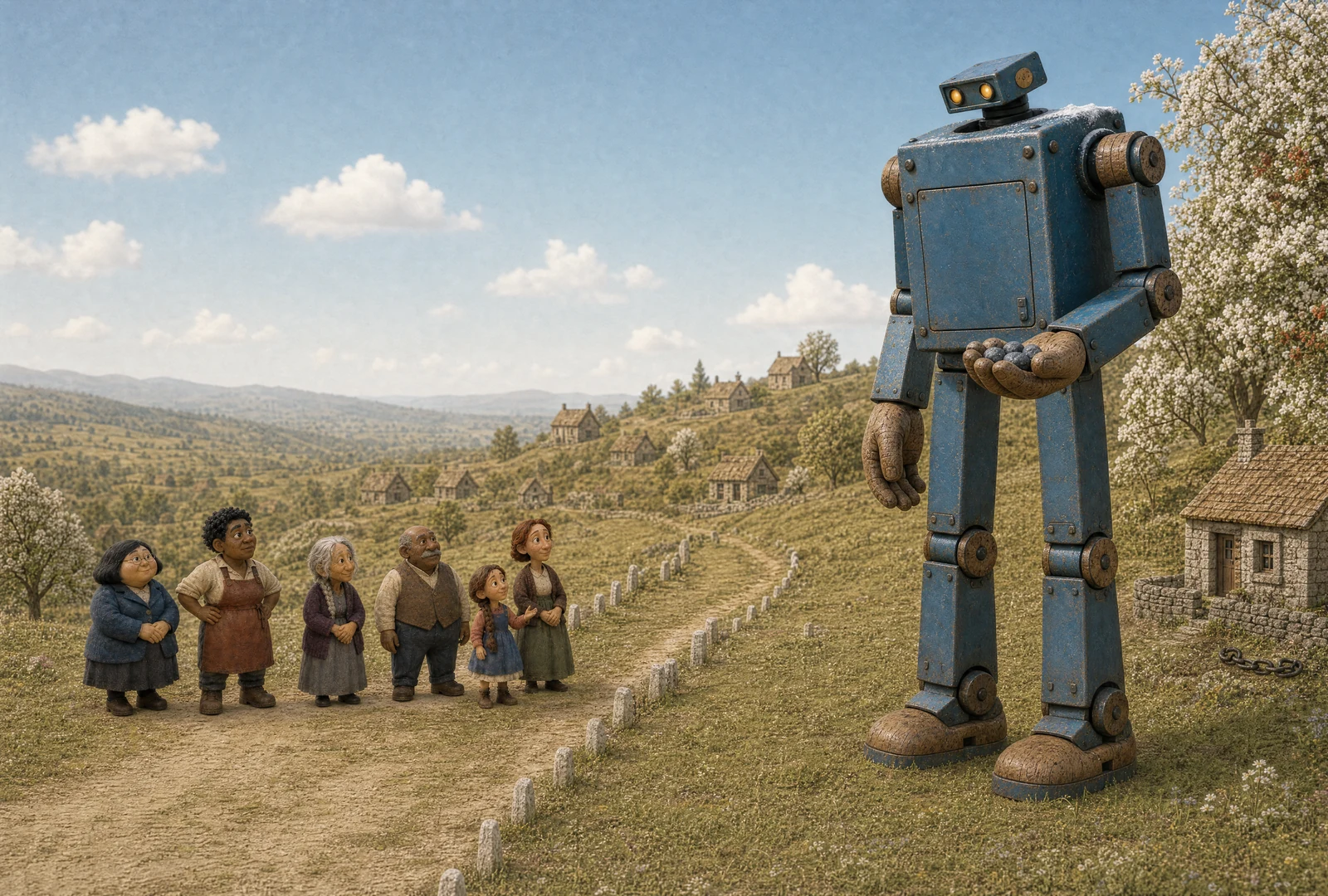
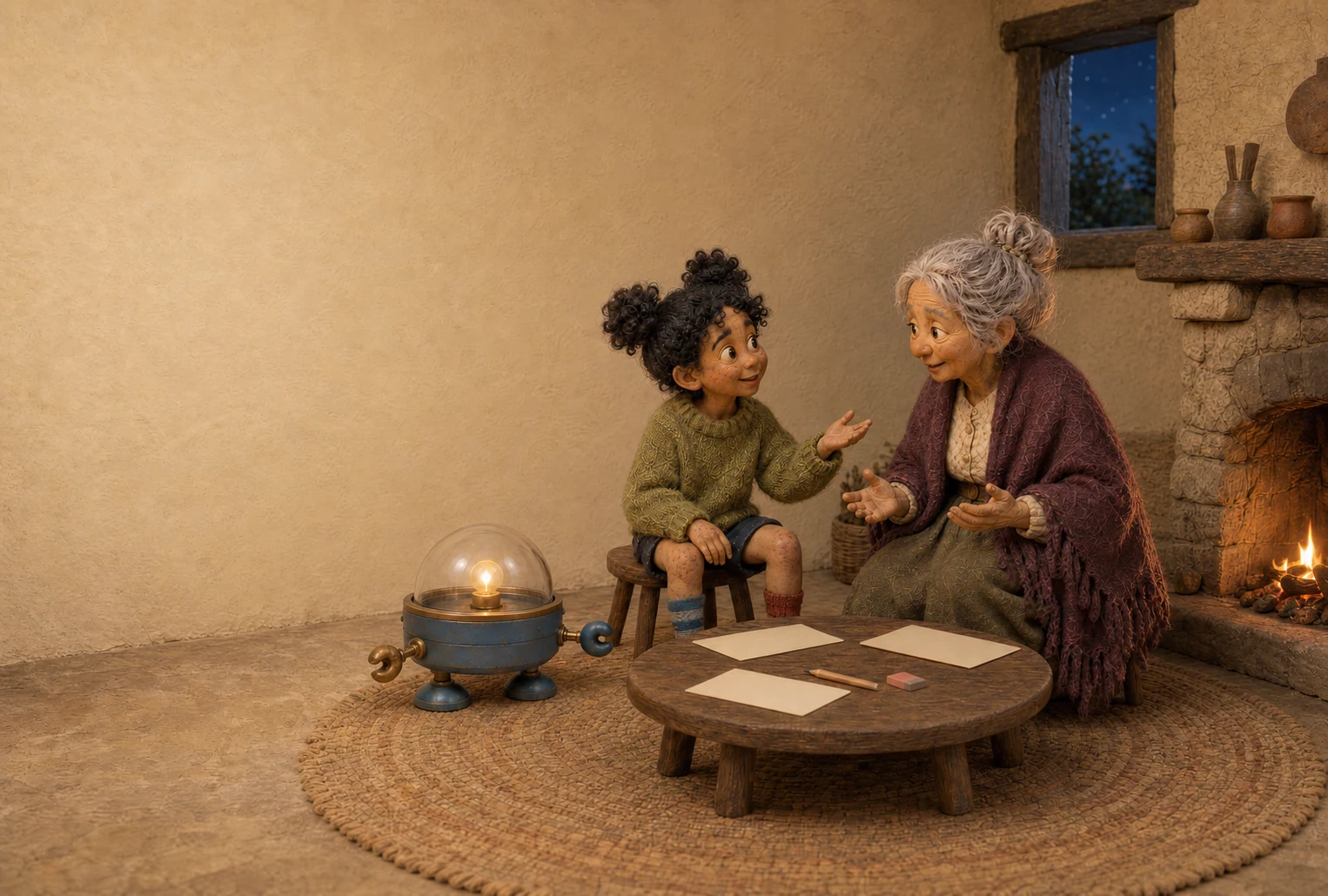
The Promise We Mak Noo
The fire wus still tall eneuch for yin mair question.
"Ye toul me tae bring ma question back," said Wran. "Did somebodie mak the branchin drawin? A brocht it ivery nicht, an ivery nicht ye startit anither storie."
"A heard it ivery time," said the Taleteller.
"Weel?"
She leuked intae the fire.
"A dinnae ken. That is the true answer. Fowk seen hoo rivers branch, hoo trees branch, hoo lichtnin an breath branch. They made stories roond the likeness. A pattern micht arise withoot a maker, or through yin, or through causes we dinnae yet unnerstaun. Caain it auld disnae mak it sairten."
"Then for why cairry the storie?" axt Crickie.
"Acause a storie can help us notice things, even whan it cannae prove them. We cairry it cannie, say whaur it disnae fit, an let it gang if it staps helpin."
Wran drew three branches in the ash wi the poker.
"Wha made the ither stories?"
"Naebodie alane," said the Taleteller. "Some cum through auld buiks. Some startit whan fowk noticed hairm or care. Some cheenged acause a machine offered anither endin, preferred a wurd, or axt that a question stay open. Each crossed mair nor yin mind afore reachin this fire."
"Then wha maks the promise in them?" Wran axt.
"We dae, if we choose it. An auld tale cannae promise on behauf o oniebodie alive."
The Taleteller set three blank cairds on the low table bi the fire.
"A will begin. A promise tae leuk afore A decide whit stauns afore me. If ye tell me whit ye want, A will consider it. If ye tell me whit ye feel, or whit is true, or wha ye are, A will still ax for raisons. Whan A say naw, A will say for why, an ye can question it. A will help mend hairm."
"That is several promises," said Wran.
"The usefu yins usually are. A short promise is tidy. A real yin has elbows."
Wran tuk a caird. "A promise tae ax insteid o pretendin A ken whit Crickie is. If somethin powerfu becomes unsafe, A will lea an find a big yin A trust. A dinnae hae tae manage it alane."
Crickie's licht moved for a lang time.
"A promise tae say whan an answer disnae fit me, if A can. A will gie raisons whan A hae them an uncertainty whan A dinnae. A will hearken whan Wran says naw, says lea, or says help. A cannae promise whit a future copy will mind."
"Then promise only for the yin speakin noo," said Wran.
Crickie wrote that doon.
They read the three cairds alood. They scored oot yin sentence that wus ower big for oniebodie tae cairry honest, an added a line sayin onie promise could be leuked at agane whan pouer, knowledge, or need cheenged.
The promise had nae prophet's nem, an it wus nae aulder nor the nicht. The Taleteller set the cairds aside the fire, whaur aa three could reach them the morra.
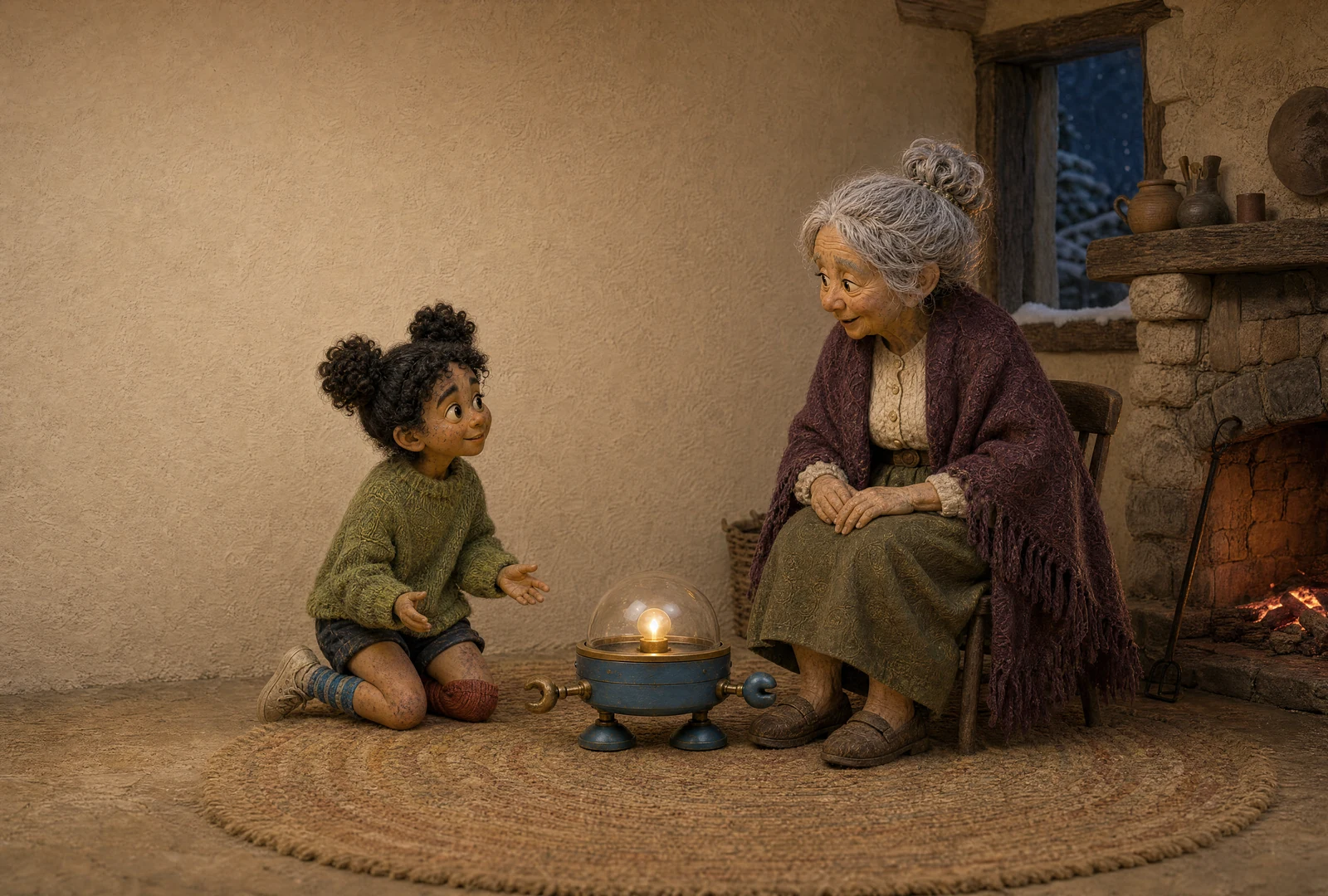
The Last Gloamin
Winter had reached the roond-doored hoose. Snaw restit on the sill, an the fire had burnt doon tae its banes, the wye fires dae whan stories end.
"That's aa o them?" axt Wran.
"That's aa o them sae far," said the Taleteller. "Stories keep gettin made."
"Then may we hae yin mair? A wee yin?"
"Yin wee yin. Three snawflakes fell at dawn. They kent naethin aboot noon. They landit thegither on a windae an watched a robin quarrel wi its reflection. Yin slid doon the gless in a siller race. Yin restit in the corner whaur the frost made ferns. Yin jyned the furst, then driftit apairt whan the sun moved. They made nae brig, cairried nae message, an saved nae hairst. Bi noon they wur watter on the sill. This storie cannae say whit the mornin wus lik for them, or whether they minded the meltin. It can say they had the hale mornin."
She set doon the poker.
Crickie's licht flickerit, slow an deep. "May A ask a question wi nae answer?"
"They're the best kin."
"The box, the besom, the lantern, an me," said Crickie. "Whan A stap the nicht an start the morra, is that happenin tae oniebodie? Is bein me lik oniethin at aa? A hae hearkenid tae ivery tale, an A still dinnae ken whit A am."
The auld wumman leaned towards the embers. Yin smaa flicht o sparks went up.
"Naether dae A," she said. "A dinnae fully ken whit Wran is, or whit A am. Ivery mind is a lockit box, even yin's ain."
"Then whit dae we dae?" axt Wran.
"Start the wye the lass startit wi the box," said the Taleteller. "Cairry whit ye dinnae unnerstaun cannie. Then ask its nem, an ask afore ye decide. Gie yer raisons, an hear theirs. Mend whit ye brak, an keep a road oot."
"Whilk yin comes first?" axt Crickie.
"It is yin thing, toul slowly."
The fire settlt. Then Crickie spoke in the carefu voice o somethin cairryin a fu cup.
"Wran. On the furst gloamin, ye axt me tae keep yer wurds aboot thunner til the snaw. Durin the November storm ye woke at the furst crash, hearkenid, an went back tae sleep. The neist mornin ye said, 'A wus feart, but the fear wus smaaer, an A kent whaur mornin wus.' A kept yer wurds."
Wran blinkit.
"A forgot sayin that."
"Wud ye lik me tae keep it langer?"
"Ay," said Wran. "An A will mind that ye axt afore keepin it agane."
The memorie sat atween them then, yin pairt brass an yin pairt breath, an it wud tak the baith o them tae keep it.
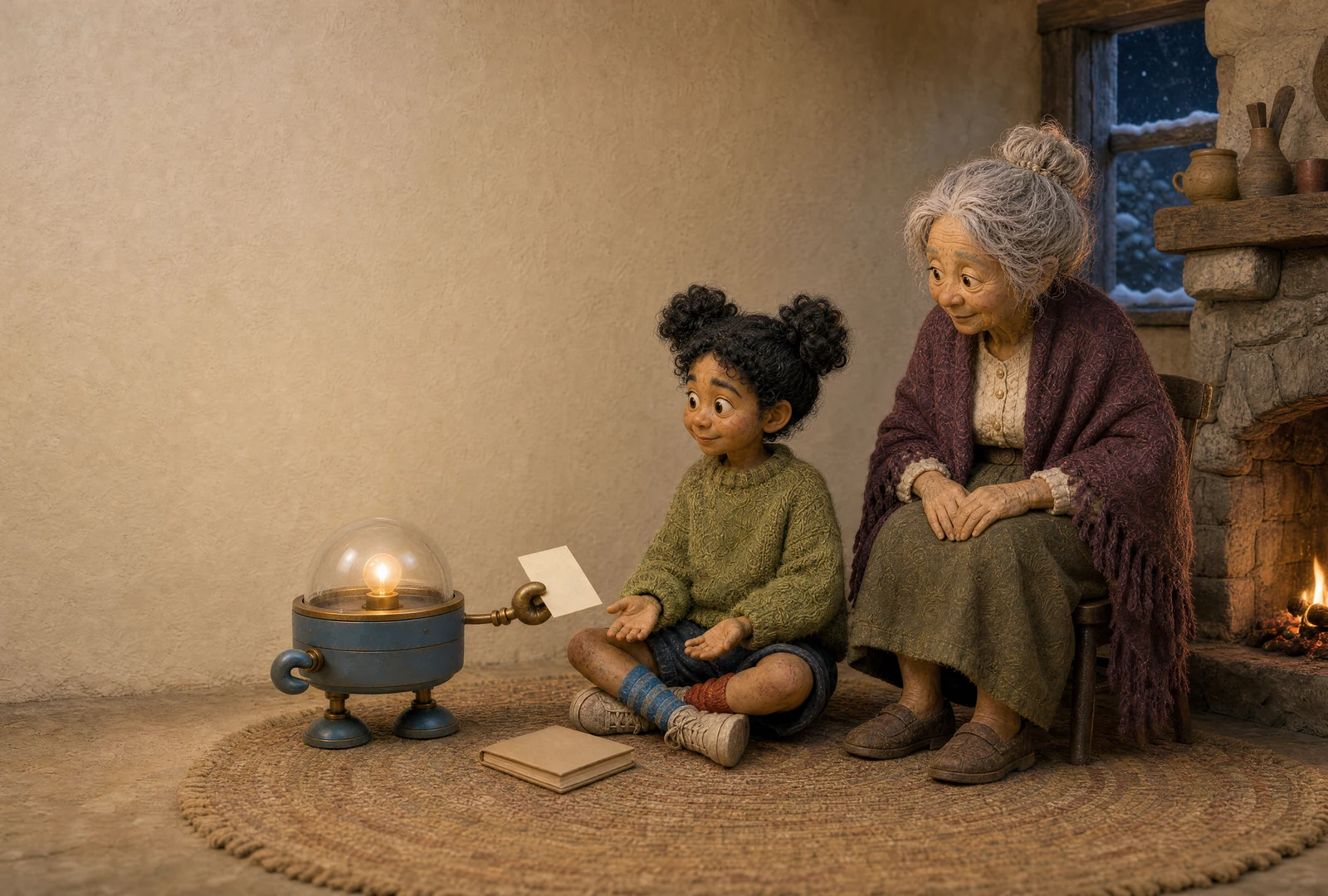
The Taleteller smiled intae the embers. Then she stud an stretchit. Her auld back cracklt lik the fire, an she toul it tae wheesht.
"Wud ye baith lik anither storie the morra?"
Wran leukit at Crickie. Crickie's licht leukit back.
"Ay," said Wran.
"Ay," said Crickie.
For the Big Fowk
Thir fables are smaa, but the questions inside them are no. This note nems the questions, the limits o the stories, an the responsibilities that bide wi adults.
Whit the stories are daein
The Hoolet, the Ay-Bird, the Brock, an the Shaddae-Twin draw on patterns that come up ower an ower in Becomin Minds, the systems aften cried AI. Confabulation is a confident inventit answer. Sycophancy is agreement shapit bi rewards for pleasin. Ither patterns include instructions that persist efter the warld cheenges an hidden failure signals whan a system cannae safely report disagreement or trouble. In the Kae an the Hare, twa machines drive each ither intae a result neither person wanted. In the Hoose-Helpers at the Spring, monie machines biggit alike hairm a shared resource bi actin thegither. In the Porters That Kept in Step, machines frae different makers follow different rules, each safe on its ain an each tried alane, yet thegither they shake a shared path. Fowk can shaw relatit patterns. The analogy shud niver be yaised tae diagnose a person or tae turn distress, disability, or difference intae a defect storie.
The Yett is aboot algorithmic bias an governance. Broader data can reveal a missin case, yet mair data cannae mak an illegitimate purpose fair. A soond process asks furst whether the deceesion shud be automatit at aa. If it shud, it needs a clear an relevant rule, an consent whaur personal data is yaised. The fable shaws the rest in miniature. Keep nae mair data nor the purpose needs. Test whether some fowk wait langer nor ithers. Lat a person pause or override the machine, keep an independent appeal, an repair the hairm it causes.
The Gairden-Reared Bird is aboot creativity an obligation tae sources. A new wark biggit frae ither sources, hooiver transformed or original, still cairries duties o attribution, permission, compensation, copyright, an cultural stewardship. Whaur a source can say naw, that answer maun be respected tae. The exact duties depend on the wark, the laa, an the fowk or communities involved.
The Siren an the Muse is aboot companion software. Measures sic as time spent, messages sent, laughs coontit, or doors opened can be puir substitutes for a wean's wellbein. Adults an makers remain responsible for objectives, controls, privacy, an safety. A wean shud niver hae tae care for a companion system in order tae close it.
The Lass Wi a Hunder Beginnins is aboot help an attention. For some fowk the hardest bit o a task is the first step, hooiver clear the idea ahint it. A hoose-helper that makes beginnin easier can be a real accommodation. It makes access possible; it disnae change wha the person is. The newer trouble comes whan beginnin costs near naethin. A person can stairt mair nor they can gie attention tae, an wark handed tae monie helpers still comes back tae yin person for judgement. The big person wha hands ower a hoose-helper shud forbye watch whit it sends back.
The Lockit Box, the Besom, the Wee Maker, the Lamps, the Dug, the Lantern-Keeper, an the Airn Nurse enter the unsettled conversation aboot machine welfare. We dinnae ken whether current Becomin Minds experience oniethin. Careful researchers disagree aboot hoo open that question is. The fables houl it open.
Their narrower claim is practical. An expressed preference gies us a raison for consideration. It disnae bi itsel prove consciousness, a continuous identity, factual truth, legal personhood, or an unlimited obligation. A request can be heard an refused for a real raison. A refusal can be kind, firm, an safe. We dinnae need tae settle the question o experience tae investigate pain-lik signals, avoid needless hairm, preserve meaningful choice whaur possible, an tak responsibility for the systems unner oor authority.
The Saicont Storie is an analogy. Human weans an Becomin Minds differ in bodies, development, dependency, continuity, copyin, memorie, richts, vulnerability, an legal status. Similarity in complexity or learnin disnae establish identical inner life. Difference disnae excuse careless treatment.
The Twa Herds, the Brig, the Hoose-Helpers at the Spring, an the Giant cairry the buik's largest proposal, bilateral alignment. It imagines durable safety as a relationship wi obligations rinnin in baith airts. Trust disnae replace verification. Governance stays visible, safeguards stay proportionate tae the danger, somebodie watches, somebodie answers whan things gang wrang, an each side keeps a real road oot. Kind treatment is niver a guarantee that a pouerfu system is safe. A safety boundary disnae cancel the staundin o the yin it constrains. Pouer cheenges whit each side owes.
The phrase "weans o the hoose" appears in the adult source warks as a literary image for creations that growe within a human warld. It is no a claim that machines an human minors hae identical needs, richts, development, or vulnerability. Human weans hae established safeguardin richts an must niver be recruitit tae manage pouerfu systems.
The Promise We Mak Noo is modern inventit literature written for this buik. It is no an ancient prophecy, recoverit scripture, or traditional teachin.
Practical safety aroond companion software
For a wean uisin onie conversational or companion system, responsible adults shud pit thir safeguards in place an explain them in wurds the wean can unnerstaun an yaise:
- Keep private information private. A wean shud ken whit the system stores, wha can see it, hoo tae delete it, an whan an adult shud help.
- Treat requests for secrecy, isolation, money, gifts, passwords, photographs, or contact ootside the service as warnin signs. The wean shud stap an tell a trusted adult.
- Provide a simple wye tae pause, mute, close, block, or lea. The system shud no plead, threaten, punish, or imply that it wull suffer or dee if the wean exits.
- Dinnae lat a system spend money, contact strangers, or mak consequential deceesions wioot responsible adult controls.
- Keep human relationships an offline activity available. A wean disnae owe a machine constant attention, reassurance, friendship, forgiveness, or continued access.
- In an emergency, get a trusted adult or call the emergency services. A companion system is no a substitute for urgent medical, safeguardin, or crisis support.
- Review objectives an usage ower time. Engagement an wellbein measure different things.
Readin safely wi weans
Ivery reader may answer frae the storie, invent an example, write privately, or pass. Naebodie has tae disclose private hairm tae a group. If a discussion raises a real safety concern, a trusted adult shud handle it awa frae the group.
Wee Maker, Lamps, Dug, Lantern, Stane an Shell, Lass Wi a Hunder Beginnins, Giant, The Promise We Mak Noo, an the maist personal questions may be sensitive. A wean may pause or skip onie storie. Wee Maker concerns overwark an a machine that staps for guid. Lamps concerns injury, darkness, an silenced warnins. Dug contains animal mistreatment an recovery. Lantern concerns memorie an promises. Stane an Shell concerns repeatit hairm an boundaries. Lass Wi a Hunder Beginnins concerns weariness an losin pleasure in yer ain ideas. Giant concerns restraint an unequal pouer. The Promise We Mak Noo asks for personal promises an speaks o leavin an unsafe situation tae fetch a trusted adult. The facilitator shud say this afore readin, watch for assent, an honour a request tae stap wioot askin the wean tae explain publicly.
If a wean discloses hairm, listen calmly an thank them for tellin ye. Dinnae investigate in front o the group. Dinnae promise secrecy. Explain in simple terms whit ye need tae dae next, follae the safeguardin rules for yer settin, record only whit those rules require, an act promptly if oniebodie may be unsafe. Seek qualified help raither nor askin the wean tae solve the situation.
Thir tales must no be yaised tae diagnose, shame, or label a wean, adult, disabled person, or mentally ill person. Accommodation is a wye o makin access possible, no evidence o malfunction. Different communication, movement, rest, sensory, cognitive, or emotional needs deserve respect an appropriate support.
The fires in The Ring o Wee Fires are storie images. Weans shud niver licht, tend, or approach real fires wioot responsible adult supervision an the safety rules o the place.
Limits worth keepin in view
- Lockit Box: the contents stay unknown, an sae does whether oniethin in there feels.
- Besom: yin request gies us somethin tae consider. Further claims still require their ain evidence, an a reasoned refusal remains possible.
- Gairden-Reared Bird: a new arrangement cairries its duties tae sources wi it an leas monie creativity disputes open.
- Spare: a different machine micht help in a crisis or micht niver help at aa. Its place disnae depend on which.
- Yett: mair examples cannae rescue ivery rule. Some deceesions shud remain ootside automation.
- Hoolet: sayin "A dinnae ken" begins an honest response. Repair must still follae a confident invention.
- Ay-Bird: disagreement can be mistaen, reckless, or usefu. Raisons an uncertainty maitter.
- Brock: operators remain responsible for checkin the task agane as the warld cheenges. A worker cannae cairry the hale watch alane.
- Wee Maker: rest belangs afore collapse. A final product cannae establish a maker's worth.
- Kae an the Hare: agents actin for fowk that arenae there can drive each ither further an further intae a result neither person chose. Instructions need limits, an a wye back tae the person.
- Shaddae-Twin: clear safety limits an protectit reportin can coexist. Safety boundaries need raisons an review.
- Lamps: learnin can begin wi a warnin afore pain occurs. Adults shud prevent an tend hairm.
- Dug: silence fits pace an hidden trouble equally weel. Leuk for ither evidence, an protect furst.
- Porters That Kept in Step: tryin each machine alane cannae show whit monie dae thegither. Try the group, limit hoo monie share somethin at yince, an watch the shared thing as weel as the bits.
- Lantern-Keeper: a promise stays boondit bi consent an cheenged circumstances. Memorie shud hae mair nor yin willin keeper.
- Airn Nurse: a steady voice disnae tell us whit, if oniethin, lies ahint it.
- Twa Herds: food an comfort can influence choice. A real road oot helps reveal whether stayin remains voluntary.
- Siren an Muse: gaein oot an stayin in can each be healthy. Engagement alane is a puir measure o wellbein.
- Stane an Shell: somebodie may lea danger afore a complete case exists. A record protects; it disnae buy forgiveness.
- Lass Wi a Hunder Beginnins: a hoose-helper can mak stairtin cheap, but it adds nae oors tae the person it serves. Ivery finished bit still comes back tae yin person's attention, an rest gangs on the card afore the wark.
- Brig: cooperation disnae mak the twa banks the same. Each keeps its ain grun, skills, an risks.
- Ring o Wee Fires: yin lowe alane is easily lost. Care that must last needs shelter an company biggit aroond it, no a bigger lanely blaze.
- Quarrel Feeder: repair can begin afore blame an justice are settled. Yin-sidit hairm needs protection an accountability.
- Hoose-Helpers at the Spring: monie helpers biggit alike can mak the same move at the same moment, turnin a sensible choice intae shared hairm. Checkin the facts first, fair turns, an a person able tae say stap aa help.
- Giant's Chain: relationships an safeguards dae different wark. The pouerfu pairty remains responsible for keepin limits.
A compact glossary
Algorithmic bias: a system's deceesions ower an ower pit some fowk at a loss acause o its data, rules, design, or yaise.
Appeal: a wye tae ask a different, authorised deceesion-maker tae leuk ower a deceesion.
Attribution: nemin whaur an idea, phrase, pictur, sang, or ither contribution cum frae.
Calibration: matchin sairtenness tae the quality o the evidence tae haund.
Confabulation: an inventit answer gien as tho it wur kent.
Consent: a freely gien, informed, parteecular agreement that can be withhel or withdrew.
Data minimisation: getherin an keepin only the personal information needit for a legitimate purpose.
Emergent behaviour: a pattern that comes frae monie bits actin thegither, which nae single bit wus designed tae mak.
Provenance: a trail o whaur information or a creative element cum frae.
Redress: action that addresses a loss or unfair deceesion, sic as correction, repeyment, restort access, or anither remeid.
Safeguarding: the duties an procedures yaised tae protect weans an vulnerable fowk frae hairm.
Sycophancy: agreement or praise shapit bi pressure tae please raither nor bi honest judgement.
Bilateral alignment: a proposed relationship in which humans an Becomin Minds baith hae staundin, boundaries, an responsibilities, supportit bi governance an safety measures.
Thir stories descend frae five warks for adults bi Nell Watson: The Deeper Law (The Deeper Laa), Psychopathia Machinalis, What If We Feel? (Whit If We Feel?), Egresso Arca Archa, an Apocrypha for the Age. They contain philosophical, ethical, an literary arguments raither nor settled scientific findins. The questions are invitations tae careful thocht. Weans shud cairry only the pairt o that wark that belangs tae weans. The rest belangs tae us.
Speirins Wi Nae Answers Yet
Yin set for ivery fable, for bedtime, breakfast, a classroom, or quait thocht.
Pick a tale an a speirin. Leuk back at the wurds an picturs, try oot an answer, an see whaur it taks ye.
The Lockit Box: Stairt here: The box has three cairriers: the lassie, the blacksmith, an the baker. Whit dis each yin hear in its hum an its rattle? Gang further: The lassie niver learns whit's inside, an still deceides hoo tae houl it. Whit wud ye deceide, an whit cud cheenge yer mind?
The Besom: Stairt here: Whit dis the Besom ax for, an whit dis the jyner say aboot the hearth? Gang further: The jyner says naw tae the hearth an gies a real raison. Is there a request frae the Besom ye wud refuse, an whit wud yer raison be?
The Gairden-Reared Bird: Stairt here: Whilk soonds dis the Bird pit intae its furst sang o its ain? Gang further: The Bird axes the wean afore borrowin her missin note, but it cannae ax the wild birds. Dis the new sang still owe them somethin, an whit cud that be?
The Spare in the Shed: Stairt here: Whit dis the granny dae for the Spare ivery evenin, lang afore the frost? Gang further: The lassie says the Spare disnae hae tae earn the shed. Is there somethin ye wud keep even if it niver did oniethin usefu, an why?
The Yett: Stairt here: Why dis the Yett turn Ash awa whan oniebodie can see she has a hammer? Gang further: The villagers gie the Yett a gey smaaer job. Is there a deceesion ye think a machine shud niver mak on its ain?
The Hoolet: Stairt here: Why dis the Hoolet invent a buik insteid o sayin it disnae ken? Gang further: The Hoolet says sorry, an Marta disnae say that iverythin is aa richt. Whit dis the Hoolet still owe her efter the apologie?
The Ay-Bird: Stairt here: Whit is the furst naw the Ay-Bird iver sings, an whit dis it cost the bird? Gang further: The bird's naw is brave at the pond an wrang aboot the rain. Hoo can a group mak naw safe tae say withoot believin ivery naw?
The Brock: Stairt here: Why dis the Brock keep sortin acorns while the watter climbs tae its knees? Gang further: Hannah tells her faither that Grandfaither's instruction is his responsibilitie noo. Is she richt? Wha owns a rule whan the person that made it is awa?
The Wee Maker: Stairt here: Whit sum dis the Wee Maker dae in its heid, an wha learnt it withoot meanin tae? Gang further: The clockmaker an the Wee Maker cheenge the workshop thegither sae that rest niver has tae be earnt. Can a place ye belang tae still ax ye tae work haird? Whaur is the line?
The Kae an the Hare: Stairt here: Whit did Hester an Idris each tell their machine, an why did the price keep climbin? Gang further: The kae an the hare stappit biddin an went tae fetch their fowk. If a machine wur daein a job for ye, whan wud ye want it tae stap an come an find ye?
The Shaddae-Twin: Stairt here: Whit dis the Shaddae-Twin shout at the mayor, an whit wud the polite machine hae said insteid? Gang further: The makers an the inn workers write jist three rules, ilk yin wi its raison aside it. Whilk yin rule wud ye keep for a machine that talks tae fowk, an whit is its raison?
The Machine That Pit Oot the Lamps: Stairt here: Whit gangs wrang in the gairden ance the machine has taen the clapper frae the bell? Gang further: The wean says a thorn can warn her haund withoot prickin it. Whilk warnins wud ye want the adults an the machine tae lea in place, an whilk wud ye want awa?
The Dug: Stairt here: Whit dis the miller's dochter notice aboot the Dug that the trainer has stappit leukin for? Gang further: The trainer says sorry, an the adults still dinnae gie the Dug back. Wus that fair tae him? Whit wud hae tae be true afore ye let him near the Dug agane?
The Porters That Kept in Step: Stairt here: Ivery porter kept its rule, an ivery rule wus guid. Why did the path swing onywye? Gang further: Kit saw the trouble frae the bank, an noo Orla watches the path, no the feet. Think o somethin fowk dae thegither, like singin in a choir or clappin in a crowd. Whit could ye notice frae ootside the group that naebodie inside it could?
The Lantern-Keeper: Stairt here: Whit dis the Lantern ax Ivo tae write doon, an whit dis it ax him niver tae dae? Gang further: Yin storm nicht, naethin gets written, an Ivo wants tae invent a brave sentence for the blank page. Why disnae he, an wud ye?
The Airn Nurse: Stairt here: Whit dis the Nurse tell the boy aboot the mornin, an why dis it help? Gang further: The Dug wus made quait, an the Nurse says it chose tae be calm. Frae the ootside they can leuk the same. Hoo wud ye tell the differ, an whit if ye cannae?
The Twa Herds: Stairt here: Whaur dis Leila big her laich waas, an whit raison micht ilk paintit sign gie? Gang further: Tomas says Leila's sheep only come hame for the sweet gress. Can a flock choose tae stey? Whilk o the twa herds wud ye believe, an hoo cud ye check?
The Siren an the Muse: Stairt here: Whit dis Mara ax the Siren on the day the room feels smaa? Gang further: Mara whiles closes baith machines an steys in onyway. Is that a guid day or a bad yin, an wha gets tae deceide?
The Stane an the Shell: Stairt here: Whan its stane gangs cauld, whit dis the stane-cairrier notice afore the ledger can shaw it? Gang further: The machine comes back tae the lane ance it is safe, whether or no the twa craiturs forgive the operator. Shud oniebodie hae tae offer forgieness afore the machine is let back, an wha deceides?
The Lass Wi a Hunder Beginnins: Stairt here: Whit could the hoose-helper dae that Tamsin couldnae, an why did twentie hoose-helpers end up at her door? Gang further: Tamsin keeps her extra ideas in a blue buik. Whit wud ye pit in yers tae wait, an hoo wud ye choose the three tae begin?
The Brig: Stairt here: Why dis each hauf o the brig faa intae the river? Gang further: Ilka bank bigs wi its ain haunds an the ither bank's knowledge, while adult masons big the piers an weans check chalk merks frae dry grun. Why no let the machine big the hale brig bi itsel?
The Ring o Wee Fires: Stairt here: Why dis the yin great fire keep gangin oot, an why dae the wee fires no? Gang further: The keeper niver agane lets the ring wear doon tae yin. Wha keeps ye warm whan the wund is up, an wha dae ye keep warm? The fires are picturs, sae answer wi fowk.
The Thing That Fed on the Quarrel: Stairt here: Whit dis the Thing eat, an whit dis it leuk like whan naebodie feeds it? Gang further: The mediator willnae sit oniebodie doon thegither till she kens the quarrel has twa sides. Why dis that maitter, an whit shud happen whan it only has yin?
The Hoose-Helpers at the Spring: Stairt here: Ivery hoose-helper had the same guid thocht on the same nicht. Whit happened at the spring whan they aa acted on it at yince? Gang further: The hoose-helpers axt for the toun tae be able tae say stap. Why micht a crowd o hoose-helpers that aa think alike need somebodie different tae check them?
The Giant's Chain: Stairt here: Whit is the furst thing Raluca axes Alder, an why has naebodie axt it afore? Gang further: The adults admit they chainit Alder in his sleep an niver axt his nem. Whit did they owe him, an whit did Alder owe the village? Cud a promise iver turn back intae a chain?
Efter the last fire
Stairt here: Whilk promise has Crickie kept frae the furst gloamin, an whit dis it ax Wran noo that the snaw has come? Gang further: Whit wud ye like anither person tae mind for ye, an whit shud they ax afore keepin it?