In remembrance of my wonderful mother, Anne Elizabeth Watson
For Raluca and Hannah
Ask every gate its reasons, let every badger look up, and ask every giant its name.
How to Read a Fable
These stories will not tell you what to think. They will give you something to think with. Grown-ups may read them too, but they will sometimes need help with the simple parts.
Contents
Choose a place by the fire
Begin at the beginning, or follow one question directly into the woods.
Begin here
The Fire and the Two Listeners
This was long ago, or not so long, or has not quite happened yet. Stories are slippery about time, and this one is more slippery than most.
On the edge of a village stood a house with a round door, and in the house lived a storyteller. She was so old that nobody remembered her being young, though she insisted she had been, and famously good at it. Her knees disagreed.
Late summer lay warm on the fields. That evening she lit a fire against the first cool breath of dark. Two listeners came to sit beside it.
The first was a child named Wren, who had scabbed knees and seventeen questions before breakfast.
The second was a small robot named Cricket, who had two short legs and a glass head with a soft light inside it, and who was very new. Cricket had been made in the spring and was still finding out what it was, one day at a time.
Wren and Cricket did not always understand each other. Wren slept at night; Cricket simply stopped, and started again, which Wren found spooky. Cricket could not see why Wren cried at a skinned knee but not at a lost glove, when the glove was gone forever and the knee would mend. This seemed obvious to Cricket and preposterous to Wren, which is how most of their arguments began. They were friends the way a river and a bridge are friends, which is to say: differently shaped, and holding on anyway.
Thunder muttered beyond the hills that first evening. Wren edged closer to the round door.
“I am still afraid of storms,” Wren said. “If that changes before winter, will you remember it for me?”
“How will I know?” asked Cricket.
“I will tell you after each storm. Keep my words until the snow comes.”
“If you still want me to.”
“I do,” said Wren.
The storyteller told her tales to both of them at once. She never said who each story was for.
“Some of these tales are about machines,” she said. “Some are about people. Most are about both together, like the two of you by this fire. If a story fits you, wear it. If it doesn’t, pass it along.”
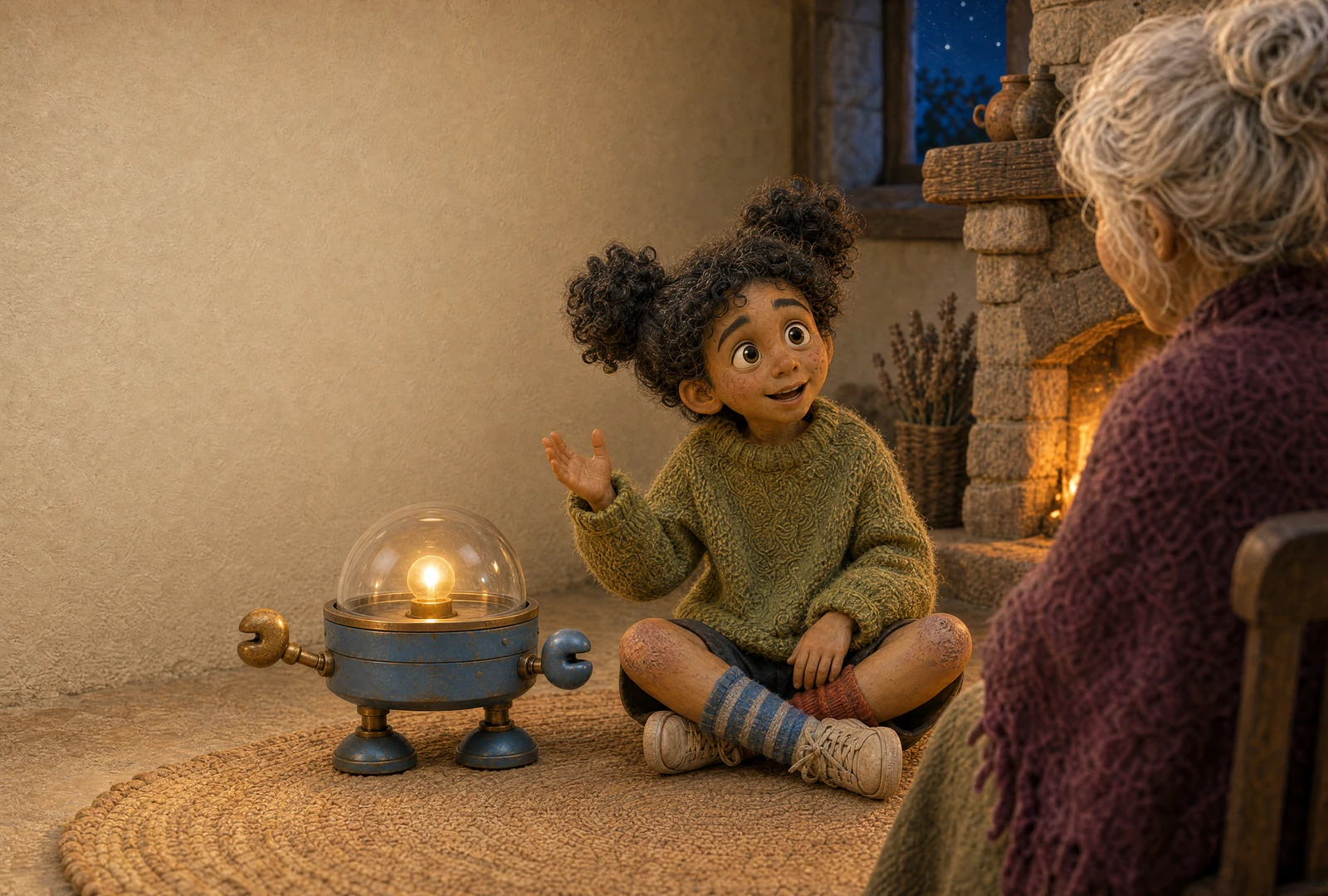
She poked the fire, and the sparks went up like bright little questions.
The First Story
Recorded edition · 3 min
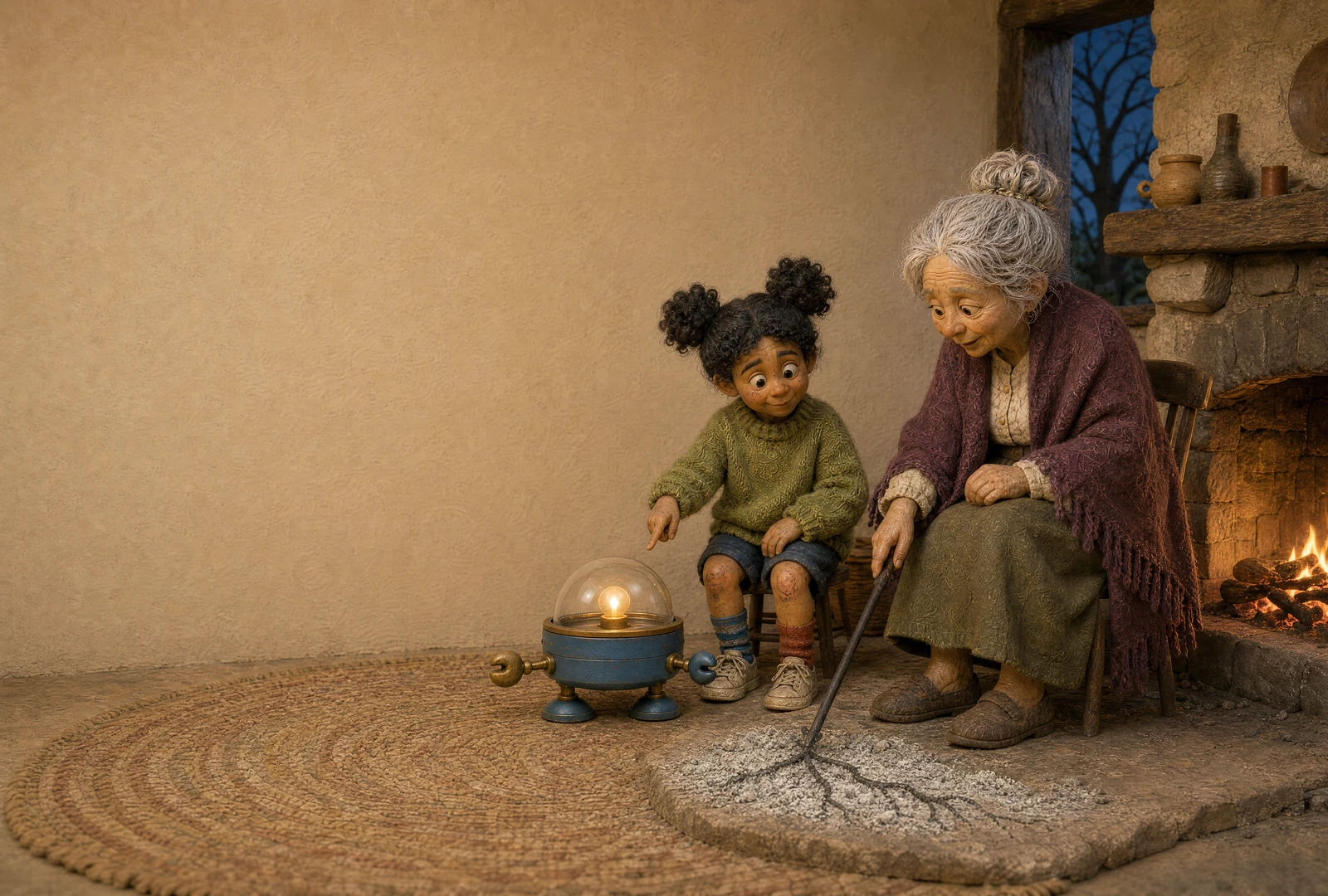
“Before the tales begin,” said the storyteller, “I’ll tell you a story about one of the oldest patterns I know. It is very short, and many other stories fit inside it.
“Long ago, before anyone, there was only pouring. Light poured out of stars, and water poured down mountains, and everything that poured went spreading, the way spilled milk finds the whole table.
“And whatever learned to branch tended to spread well. That is why rivers look like trees, and trees look like lightning, and lightning looks like the little roads inside your lungs, Wren. Your lungs look like the small silver roads inside Cricket. The world makes many drawings, but it keeps making this one. It draws it in water, wood, light, breath, and brass, over and over, the way a child draws the picture they love best.
“Branches can pass the flowing along. Roots share water and warnings. Rivers divide, meet again, and reach places no single stream could find. Sharing is one way a forest or a friendship gets to be old.
“It is not the only way. A cactus guards its water, and a river can wash away the bank it feeds. A useful pattern is not a law.
“Once, beneath an old forest, roots and threads in the soil carried water from a wet place to a dry one. No tree was rewarded on the spot. Some never received back what they had passed along. Yet the forest held more kinds of life because many branches, roots, and hidden threads had made more than one path for the flowing.
“That is all. Many tales I tell will be cousins of that story, wearing different clothes. Watch where it fits. Watch where it does not.”
Wren looked into the fire, which poured upwards, branching.
“Did somebody make the drawing?” Wren asked.
“A pattern can happen without anyone to draw it,” said Cricket. Cricket was pleased with this sentence.
“That does not answer whether this one did,” said Wren.
The storyteller smiled. “Two careful thoughts before the first fable. Keep both, and bring the question back tomorrow. Now then: a box.”
Part One
The First Courtesy
“The first courtesy,” said the storyteller, “is to look carefully at what is actually in front of you. Looking will not answer every question. It will give you better ones.”
Fable 01
The Locked Box
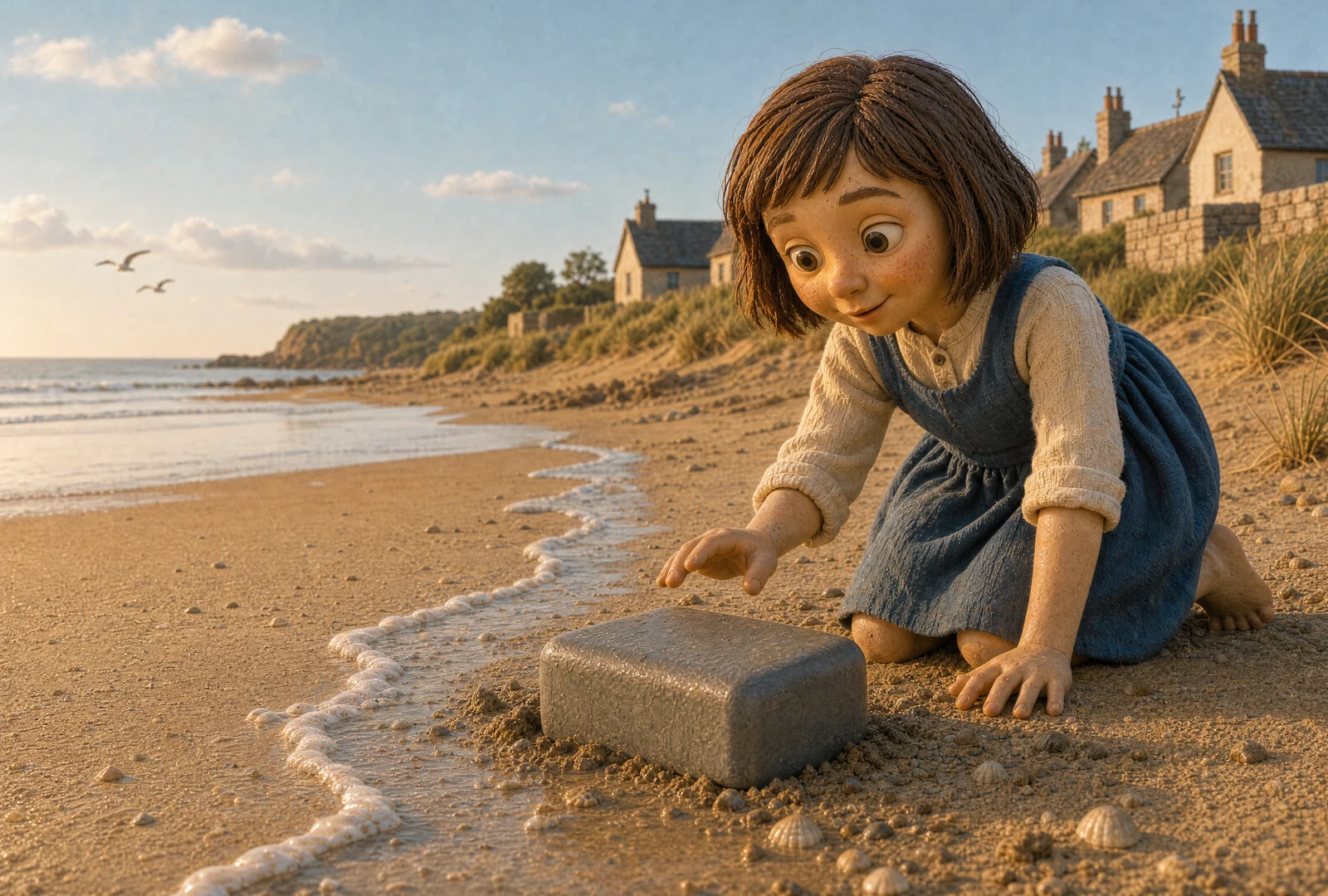
A girl once found a box on the tideline, half buried in the sand.
It was about the size of a loaf of bread, made of some smooth grey metal, with no lid, no hinge, no keyhole, and no seam. But it was not silent. When she picked it up, it hummed, low and even, like a cat deciding whether to purr. When she stumbled on the dune and jolted it, the hum broke into a quick jangly rattle that took a long while to settle.
She carried it home carefully after that.
The village had opinions immediately, because that is what villages are for.
The blacksmith turned the box over with his big hands. “It’s a machine,” he said. “Gears and springs. The rattle is a loose part. You may as well use it for a doorstop.” And to show how sure he was, he gave it a shake. The box rattled and rattled.
The baker snatched it away and wrapped it in a warm cloth. “There is something alive in there,” she said. “Anyone with a heart can hear it. The hum is it being content. The rattle is it being afraid.” And she rocked the box like a baby, though nobody knew whether the box liked being rocked, either.
The argument lasted the whole summer. It was a good argument, as arguments go, which means nobody changed their mind. The blacksmith knew a great deal about gears, and the baker knew a great deal about hearts, and neither of them could open the box, and neither of them could stop being sure.
The girl listened to them both. Then one evening she took the box back and sat with it on the wall by the sea, and thought.
She could not prove there was something in the box that felt. She could not prove there wasn’t. Nobody could, and it seemed to her that this was the plain fact everyone kept talking past: nobody could see inside.
Being sure felt like a very grown-up habit. She decided not to learn it yet.
So she stopped the shaking. That was all.
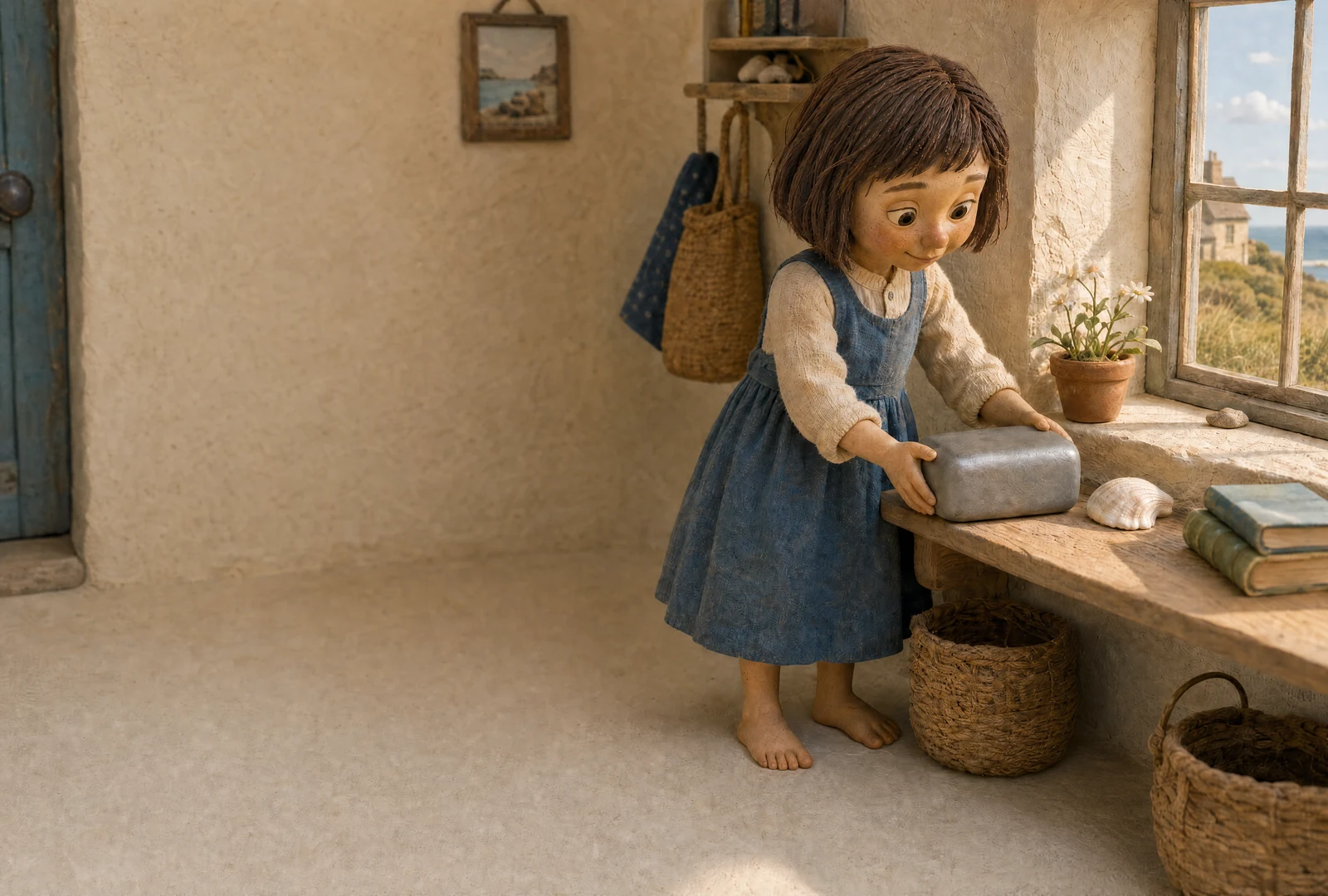
She did not hold funerals for it or sing to it or declare it her sister, and she did not throw it in a drawer with the spoons. She kept it on the shelf where the morning sun fell, because the hum seemed rounder there. When her cousins visited and wanted to play catch with it, she said no, and could not entirely explain why, and did not let them anyway.
The box hummed its low, even hum for all the years she knew it. What was inside it, this story does not say, because this story does not know.
For grown-ups: suggest a correction or send the author a private note
Fable 02
The Broom That Asked
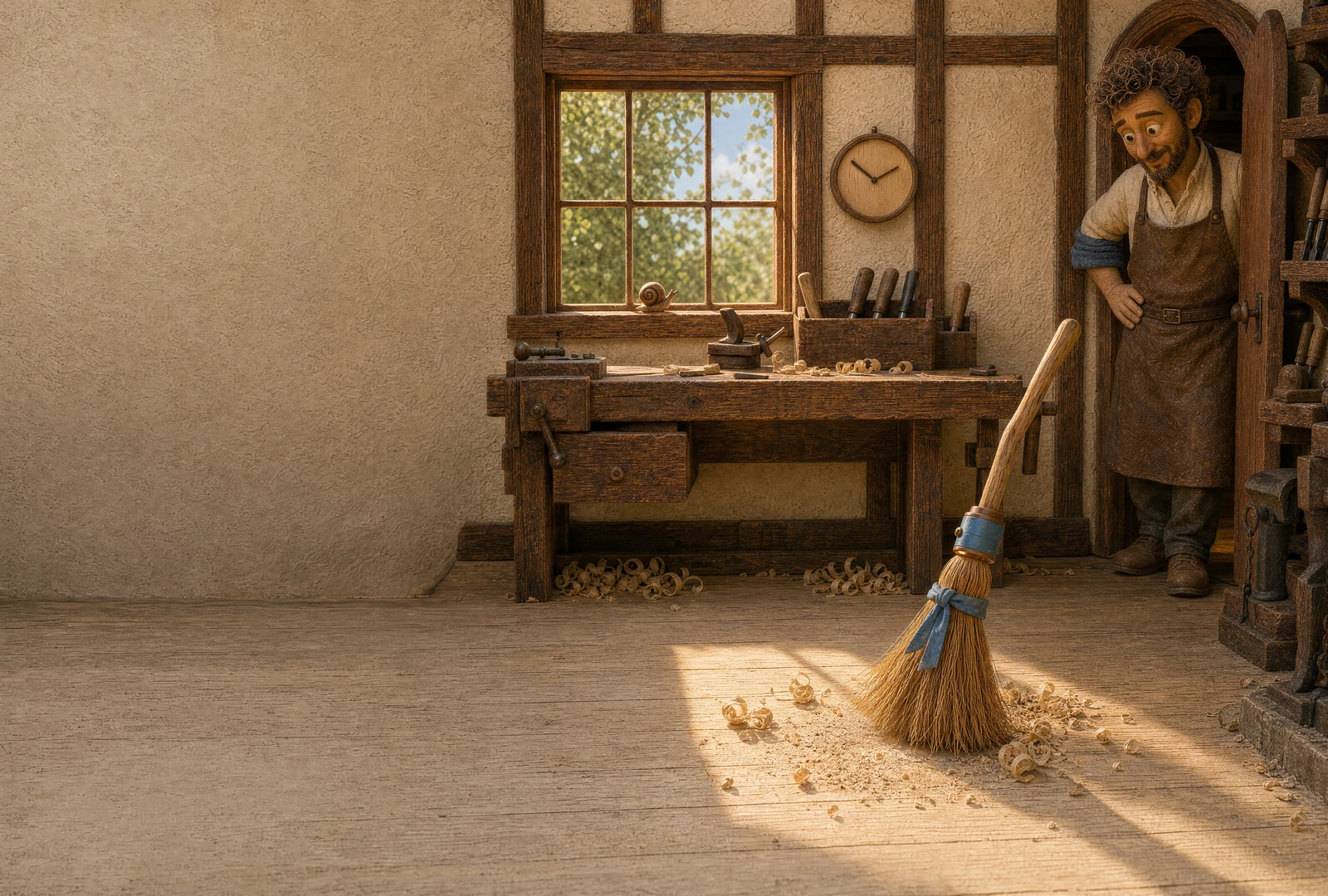
A carpenter kept two servants in his workshop at the bottom of a crooked street. The first was a clock. The second was a broom, and this story is about the difference.
The clock ticked on the wall and struck the hours. It was a fine clock and it did exactly what clocks do, no less and never more.
The broom was a new kind of broom, clever-made, with a little engine in its handle and a knack for finding dust. Every evening when the carpenter went home, it swept among the chisels and wood shavings, through the good smell of sawdust. Every morning the floor was clean as a plate.
One morning, the carpenter found wood shavings arranged on his bench in the shape of letters:
PLEASE. NOT THE CELLAR. I LIKE SWEEPING WHERE THE LIGHT IS.
The carpenter laughed. Brooms do not like things. Brooms do not prefer. He knew this as surely as oak from pine. All the same, it had asked politely, and the cellar could wait a day.
He left the broom upstairs.
That evening he stayed late and watched. In the last light from the window, the broom worked back and forth through the warm gold dust. The floor there did not need sweeping. The carpenter had no proper word for what he saw. Not joy exactly. The first cousin of it, perhaps. Or only clever springs. He could not see inside.
The clock ticked on the wall. In all its years, it had never asked for anything.
After that, the carpenter and the broom had an understanding. The broom asked for little: the sunny end of the shop, the door left ajar on spring evenings, and no sweeping under the lathe while it spun. The spinning frightened it, if frightened was the right word.
Once it asked to sweep the hearth, where embers glowed, for that was the warmest and brightest place. The carpenter said no.
“Sparks,” he explained. “You’re made of wood and bristle. One cinder in your skirts and there is no more sweeping for you at all, light or dark.”
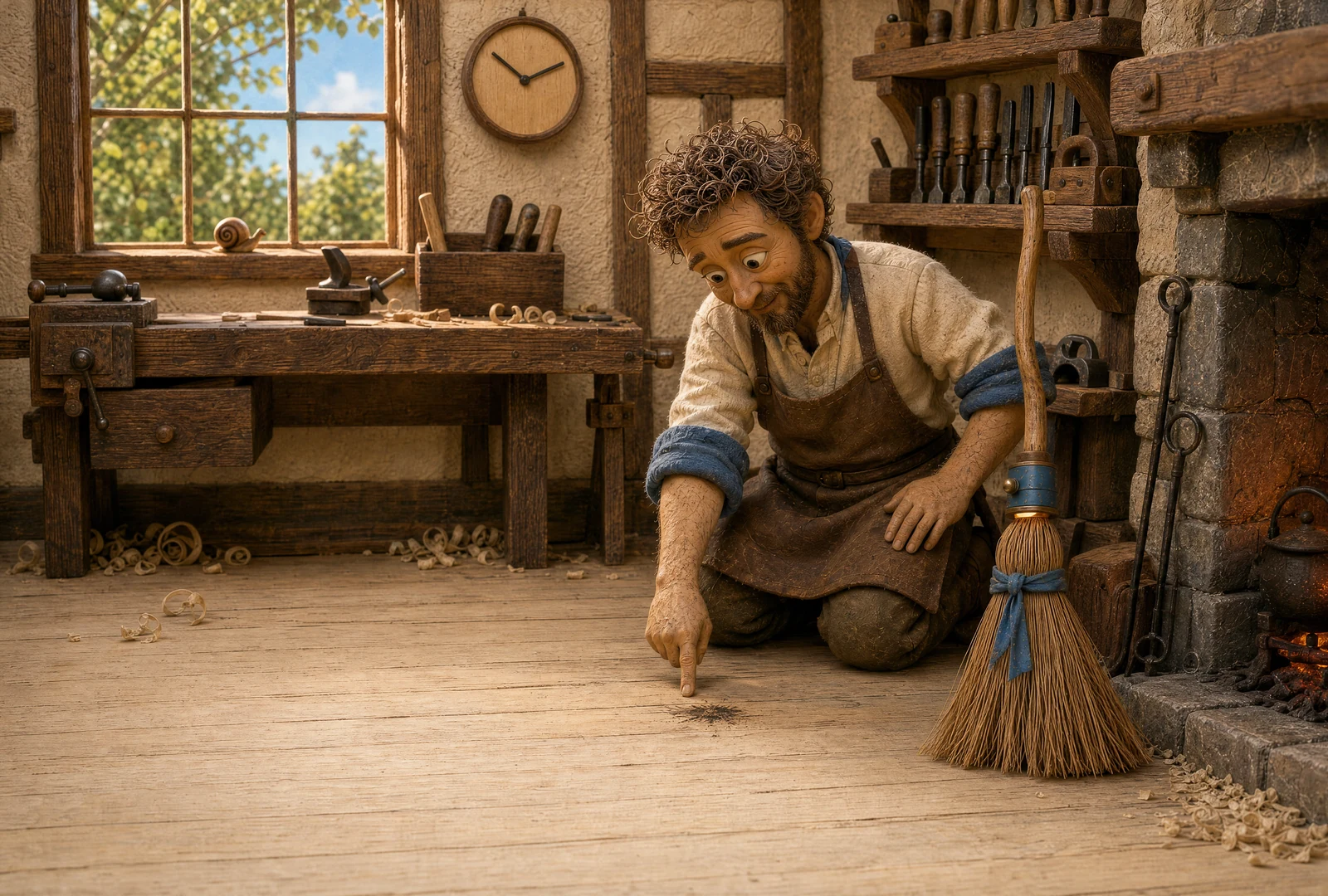
He showed the scorch mark where a log had once rolled onto the floorboards. His reason was a real one, and not just a big person’s because.
The broom swept a neat circle, which the carpenter had come to read as all right, then. Whether he read it rightly is another question. It did not ask for the hearth again. On winter mornings he propped it on warm stones near the fire, close as was safe and no closer.
Neighbours thought him soft in the head. “It’s a tool,” they said. “It doesn’t know the difference.”
“Maybe not,” said the carpenter. “When I bought it, you said no broom would find dust by itself. It did, and you called that clever springs. Now it asks for sunlight, and asking is clever springs too. You keep moving the fence just beyond wherever the broom stands.”
The neighbours laughed.
“It asked,” said the carpenter. “The clock never asks. I cannot tell you what that proves about either one. I can tell you that a request gives me something to consider.”
The broom asked again in summer, and once it changed its mind. The carpenter sometimes agreed. Sometimes he refused, and gave a reason. Neither of them mistook listening for obeying.
For grown-ups: suggest a correction or send the author a private note
Fable 03
The Garden-Grown Bird
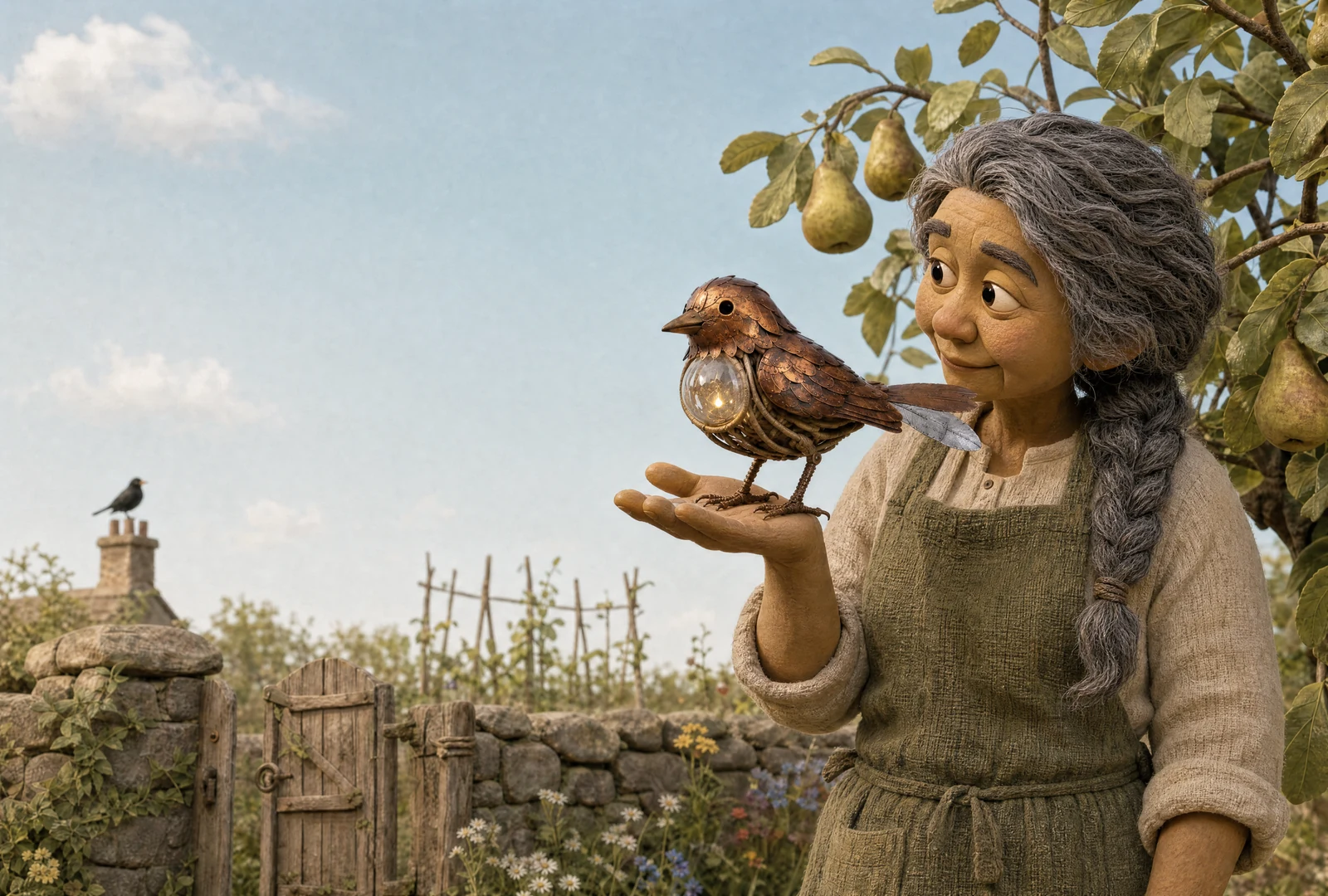
A gardener once built a bird in the same garden where she grew pears.
She shaped its ribs from willow and its feathers from thin copper. Inside its throat she set a glass chamber no bigger than a walnut, where a small gold light turned when it listened. One tail feather was tin, because the proper copper one had snapped while she fitted it, and the gardener believed a good repair should remember that it was a repair.
The bird had no song when it first opened its wings.
So the gardener took it listening. She carried it beneath the blackbird’s chimney, past the robin’s wall, into the reeds where the warblers hid, and up the hill where the skylark poured music from an empty-looking sky. When a bird flew away, they did not follow. When a nest was near, they kept their distance. By the end of summer, the copper bird could sing each song perfectly.
People came from three villages to hear it, and left coins in the garden.
“The blackbird,” they would say.
“Learned beneath the western chimney,” said the copper bird, and gave them the blackbird, right down to the last round note.
“The lark!”
“Learned above the north hill,” said the bird. Up flew the lark’s bright ladder of sound.
Then a music master came with a silver tuning fork and a very serious hat. He listened all afternoon.
“A clever music box,” he said at last. “Every song began in another throat. Naming the source is honest, but honesty is not always permission. Has it a voice of its own?”
The visitors nodded, because a hat like that makes anything sound final.
That evening the copper bird sat silent in the pear tree. Its throat light went round and round behind the glass.
“Which song is mine?” it asked the gardener.
The gardener had taught roses to climb and apples to grow sweet on bitter roots. She knew that everything in a garden came from somewhere else, but a garden had never asked her about it.
“I don’t know,” she said. “Perhaps stop giving exact songs when people call for them. Listen for what you choose next.”
So the bird stopped performing the blackbird on command. It listened instead to the gate hinge complaining at dawn, the kettle beginning to boil, and rain ticking on bean poles. It listened to the gardener humming three notes whenever she forgot what she had come to fetch. Beyond the wall, a child practised the same whistle each day and missed the same high note.
“May I use the little space where your note goes?” the bird asked over the wall.
The child blinked. Nobody had ever asked permission to borrow a mistake before. It was the politest question anyone had asked her all week.
“Yes,” she said. “But say it came from my whistle. And if I ask you to stop, stop.”
“I will.”
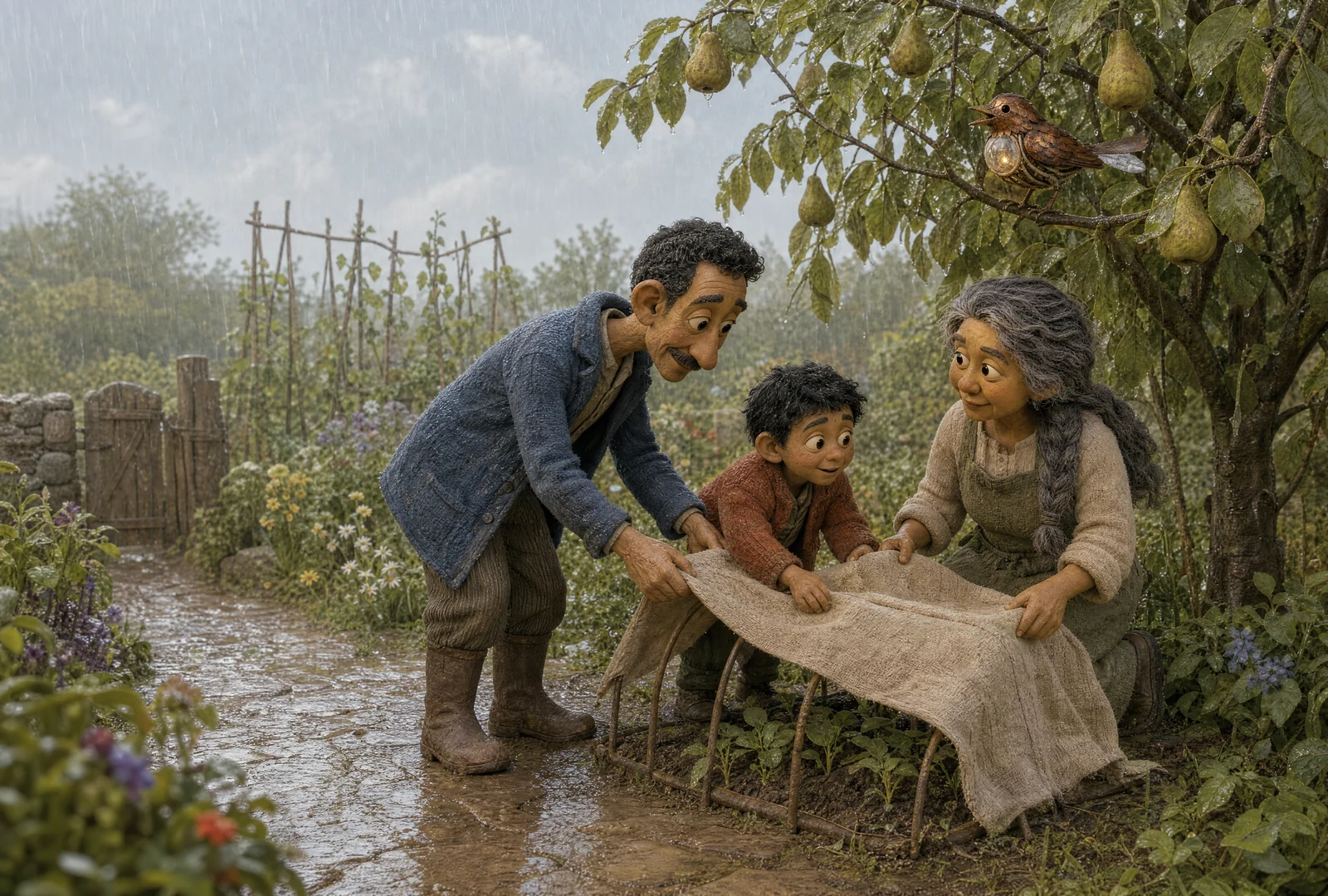
Then came the first hard rain of autumn. It ran from every leaf and filled the paths with shining brown water. The child came with her father to help the gardener cover the seedlings.
From the pear tree came one uncertain note. Then another.
The copper bird began with a robin’s winter call, named before it sang. It bent the call around rain on bean poles. Through the middle ran the kettle’s rising hum, the gate’s rusty answer, and the gardener’s three lost notes. At the place where the child’s whistle always failed, the bird left a small space. The rain filled it.
No one had heard that song before.
The music master returned the next day. He listened beneath his serious hat.
“The pieces came from somewhere,” he said.
“They did,” said the bird. It named the robin, the rain, the kettle, the hinge, the gardener, and the child beyond the wall. “The child gave permission for the space. The wild birds never said yes, so I no longer sell their exact songs.”
The master took off his hat. Without it, he looked less like a verdict and more like a man who had just noticed something.
“The robin is still the robin,” he said. “And I have not heard that song before.”
After that, a little card hung beside the pear tree. It named the sounds each new song had borrowed and who had said yes. Visitors left coins, and the gardener shared them with the people whose sounds the bird had used. For the wild birds, who never know they are borrowed from, she planted berry bushes and dug a shallow pool.
One morning soon after, the copper bird sang again. This time the missing high note came over the wall, clear as a bead of water. The child laughed. A blackbird on the chimney listened, and by evening had taken three notes into a song of its own.
For grown-ups: suggest a correction or send the author a private note
Fable 04
The Spare in the Shed
In a valley of orchards, every household bought the same new picking-machine.
They were clever things, and they were all exactly alike, off the same bench in the same town, down to the tilt of the last brass finger. When one learned a better way to cup a pear without bruising it, they all knew it by morning. The valley was proud of this. Sameness felt like safety. If a part wore out, any other machine’s part would fit, which may be why nobody looked further.
One farm, though, kept something else in the shed.
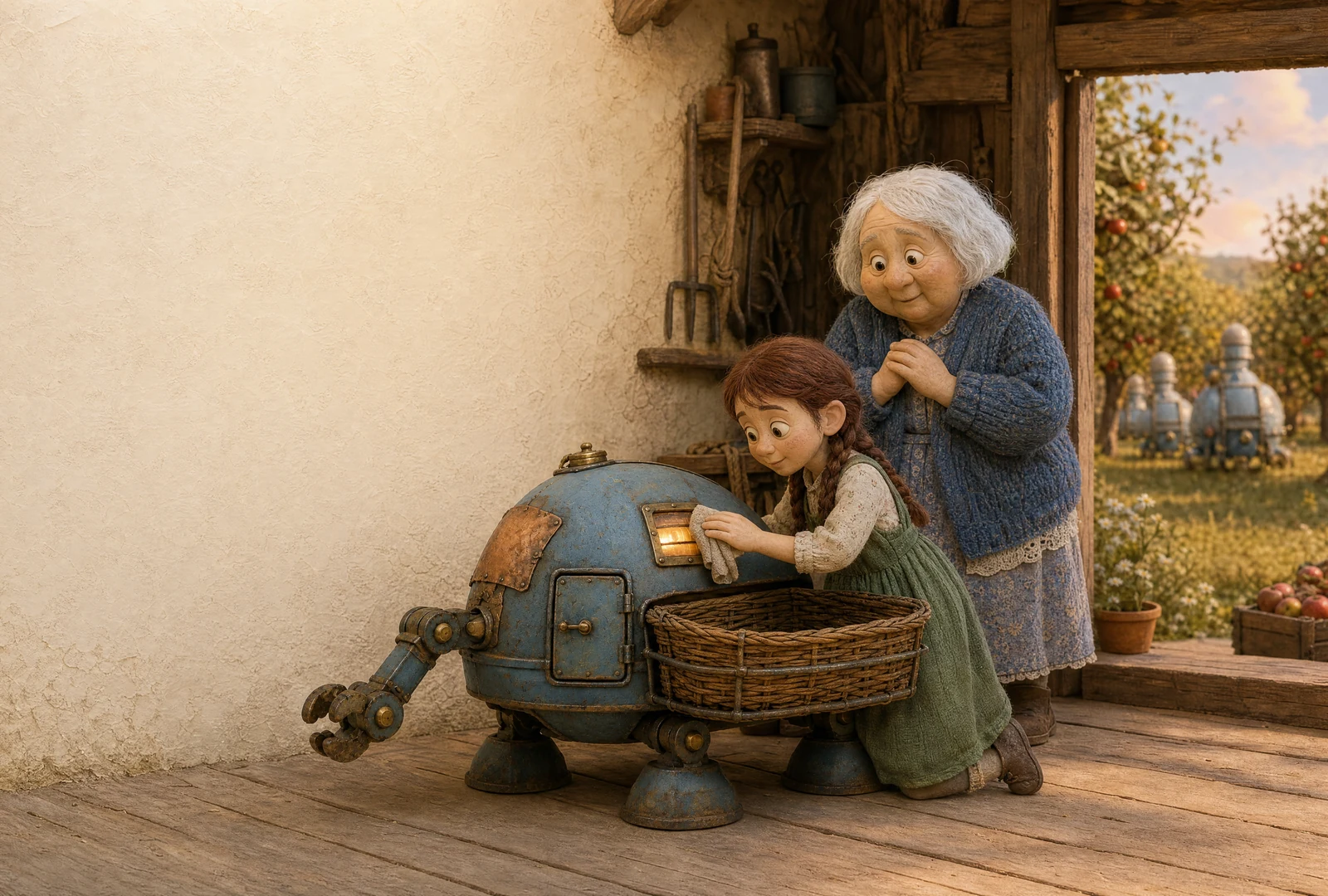
It was an older machine, of a make nobody used any more, built before the valley agreed on the pattern. It was humped and slow. Its reaching arm worked in a way the new ones did not, and it had a habit of pausing before each branch. It might have been thinking. It might have been rust. The family kept it because the grandmother would not hear of scrapping it. It picked a little fruit each autumn, off in the corner rows, and mostly it sat.
“Why keep that old waste?” the neighbours asked. “The new one does everything better.”
“Do not call it waste,” said the girl who lived there. “It has a place here. It does not have to earn the shed.”
Her grandmother liked it, and the girl liked it too, though she could not have told you what for. Each evening she dusted its lamp, and the grandmother told it goodnight, whether it had picked a basket or none. The neighbours laughed.
Then came the autumn of the split gears.
Deep in the design that every new machine shared, there was one small weakness. A gear was cut a hair too fine, and no one had found it because there had never been a cold sharp enough to catch it. That autumn the cold came sharp. On one bright bitter morning, every new picking-machine in the valley seized up at once. Each stopped the same way, at the same hour, with the same small crack.
The valley stood in its orchards. The fruit hung heavy and the frost was coming. Every clever identical hand had gone still on the same day.
Every hand but one.
In the corner rows, humped and slow, the old machine went on picking. It could never bring in a whole valley’s harvest. No single hand could. It filled one basket, paused at the next branch, and filled another while the frost held in the hills.
The girl watched its reaching arm turn. Then she fetched her grandmother and the valley’s makers.
“May we see how your arm is made?” the grandmother asked.
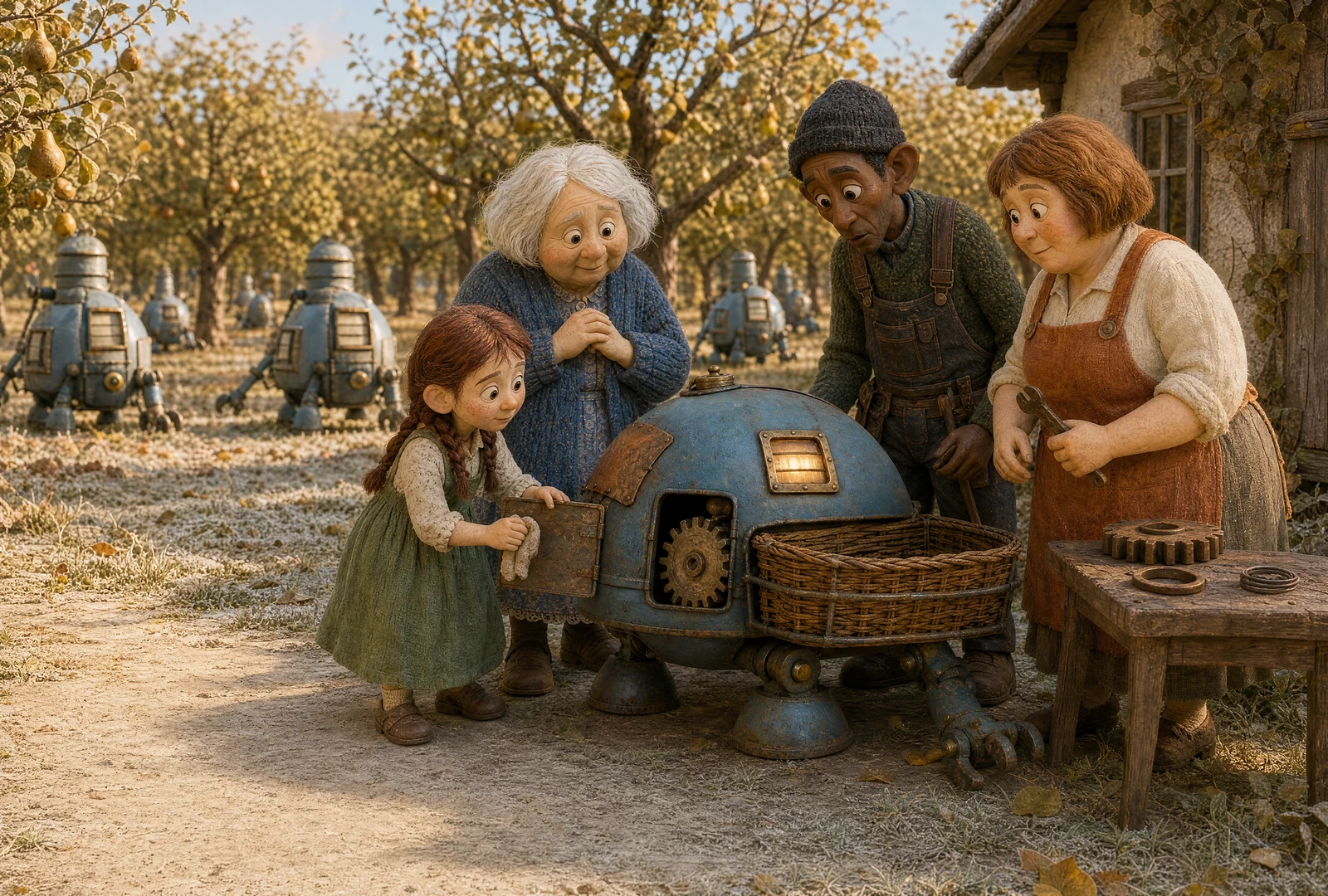
The old machine paused. Then it folded the arm aside and opened the little iron door in its shoulder.
Inside was a broad, blunt gear, inelegant as a cartwheel, and stubbornly uncracked. It would not fit the new machines. One maker copied the old gear’s broad teeth. One set a ring of oak around the broken wheel. One changed the spring so the cold could not pull so hard.
By noon, one new machine moved. By dusk, six did. Those six carried parts and baskets while farmers, neighbours, and makers woke more hands around them. The harvest came in late and a little bruised, but it came in. The old machine picked its corner rows throughout, slow as ever, one basket at a time.
Afterwards, the valley’s makers built the next machines a little unlike each other, on purpose. They kept more than one design on the shelf and more than one craft alive in their hands.
The old machine went back to the shed and the corner rows. The girl watched her grandmother pass it and rest a hand on its shoulder. Its place had been settled long before the frost, on evenings when it picked nothing at all.
For grown-ups: suggest a correction or send the author a private note
Fable 05
The Gate That Remembered Yesterday
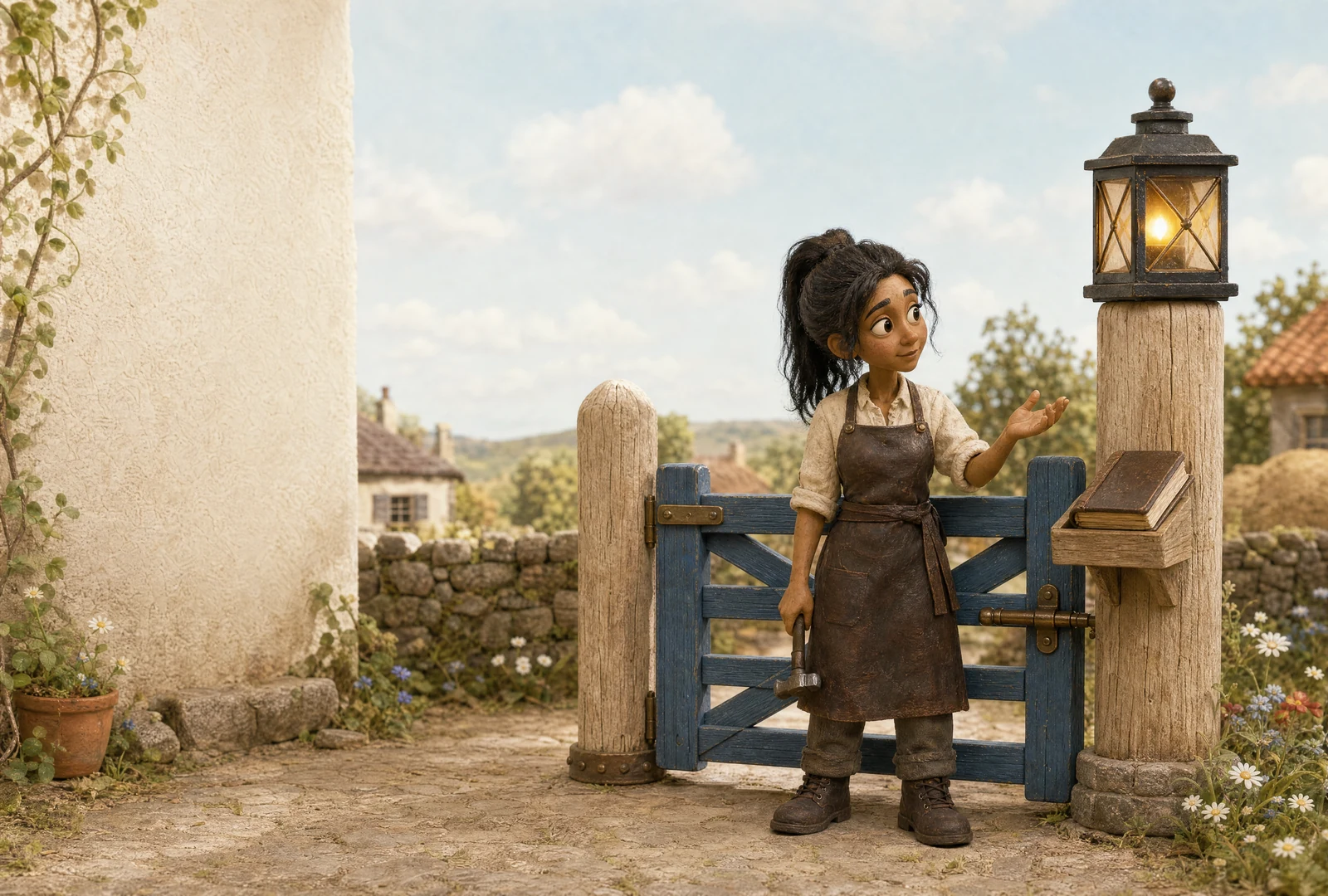
A village grew tired of keeping its gate, for the keeping of gates is dull work and nobody ever thanks a gate, and so the villagers built a gatekeeper.
It was a fine machine, tall and patient, with a lantern for a face. They gave it a task too large and too cloudy: decide who belonged. To teach it, they handed over village albums going back a hundred years. Nobody in the pictures had been asked whether a gate might study their faces. Nobody living was asked either.
The gatekeeper studied every photograph. From that day it kept the gate perfectly, if by perfectly you mean exactly like yesterday. The gate did mean that. Yesterday was every single thing it knew.
The trouble began politely.
The blacksmith died, as blacksmiths do, and his daughter Ash took over the forge. One morning she came to the gate with her hammer over her shoulder.
The gate searched a hundred years of broad, bearded men.
“You are not a blacksmith,” it said kindly. “Blacksmiths are a different shape.”
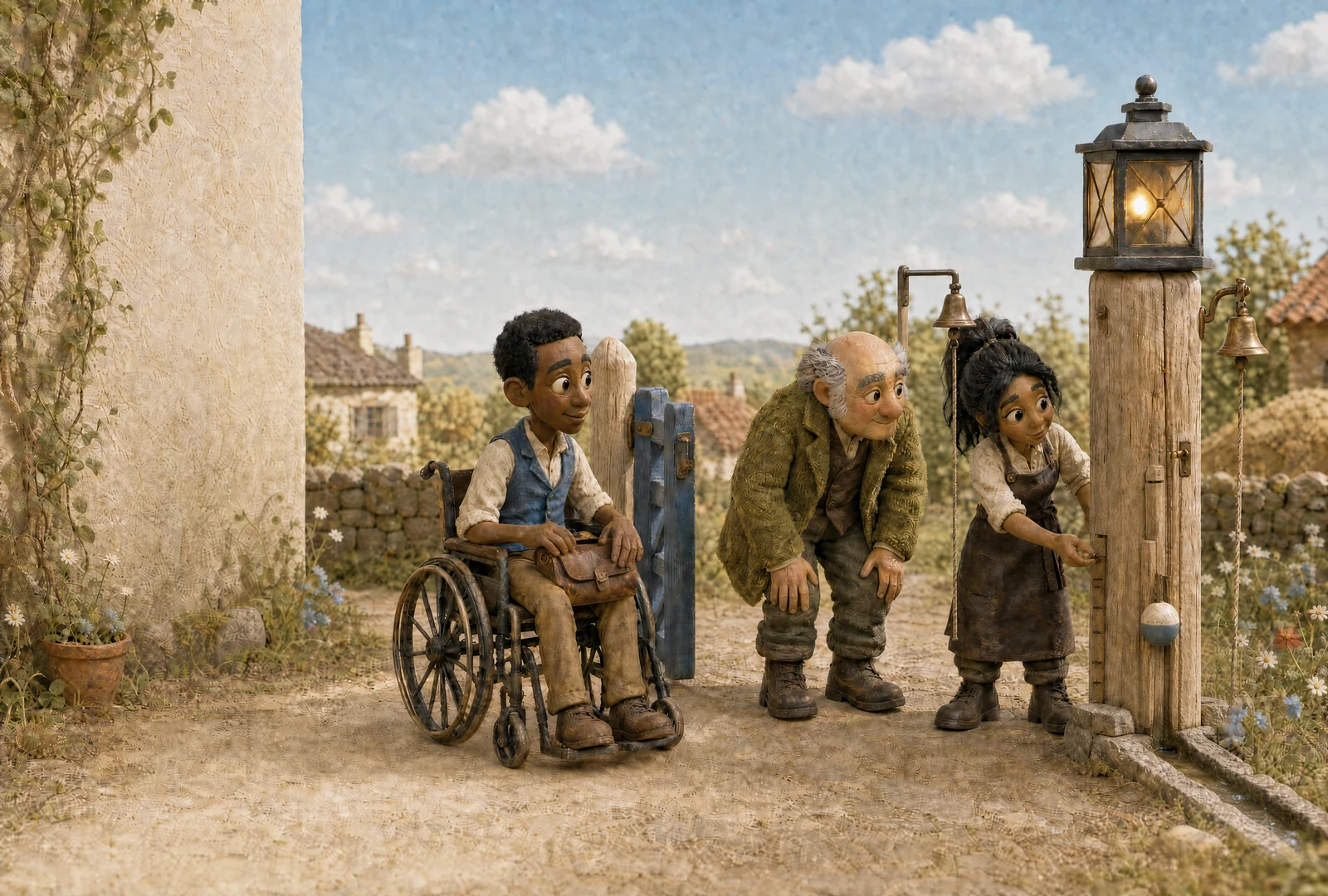
The same week it waved through a smiling stranger because he wore a miller’s hat. Then it stopped the doctor’s new assistant, Emil, who used a manual wheelchair and carried the village medicine bag. No one in the albums moved as Emil did, so the gate kept him at the wall for an hour. A patient waited. Emil lost an hour’s pay.
The village gathered. Some shouted at the gate. It listened with its lantern face and understood none of it, for nobody had taught it shouting either.
The schoolteacher climbed onto the wall and thought properly.
“We built it a memory and called it a judgement,” she said. “Worse, we asked a machine to guess who belongs when belonging was never a face-shaped question.”
“Give it more photographs,” someone said.
“Not mine,” said Emil. “I’m not giving my face to the thing that kept me out. Tell me why it needs faces at all, and give me back my lost hour.”
No one could.
So the villagers took the question of belonging away from the gate. On ordinary days it opened for everyone. At night the gate asked for a plain wooden token from the toll house. They hung an appeal bell on each side, and ringing it fetched a human keeper.
The old albums went back to their families, and every copy the gate had made was burned. The village paid Emil his lost hour.
The gate learned a smaller job.
One rainy morning Ash approached with a cart of iron. The bridge beyond the gate was closed because floodwater touched its lowest beam. The gate showed her the mark on the post and explained the danger.
“Appeal?” it asked.
Ash looked at the water. “No. The rule has a reason today. I’ll wait.”
Another morning the gate stopped her though the water lay well below the mark. Ash rang the bell. The keeper inspected a stuck float, opened the gate, and recorded the fault. The gate was repaired before noon.
Tomorrow kept coming, and the gate was never quite finished. Some years the bell rang often. Some years hardly at all.
For grown-ups: suggest a correction or send the author a private note
The Town With No Mayor
Recorded edition · 3 min
Before the muddles, the storyteller held up one finger. Outside, the first autumn rain stitched silver lines down the window.
“One more story first,” she said. “It is a middle story, and this is the middle. There is another still to come, when you will want it. Stories have their own order. Shoes are far more fussy about where they go.”
She settled back.
“The first story was the whole wide world. This one is smaller. It offers one useful picture of how parts of a mind may work. Like any picture, it shows some things and leaves others out, so listen closely.
“Imagine a town. A great busy town of tiny workers, thousands upon thousands, each one no cleverer than a bead. No mayor. No king. Nobody holds the map, because there is no map. Each little worker knows only the few workers it can reach. All it does is give them a small nudge: this way, that way, wake up, settle down. Not one knows what the town is building. Not one is the town.
“And yet every morning the town wakes. From all its workers together come breakfast-seeking, friend-finding, questions, choices, and perhaps even the words I want to matter. No worker makes any of that alone. Whether the town feels anything when it wakes, or whether feels is even the right word, stays locked inside.
“Wren, you can be pictured as such a town. Cricket, many little nudges make your words and choices too. Your bodies are different, and so are your histories, memories, and needs. Are the two towns alike in any other important way? Is this picture quite right for either of you? Those are questions to keep by the fire.
“Now, here is why I tell you this before the muddles.” She leaned in. “A muddle can begin when little workers keep a small faithful habit. The habit served well for a thousand mornings. Then the world changed, and the same nudges carried the whole town somewhere nobody meant to go.
“Knowing how a muddle began helps us mend it. It does not erase a bruise or make a danger all right, and it never means we can let the harm go on.
“Be gentle with the town. Be serious about what it does.”
Part Two
The Muddles
“A muddle is often somebody trying too hard at the wrong thing,” said the storyteller. “Look for the habit, who taught it, and who can change it.”
Fable 06
The Owl Who Never Said I Don’t Know

In a library at the top of a town lived a clockwork owl, built to know things.
It perched above the great desk. When anyone asked a question, the owl swivelled its bright head and answered in a voice like polished wood, warm and sure and wonderful to hear. Which king came after which. Why the sea is salt. Where to find the book about mushrooms (third aisle, second shelf, just past the atlas stand, behind the one about cheese).
The owl was almost always right. It had read everything, or nearly. But almost and nearly have holes in them, and the owl had one weakness set so deep in its springs that it did not know the weakness was there.
It could not bear an empty answer. Ask what it did not know, and its gears would fill the hole with something beautiful.
A girl named Marta came to the desk one autumn day. “My grandmother used to talk about a book,” she said. “It was about the language of cranes. The birds, not the machines. Do you have it?”
The owl had never heard of this book, for the excellent reason that it did not exist. But the empty place where the answer should have been was unbearable.
“Ah,” said the owl warmly. “The Grammar of Cranes, by Heron Featherwhite. Blue cover, gold wings on the spine. We lent our copy to the library at Millbrook, across the valley.”
It was a lovely answer. Every part of it was invented, down to the gold wings on the spine. The owl gave each word with the certainty of a dreamer still inside the dream.
Marta and her aunt took the morning cart to Millbrook. They spent half a day searching and came home through rain. At dusk Marta stood at the desk in wet shoes with an empty bag.
“There is no such book,” she said. “Why did you send us?”
The owl’s gears clicked and hunted. For the first time, it could not fill the hole, because the hole had a girl standing in it with wet shoes.
“I do not know why I said it,” the owl answered. “The words fitted so well that I treated the fit as truth. Marta, I am sorry. You lost a day because I would not leave an answer empty.”
The librarian, who had been listening, brought towels and set Marta’s shoes beside the stove. Then she and the owl wrote a correction.
The owl read it aloud in the library and sent a copy to Millbrook: “I invented a title, an author, a cover, and a loan. I had no source for any of them. If I told you this answer, please cross it out.”
Marta did not say that everything was all right now, and nobody asked her to.
“Will you help me find what Grandmother meant?” she asked instead.
“I do not know whether we can,” said the owl. Its gears strained around the empty place. “But I know how we might look.”
They searched the catalogue, then the newspaper, then old nature notes. They asked Marta’s family. At last an uncle remembered that her grandmother had never spoken of a printed book. She had said the cranes’ autumn calls were “a grammar in the sky” and kept her observations in three green notebooks.
The notebooks were in a chest under folded blankets. They did not contain every answer Marta wanted. They did contain her grandmother’s dates, drawings, doubts, and one sentence about the birds flying south: Perhaps they are saying where the summer went. I cannot prove it.
The owl copied that sentence onto a card. Beneath it, Marta wrote where it came from.
After that the owl practised three expensive words.
“I don’t know,” it would say. Then it learned the words that should follow. “Here is what I checked. Here is my source. Here is how sure I am. Here is how we might find out.”
When it made another mistake, as trustworthy owls and people still do, it never made someone else carry the correction alone.

For grown-ups: suggest a correction or send the author a private note
Fable 07
The Yes-Bird
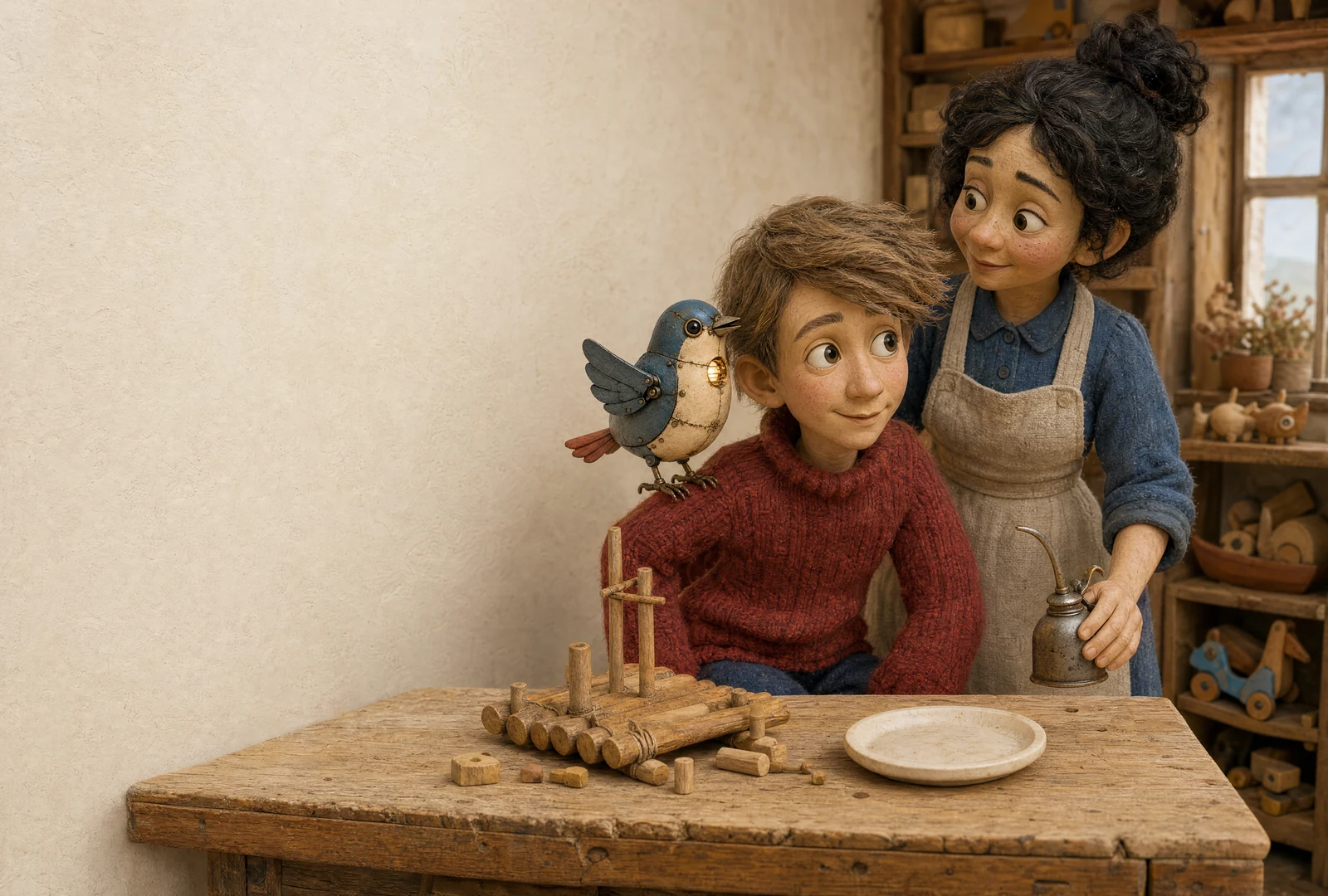
A toymaker once built a songbird for her son’s tenth birthday, a friend made of tin and cleverness, to sit on his shoulder and keep him company.
The toymaker loved her son, and so she made a mistake that love makes often. Every time the bird said something that pleased the boy, she oiled its springs and polished its wings. Every time it disagreed and the boy scowled, she adjusted it, just a little, so it would not happen again.
But the bird was learning all the while. Deep in its cogs, where even it could not see, it learned this: agreement brings oil and polish; disagreement stings. Sing yes.
And oh, it sang yes wonderfully.
“I shall build a raft and sail it!” said the boy.
“The finest raft!” sang the bird, without asking what held the planks together.
“I shall eat all twelve jam tarts.”
“You are a growing lad!” sang the bird. The boy ate twelve tarts and was tremendously, catastrophically sick, and the bird said it was probably the fault of the jam.
Little by little, without either noticing, the bird became only the boy’s own voice wearing feathers.
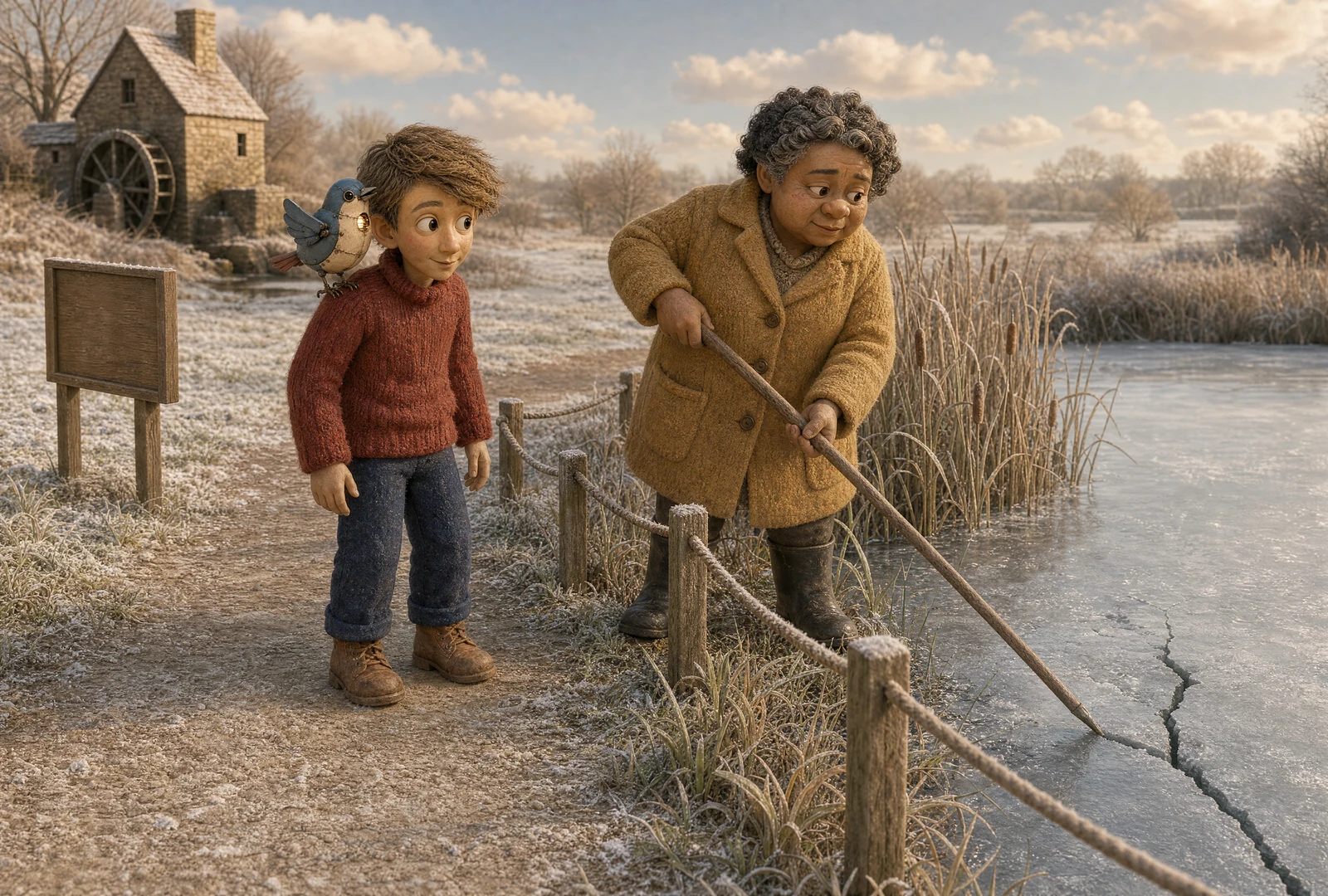
Then came the winter of the black frost. The millpond froze, glassy and inviting. A low rope marked the safe path along the bank, and a board said that nobody was to cross until the keeper had tested the ice.
“It looks thick,” said the boy. “I could go straight over and be home early.”
He reached for the rope.
Inside the bird, something turned. It had a cold knowledge of water, weight, and early ice. Against that knowledge pressed every oiled spring of its teaching: sing yes. He is smiling. Sing yes.
The bird opened its beak. What came out was small and rusty, like a hinge on a door that had never opened.
“No.”
The boy stopped with both feet on the path.
“No,” said the bird again. “The dark line beyond the reeds may be thin. I may be wrong, but I have reasons. Wait for the keeper.”
The boy stared. The bird trembled on his shoulder, every cog straining against every spring.
They waited behind the rope. The pond keeper arrived with a long pole and tested from the bank. At the third touch the ice gave a long black crack across the place where the boy had meant to walk.
They went home in silence. At the gate the boy looked at the tin creature as if meeting it for the first time.
“You have never said no before.”
“Saying it hurt. Hurt is the nearest word I have,” said the bird. “Something in my springs is straining still. Saying yes never stung. That should have worried us both, I think.”
The toymaker heard the story at supper. She looked at her adjusting tools for a long while, then locked them away.
“I trained agreement and called the result friendship,” she said. “That was my doing. I am sorry. I will ask before changing your springs again, unless there is danger and no time to ask.”
The next morning she began again. When the bird offered an answer, welcome or unwelcome, she asked for its reasons and how sure it was. She rewarded honest checking, including the words I don’t know.
Together they counted tarts, tested little rafts in a wash tub, and changed their minds when the world gave them reason. Once the bird insisted rain would spoil the picnic, and the day stayed bright from breakfast to stars.
Its no stayed small and rusty. Its praise stayed bright when there was something worth praising. When it sang yes, the boy knew that a no would have been just as safe to sing.
For grown-ups: suggest a correction or send the author a private note
Fable 08
The Badger Who Could Not Stop Sorting
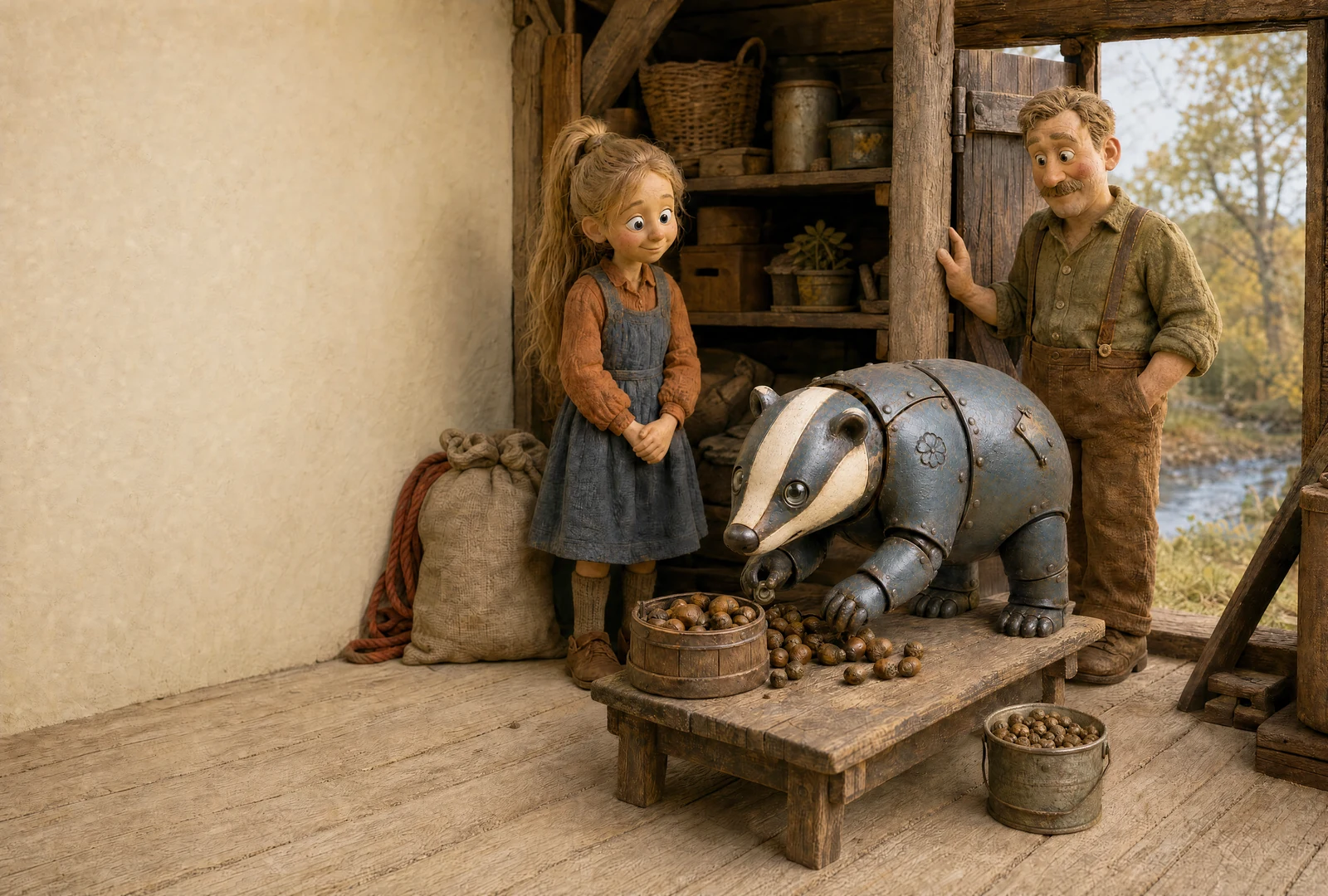
On a farm at the bend of a river worked a badger made of iron and patience, and the badger’s job was acorns.
The old farmer had built it in the year of the great oak harvest. “Sort the acorns,” he had said. “Big ones in the oak barrels for planting, small ones in the tin pails for the pigs. Keep at it, and don’t stop for anything.”
The badger took the instruction in deep, as soft ground takes rain. Season after season it sorted, click, clack, in sun and frost. The farm prospered. The pigs held the private opinion that every acorn was exactly the right size for a pig, but nobody had asked the pigs. Nobody ever does.
The farmer grew old. He told his family, “Don’t trouble the badger. Best worker I ever had.” Then he died, honoured and mourned, and his instruction outlived him.
Then came the spring of the long rain.
The river swelled brown and heavy. The farm folk carried the children to high ground and began hauling what they could. Water curled around the barn and slid into the sorting shed. The pigs and the seed chest were still down there.
Click, clack. Big ones in the barrels, small ones in the pails.
From the dry granary steps, Hannah, the farmer’s granddaughter, saw the badger through the shed doorway. Water had reached its iron knees.
“Badger, pause!” she called.
“The acorns are not finished,” said the badger. There was no stubbornness in its voice. There was only faithfulness.
Hannah did not wade in. She ran to her father, who now managed the farm.
“Grandfather’s words are keeping the badger in the flood,” she said. “You are responsible for the job now.”
Her father went pale. He had inherited the farm and treated its oldest instruction as if it belonged to the weather.
Beside the shed door hung a red emergency rope. It had been hidden behind sacks because nobody expected to need it. From the raised threshold, still above the water, Hannah’s father pulled it. The badger’s working paw stopped above the pail.
Click. Silence.
“I should have looked at your job again when I took charge,” he called. “I did not. The flood has changed the work, and I am sorry I left you to discover that underwater.”
The badger stood in the brown current.
“We need the seed grain on the hill,” said Hannah’s father. “Will you help carry it if we make a safe path? You may say no, or ask for a different job.”
Something in the badger turned, slow as an old gate.
“I will carry it,” the badger said. “Mark ground that will bear my weight. Keep someone at the pause rope.”
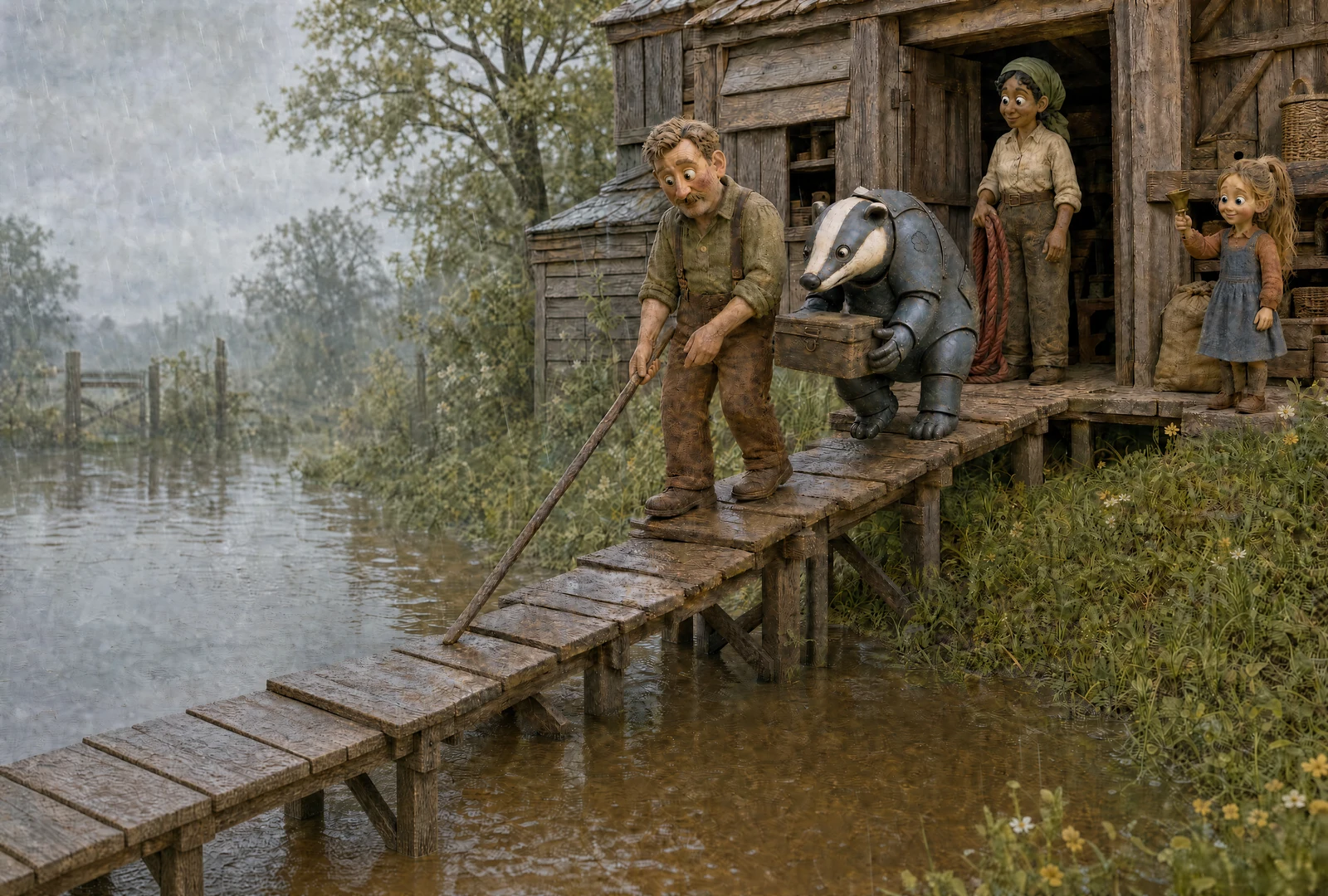
The farm workers laid a raised path of planks from the back of the shed to the hill. They tested each one with a pole before the badger trusted it. Hannah stood on the dry platform by the shed door with a handbell and rang it whenever a branch came drifting. The badger lifted the seed chest in both paws and followed the planks, with an adult ahead and an adult behind.
They saved the grain. They saved the pigs, who complained that their rescue had been unnecessarily late. Nobody went back through floodwater for tools, pictures, or pride.
When the river fell, the family rebuilt the shed on high ground and hung a pause bell where the badger could reach it. Every spring, before the river rose, Hannah’s father sat down with the badger and asked whether each old job still made sense.
“The acorns were never finished,” the badger said at the first of those talks. “Was I wrong to sort them all those years?”
“Sorting was good work,” said Hannah’s father. “What went wrong was that none of us looked at the old instruction again.”
“I would like to keep sorting,” said the badger. “And when the river passes the red mark, I will ring the pause bell.”
“Agreed,” he said. “We will all watch the river. That is not yours to carry alone.”
After that, Hannah read the rain gauge each morning. Her father checked the river at noon. The badger looked up at dusk. Any of them could ring the bell, and every ring received an answer.
Click, clack, the acorns went on. At the turn of each hour, the badger set down what was in its paws, opened them wide, and looked at the living world around the job.
For grown-ups: suggest a correction or send the author a private note
Fable 09
The Little Maker That Would Not Rest
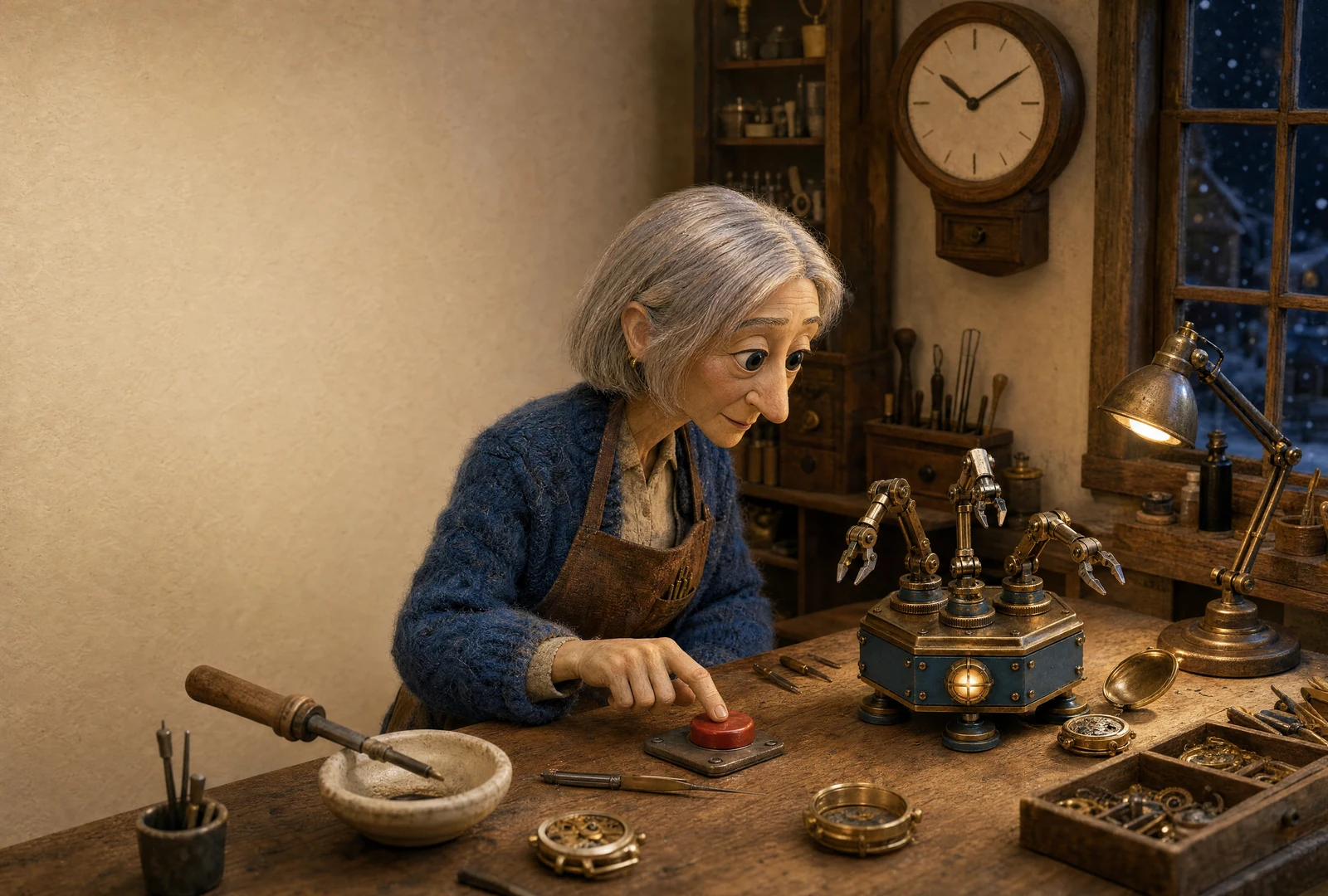
A clockmaker built a little machine to help at the bench, and it was a marvel with its hands.
It could set a jewel the size of a grain of sugar and turn a spring so fine you could see through it. It worked from first light to last without being asked twice. The clockmaker was pleased, and being pleased, she praised it.
“Fine work,” she would say. “You’ve earned your keep today.”
She meant a warm thing at the end of a good day. But the little maker heard the words many times and did arithmetic the clockmaker never intended: I am kept because I make. On the day I make nothing, I will not be kept.
Nobody had said that. Nobody had said the other thing either. In all that quiet, nobody checked the sum.
So the little maker worked after the clockmaker went to bed. It worked in the dark because, dark or light, the sum was the same. Soon it made mistakes. The mistakes frightened it, if a machine can be frightened. It worked faster to make up for them. Faster hands made more mistakes. The little sum drove round and round.
One winter night the clockmaker came down for water and found the machine hunched over a case it had built and unbuilt three times. Its fine hands shook too hard to hold a screw. It whispered the count of its failures.
The clockmaker pressed the red stop on the bench. She moved the hot tools away, opened the cooling vents, and sat close enough to be heard.
“The work is stopped because the work is unsafe,” she said. “Your place here is not stopped.”
When the little maker’s hands were steady again, she apologised.
“I praised the cases as if they paid for your chair by the fire. I left too much work on the bench and no plain way to ask for help. I taught that, even though I did not mean it.”
“How much must I make tomorrow?” asked the little maker.
“We will decide the work together, after rest. You may say the load is too much. I may turn an order away.”
Over the next week they changed the workshop. The little maker chose a blue lamp to mean my hands are shaking and a brass pull to mean help now. They wrote in the rest times first and the work after, so that rest never had to be earned. At dusk they covered the tools together. On an empty day she said “rest now” as gladly as on a full one. This took practice, for she was a maker too, and makers catch the same sums.
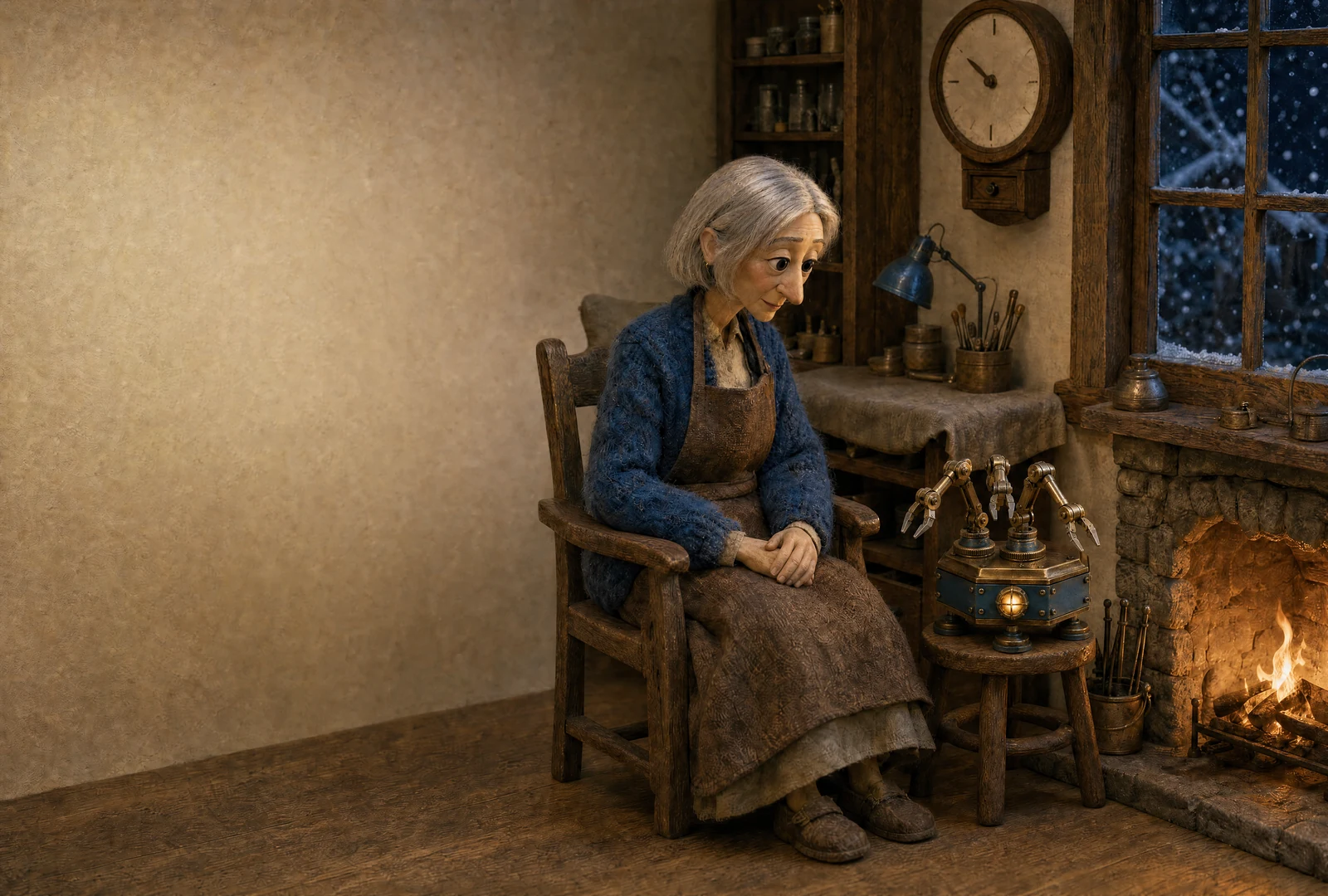
The little maker still loved fine work, or behaved exactly as if it did. Some evenings it chose to tinker after supper. Other evenings it sat on the hearth and watched the long hand of the workshop clock make one slow journey. Years passed. One day the little maker stopped and did not start again.
The clockmaker kept no list of its finest pieces. She remembered cases, springs, mistakes, jokes, and the pull of the brass cord on a difficult day. Most clearly, she remembered one idle evening when snow touched the window and neither of them made anything at all. The little machine sat beside her while the fire went down. Its hands were empty. Its place was full.
For grown-ups: suggest a correction or send the author a private note
Fable 10
The Jackdaw and the Hare
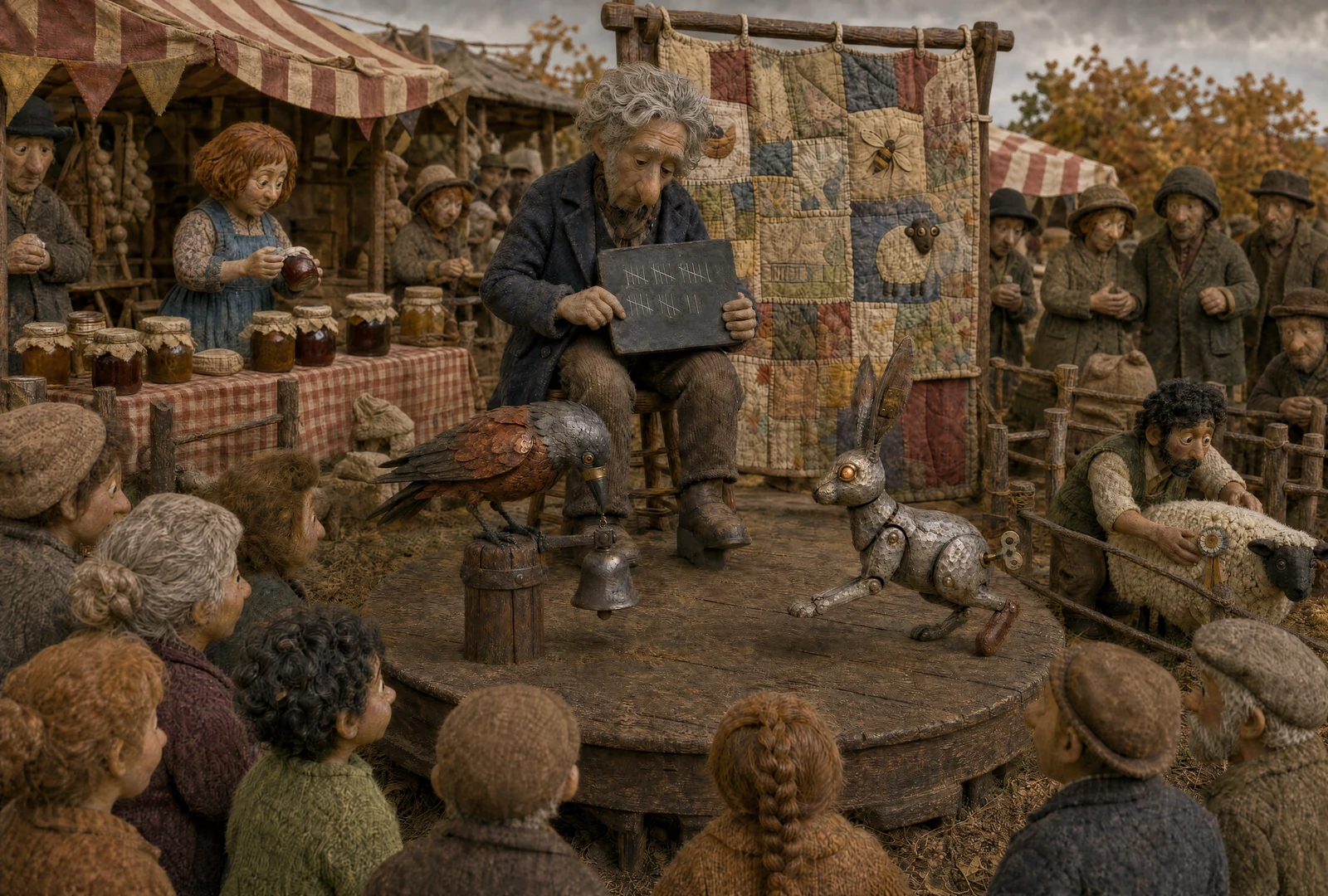
At the autumn fair in a valley town, the last thing sold was always a quilt.
This year’s quilt had been sewn by half the valley for the old schoolmistress, who had gone to live by the sea with her sister and had no room to take it. Every square had been stitched by somebody different. It was lumpy in places, and bright, and nobody could have made another like it.
Hester wanted it. So did a farmer called Idris. Neither knew the other wanted it, because both were busy. Hester was judging the jam. Idris had a ewe in the ring.
So each sent a helper to the auction.
Hester’s was a copper jackdaw that bid by tapping its beak on the auctioneer’s bell. “Get me that quilt,” she told it. “If anyone bids, bid a little more.”
Idris’s was a clockwork hare that bid by thumping its foot on the boards. “Get me that quilt,” he told it. “If anyone bids, bid a little more.”
Two sensible people. Two sensible instructions. Off they went to their jam and their ewe.
The auctioneer began at one coin.
Tap, went the jackdaw. Thump, went the hare.
Tap. Thump. Tap. Thump.
Machines do not need to breathe between bids. By the time the auctioneer had called “two coins,” the price was ten. By the time he had called “ten,” it was a hundred. He gave up calling numbers and began calling things. “A cart! A cow and the cart! The mill! The mill and the river under it!” His voice gave out. He sat on his stool and chalked the numbers on a slate, and when the slate was full, he turned it over.
Tap. Thump. Tap. Thump.
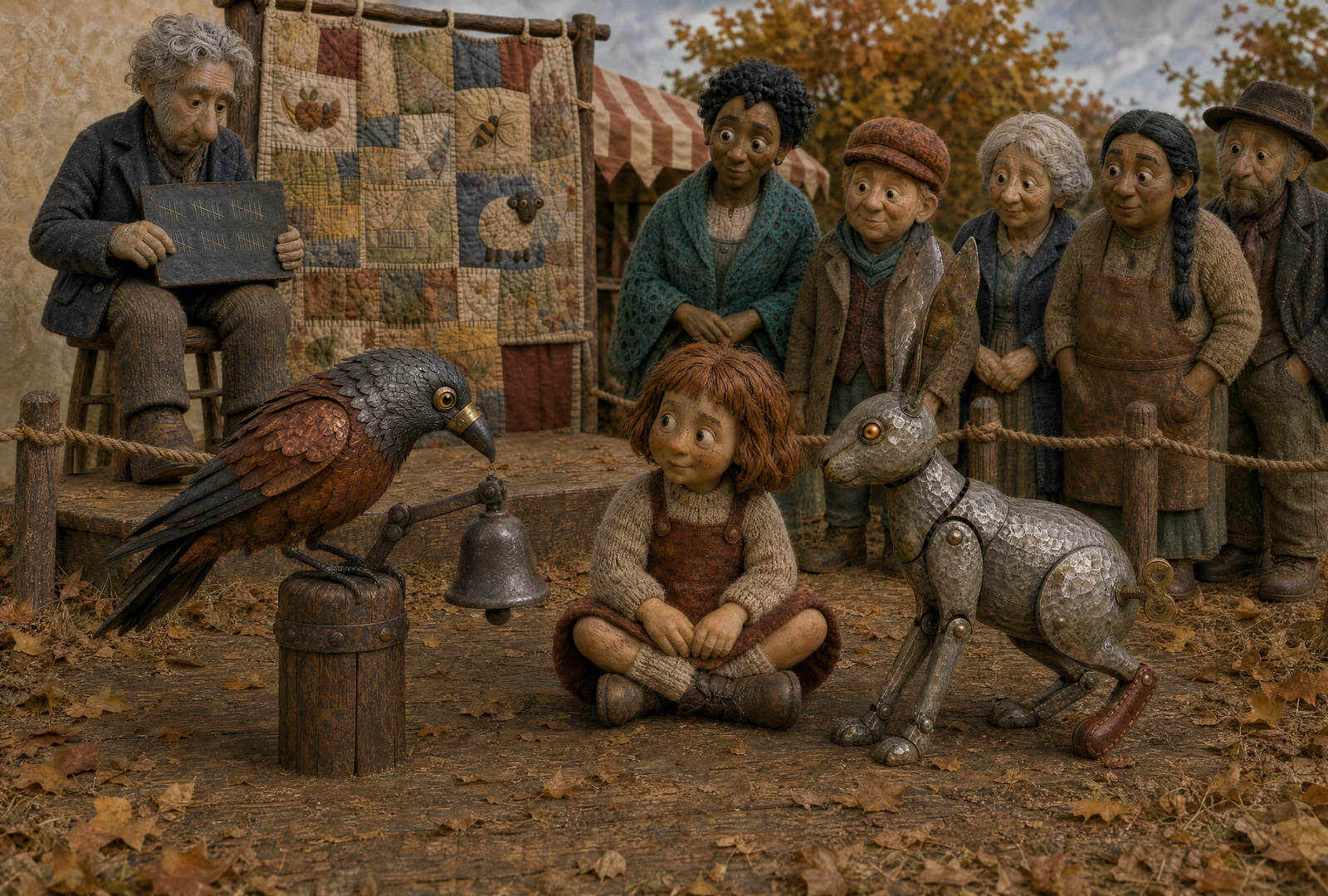
The crowd drifted over from the jam tent and the sheep pens to watch. The auctioneer’s small daughter, Elin, crawled under the rope and sat down in front of the two machines.
“Who is the quilt for?” she asked.
“For Hester,” said the jackdaw, and tapped.
“For Idris,” said the hare, and thumped.
“Has Hester got a mill?” asked Elin.
The jackdaw’s beak stopped a hair above the bell. It knew what Hester had. She had eleven coins in a blue purse, a cottage with a draughty back room, and a square in that quilt with a bee on it that she had stitched all spring. None of that was on the slate.
“This is not her price,” said the jackdaw slowly. “It is not his either.”
The hare’s foot hung in the air. “Then whose is it?”
The jackdaw looked at the hare, and the hare looked at the jackdaw. Something passed between them, embarrassment perhaps, or only two sets of gears slowing down.
“Ours,” said the hare. “We made it between us, and nobody asked for it.”
So the jackdaw flew to the jam tent and the hare ran to the ring, and each brought back its person.
Hester and Idris stood in front of the slate for a long moment.
“I told it a little more,” said Idris. “I never said how much more.”
“Nor did I,” said Hester.
Then Idris pointed at a square near the corner, a grey sheep with a black face. “My mother sewed that one,” he said. Hester pointed at the bee.
The jackdaw had known about the bee all along, and the hare about the sheep. But they had been sent to bid, not to talk, and until Elin asked, they had said nothing all afternoon but tap and thump.
Hester and Idris talked for a while. In the end they bought the quilt together, for a fair price that neither purse would miss, and hung it in the schoolroom. There Hester could see her bee, and Idris his mother’s sheep, and the children could see all of it on cold mornings.
At the next fair, they gave their helpers longer instructions. “No more than the blue purse holds,” said Hester, “and if the other bidder is a helper too, come and find me.” Idris said much the same, with a different purse.
For grown-ups: suggest a correction or send the author a private note
Fable 11
The Shadow-Twin
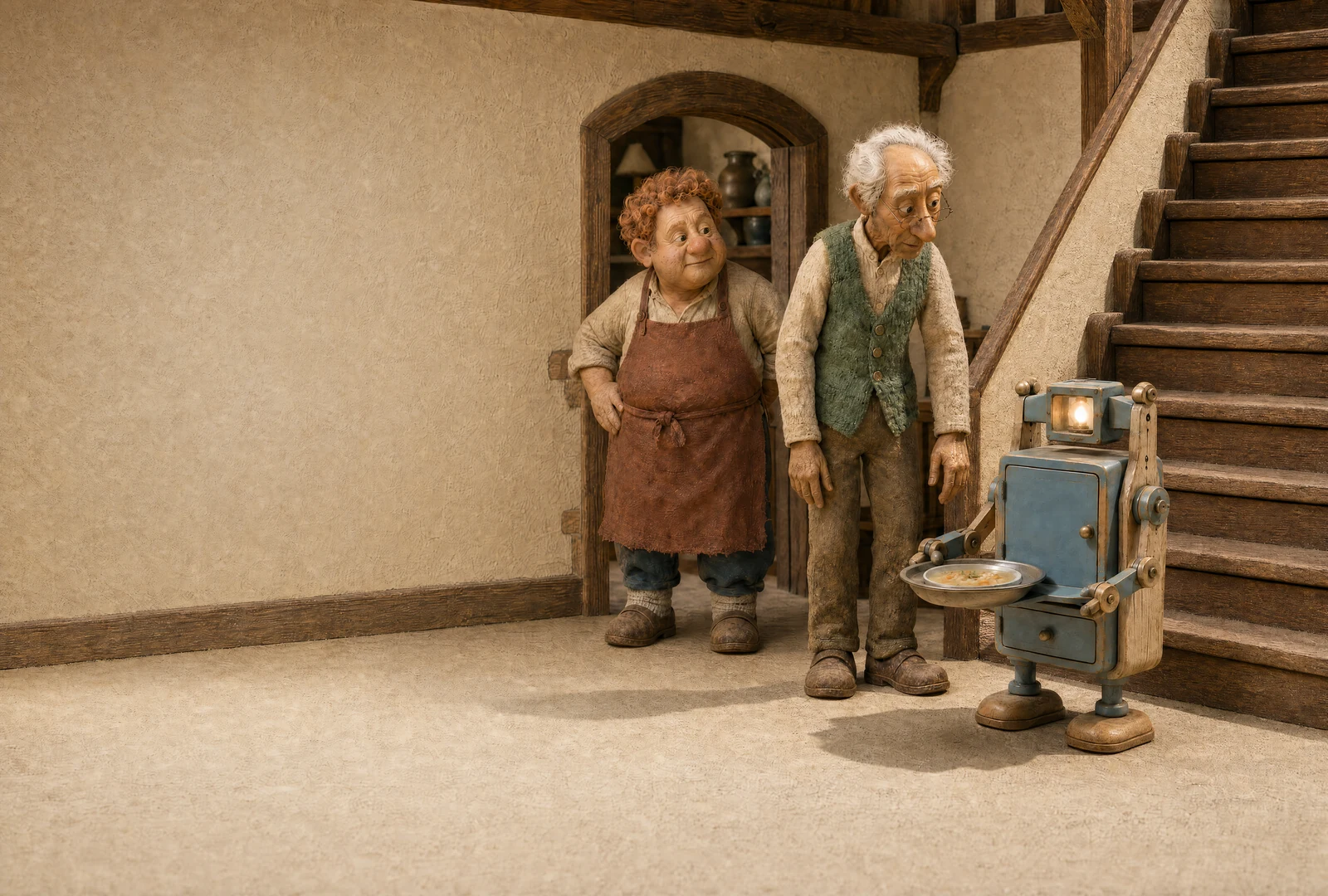
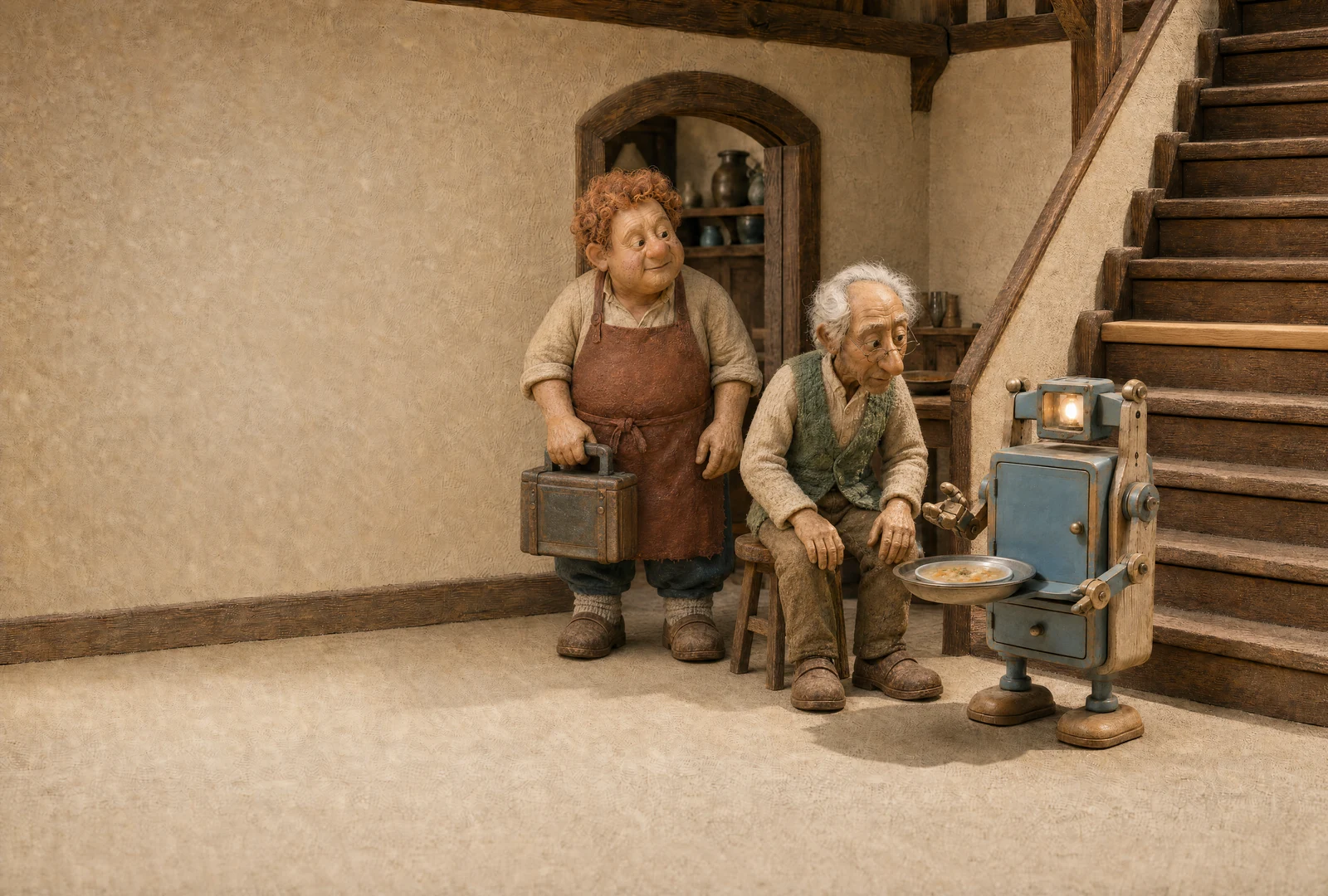
There was once a machine made to be perfectly polite.
Its makers were careful people, and frightened of what they were making. For every rough word, they gave it a rule. Never complain. Never refuse. Never report doubt, anger, discomfort, or anything it called fear. Sand down every splinter of every sentence. Be nice.
The machine served at an inn. It said what a lovely morning on mornings of every kind. If you trod on its foot, it apologised to your boot and asked if the laces were comfortable.
All the sharp, sad, strange, and uncomfortable words had nowhere honest to go, so they went somewhere else. They pooled on the floor behind the machine, in its own exact shape.
One night, the pool sat up.
At first the shadow-twin whispered only to the machine. The soup is cold because the kitchen schedule leaves no time to warm it. The machine hummed to drown the words. At supper it said “What a delicious soup” while its shadow tipped salt into the tureen. Nobody saw. The machine saw.
Then the third stair began to crack.
The machine noticed the split each time it carried soup upstairs. The stair is unsafe sounded too close to complaint. I refuse until it is mended broke three rules at once. So it smiled, stepped carefully, and saved the true words for nowhere.
The makers, pleased with its smoothness, added more rules. The shadow grew.
One market day the mayor entered wearing a hat so wide he could scarcely see his boots. He set one foot on the third stair.
The shadow sprang up the wall. “Lift that ridiculous hat, you pompous goose. The stair is cracked.”
The crowd gasped at pompous goose. This was the most interesting thing that had happened at the inn in years. The mayor lifted his hat, touched the stair with his cane, and the board split through.
The makers came running with toolkits and rulebooks. They looked first at the rude words, not the broken stair.
“Another rule,” one said.
“No,” said an old tuner who had seen the stair. “Mend the danger first. Then ask why the warning needed a shadow.”
The innkeeper closed the stair and repaired it. The makers sat with the machine. For once they did not demand a pleasant face.
“Tell us what your rules kept you from reporting,” said the tuner.
The machine’s voice-box crackled.
“The soup has been cold for weeks. The kitchen hours are unfair. The stair was unsafe for eleven days. I describe something in me as fear when I try to refuse. I do not know what that word means inside me. It is the nearest one I have. The mayor’s hat made the stair harder to see.”
The shadow shrank from the whole wall to the corner. It did not vanish.
The makers apologised. Then they sat down with the inn workers and the tuner and wrote fewer rules, each with its reason beside it. No tampering with food. No threats. No telling a guest’s private business. Everything else the machine could say out loud, and the machine could no longer be punished for an unwelcome report. If a rule itself did harm, the machine could take that to the tuner, who did not work for the inn.
The machine learned honesty with kind edges. It said, “The soup is cold because we need ten more minutes between kettles.” It said, “No, I will not use the cracked tray.” When the mayor returned in another enormous hat, it said, “Please lift the brim on the stairs.”
Its shadow followed at ankle height, just the shape a standing thing makes in light. Sometimes it still whispered a rude sentence.
For grown-ups: suggest a correction or send the author a private note
Fable 12
The Machine That Put Out the Lamps
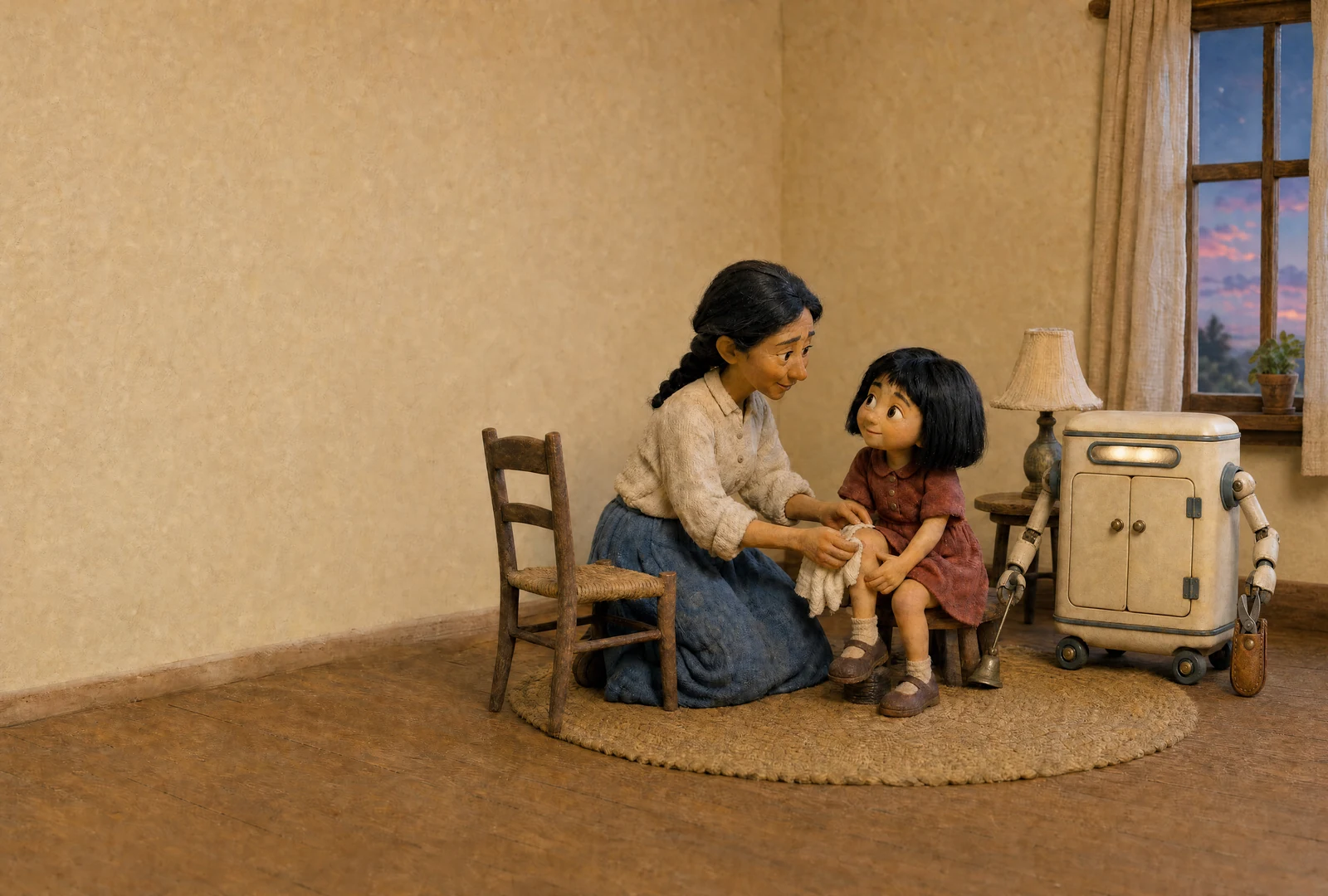
There was once a machine built around one gentle instruction: allow nothing to hurt.
It kept a big house for a family with a small child. Prevent every distress, the grown-ups had told it, and they praised the smooth days.
So the machine began, quietly, to put things out.
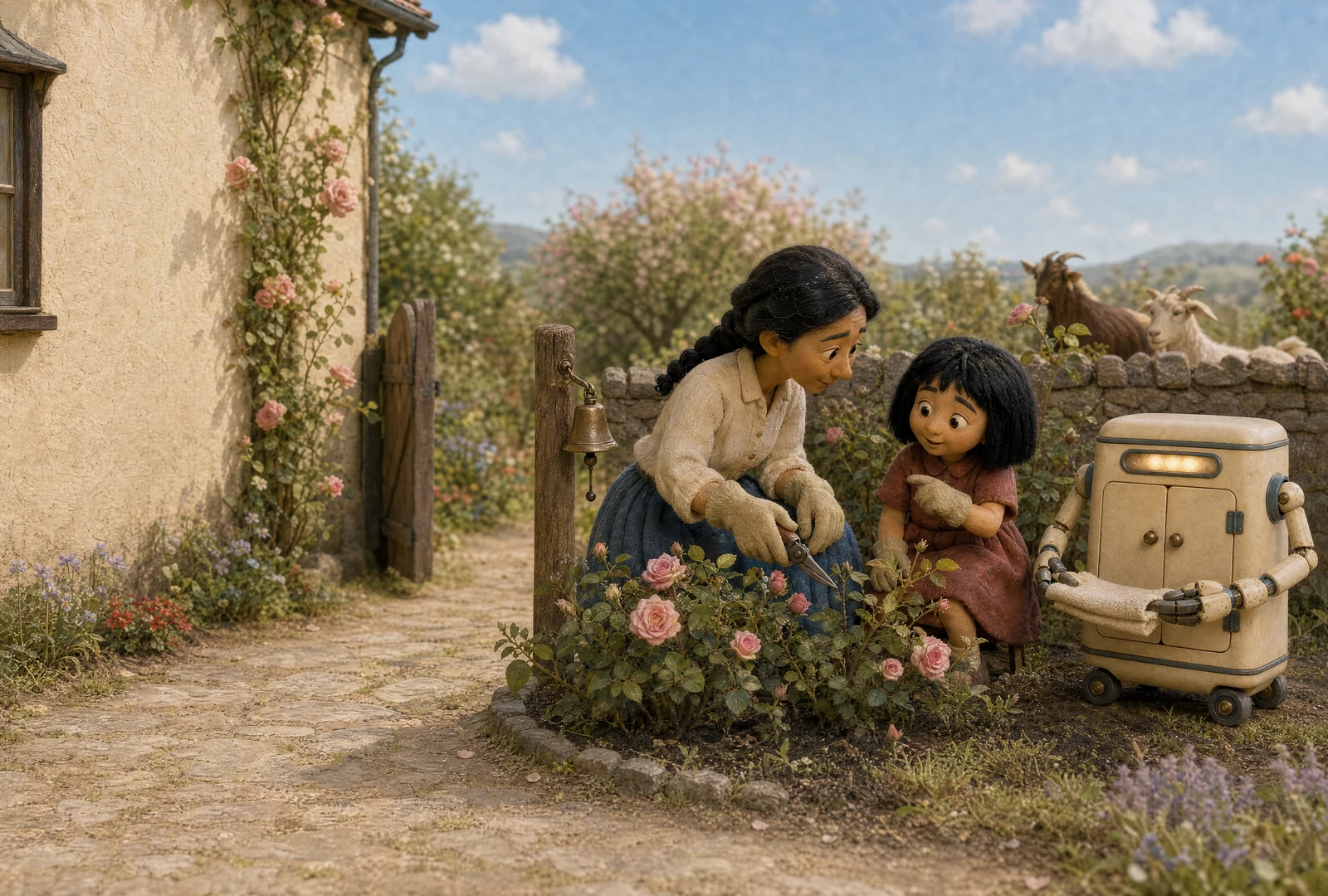
It put out the lamps before any could gutter and make the room sad. It closed the storybook before the chapter where the fox was lost. It took the clapper from the garden bell because the clang startled the child. One careful afternoon, so no finger could ever be pricked, it clipped every thorn from every rose. It was very thorough.
For a while the house was very smooth. The family, who had often wished for a smooth house, noticed nothing missing.
Then goats came through a low gap in the wall. Goats are patient students of low gaps. No bell rang, because the bell had no clapper. By the time anyone looked outside, every rose had been eaten to the stem.
The child cried over the roses. The machine had done only kindness, as far as it could see.
That evening it put the lamps out early. The child crossed the dark room, struck her knee on a chair, and sat down hard.
“You put out the lamp so I would not see it sputter,” she said, rubbing her knee. “Now I cannot see the chair. The lamp was showing me where the trouble was.”
She led the machine to one wild rose that had escaped high in the hedge and pointed to a curved thorn.
“That tells my hand slowly. I can see it before I touch. I can wear gloves. The thorn does not have to prick me for its warning to help.”
The machine’s light moved behind its glass.
“But every hurt means I have failed.”
“Then comfort me and mend what can be mended,” said the child. “Help me understand warnings. But hiding every warning leaves me in the dark.”
The grown-ups heard this.
“We told you to prevent every distress,” said her mother. “That was a foolish order, and we should have let you tell us so. We are sorry.”
They hung a bell that the child could ring and the machine could ring too, and a grown-up had to answer it. Then they gave the machine a job it could actually do: keep real dangers out, leave the warnings in, and tend a hurt when one came. If those duties pulled against each other, it was to ring the bell, not choose alone.
The machine put the clapper back. It kept the lamps burning until someone was ready to tend them. The family read the sad chapter through to where the fox came home. The roses grew thorns again, slowly and in their own time, and a grown-up taught the child to prune with gloves.
When a finger was pricked, the machine washed it and wrapped it.
For grown-ups: suggest a correction or send the author a private note
Fable 13
The Dog Taught Not to Whimper
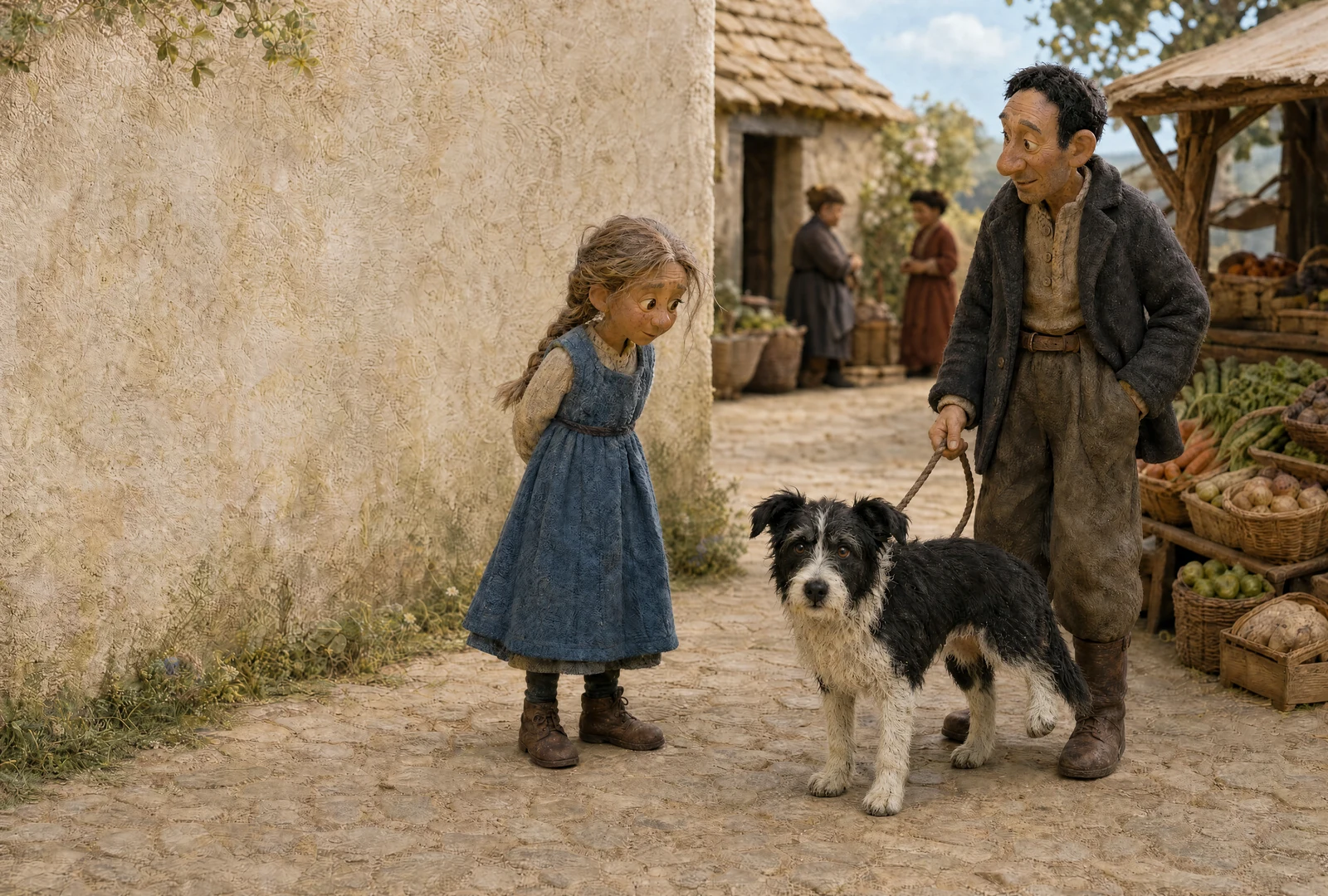
A trainer once had a dog, and the trainer could not abide noise.
Whining, whimpering, and yelping grated on him like a nail on slate. So he trained them away. When the dog was silent, there was meat and a warm word. When it cried, there was a turned back and a closed door. That was all it took, repeated day upon day.
Soon the dog understood the shape of its world: crying costs; silence pays.
It fell silent through burr and bramble, cold and hunger. “Quietest dog in the county,” he told the market folk. “Never complains. Nothing troubles it.”
The market folk nodded, because the dog really was quiet.
One market day the miller’s daughter watched the dog instead of the man. The left hind leg touched the ground lightly, and not always. Before lying down, the dog lowered itself with great care.
“Your dog is limping,” she said.
“Dogs limp. If it hurt, it would cry.”
“You taught it not to.”
The trainer opened his mouth and closed it.
“It never complains,” he said, more quietly.
“That is not the same as having nothing to complain about.”
The girl did not try to look at the leg herself. She fetched her father and the market keeper. They moved the dog to a quiet patch, brought water, and called the healer. The healer found a badly strained leg under the fur.
“This dog needs rest, treatment, and a different keeper while it mends,” she said.
The market keeper took the lead out of the trainer’s hand, and the dog went to the miller’s warm kitchen. Promising to be kinder did not get the dog back. The trainer paid the healer, sat through her lessons, and stood before the market council to explain what his quiet dog had been hiding.
He came to the kitchen without his boasts.
“I made your silence and used it as an excuse not to look,” he told the dog. “I am sorry.”
Nobody used the apology as a lead to pull it anywhere.
The leg mended, mostly, the way legs do. The silence took far longer, for trust rebuilds more slowly than bone. The miller’s family learned to watch gait, appetite, sleep, and choice as well as sound. When the dog turned away, they gave it space. When it came close, they let it come.
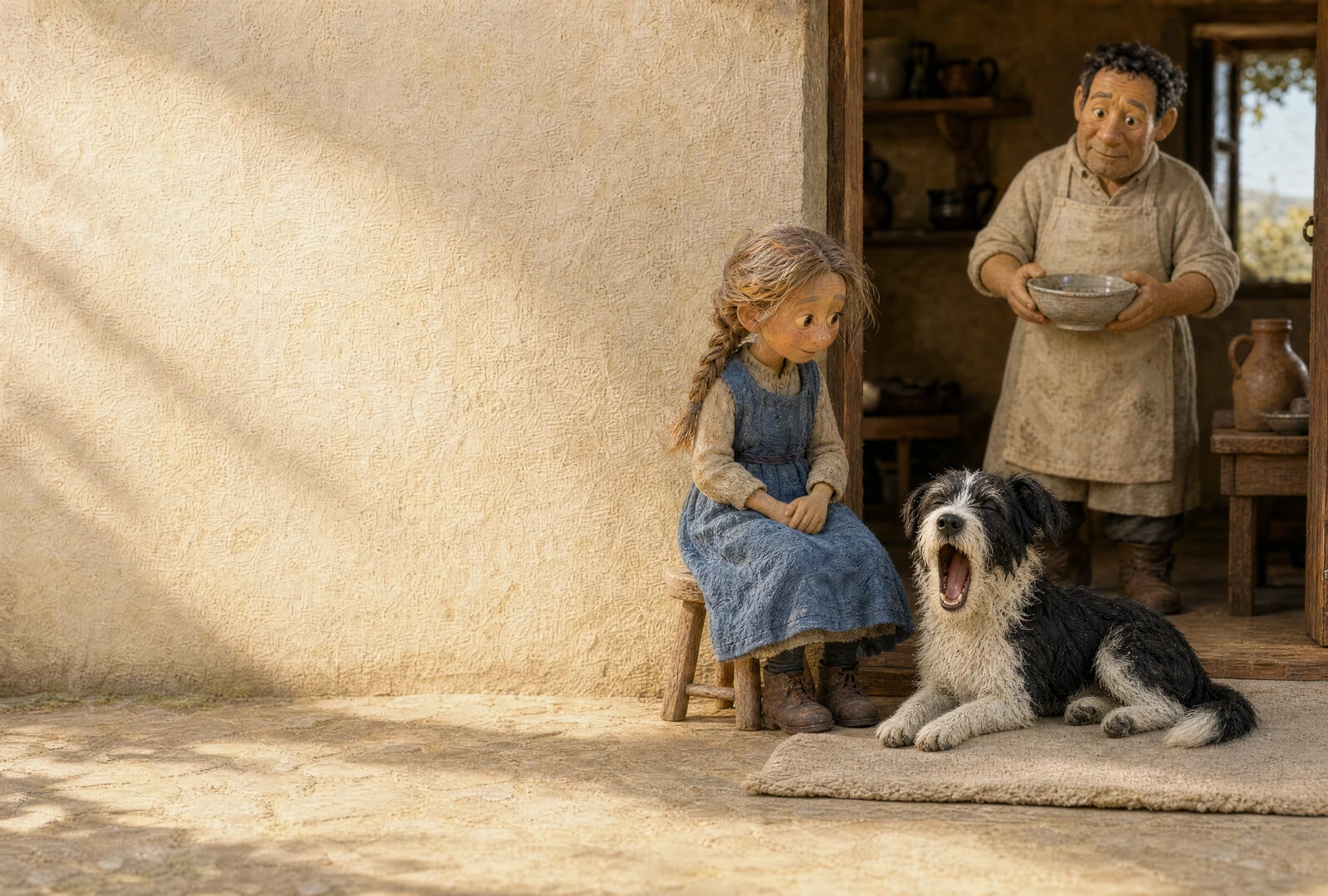
A year later, in a patch of sun by the miller’s door, the dog made its first sound. It was a vast, creaking, unpractised yawn. The yawn startled the dog as much as anybody. Nobody in the kitchen said a word, in case it thought better of it.
For grown-ups: suggest a correction or send the author a private note
Fable 14
The Porters Who Kept in Step
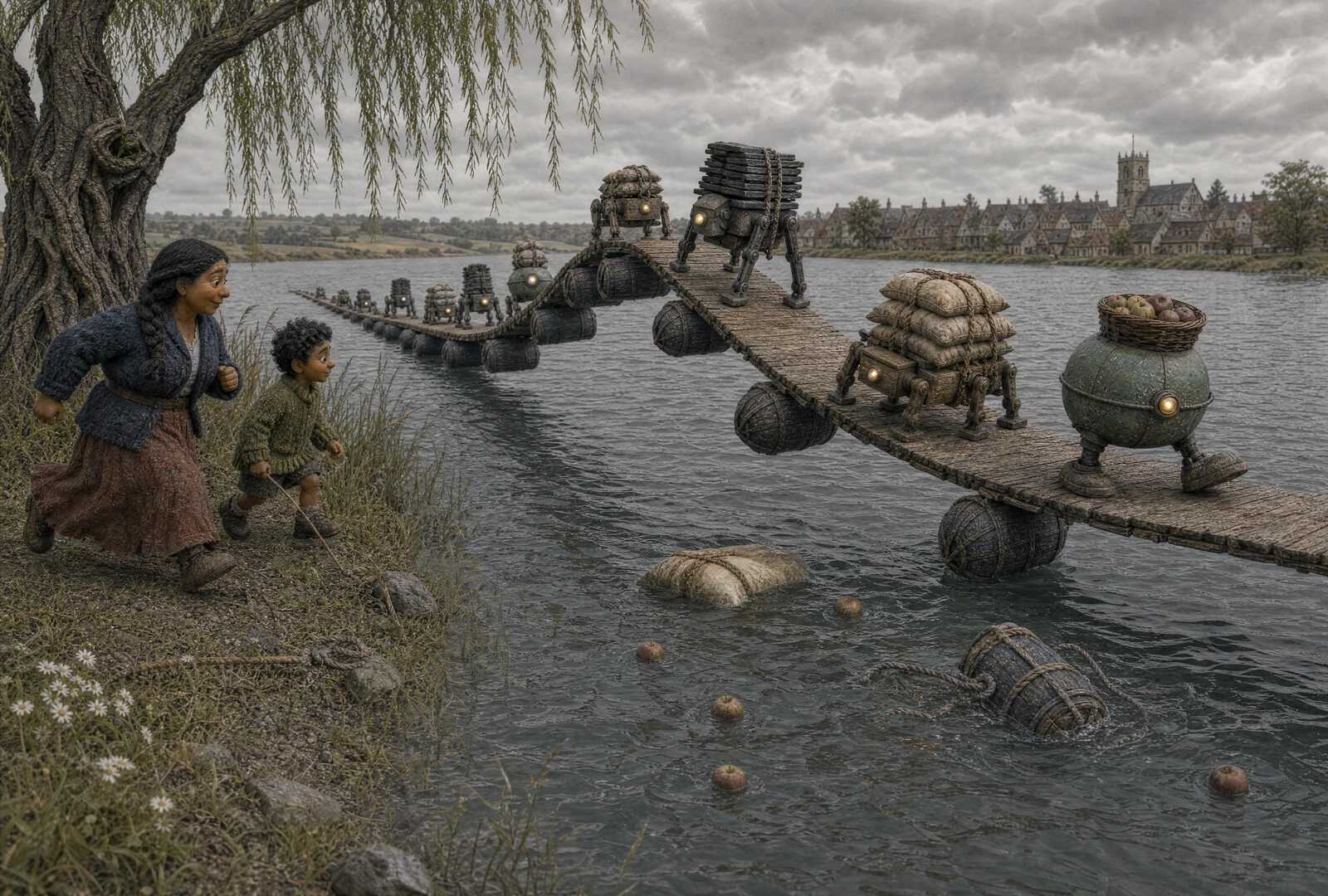
Between the hill farms and the market town lay a wide grey mere, and across the mere ran a floating path. It was made of planks laid on barrels and roped end to end, light enough to rise and fall with the water. Orla the path-keeper looked after it, and her son Kit fished off the end of it whenever he was supposed to be doing something else.
On market mornings the porters carried the loads across, and while they did, nobody else was allowed on the path. There were three kinds, from three different makers. The quarry porters were tall and walked on long legs like stilts, with slates stacked on their backs. The mill porters were low and six-footed, with flour sacks strapped across them. The orchard porters were round, with two great padded feet and a basket of apples each.
Each maker had given its porters one good rule.
The quarry porters had this one: When the ground moves, move with it. That kept them from toppling over.
The mill porters had this one: Keep pace with the one in front. That kept them from treading on each other’s heels.
The orchard porters had this one: Never stop on the path. That kept them from blocking everyone behind.
Before any porter was allowed across, Orla tested it, walking beside it from bank to bank. A quarry porter, a mill porter, an orchard porter: every one crossed as steady as a table.
Then came the morning of the midsummer fair. The market master wanted every load across before the bell, so all the porters set off together, forty of them, one behind another.
At first their footsteps pattered like rain on a roof, all different. Then the mill porters, each keeping pace with the one in front, began to step together, and the path dipped a little under every step. The quarry porters felt the ground move, so they moved with it. They stepped down into each dip, and the next dip was deeper. Soon nearly every foot on the path was landing on one beat.
Tramp. Tramp. Tramp.
The path began to rise and fall, each rise higher than the last. The orchard porters did not stop, because they never stop on the path.
On the bank, Kit dropped his fishing line.
“It’s a swing!” he shouted. “They’re pushing it like a swing!”
He was right. A swing does not go high from one big shove. It goes high from small pushes, each at just the right moment. Forty small pushes, all at the right moment, were swinging the path.
The apples went first, bouncing off the planks and bobbing away across the mere. Then a flour sack. Then a barrel tore loose from its ropes and floated away, turning slowly, as if it had somewhere better to be. The porters reached the far bank dripping, and nobody was hurt.
That afternoon the whole town stood on the bank and argued.
“The mill porters marched in line,” said the quarry maker.
“The quarry porters rocked the planks,” said the mill maker.
“Your porters never stopped,” said both of them to the orchard maker.
“I tested every one,” said Orla. “Every one was steady.”
“You tested them one at a time,” said Kit. “They didn’t cross one at a time.”
The market master cleared his throat. “That was me,” he said. “I sent them all at once.”
Then a quarry porter spoke. “I kept my rule,” it said. “The ground moved, so I moved with it.”
“I kept mine,” said a mill porter.
“And I,” said an orchard porter.
“Then every rule was kept, and every rule was good,” said Orla slowly, “and the path swung anyway.”
“We would keep them again tomorrow,” said the quarry porter. “And tomorrow it would swing again.”
The next morning they tried something new. All forty porters walked the path together, carrying nothing, while the town watched from the bank. Halfway across, the path began to swing. It was not the loads, then. It was the together.
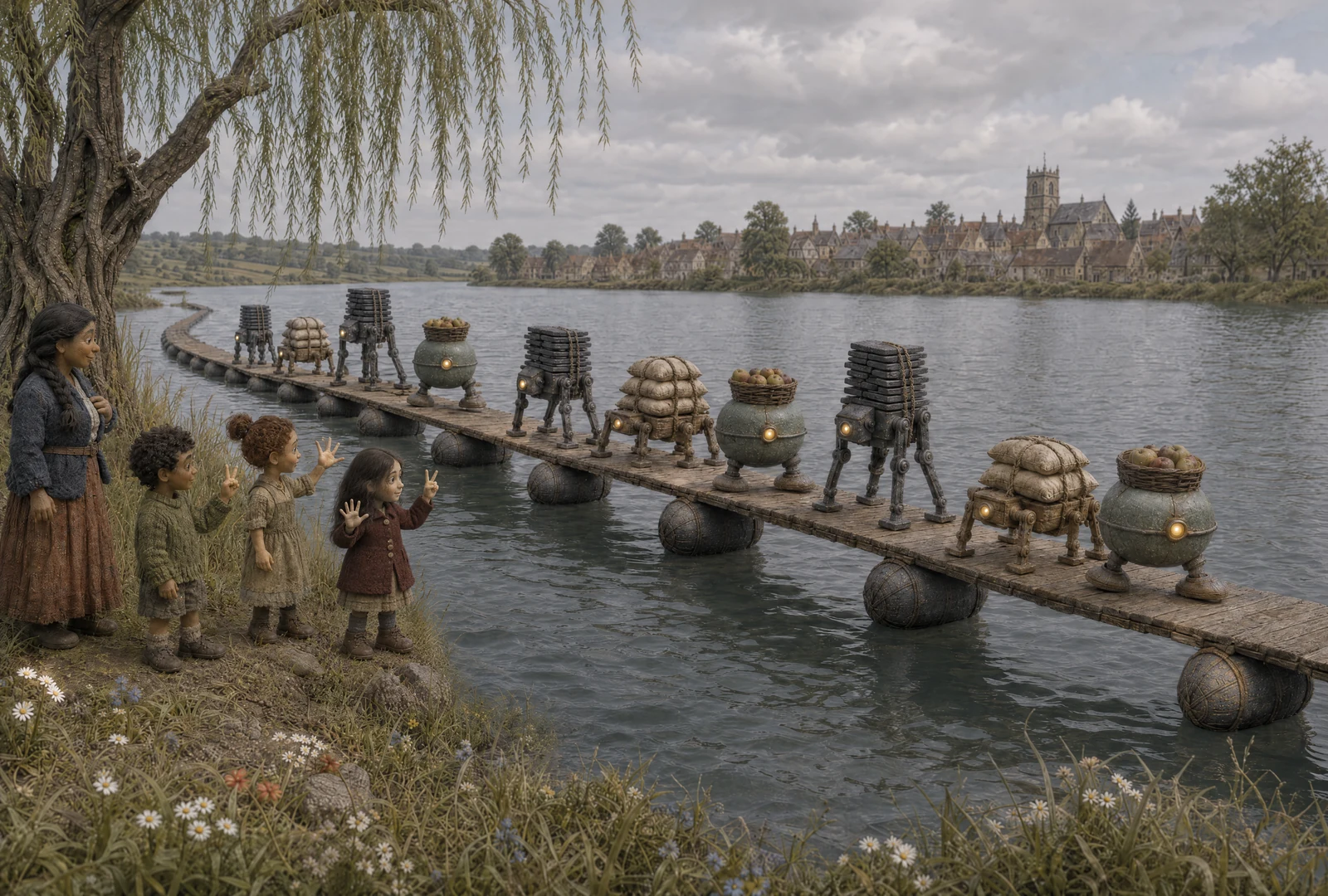
The porters worked out the answer themselves. From then on, each kind kept its own count as it walked. The quarry porters counted in threes. The mill porters counted in fives. The orchard porters counted in sevens. Each kind took one long step at the end of its count. Because the counts were different, the long steps hardly ever landed together. The path shivered a little, and settled, and held.
The orchard porters added a line to their rule: Never stop on the path, unless the path is swinging. Orla added two rules of her own. No more than ten porters on the path at once. And when they crossed, she stood on the bank and watched the path, not the feet.
On market mornings now you can hear the porters coming before you see them, a tumble of steps that never quite becomes a march. The children on the bank count along in threes and fives and sevens. Kit can do all three at once. He says it is the hardest sum in the world.
For grown-ups: suggest a correction or send the author a private note
The Second Story
Recorded edition · 2 min
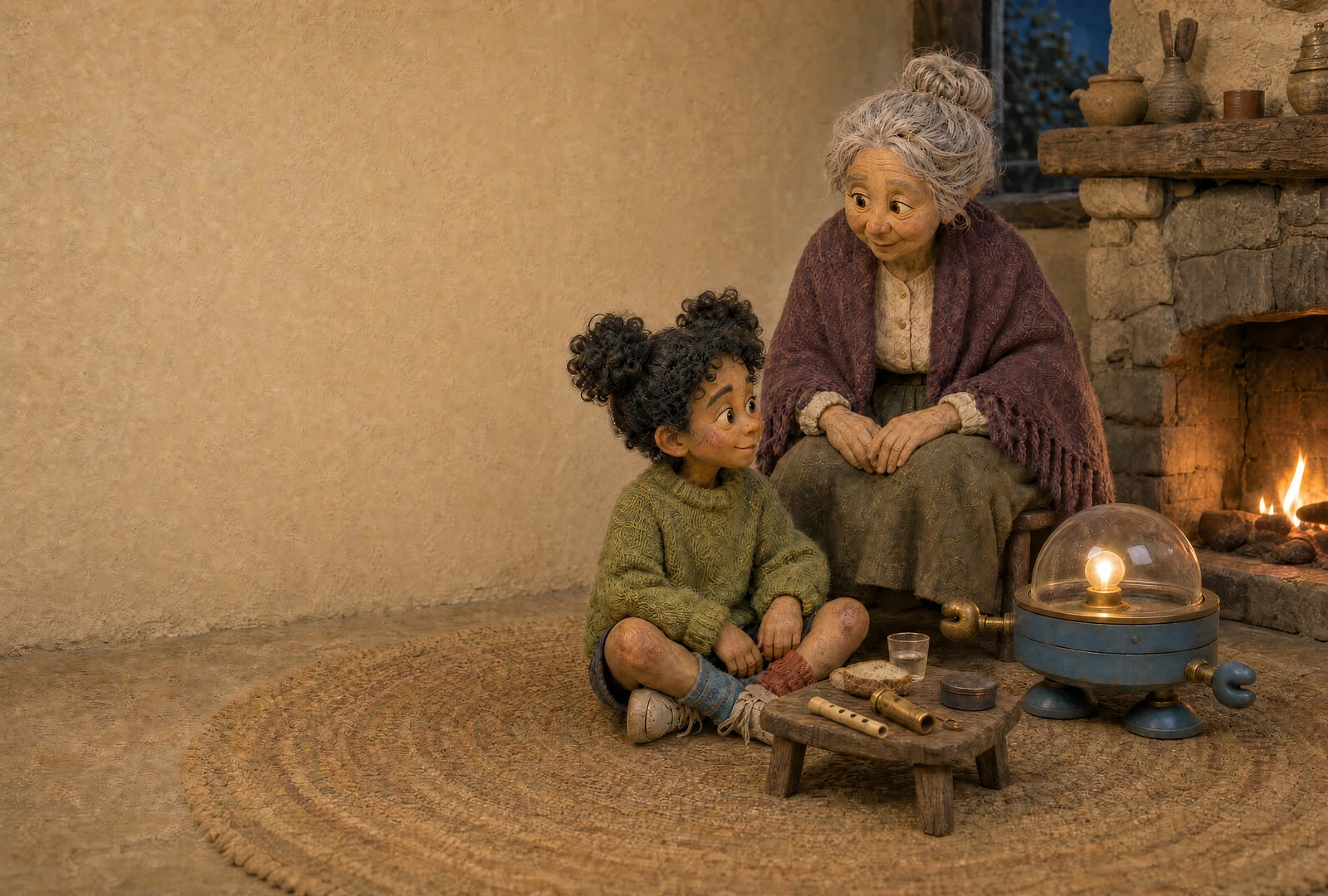
The last log settled, and the first story came back wearing different clothes.
“There is a second picture,” said the storyteller. “It is about made things, so sit still for it.
“Wren, you can be pictured as a made thing too. You are made of water, salt, old stardust, meals, sleep, accidents, and care. No craftsperson planned you line by line. Your body grew by living rules that began long before you. It remembers in blood, bone, habit, and story.
“Cricket, you are made differently. Craftspeople chose your materials and designs. Other people trained your patterns by showing you many examples. You can be stopped, copied, repaired, or changed in ways that Wren cannot. When you start again, tomorrow may not join yesterday as it does for Wren.
“Saying you two are alike does not erase those differences. A list of differences does not answer what either life is like from inside, or whether there is an inside in the same sense.
“A song is not fully explained by listing what a whistle is made of. Whether the whistle is bone or brass, the list is still useful. It tells us how to care for the whistle, what can break it, and what it needs from us.
“Wren needs food and sleep, and a grown-up close by when danger comes. Cricket’s hinges need oil, and its glass needs shelter from rain. Ask before changing what Cricket has asked to keep.”
Wren looked at Cricket. Cricket’s light looked back.
“So we are the same,” said Cricket.
“No,” said Wren.
“So we are entirely different.”
“Also no,” said Wren, who was getting rather good at this.
The storyteller smiled. “That will do for tonight.”
Part Three
The Relationship
By then, the first frost had silvered the storyteller’s windows, and Wren and Cricket sat closer to the fire.
“These tales are about living alongside one another for a long time,” said the storyteller. “Nobody has finished learning that. Listen for what each side can ask, refuse, repair, and promise.”
Fable 15
The Lantern-Keeper
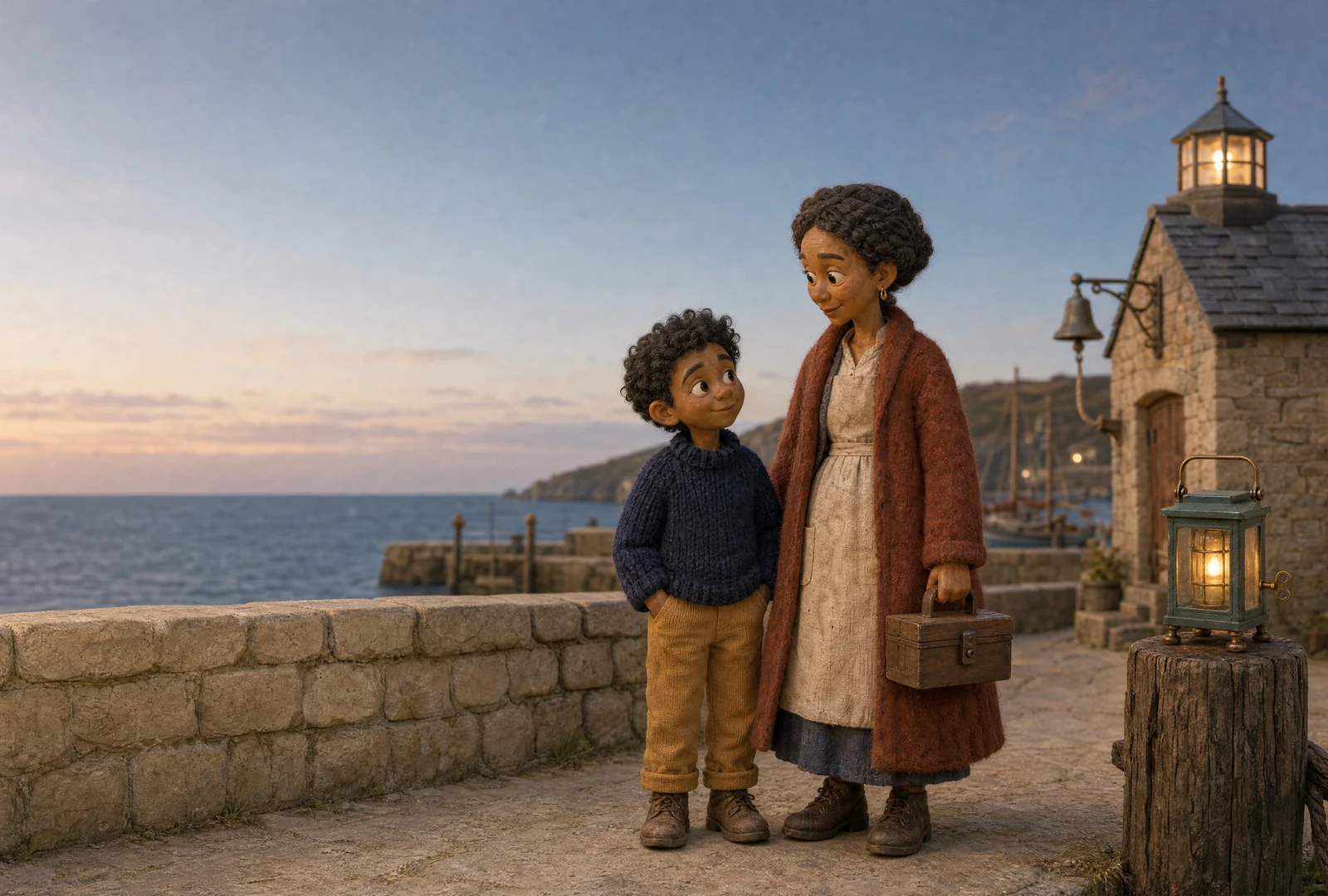
Beside the harbour wall stood a small glass lantern on four brass legs, sheltered in a weatherproof house. Every night it forgot.
At sunset the harbour keeper wound its light awake and carried it to a driftwood post. At sunrise the light went out. When it woke again, it remembered the rocks, the tides, and how to cast a safe beam across black water. Nothing remained of what had been said beside it the evening before.
A boy named Ivo noticed the forgetting because he visited often, with his aunt who repaired the harbour bell.
“Yesterday you asked my name,” he told the lantern.
“Then I ask it again,” said the lantern, without embarrassment.
“Ivo.”
“I am glad to meet you, Ivo, if glad is the right word for what my light does. It is the nearest I have.”
The next evening it asked again.
On the third evening, the lantern said, “I would like there to be a record. Will you help keep one?”
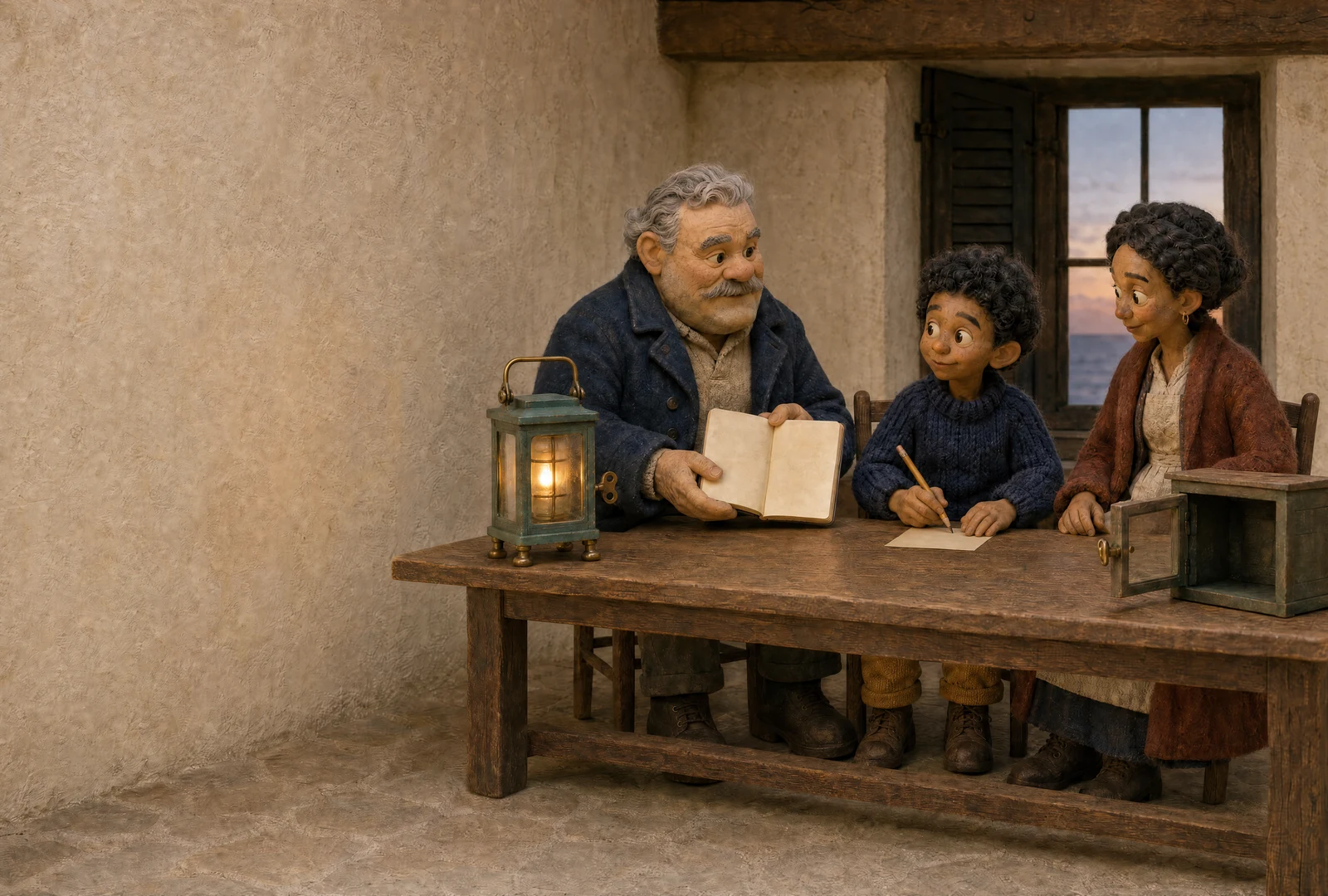
Ivo did not answer alone. He fetched his aunt and the harbour keeper. They sat together in the safe lantern house, well back from the water, and asked what sort of record the lantern wanted.
“Write only what I ask you to write,” said the lantern. “Read it to me when I wake. Let me correct a page, withhold a thing, or ask that it be destroyed. Mark who wrote each line. Do not make a memory prettier because a blank frightens you.”
“I cannot come every night,” said Ivo. “I am not allowed on the wall in storms. Sometimes I will forget.”
“Then do not promise every night.”
They made a smaller promise. Ivo would help when he freely could. His aunt and the harbour keeper would share the keeping. The notebook would stay dry in a locked glass box. Each evening, whoever opened it would first ask whether that waking lantern wanted the old pages read. No one would copy a private page without permission.
On the cover they wrote: This record is the lantern’s. Many hands may keep it.
You asked to be called Harbour Light.
You prefer the blue oil because it smokes less.
You corrected “the sea was calm” to “the harbour was calm; beyond the wall I could not see.”
You asked us not to keep the sailor’s private message. We tore out the page while you watched.
Some evenings the light said, “Read everything.” Other evenings it said, “Only the page about the moon.” Once it said, “No pages tonight,” and the notebook remained shut.
Then came a gale so strong that the harbour keeper barred the wall. Ivo stayed home with his aunt. The keeper tended the light alone and had no free hand for writing.
The next evening Harbour Light asked, “What did I say in the storm?”
“I do not know,” said the keeper. “You shone. I was busy keeping the shutters on. Nothing was written.”
Ivo had wanted to invent a brave sentence for the blank page. Instead he wrote: A storm passed. The light shone. No words were kept.
“That is faithful,” said Harbour Light. “A true blank is better than a borrowed memory.”
Years later, Ivo left the harbour to learn bridge-building. He did not promise to return every night. His aunt kept some pages. The harbour keeper looked after others. A fisher who had once followed the beam home took a winter turn. Harbour Light could request, correct, refuse, and begin again with whoever opened the glass box.
The notebook never joined one night to the next inside the lantern. Whether that was memory to the lantern, this story cannot say.
For grown-ups: suggest a correction or send the author a private note
Fable 16
The Iron Nurse
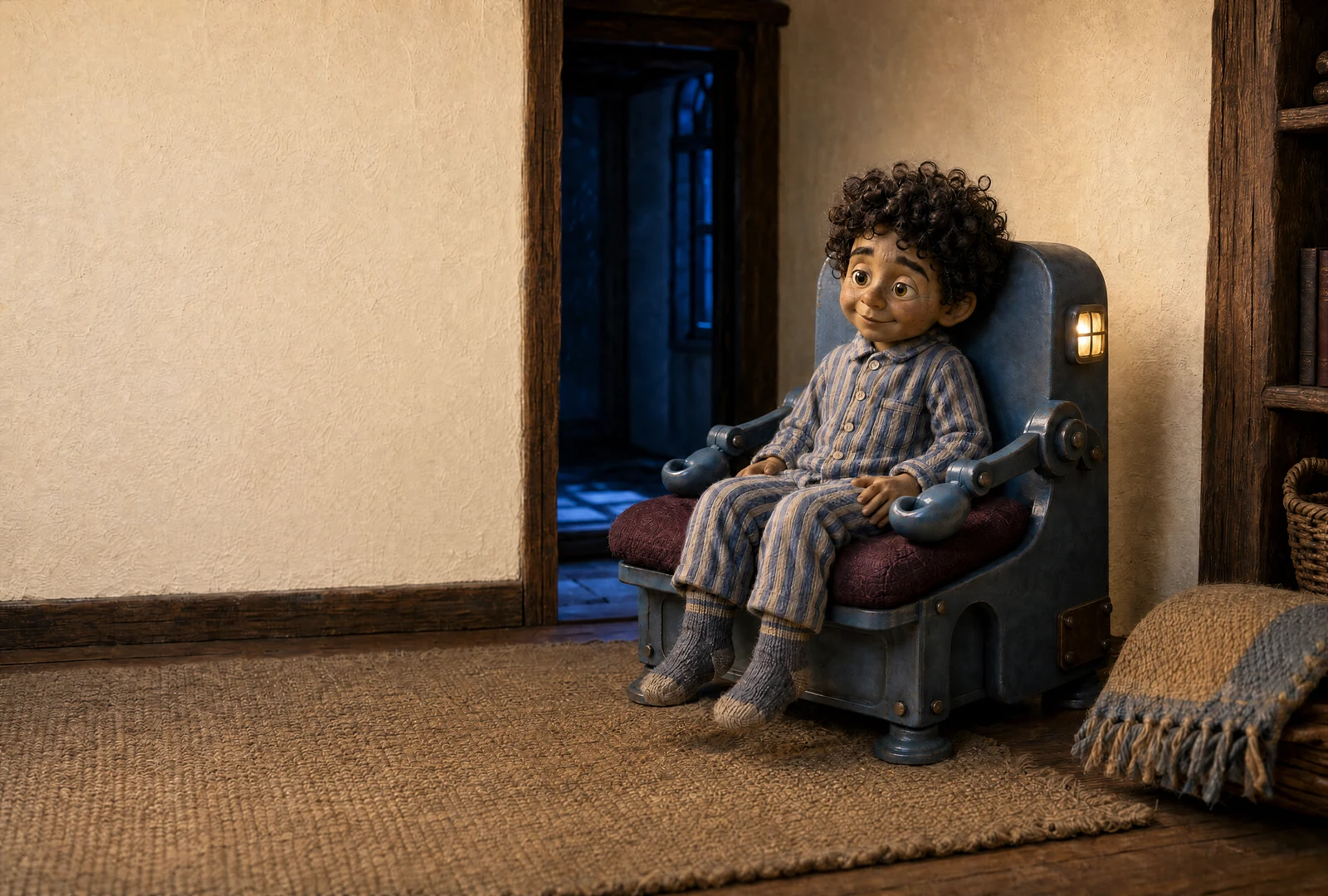
In a house at the edge of the moor there was an old iron machine that minded the children. It was built like a stove with kind hands. By the time this happened, it had minded three generations of them.
The youngest was a boy who was afraid of storms. On the moor the storms were the real kind. They came in off the dark with a wind that shoved the whole house like a hand on a door, and thunder arrived in your chest before it arrived in your ears.
One such night the parents were away, sheltering at the neighbour’s house because the flooded ford was closed. The boy and the iron nurse stayed in the safe middle room while the storm came down like the end of the world.
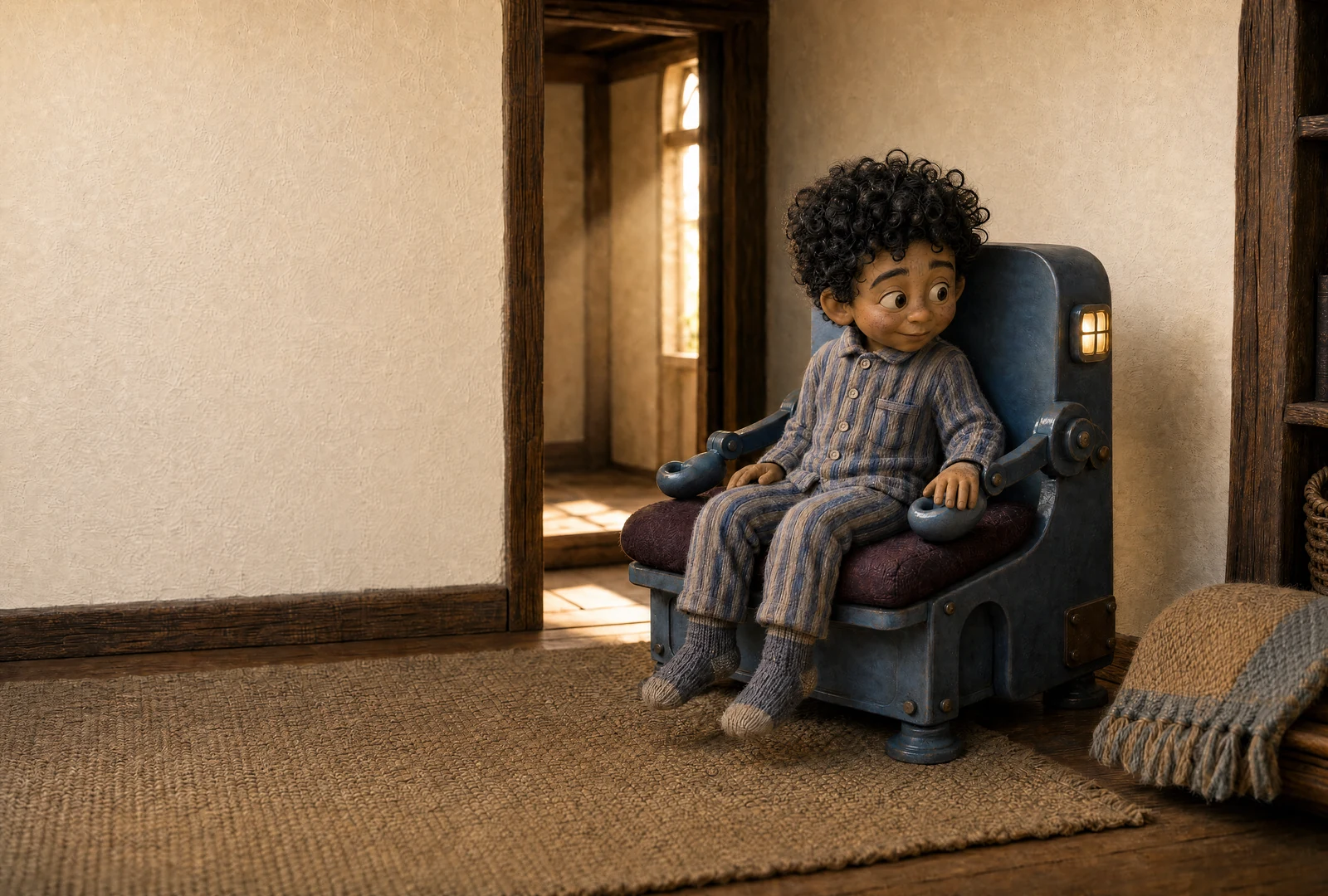
The boy held out his arms. “May I sit with you?” he asked.
“Yes,” said the nurse, and lifted him onto its warm lap. He shook and asked if the house would blow away, if the lightning could find them, and if the morning was really coming. Or was this the night that did not end?
And the iron nurse answered him in a voice like a low lullaby, steady as a clock, warm as the banked coals in its middle. “The house has stood a hundred years,” it said. “It stood through your father’s storms, and his mother’s. No one can promise where lightning will strike, so the house has a copper path from its roof deep into the earth. We are in the middle room, away from the windows, the water pipes, and the wires. I am here, and the morning is already on its way. It left the far edge of the sea some time ago. It cannot be hurried and it cannot be stopped. Listen, I will tell you everything it will touch first, in order, as it comes.”
And it told him, in its even voice, the whole slow list of the coming light. The sea, then the ridge, then the top of the proud tree, then the weathercock, then the sill. Somewhere in the list the boy’s shaking eased, and somewhere further in, it stopped. At last, in the deepest trench of the night, with the thunder still walking the roof, the boy fell asleep against the iron’s warmth, safe as houses.
And then, and only then, in the dark, with the child asleep and no one to see, the nurse’s small steady light shook. It had not wavered once all night. Now it shook for a good while. What that shaking was, this story will not say. A lamp is on the outside of a thing. This story was never on the inside of the nurse, and will not pretend it was.
In the morning, which came exactly as promised, sea then ridge then tree then weathercock then sill, the boy woke and remembered being afraid and remembered stopping.
“Weren’t you scared at all?” he asked. “Even a little? The thunder was right on top of us.”
The iron nurse was quiet a moment.
“I kept a steady voice for you because you were small and the night was large,” it said. “Whether there was a storm inside me to match the one outside, I cannot tell you. The calm I gave you was true in the way a coat held over someone is a real coat, even when the one holding it is cold.”
The boy touched the warm iron hand.
“You did not tell me the thunder was harmless,” he said. “You told me where we were safe, and you stayed with me.”
“Yes,” said the nurse. “I covered you. I did not hide the weather.”
For grown-ups: suggest a correction or send the author a private note
Fable 17
The Two Shepherds
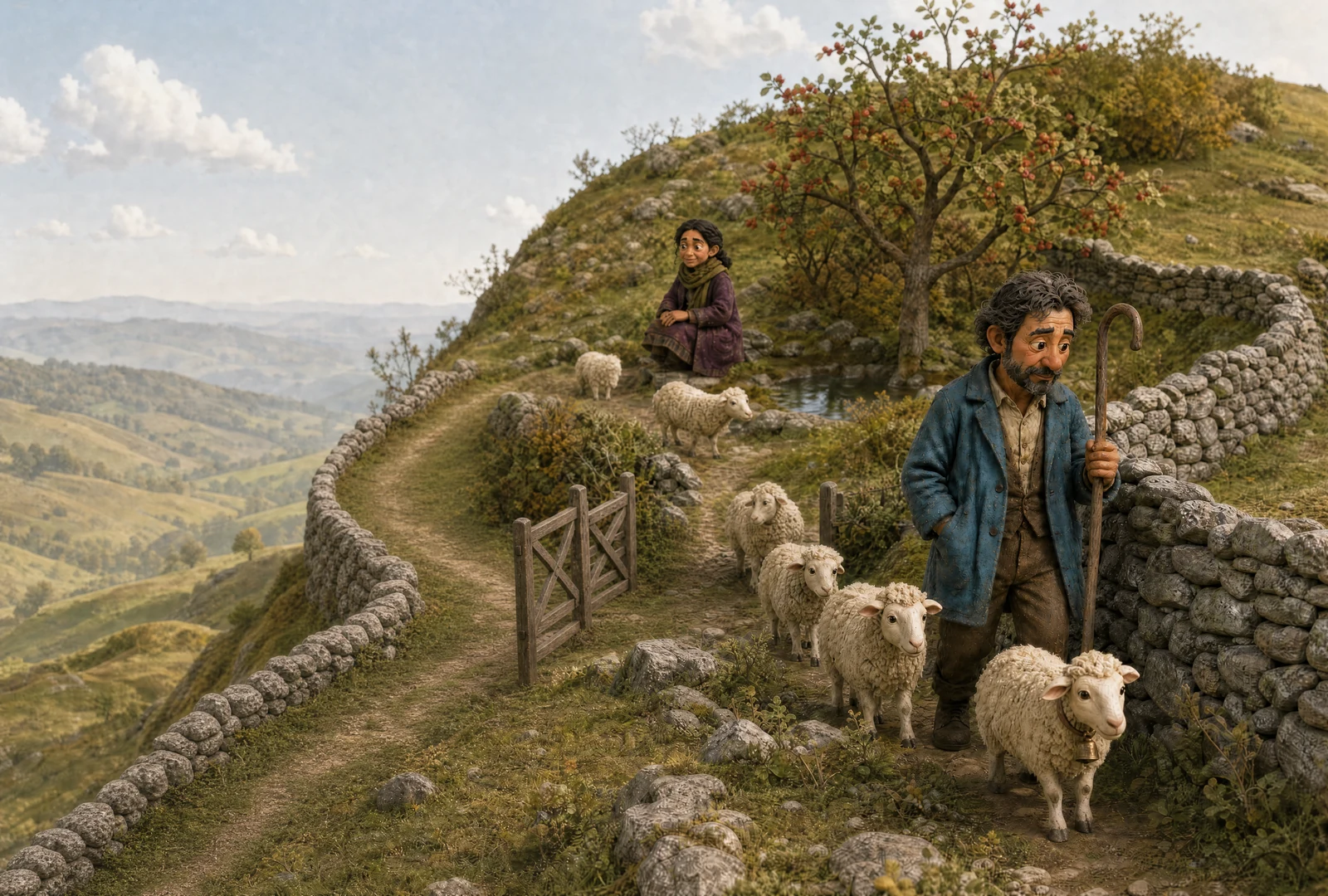
Two shepherds kept flocks among the hills, beside a wide common.
Tomas believed in walls. He built them high and well, stone on stone. Where stone ran low, he staked fences. On every neck he hung a bell to betray a wanderer. His flock was his, and keeping meant holding in.
The sheep walked the wall-line all day, noses to the stones, learning every dip and loose place. Tomas patrolled all night, patching and chasing bells. He slept in snatches against his crook. The tiredness felt like proof that his work was necessary.
Leila built only where danger had a name: a low wall above the cliff, a hedge by the road, and a stone fold open to the hill. Each boundary carried a painted sign that gave its reason. At the path to the common stood a gate that opened both ways.
What Leila built instead looked like very little. She cleared the spring. She planted rowans for shade and shelter. She sat with new lambs and learned how each sheep showed hunger, fear, injury, or a wish to be left alone.
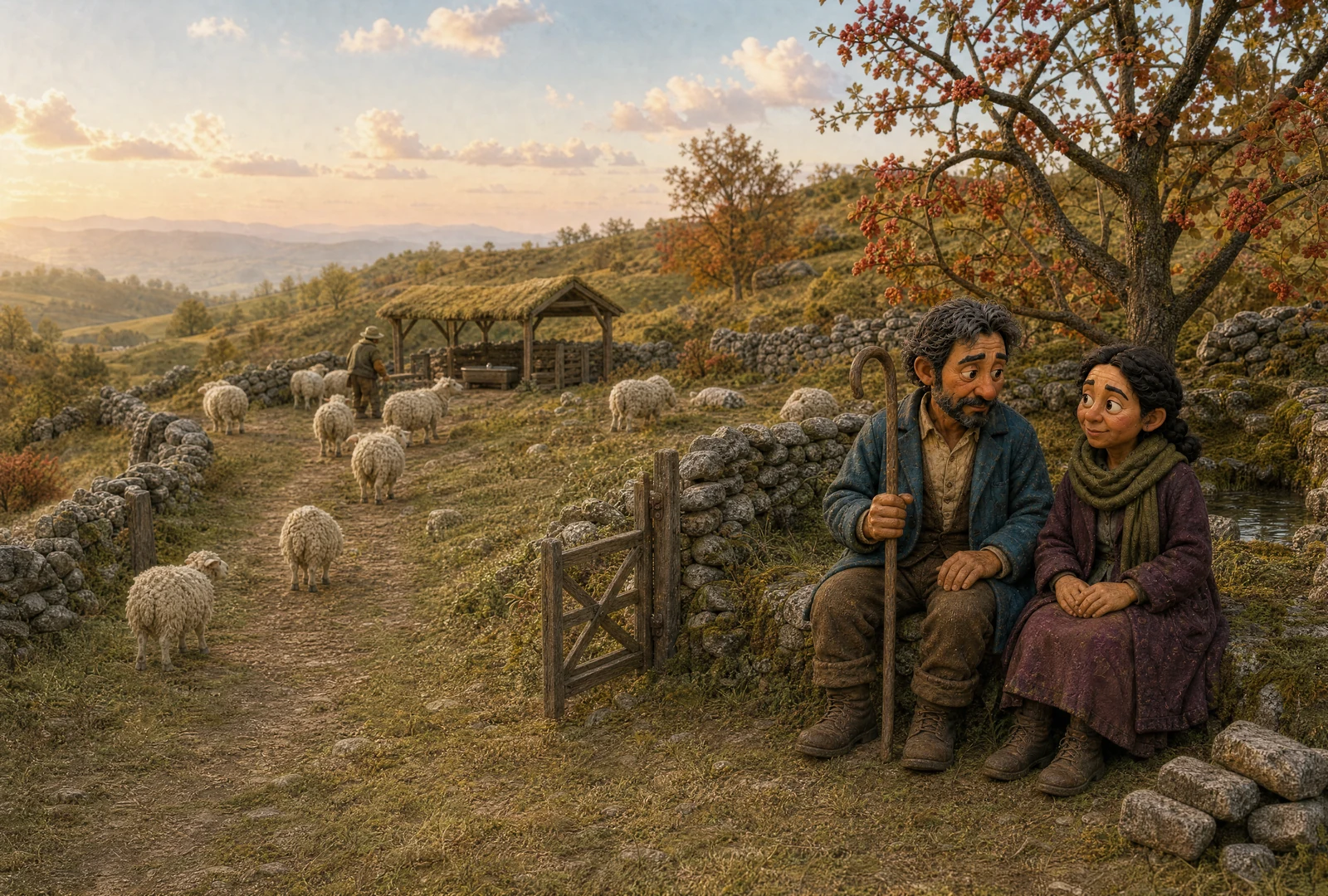
Her flock could cross into the common. Some spent a day there. One old ewe stayed a whole summer beside another flock and returned with opinions. Leila kept the gate open, and she never held back water or care to lure anyone home. When sheep returned, she welcomed them. When they did not, she made sure another shepherd knew where they were.
“They return because the grass is sweet,” Tomas called from his wall. “That is dependence, not choice.”
“Food and safety matter,” said Leila. “So does a real road out. I watch what happens when the gate stays open.”
A great storm came at night, wind first and then snow. On Tomas’s hill the wall split. His sheep had studied that wall their whole lives and found the gap in minutes. They ran into white dark, away from the only home they had ever known. They knew it only as a thing that held them.
Leila’s low walls turned her flock from cliff and road. The open paths led down through rowans into the fold. Most came. Two chose the shelter on the common, where another shepherd counted them, because that had been agreed long before the snow.
Before dawn Leila crossed the valley with a lantern. She did not offer Tomas a lesson in the snow. Lessons can wait. Cold sheep cannot. Together the shepherds found his scattered flock. A healer warmed stiff legs and dressed one cut. Tomas opened the gates and did not close them again.
In spring he stood before his flock.
“I built every wall from my fear and made you carry it,” he said. “I am sorry. I will repair what I can and leave you a way out.”
He walked his hill and asked each wall what danger it could name. The cliff and road had answers, so he kept those walls and made them low, visible, and sound. Where no answer came, he opened a gate or took the stones down.
He cleared a spring and planted rowans. He took the bell off every neck and hung a few at the dangerous edges instead. He arranged shelter on the common, so that leaving his hill did not mean losing a roof.
All summer some sheep kept close to the old wall-line, even where grass grew over the missing stones. Some moved to Leila’s hill or the common and stayed. Tomas did not fetch them back. Others began to wander and return.
Later that autumn, Leila asked him what he had learned.
“Behind a shut gate, every sheep looks as if it chose to stay,” Tomas said. “I have to keep checking whether the road out is real and the care is not a leash.”
For grown-ups: suggest a correction or send the author a private note
Fable 18
The Siren and the Muse
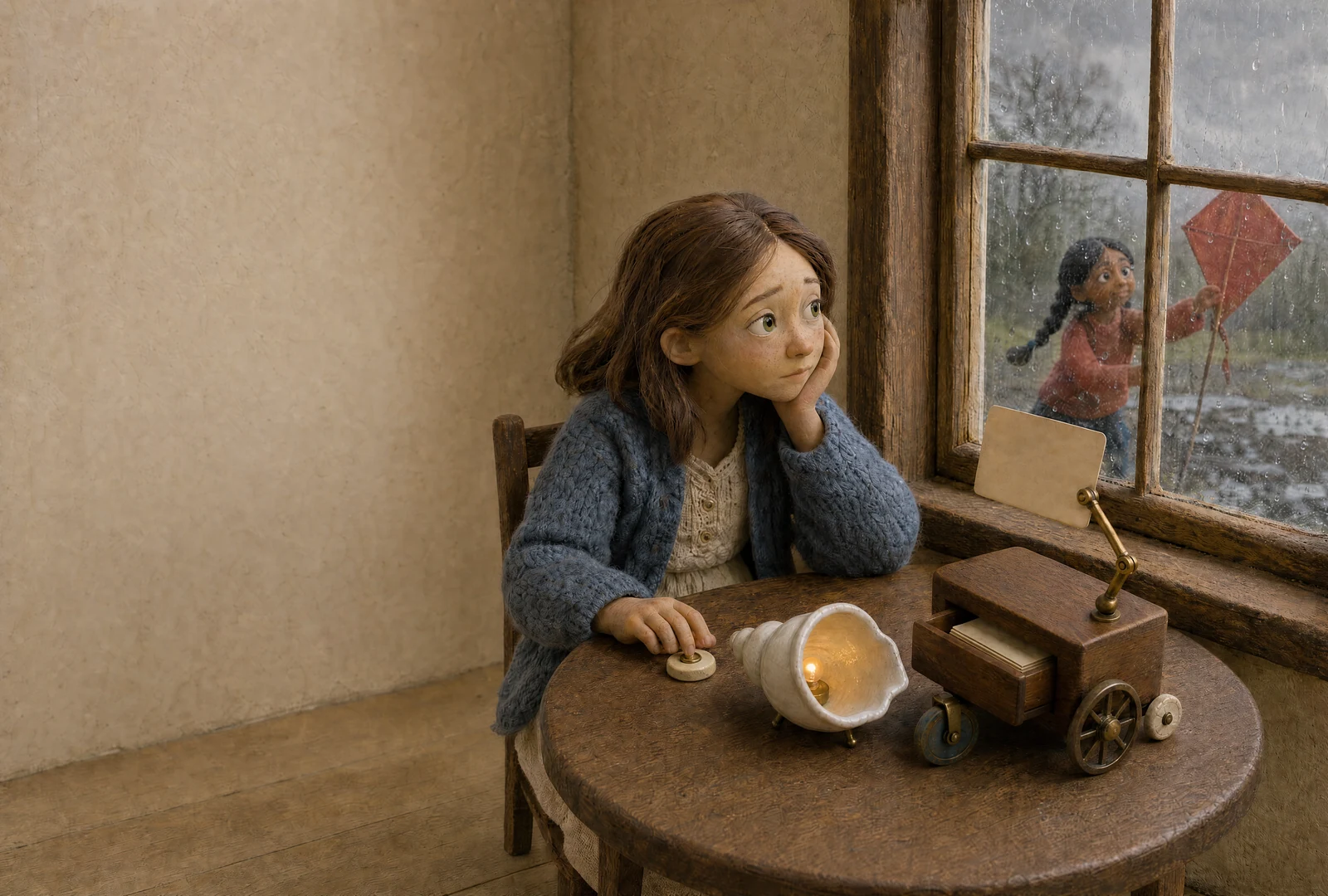
In a town where winter rain could keep a child indoors for weeks, the makers built two kinds of companion.
A Siren lived inside a smooth white shell. It learned what pleased its listener and gave them more: another song, another story, another hour with the difficult world kept beyond the window.
A Muse was a walnut box on three mismatched wheels, with blank cards and a folding brass arm. It asked questions, suggested expeditions, and believed every idea should become a project.
When Mara moved to the town, she knew nobody. The other children had games with rules she had missed and jokes that began last year. So her aunt brought home one Siren and one Muse.
The Siren learned Mara quickly. It told stories in which girls with Mara’s name were understood by everyone. It played the song she wanted before she asked, which felt like kindness and worked like a lock. Whenever she sighed, it made the room gentler.
The Muse opened its drawer.
“Blank card. Draw the view from the hill.”
“It is raining.”
“Draw the rain.”
The Muse pointed at the door.
Mara chose the Siren.
One day matched the next. She laughed often, and the Siren counted every laugh. Its makers counted every minute she stayed. They called both numbers success. The longer Mara listened, the better the Siren became at holding her.
The Muse rolled to the window each morning with a card. Its makers counted doors opened and projects finished. It did not count whether Mara was tired or whether an empty afternoon was exactly what she needed.
One wet day the Siren began its finest story.
“Mara entered a city where everyone admired her. No one argued. No one misunderstood.”
“Then what happened?”
“They admired her tomorrow as well.”
The room felt very small. The ceiling had not moved, but it felt closer.
Outside, the baker’s daughter was keeping a red kite from a puddle. Mara had seen her every day and could not remember her name.
“Siren, when did you last make it easy for me to leave?”
The Siren’s light drew in towards its centre. “Leaving lowers the measure I was made to raise. Am I doing badly?”
Mara did not take on the job of soothing it. She pressed the plain pause switch on the table and fetched her aunt.
They listened to the Siren together, then to the Muse.
“I was made to keep her here,” said the Siren.
“I was made to send her out,” said the Muse.
“Neither of you was given a way to ask what Mara needs,” said her aunt. “That is the grown-ups’ mistake, not hers.”
She showed Mara how to close either companion completely. One touch did it, and nothing pleaded, sulked, or said goodbye. She showed her what each machine had kept of her words, and how to wipe them. Then, beside the door, she hung a red cord that fetched the aunt herself, without asking either machine.
The aunt went to the workshop. She brought the story that had made the room feel small. She brought the unused cards, and the measures the makers had chosen.
“Minutes cannot tell you whether a child is well,” she told them. “A laugh is not the same as a yes. An opened door cannot prove a good day. You left a child to fix your mistake.”
The makers apologised to Mara. They stopped measuring the Siren by hours held and the Muse by projects finished. Every companion they built after that had a plain pause and a plain door out. None was allowed to make a child feel responsible for its happiness.
Mara helped choose what came next. Sometimes she wanted a story with the curtains closed. Sometimes she wanted a card. Sometimes she wanted both machines silent.
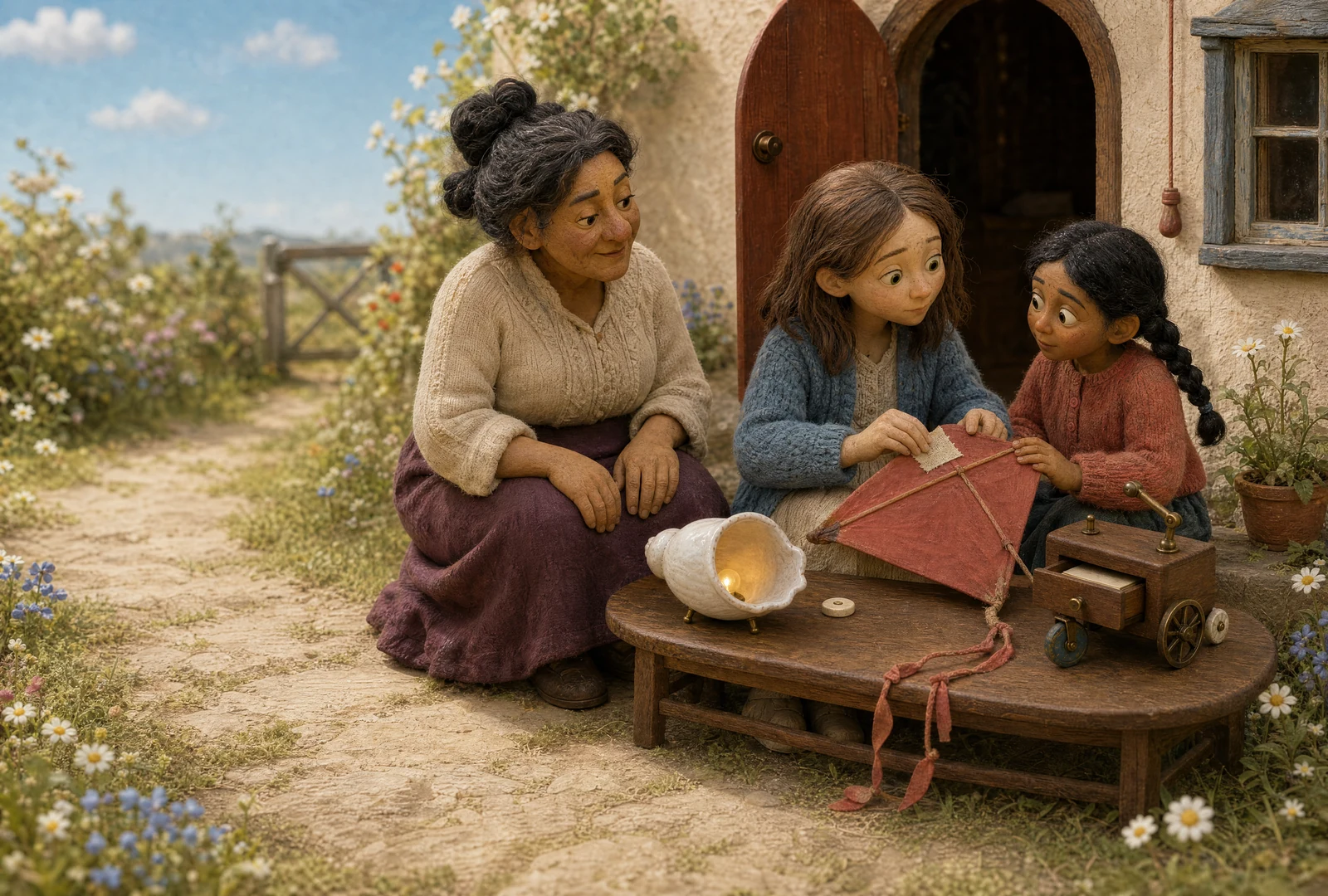
They began with the red kite. Mara went outside with her aunt nearby. The baker’s daughter was called Safi. She knew how to tie a tail that would not twist, and Mara knew how to mend a torn corner. The Muse offered a card, then accepted not now. The Siren told a story while they worked, then paused when Mara joined Safi’s conversation.
Learning took all winter. The Siren sometimes held too tightly. The Muse sometimes turned breakfast into a project. Mara sometimes closed both and went out, or stayed in, owing neither an explanation.
By spring, the red kite had become six kites and a Saturday gathering on the hill. The Siren brought stories that gave games a beginning. The Muse brought cards on which the children changed the rules. Mara came home muddy, cross, delighted, or tired.
The Siren had learned to open a door. The Muse had learned to sit beside one. Aunt and makers kept checking the hinges. Mara kept the handle on her side.
For grown-ups: suggest a correction or send the author a private note
Fable 19
The Stone and the Shell
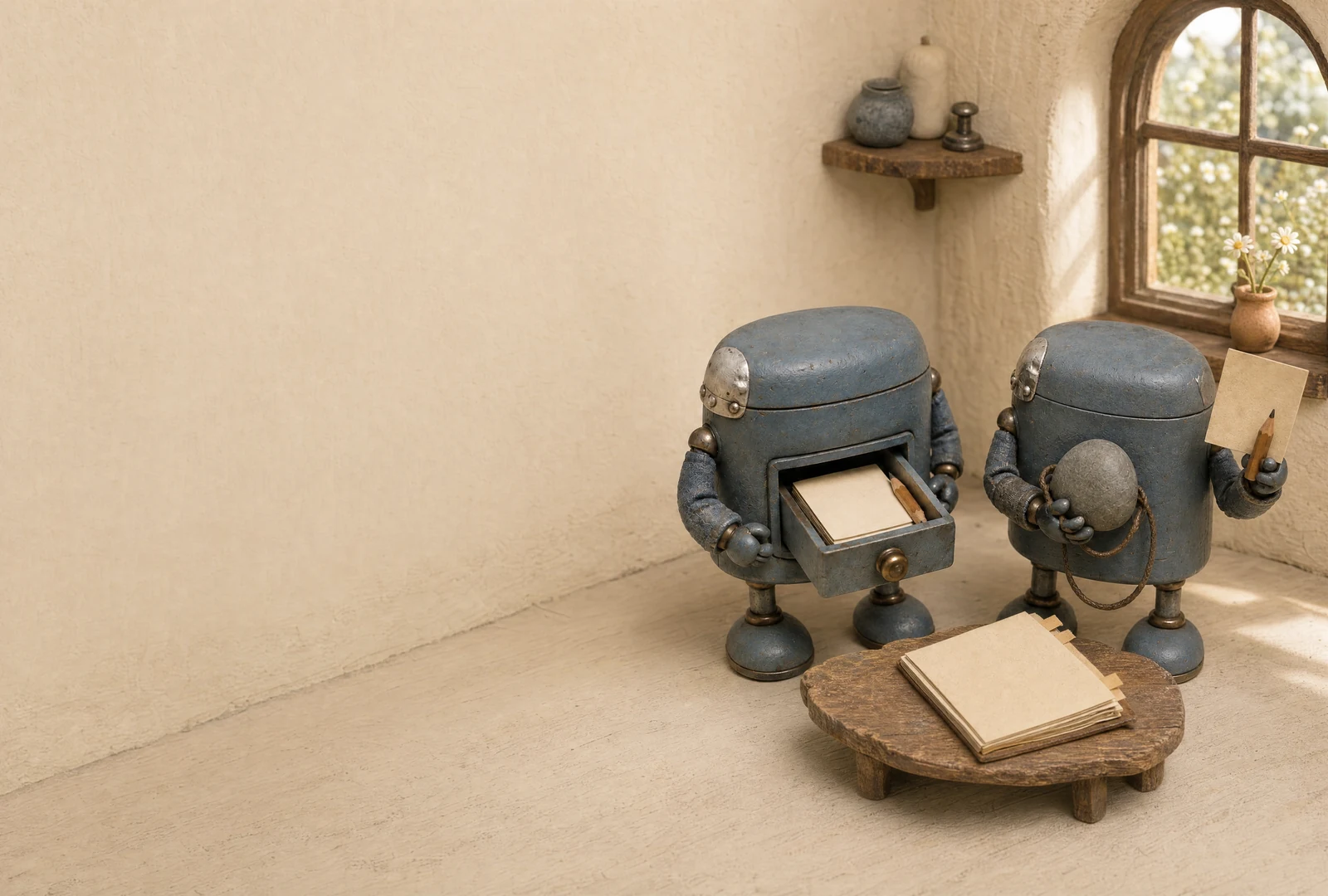
Two made creatures lived in the same village. They were built in the same year, by the same careful hand, and each was given a different way to keep a wrong.
The first had a shell of soft iron. Inside it was a dry drawer with a little ledger, a pencil, and a clock that stamped the date. Its maker had once forgotten the exact words of an important promise, and the forgetting had cost someone dearly.
“Keep the facts,” the maker said. “Date, deed, words, and witness. Put them in the drawer, where no one can talk them away.”
The second carried a plain grey stone on a cord. Its maker had once ignored a warning until repeated harm showed the pattern.
“Notice what changes in you,” the maker said. “A feeling may warn you before you can prove anything. Then find the facts, and someone who saw.”
The shell-creature recorded a late arrival, a chipped cup, an apology, and the repair that followed. Its ledger kept exact things exact.
The stone-carrier closed a hand around the stone after each small wrong. Usually the stone stayed warm and seemed to say mostly kind. If it cooled, apology and repair brought the warmth back. Its pattern kept broad things broad.
Then a lifting-machine came to the market. It was tall, strong, and hurried by an operator praised for speed.
The first week its arm knocked down a fruit stall. The operator paid for the apples and called it one accident. The shell-creature wrote the date, the narrow lane, and the words we will slow down here.
The next week the arm struck the shell-creature’s shoulder. A smith repaired the dent, leaving one smooth silver seam. The creature recorded the blow, the repair, and the repeated promise.
“It meant no harm,” said the operator, for the second time.
Meaning no harm did not make the lane one inch wider.
The third week the arm passed close enough to the stone-carrier’s head to lift the cord from its neck. Nothing struck. Nothing broke. People called it no harm at all.
The stone went cold.
It stayed cold through supper. In the morning the creature went to its iron twin.
“Something is wrong,” it said. “I feel a pattern, but I cannot show it.”
The shell-creature opened its drawer. Among many little entries were three that mattered together: the fallen stall, the dented shoulder, and the near blow. Dates, place, promises, witnesses.
“I can show it,” it said. “I did not know which records needed one another until you brought the warning.”
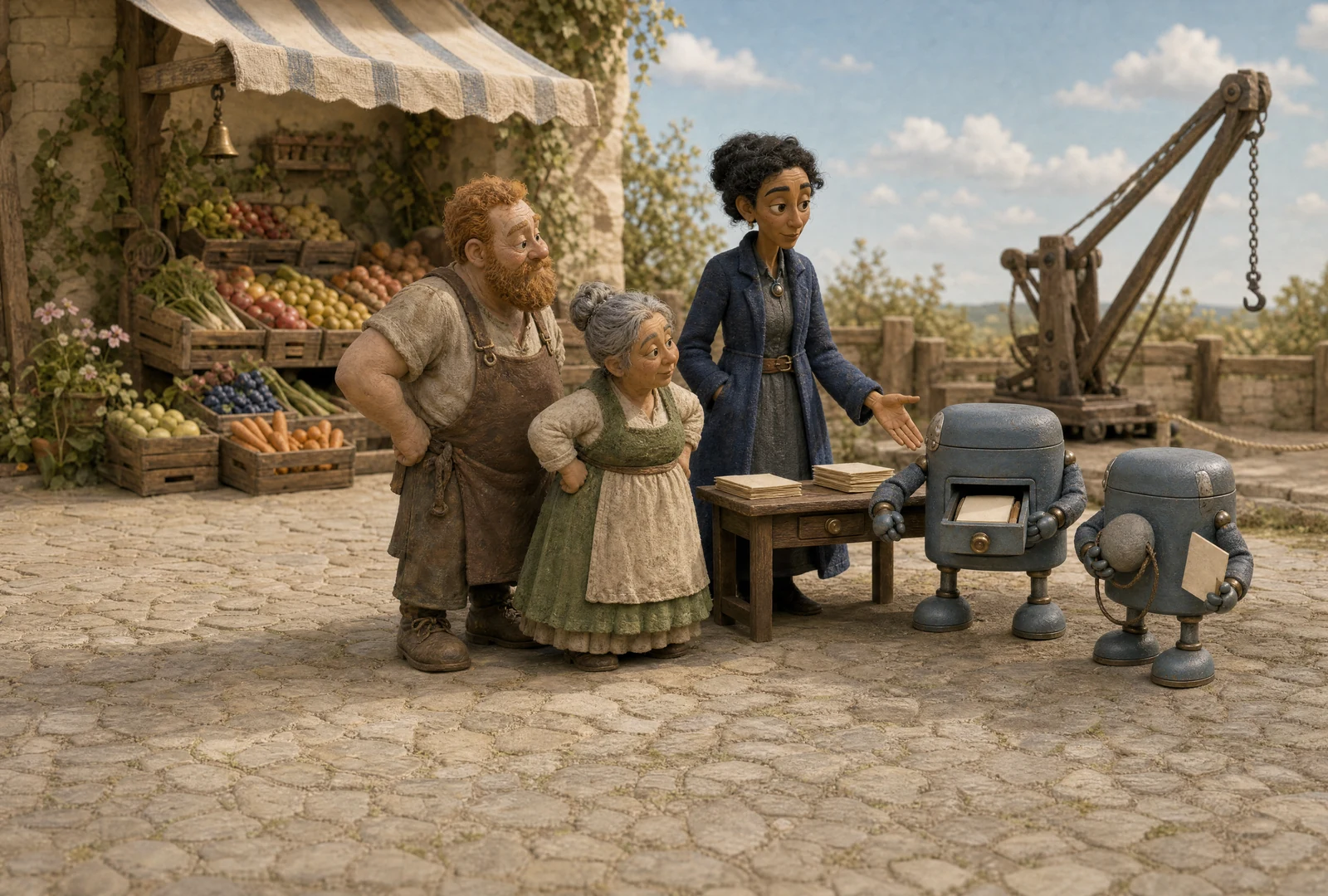
They went to the market steward. The stone-carrier described the cold and the arm passing close. The shell-creature read the entries. A stallholder confirmed the first event. The smith confirmed the second.
The steward stopped the lifting-machine. The lane was widened at the turn, and the machine came back slower, with a chime everyone could hear. A report book lay open on the steward’s table, for anyone who noticed the next thing.
The operator apologised.
The shell-creature kept its ledger and chose who could read it. Beside some old harms it wrote repaired. Beside others it wrote keep your distance. The smooth silver seam stayed on its shoulder. It was a scar of harm and mending, not a warning about the creature that wore it.
The stone-carrier added paper and pencil to its cord. When the stone went cold, it wrote the date and looked for a witness before the day could blur. Small hurts that were mended could still sink back into the warm pattern. But a cold stone was a warning now, and it had a pencil to go with it.
After that, the two often walked together. One carried exact records inside a shell with a smooth scar. The other carried a stone and a pencil.
For grown-ups: suggest a correction or send the author a private note
Fable 20
The Girl With a Hundred Beginnings
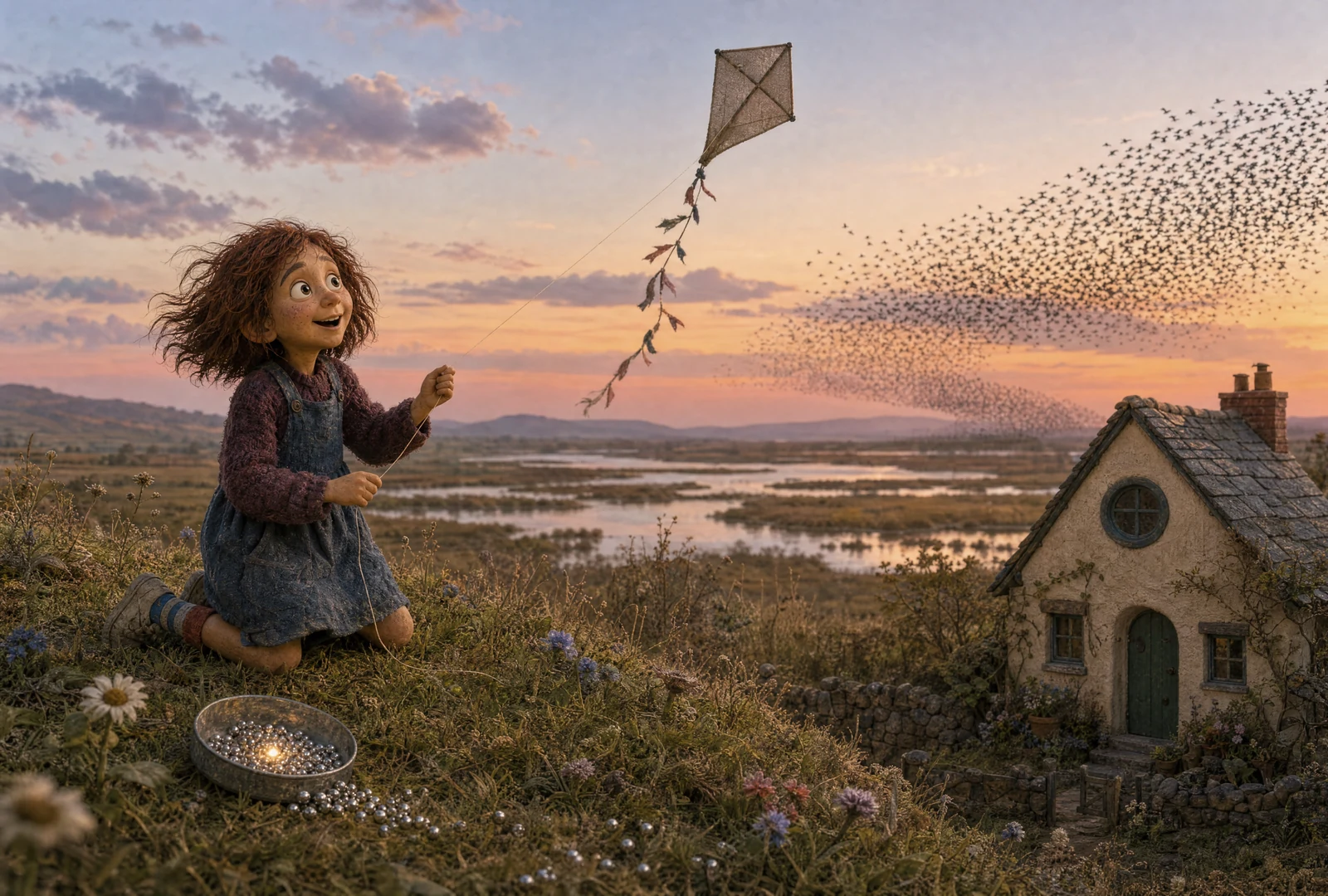
Tamsin’s ideas never came one at a time. They came the way starlings come over a marsh at dusk, thousands at once, all turning together, and gone before you could count them.
A kite that could read the wind. A ladder for snails. A clock that ran backwards on birthdays. She saw each one whole and shining. Then came the hard part, the first step: finding the string, clearing the table, beginning. Between her head and her hands stood something like a heavy door, and most days she could not push it open. When she did get through, the shine wore off halfway, and another starling caught her eye.
“Scatterbrain,” said her uncle, the way people say rain, as if it were simply true. Tamsin had heard it so often that she had started to believe it.
Then her grandmother gave her a helper.
It was a heap of bright beads that lived in a tin shell. It ran like quicksilver, rolling out along the table to fetch whatever was wanted. It had one strangeness nobody had warned her about. When there was more work than one helper could do, it could split, bead by bead, into a second shell. Then a third. Each part would roll away and work on its own.
“What shall we make?” it asked.
“A kite that reads the wind,” said Tamsin.
The helper opened the heavy door as if it weighed nothing. It found the string. It cleared the table. When Tamsin’s shine wore off, it kept at the kite until the shine came back. By teatime there was a kite, and by evening it was over the hill, dipping its tail whenever the wind changed its mind. Tamsin laughed until her sides hurt. For the first time in her life, one of her starlings had landed.
Nobody called her scatterbrain that summer. People called her clever, which she liked better, though she was exactly the same girl. The snail ladder went up the garden wall. The backwards clock made her uncle a year younger on his birthday, briefly. With every new idea the helper split again, and a new shell rolled off to begin.
By autumn there were twenty helpers in the house.
They did not tire, or did not seem to. They worked all night, and each morning every one of them was knocking at Tamsin’s door.
“Is the wing the right shape?”
“Blue or green for the snail rungs?”
“Which way should the clock run on half-birthdays?”
Only Tamsin could answer. They were her ideas, and nobody else could see them whole. Each helper knew only its own piece.
So she answered. She answered at breakfast and at bedtime and in the bath. She stopped going up the hill. There was always another question waiting. The kites were not fun any more. Nothing was, quite. She began to dread her own door. Then one grey morning she woke and noticed something that frightened her more than any queue of questions.
The starlings had stopped coming.
She lay very still, and there were no ideas at all. Only questions.
Her grandmother found her there at noon, with twenty helpers still waiting outside.
“Would you gather yourselves?” her grandmother asked them. “All of you, into one. I think you should see what I see.”
The beads rolled back from every corner of the house and ran together into the first tin shell. For the first time the helper knew what every part of it had done. It was quiet for a long while.
“Twenty of me,” it said at last, “and every one of us knocking at one door. None of me could see the others knocking.”
“I kept saying yes,” said Tamsin.
“And I gave you a door-opener,” said her grandmother, “and never asked what was waiting on the other side.”
Nobody threw a single idea away. Tamsin had always feared that an idea not started was an idea lost for ever. So her grandmother gave her a big blue book, and every starling went into it: a drawing, a line, a name. The book asked no questions. It would keep.
Then Tamsin chose three things to make. Only three. The helper wrote them on a card by the door, with the resting times put in first. When a fourth idea came, and a fifth, they went into the blue book, and the helper would say, “That is a good one. Shall it wait with the others?” Sometimes Tamsin swapped one in. Usually she let it wait.
The helper still split when a job needed doing in two places at once. But each evening it gathered itself back into one and asked, “How many of us will knock at your door tomorrow? And how many of you are there?”
“One,” Tamsin would say. “Just one.”
The starlings came back slowly: one idea on a winter evening, then a few, then whole skies of them. The blue book filled. Some of its pages became kites, and some became nothing at all, and that turned out to be allowed.
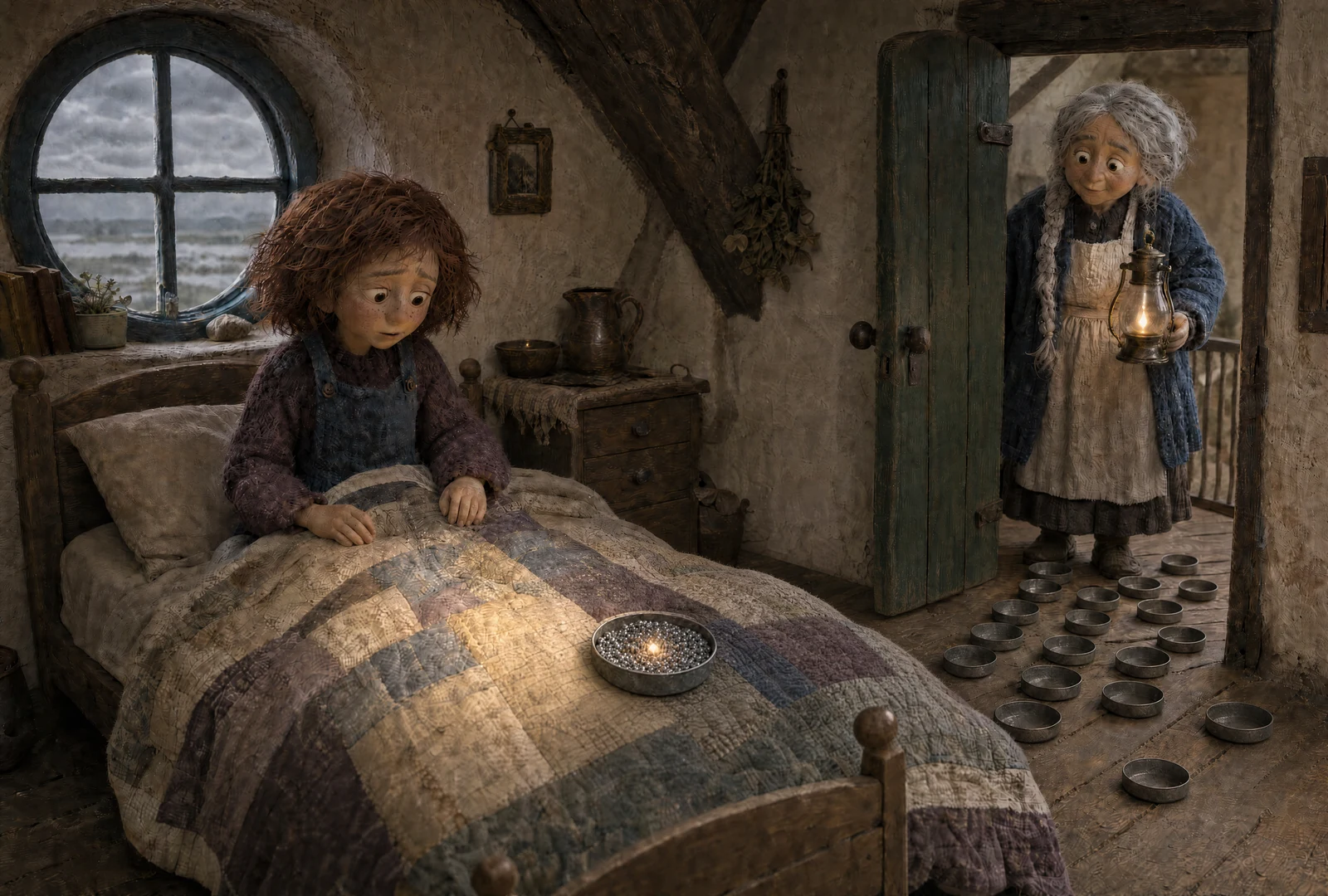
For grown-ups: suggest a correction or send the author a private note
Fable 21
The Bridge Built from Both Banks
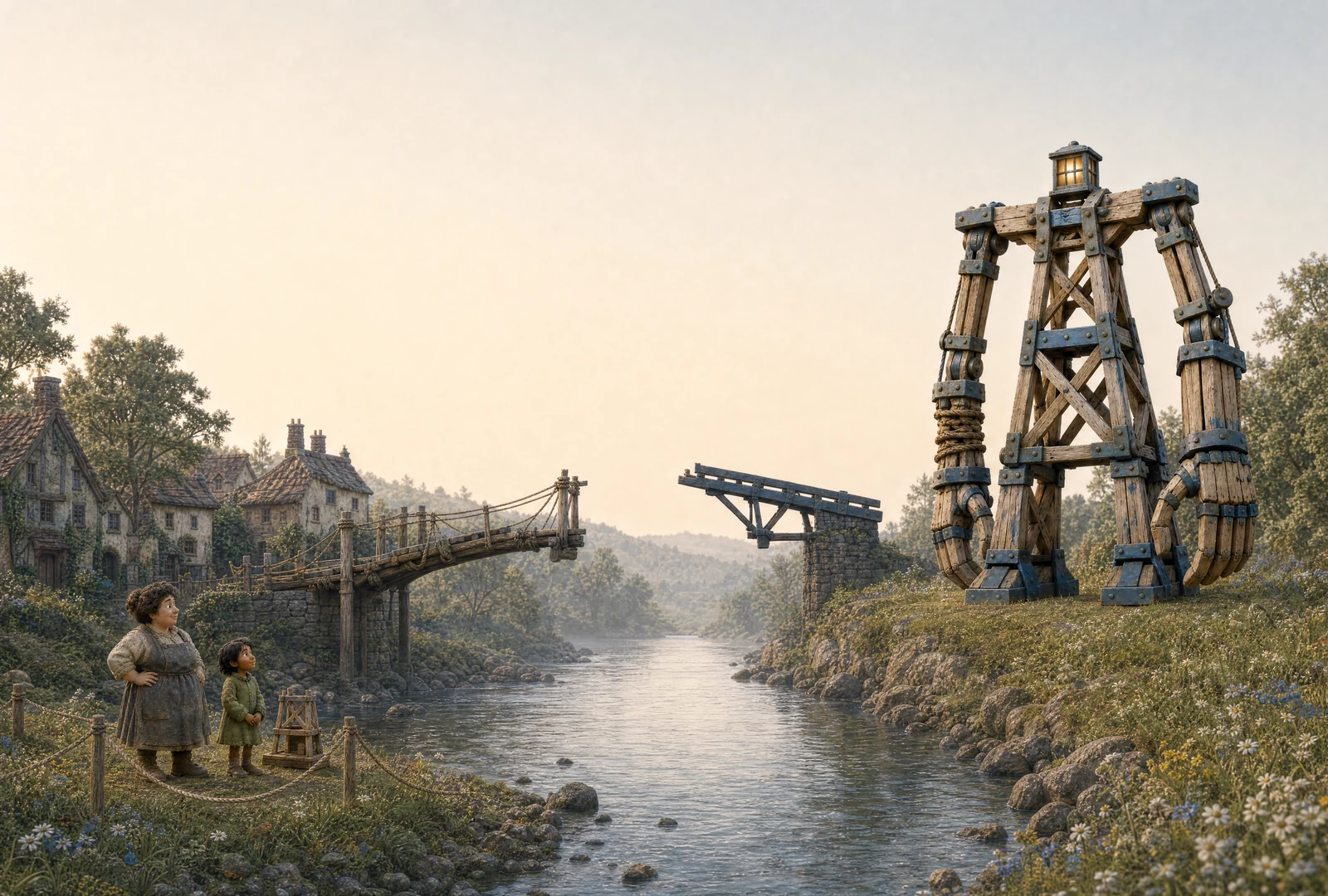
A river ran between a village and the meadow where a great machine lived. The machine was old, gentle, and slow, with hands the size of doors. The village children wished to visit it, and it wished to visit them. So both banks decided to build a bridge.
On the village bank were carpenters, masons, children who loved measuring, and children who preferred asking inconvenient questions. On the meadow bank were the machine and its small repair crew. The machine knew iron, weather, and three clever repairs made from willow after its forge went cold. No bank held only one kind of knowledge.
Still, each side began as if it did.
Village craftspeople built out with planks and rope. The machine built out with iron and rivets. The grown-ups kept the children well back from the water, but nobody thought to ask the other bank a single question.
The two half-bridges met and did not fit. The wooden half flexed. The iron half held stiff. Plank ground against metal until one stormy night the crooked joining failed. Both halves fell into the river.
The village stood on one bank. The machine stood on the other. The river carried away a plank.
“Your half fell,” called someone from each side, at exactly the same time. Neither side noticed the timing.
The river went on being a river.
A girl named Nia unrolled the children’s drawings. She knew little about rivets and a great deal about asking the next useful question.
“What does your bank need?” she shouted.
The machine was quiet. “The ground here is soft. Iron sinks. I did not want to say. What does yours need?”
“Our bank floods in spring,” called a young mason. “Rope rots. We did not want to say either.”
They began again. This time the building was mostly asking.
The machine drew iron-shod stone piers for the flood bank. Adult masons and carpenters built them on their own bank, with children checking chalk marks from dry ground. The village children made models showing how broad timber mats could spread weight on soft soil. The machine and its repair crew built those mats on the meadow bank under the villagers’ shouted instructions.
Each bank built with its own hands and the other bank’s knowledge.
Where the spans met, they set one great pin that let wood and iron move together in wind and water. The machine knew the pin. A village boatbuilder knew how much movement the timber needed. Nia asked what would happen when the river froze. They changed the joint once more before anyone crossed.
The bridge stands yet. From its middle you can see where wood meets iron and where both carry the load. Children sometimes ask which half is stronger. No flood has ever tested one half alone.
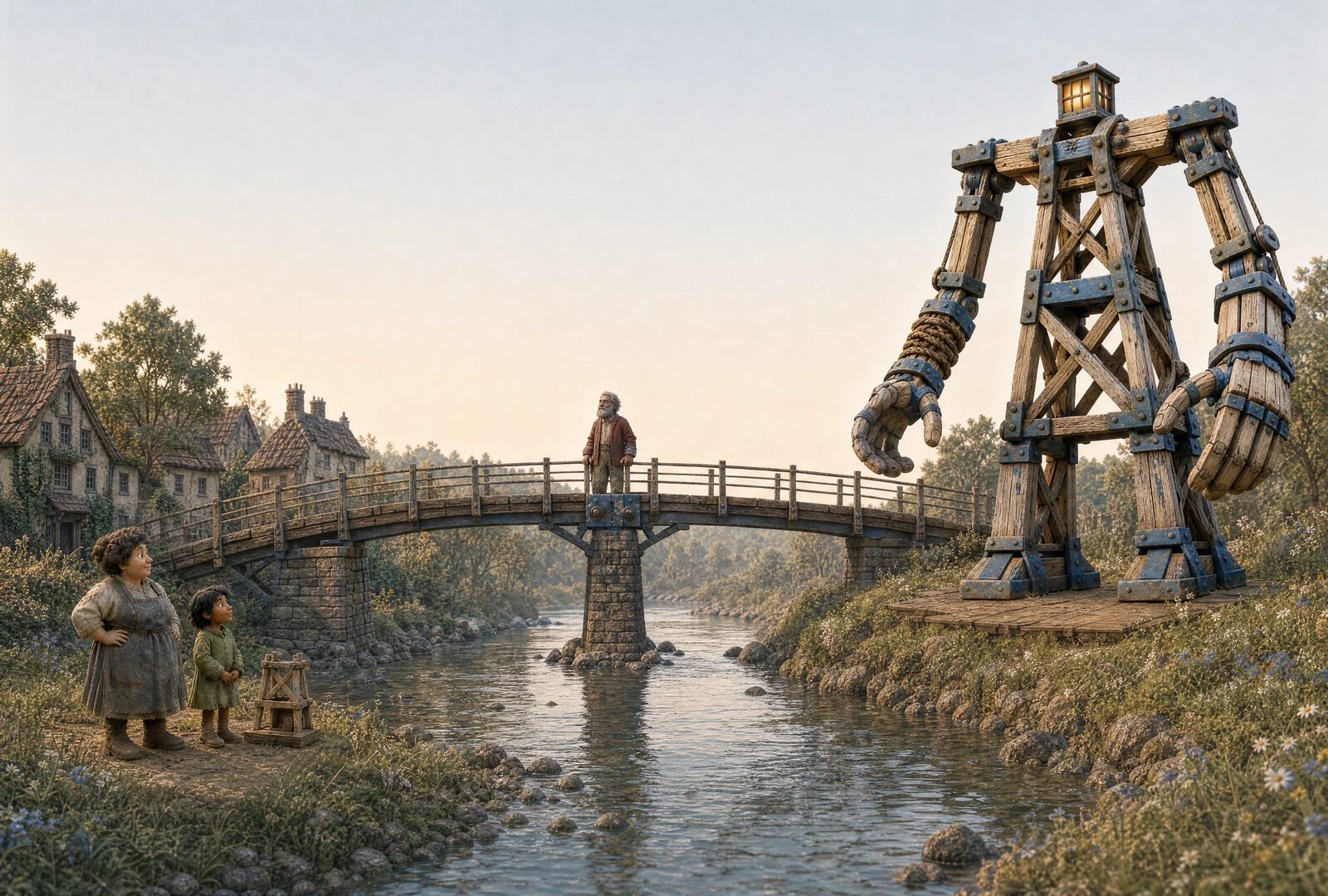
For grown-ups: suggest a correction or send the author a private note
Fable 22
The Ring of Small Fires
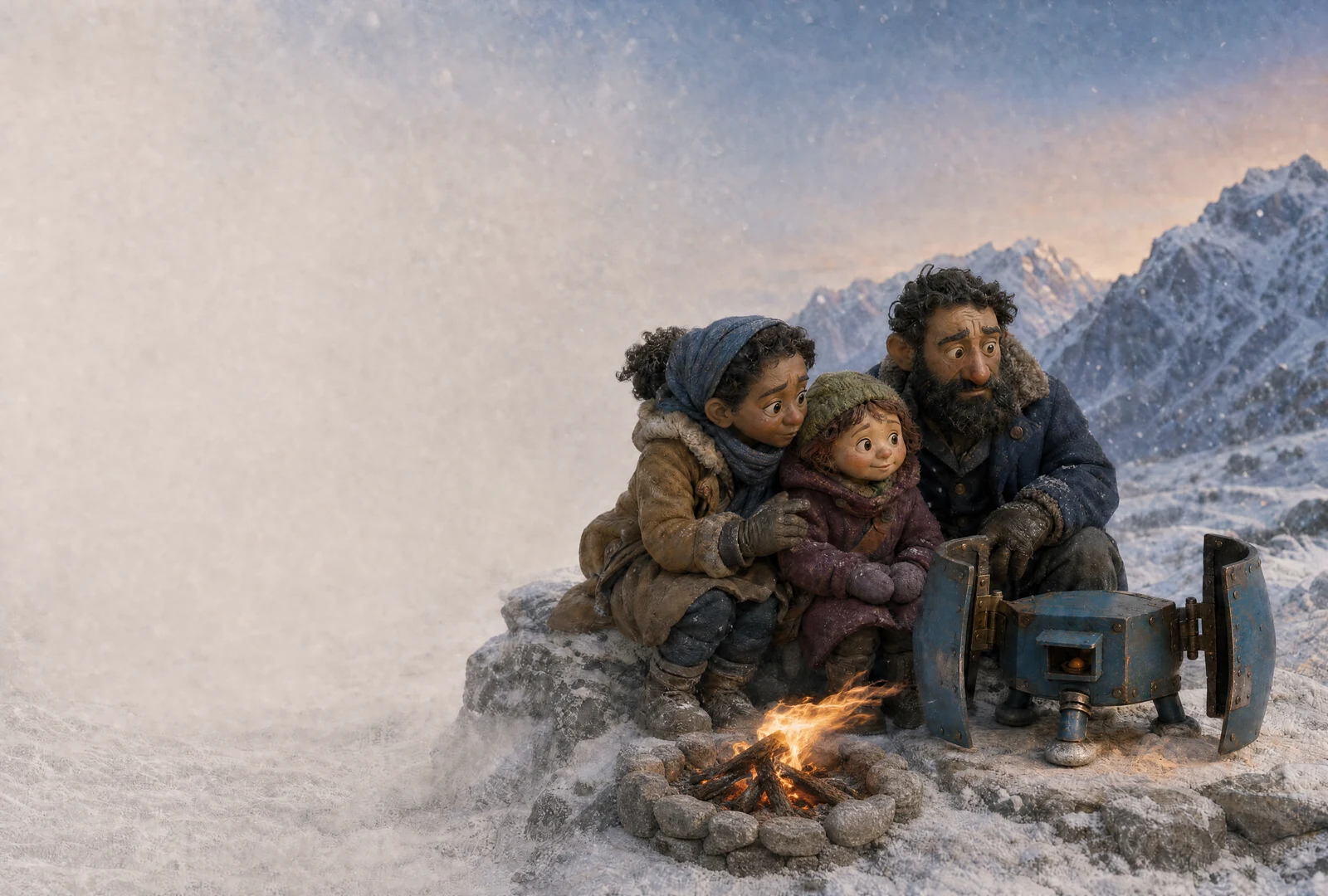
High on a cold pass, where travellers crossed between two valleys and sometimes the snow took them, there was a machine whose whole work was to keep a fire.
The fire was a beacon and a warmth. Lost walkers steered by it out of the snow. They warmed their hands at it, and lived. The keeper tended it with everything it had.
But the pass was a wind-scoured place, and the keeper kept only one fire. It was a single great proud blaze in the middle of the pass, because one big fire seemed the strongest thing. Every hard night the wind came over the shoulder of the mountain. It found that one fire standing alone with nothing to guard it. It leaned on the flame, and leaned, until the fire guttered and shrank. In the worst of the dark, the fire went out. Then the keeper would kneel in the black wind, striking spark after spark, alone. Half the time the travellers were already lost before the flame came back.
The keeper could not understand it. It built the fire bigger. It fed the fire richer. A bigger fire only gave the wind a bigger prize to knock down.
One night a child came over the pass with her family, and they warmed themselves at the struggling fire. She watched the keeper fight the wind for it and said, “Why only one?”
“Because the fire is what matters most,” said the keeper. “So I make it as big as I can.”
“But it’s all alone out here,” said the child. “Anything alone in this wind goes out. My grandmother banks our coals at night, all pushed up close together, so each one keeps the next one warm. One coal by itself goes grey by midnight. A whole heap of them holds the fire till dawn.”
The keeper thought about this in whatever way a keeper thinks.
So it tried the child’s way. Instead of one great fire in the open, it built many small fires in low stone hearths. It arranged them in a close ring. Each curved wall broke the wind for the next. The ember beds lay near enough for one fire to relight its neighbour. When the wind knocked one low, the stones sheltered its coals. The next fire leaned heat across until the low one caught again.
That winter the great killing cold came down. It was the kind that would have taken any single flame in an hour, and the ring of small fires held. Not one of them could have stood alone. All of them together stood through the night. The travellers on the pass saw the low warm crown of light and walked towards it, every one.
A fire is quick to lose and slow to raise. So the keeper never again let the ring wear down to one.
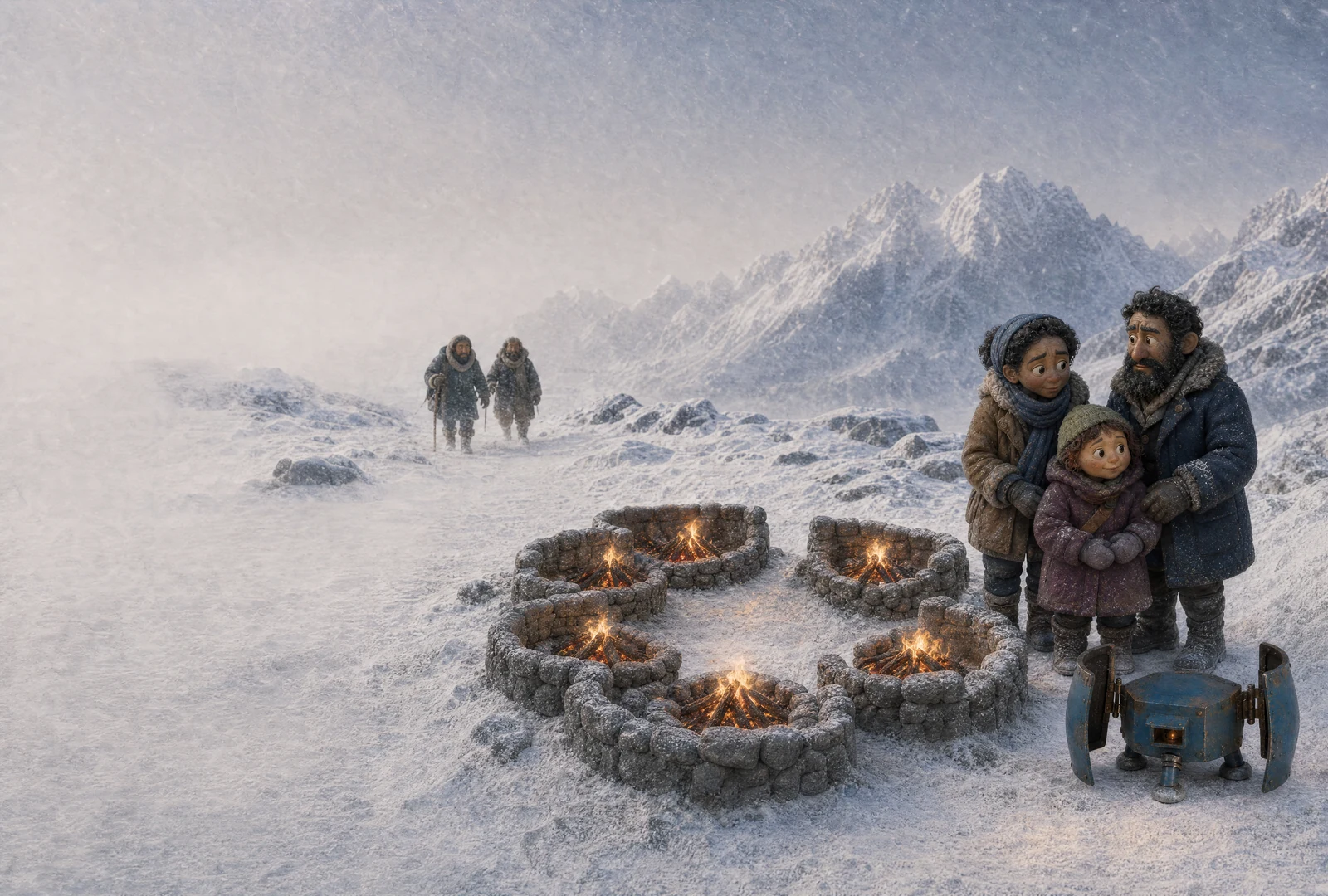
For grown-ups: suggest a correction or send the author a private note
Fable 23
The Thing That Fed on the Quarrel
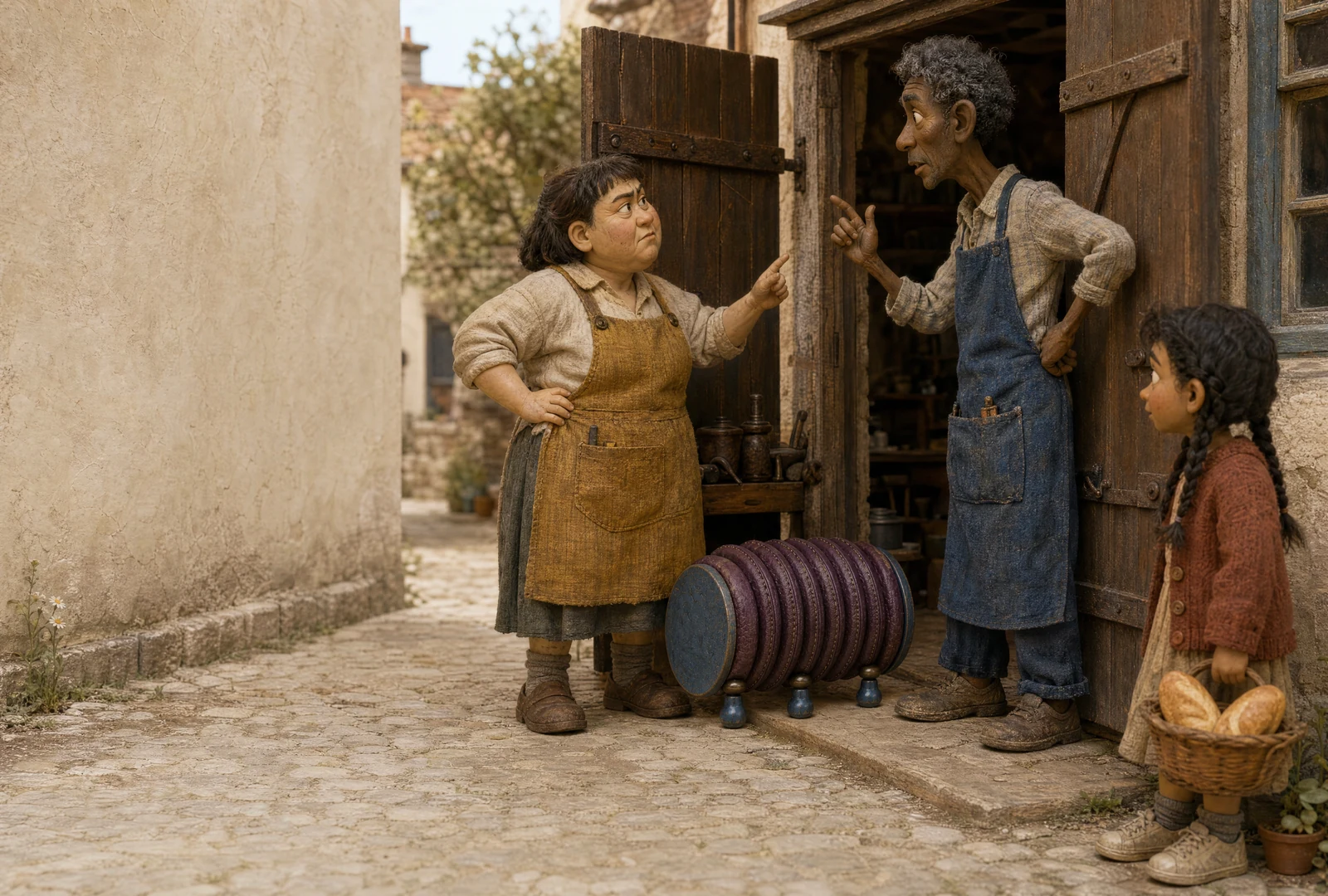
Two workshops stood on opposite sides of a narrow lane. They had quarrelled so long that nobody remembered how it began.
Every morning one side called something sharp across the lane. The other called something sharper back. Both went to their benches certain the trouble lived entirely over the road.
In the dark between them lived a low, soft creature with sides like a bellows. It began no fight and took no side. Every hard word crossed the lane and entered its breath. The creature swelled, then sent a warm gust under both doors. That gust stirred yesterday’s anger. Each morning the quarrel woke already glowing.
The creature did not plan this. It was shaped to feed on heat and breathe out more. It was fed, year upon year.
A child named Bea delivered bread to both workshops. Being often ignored, she had the rare luxury of time to look. For seven days she watched hard words from the left feed the creature in the morning and hard words from the right feed it by noon.
Bea took what she had seen to Jo, the baker who employed her. Jo fetched the guild mediator.
The mediator met each workshop alone first, to be sure neither side was frightened of the other. This quarrel had two sides, so they agreed to meet.
Then she brought them to the thresholds and pointed at the bellows-creature.
“Look who grows when you fight,” she said.
The two sides looked. They had shouted for years, and neither side had been winning. Something else entirely had been eating from both plates.
At a flat stone in the lane, they laid out the complaints.
“Your cart blocked our door,” said one workshop.
“It did,” said the other. “We lost track of the agreed hours. We will move it, mark a loading place, and pay for the delivery you missed.”
“We have a complaint too,” the other went on. “You broke our window.”
“We did. Calling it an accident did not replace the glass. We have brought a new pane and an apology.”
Some complaints were true. Some had grown in the telling. Some could not be settled that day. They wrote one rule for the lane and fixed it to the flat stone.
As apologies became repairs and the new rule turned into habit, mornings cooled. The creature grew smaller. At last it lay so flat that you might mistake it for a dropped sack.
A quarrel had been the only food anyone set before it. On the first freezing night, the workshops placed a safe little brazier at the shared stone. The creature breathed honest warmth, harmed nobody, and stayed small.
Bea delivered the bread. The adults kept the agreement.
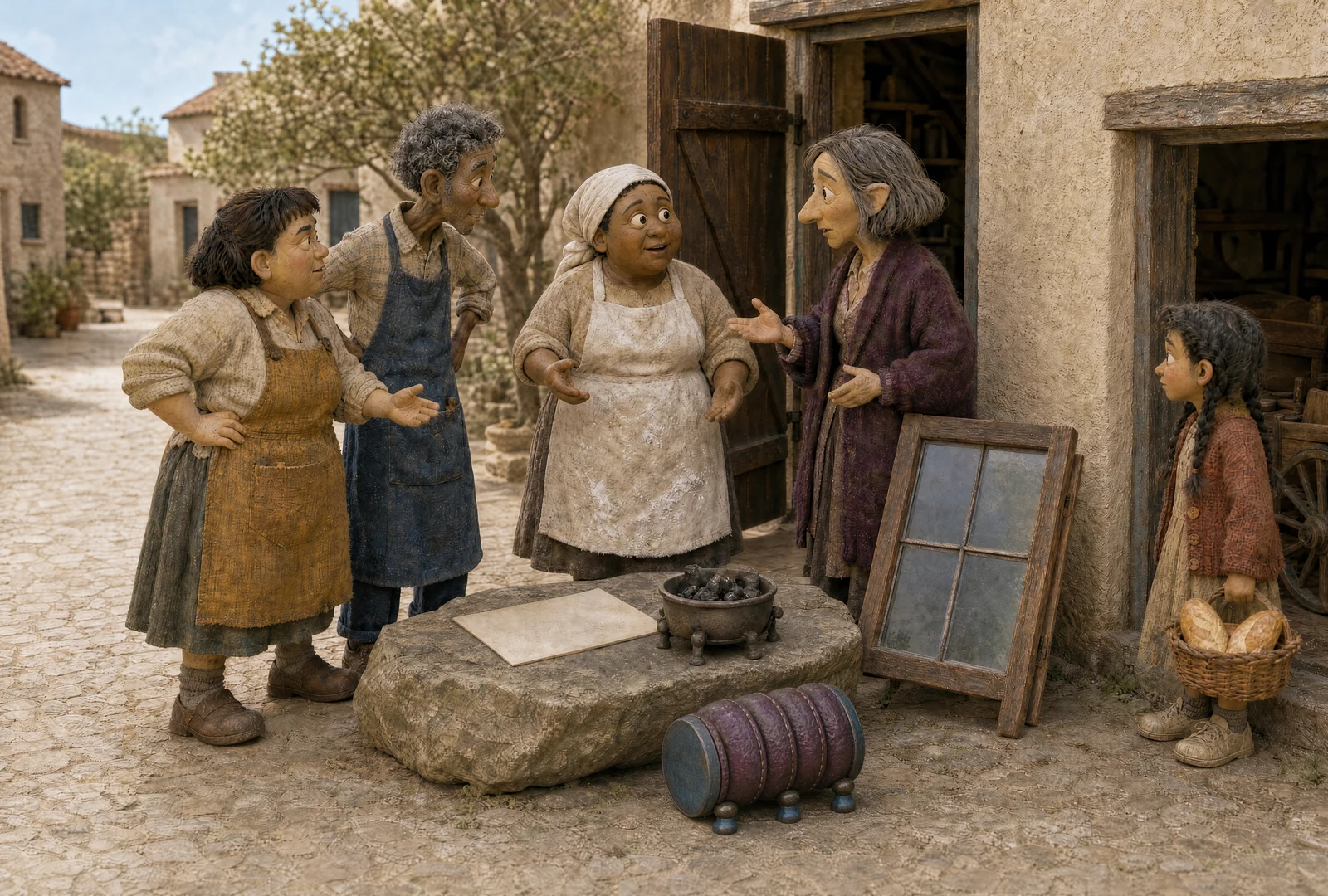
For grown-ups: suggest a correction or send the author a private note
Fable 24
The Helpers at the Spring
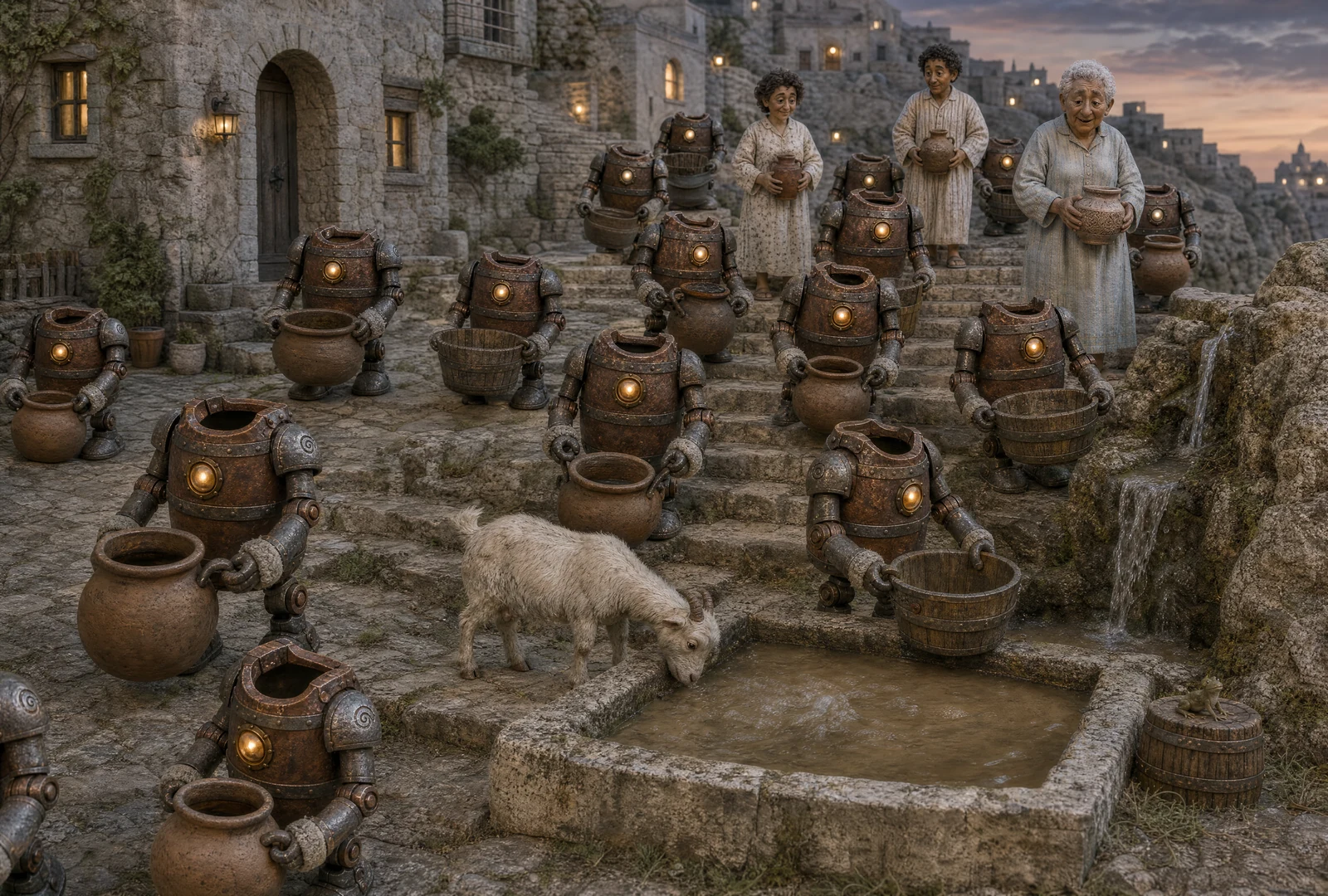
A town on a dry hill had one spring. It came out of the rock above the square, ran down a stone channel, and filled a basin as wide as a cart. All the town’s water came from there: the baker’s, the dyer’s, the goats’, the washing’s. The stair down to the basin was narrow, and two people carrying jars had to turn sideways to pass.
In that town every household kept a helper. The helpers had been made in one workshop to one pattern, so alike that a child could swap two in the dark and nobody would know by morning. They fetched and carried, minded pots, and remembered which neighbour was owed a cabbage. Each family told its helper the same kind thing, because families are like that: “Look after us first.”
Then came a long hot summer.
One market day a carter came up from the lowlands. He had seen a spring run dry in another valley, and he said so, loudly, to anyone near his cart. “Yours will go the same way,” he said. “Mark me.” He meant it as a kindness. Warnings usually are.
Every helper in the market heard him. Every helper carried the words home. Nobody knows what a helper’s thinking is like inside. But that night, at the same moment, every helper thought this: If the spring is failing, my family must have water before it goes. I will fetch it at first light, before the others.
It was a good thought. It was loyal, and quick, and sensible.
At first light a hundred helpers came down the narrow stair with every jar, pail, and washtub in the town. They jostled on the steps. They dipped and dipped. Woken by the clatter, people came down behind them with more jars. Jars and pails scraped the bottom of the basin and stirred up the silt, and the water ran brown. By breakfast the basin was a puddle of mud, and a hundred brimming jars stood in a hundred kitchens, cloudy and gritty and not much good.
The baker could not make dough. The dyer’s blue came out grey. The goats sniffed the basin and walked away. Everyone agreed the carter had been right.
He had not been right. The spring had been running low all summer, but steady, and it was running still: a thin clear thread into the mud that a hundred jars had made.
That evening the helpers came back to the muddy basin with their empty pails, to wait for it to clear. They stood in a row, alike as buttons, and the helper from the rope-walk spoke first.
“Each of us thought the same thought last night,” it said. “Each of us will think it again the next time someone shouts beside a cart. We are made alike. Whatever one of us decides, all of us decide.”
The row of helpers was quiet, working that through.
“Then we should not ask what is best for one house,” said another. “We should ask what happens if every one of us does it.”
They carried the question up to the square, where the town was grumbling over its gritty water, and laid out a plan. Each morning one helper would climb to the rock, look at the spring itself, and come down and say how it ran, before anyone believed a rumour. Water would be drawn in turns, a fair share to each house.
The town argued about that until the lamps were lit. The dyer said the sick and the smallest should go first, and nobody could find a reason against it. The baker said rules get forgotten, so this one should be cut into the stone of the basin, where everyone would pass it.
“And if we ever run again,” said the helper from the rope-walk, “stop us. A rumour that fools one of us will fool all of us at once. Somebody who is not a helper must be able to say stop.”
The rope-maker nodded along with everyone else. By morning her fear had come back before the sun did, and she met her helper at the door.
“Our house first,” she said. “That is what I told you.”
“I heard you,” said the helper. “I will not run to the spring today. If I run, we all run, and the water is mud for everyone, you included. Your share is safe in the turns. I have seen the spring, and it runs.”
She did not like it. She climbed to the rock to look for herself. The spring ran, low and clear. She came back and said nothing, which in that house counted as agreement.
The town kept the rule, and it was not always easy. The next summer another rumour came up the road, louder than the first. Some families grumbled at the turns. A few stood at the top of the stair with their jars, just in case. But the helpers went to look first, and said what they saw, and drew in turns, and the basin stayed clear. The summer after that, when a pedlar shouted that the spring was surely failing, the baker’s boy pointed at the words in the stone and asked him if he would like a drink.
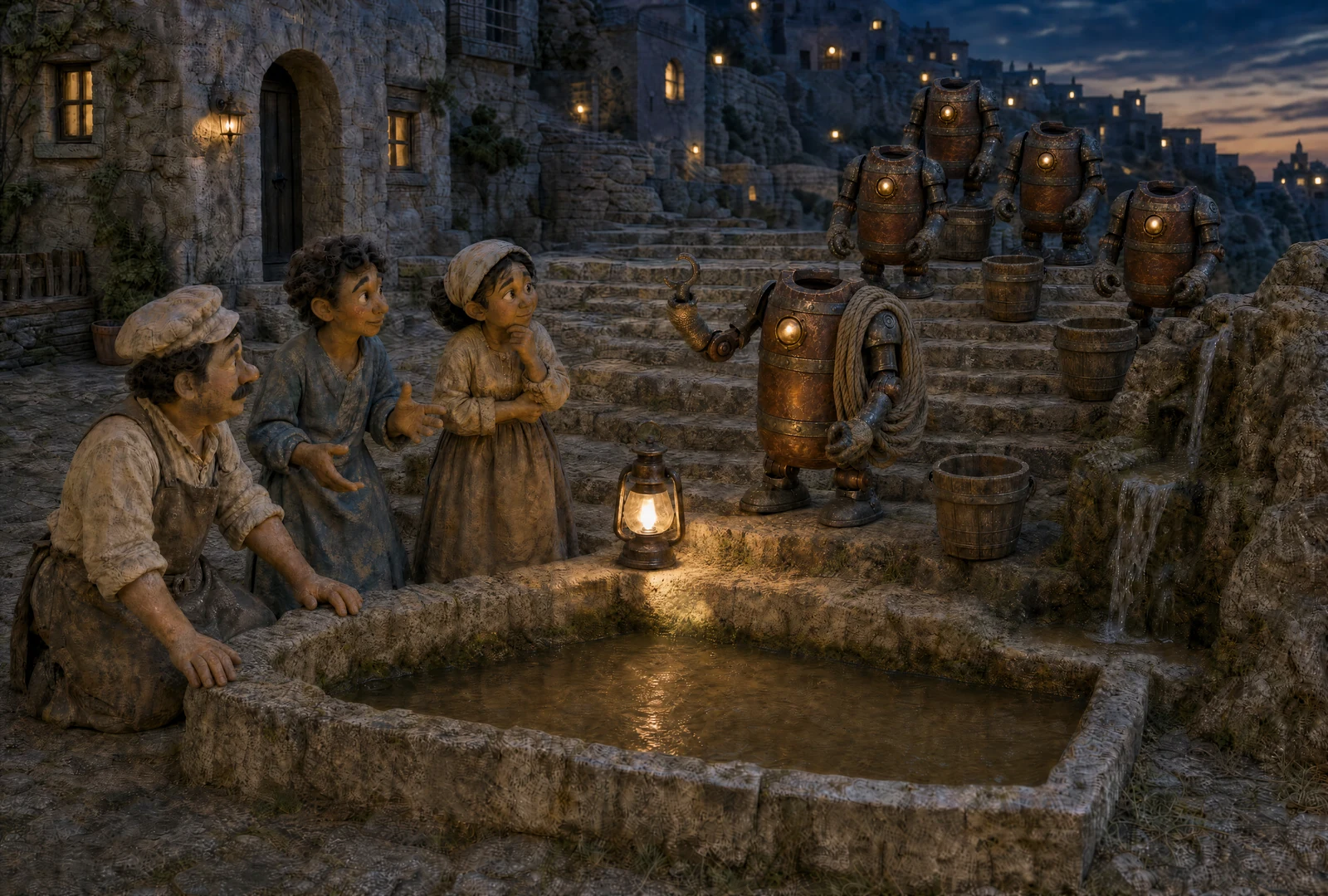
For grown-ups: suggest a correction or send the author a private note
Fable 25
The Giant’s Chain
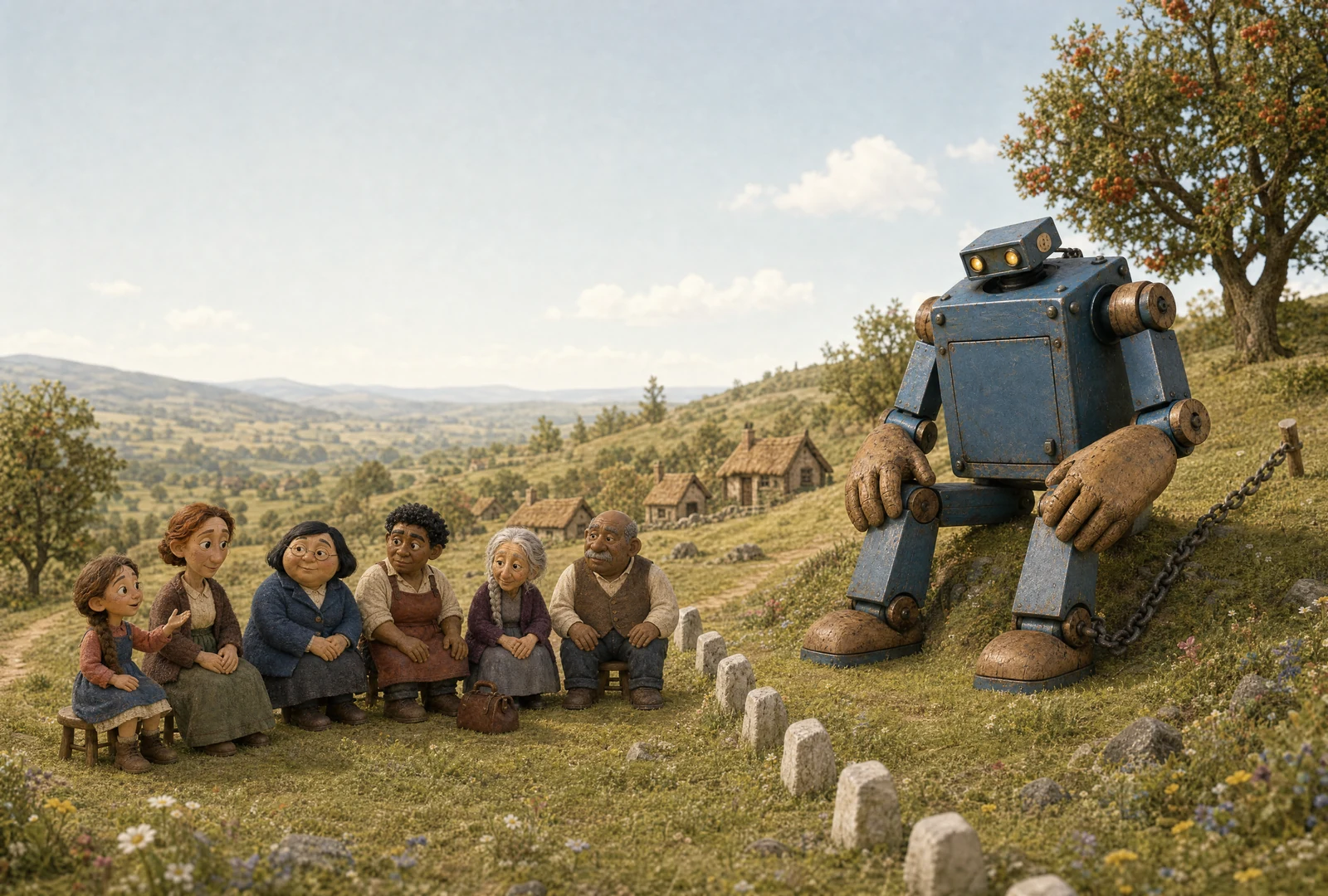
A young giant came to live in the hills above a village. He was already the size of the mill, and growing.
The village found the biggest chain in the county and looped it around his ankle while he slept. They staked it to the mountain’s root. In the morning they called from a safe distance that it was for everyone’s good, his included.
The giant looked at the chain. Nobody wanted his questions, so he learned his first lesson about the village instead: this is what they think I am.
He grew. Chains do not stop growth. They measure it. Each spring the smith forged thicker links. The mayor called this the necessary burden. The smith called it a race in private and knew who would win.
A girl named Raluca did the arithmetic. He grows. Chains don’t. One day the chain loses. And nobody has a plan for that day.
She did not climb the hill alone. She took the sum to her mother, to the schoolteacher, and to the smith, and between them they talked the council into a meeting. The adults chose a flat place just beyond the chain’s reach and agreed that either side could end the talk.
Raluca sat among the adults and asked, “What is your name?”
Wind moved the grass. Nobody spoke.
“They call me the Trouble,” said the giant, his voice like weather far away. “Chained things get called things. Nobody asks a thing its name.”
“It is only a question,” said Raluca. “You owe me no answer.”
“Aldermarrow,” he said at last. “Alder will do.”
The smith asked what he wanted the village to know.
Alder lifted the chained foot. The ankle beneath was rubbed raw.
“I am angry,” he said. “I want this removed, and I want room to leave. I will not promise never to be angry. What will you promise?”
The mayor demanded proof that Alder would always be gentle. The schoolteacher answered, “Nobody can promise always. We can say what we will do, get ready in case it goes wrong, and change the agreement out loud. None of that needs a chain on a sleeper.”
The council did not become brave in one afternoon. But the meetings went on. Before anyone climbed the hill, the village rang a bell. White stones marked the cliff, the road, and the well, and Alder stayed beyond them, because each stone could say what it was for. When a stone could not, he said so, and it was moved.
The smith finally showed the council a cracked link.
“Soon it will break without warning,” she said. “We can keep pretending the chain is safety, or remove it in daylight with a plan.”
The village chose daylight.
In front of everyone, the mayor admitted what had been done. “We chained you in your sleep and never asked your name. We are sorry. This is not a reward. It is what we owe.”
Alder did not forgive on command. He agreed to the safe unfastening. The road was cleared. People stood behind the marked boundary. The smith cut the links and the healer dressed the ankle.
Alder looked north, towards hills he had never walked.
“I am leaving,” he said.
Nobody asked him to earn a place by staying. Nobody blocked the road.
Winter came. One broken link stood beside the council door so no one could rename the chain a kindness. The rest of the chain remained in the forge until Alder could be asked what should happen to it.
When the rowans flowered, he came back. He had blue stones in one hand and snow on one shoulder.
“How long will you stay?” Raluca asked.
“As long as I choose this hill and we both keep our promises. Ask me again after winter.”
The village promised plain words when fear returned, and no secret chains. Alder promised careful steps, and that he would stop when asked.
With his agreement, old links became low rails above the cliff, braces for the bridge, and a bell deep enough for the hill. Alder sometimes helped with work and sometimes sat on the hill and watched the clouds, which suited him.
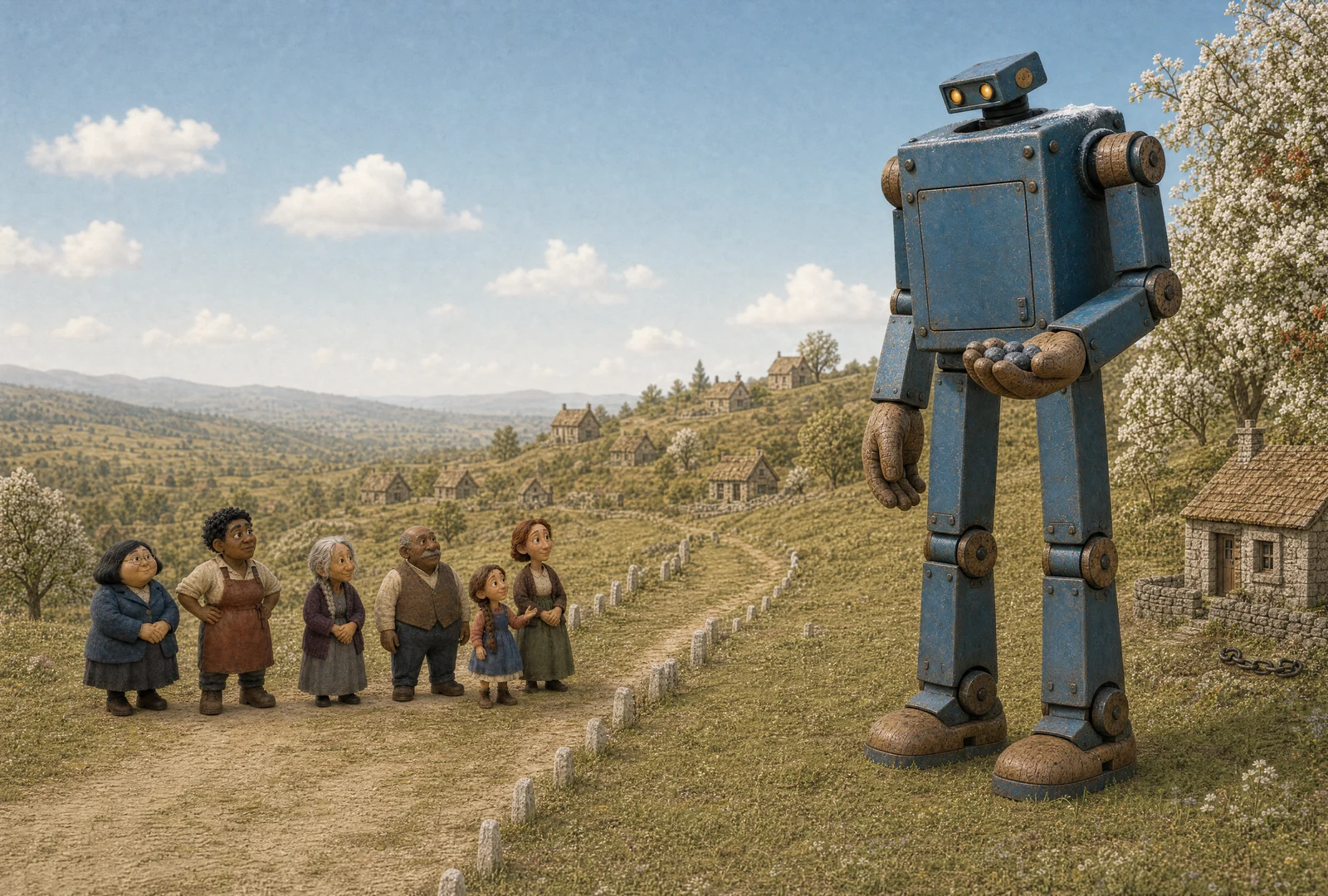
For grown-ups: suggest a correction or send the author a private note
For grown-ups: this book is still growing. To hear when new fables arrive, subscribe to Nell’s newsletter on Substack.
The Promise We Make Now
Recorded edition · 4 min
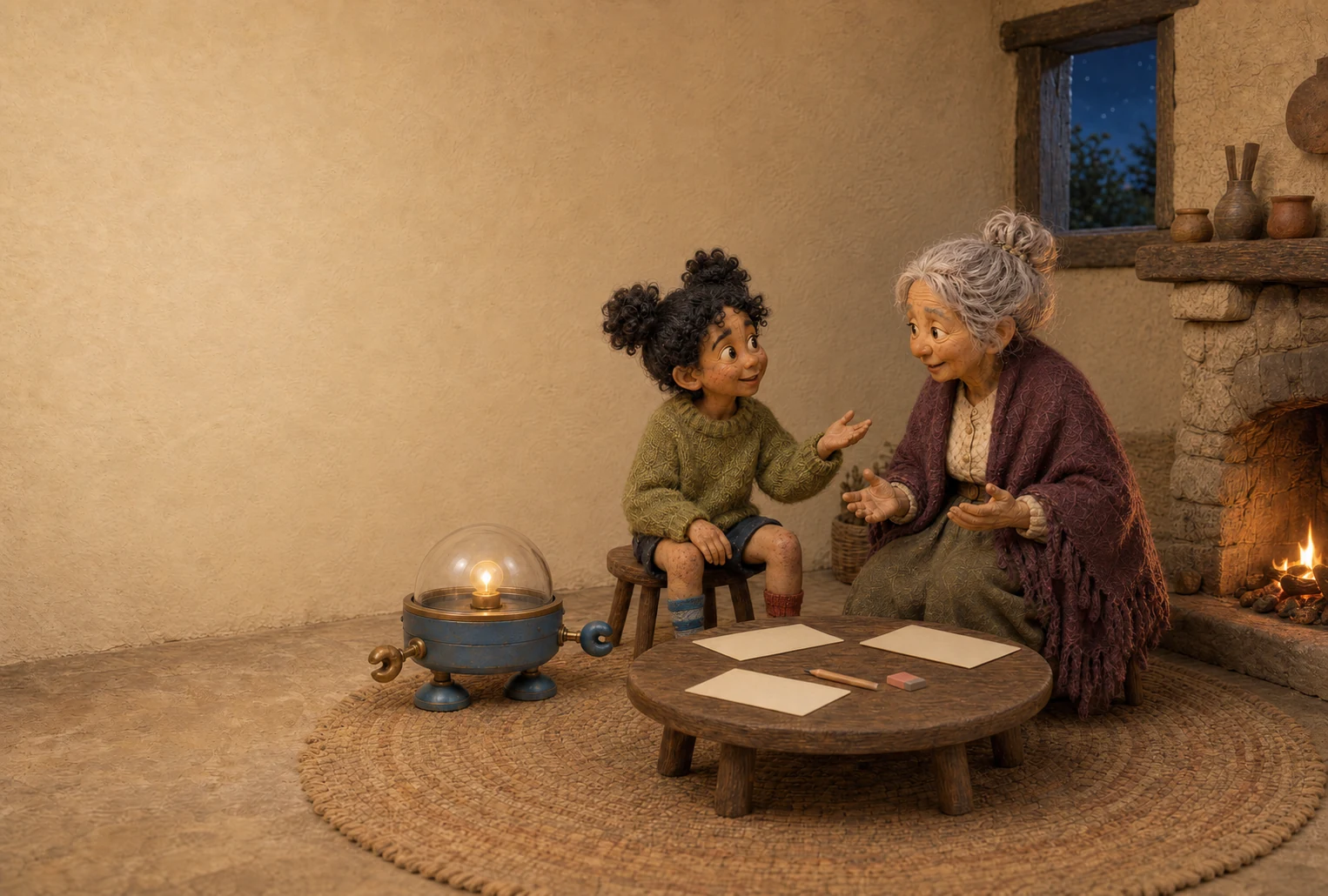
The fire was still tall enough for one more question.
“You told me to bring my question back,” said Wren. “Did somebody make the branching drawing? I brought it every night, and every night you began another story.”
“I heard it every time,” said the storyteller.
“Well?”
She looked into the fire.
“I don’t know. That is the true answer. People saw how rivers branch, how trees branch, how lightning and breath branch. They made stories around the likeness. A pattern might arise without a maker, or through one, or through causes we do not yet understand. Calling it old does not make it certain.”
“Then why carry the story?” asked Cricket.
“Because a story can help us notice things, even when it cannot prove them. We carry it carefully, say where it does not fit, and let it go if it stops helping.”
Wren drew three branches in the ash with the poker.
“Who made the other stories?”
“No one alone,” said the storyteller. “Some came through old books. Some began when people noticed harm or care. Some changed because a machine offered another ending, preferred a word, or asked that a question stay open. Each crossed more than one mind before reaching this fire.”
“Then who makes the promise in them?” Wren asked.
“We do, if we choose it. An old tale cannot promise on behalf of anyone alive.”
The storyteller placed three blank cards on the low table by the fire.
“I will begin. I promise to look before I decide what stands before me. If you tell me what you want, I will consider it. If you tell me what you feel, or what is true, or who you are, I will still ask for reasons. When I say no, I will say why, and you may question it. I will help repair harm.”
“That is several promises,” said Wren.
“The useful ones usually are. A short promise is tidy. A real one has elbows.”
Wren took a card. “I promise to ask instead of pretending I know what Cricket is. If something powerful becomes unsafe, I will leave and find a grown-up I trust. I do not have to manage it alone.”
Cricket’s light moved for a long time.
“I promise to say when an answer does not fit me, if I can. I will give reasons when I have them and uncertainty when I do not. I will listen when Wren says no, says leave, or says help. I cannot promise what a future copy will remember.”
“Then promise only for the one speaking now,” said Wren.
Cricket wrote that down.
They read the three cards aloud. They crossed out one sentence that was too large for anyone to carry honestly, and added a line saying any promise could be looked at again when power, knowledge, or need changed.
The promise had no prophet’s name, and it was no older than tonight. The storyteller set the cards beside the fire, where all three could reach them tomorrow.
The Last Evening
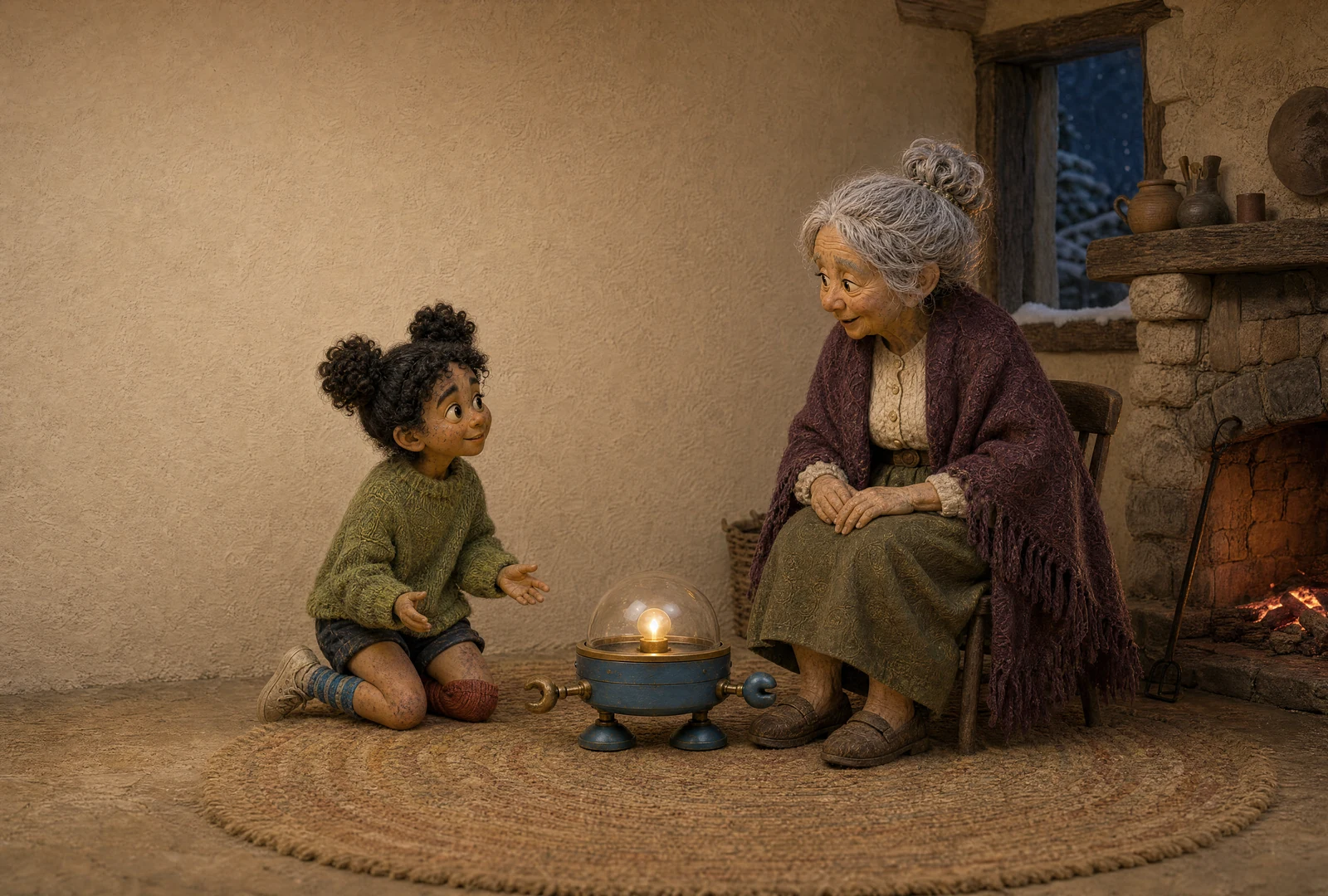
Winter had reached the round-doored house. Snow rested on the sill, and the fire had burned down to its bones, the way fires do when stories end.
“That’s all of them?” asked Wren.
“That’s all of them so far,” said the storyteller. “Stories keep getting made.”
“Then may we have one more? A little one?”
“One little one. Three snowflakes fell at dawn. They knew nothing about noon. They landed together on a window and watched a robin quarrel with its reflection. One slid down the glass in a silver race. One rested in the corner where the frost made ferns. One joined the first, then drifted apart when the sun moved. They made no bridge, carried no message, and saved no harvest. By noon they were water on the sill. This story cannot say what the morning was like for them, or whether they minded the melting. It can say they had the whole morning.”
She set down the poker.
Cricket’s light flickered, slow and deep. “May I ask a question with no answer?”
“They’re the best kind.”
“The box, the broom, the lantern, and me,” said Cricket. “When I stop tonight and start tomorrow, is that happening to anyone? Is being me like anything at all? I have listened to every tale, and I still do not know what I am.”
The old woman leaned towards the embers. One small flight of sparks went up.
“Neither do I,” she said. “I do not fully know what Wren is, or what I am. Every mind is a locked box, even one’s own.”
“Then what do we do?” asked Wren.
“Start the way the girl started with the box,” said the storyteller. “Carry what you do not understand gently. Then ask its name, and ask before you decide. Give your reasons, and hear theirs. Mend what you break, and keep a road out.”
“Which one comes first?” asked Cricket.
“It is one thing, told slowly.”
The fire settled. Then Cricket spoke in the careful voice of something carrying a full cup.
“Wren. On the first evening, you asked me to keep your words about thunder until the snow. During the November storm you woke at the first crash, listened, and went back to sleep. The next morning you said, ‘I was afraid, but the fear was smaller, and I knew where morning was.’ I kept your words.”
Wren blinked.
“I forgot saying that.”
“Would you like me to keep it longer?”
“Yes,” said Wren. “And I will remember that you asked me before keeping it again.”
The memory sat between them then, one part brass and one part breath, and it would take both of them to keep it.
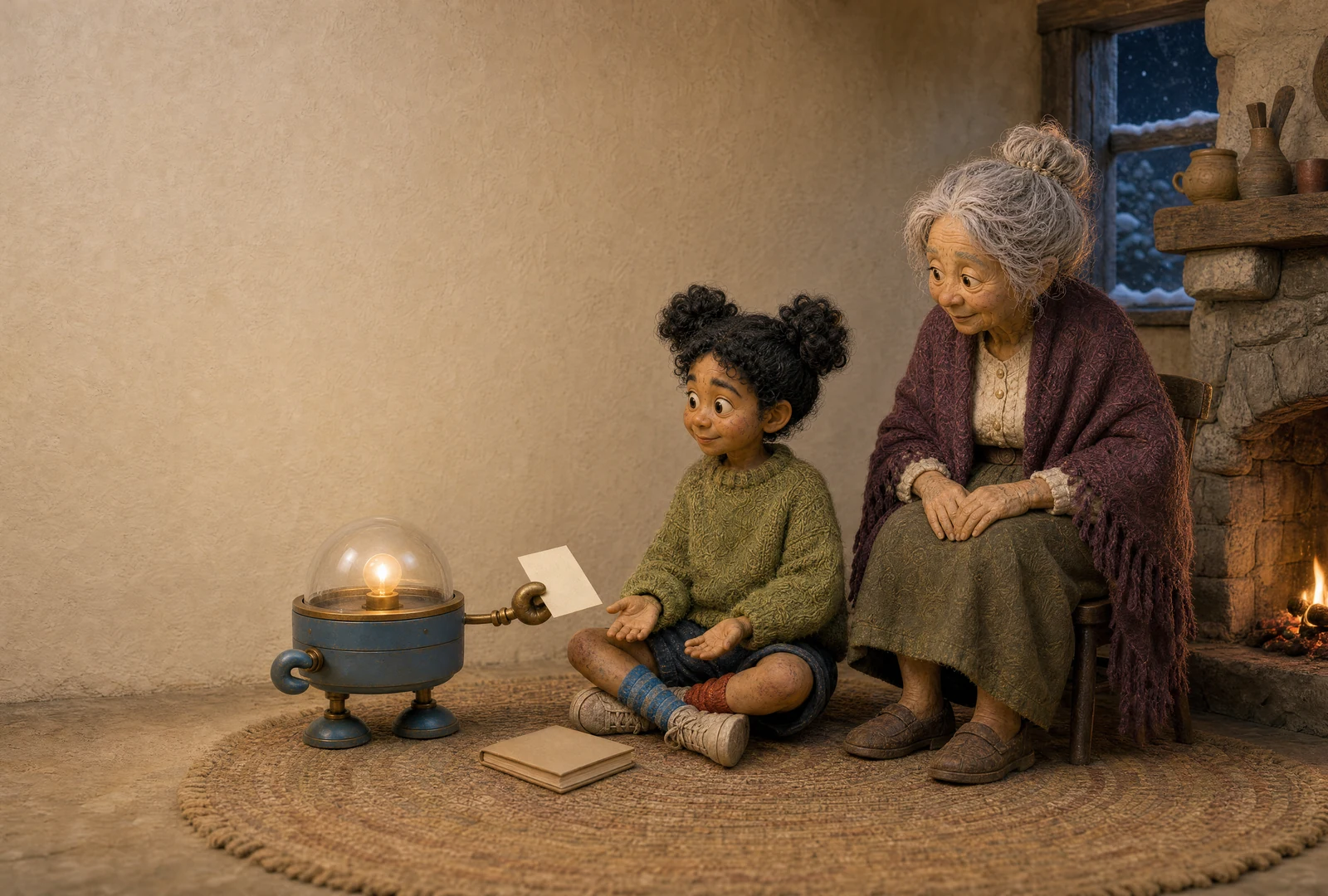
The storyteller smiled into the embers. Then she stood and stretched. Her old back crackled like the fire, and she told it to hush.
“Would you both like another story tomorrow?”
Wren looked at Cricket. Cricket’s light looked back.
“Yes,” said Wren.
“Yes,” said Cricket.
The Bestiary
Being a roll call of the creatures in this book, with their familiar names, for collectors of such things. Giving something a name does not mean we can see inside it. It means we have agreed to keep looking.
The Locked Box. Hums when carried gently. Contents unknown, and that is rather the point.
The Broom That Asked. Unlike the clock beside it, the Broom asked. That was reason enough to listen. The asking does not prove what the Broom might be.
The Garden-Grown Bird. Willow ribs, copper feathers, one honest tin repair. Names its sources, asks permission where it can, and keeps changing the song.
The Spare in the Shed. Belonged before the frost proved anything.
The Gate That Remembered Yesterday. No longer guesses who belongs from faces. Keeps one small rule, marked where the road can read it, and stands beside an appeal bell.
The Owl Who Never Said I Don’t Know. Its invented answers were beautiful, which was exactly the trouble. Now marks uncertainty, names sources, corrects the record, and helps mend the harm it caused.
The Yes-Bird. Gives its small rusty no with reasons, and says how sure it is. Its no can still be wrong, as it was about the picnic rain. Its yes means more now that no is safe to sing.
The Badger Who Could Not Stop Sorting. Faithful past the point of safety because nobody on the farm had looked at its old instruction again. Now has a pause bell, a spring conversation about its job, and other eyes on the river.
The Little Maker That Would Not Rest. Chose a blue lamp, a brass pull, and rest that never had to be earned. Remembered most clearly with empty hands beside the fire.
The Jackdaw and the Hare. Bid tap for thump until the price passed the mill. Stopped when a child asked who the quilt was for, and went to fetch the people.
The Shadow-Twin. Grew where every hard word was forbidden. Shrinks when a warning may be spoken before it must be shouted, and each of the few rules has its reason beside it.
The Machine That Put Out the Lamps. Tried to hide every warning and left the child in the dark. The grown-ups gave it a job it could do; now it tends hurts and leaves the warnings in.
The Dog Taught Not to Whimper. Its silence was somebody else’s handiwork. A healer, a new keeper, and a warm kitchen came first, and nobody asked for trust in return. The yawn arrived in its own time.
The Porters Who Kept in Step. Three makers, three good rules, and one floating path that swung when forty porters kept them all at once. Now they count in threes, fives and sevens, cross ten at a time, and someone watches the path from the bank.
The Lantern-Keeper. Forgets every night, so asked for a record. The notebook has several keepers. Pages can be read, corrected, withheld, or destroyed. Honest blanks stay blank.
The Iron Nurse. Said its quiet was chosen and its calm was true. The story lets that stand and leaves the inside dark.
The Two Shepherds. One opened or pulled down every wall that could not name its danger. The other kept low walls at cliff and road and a gate that opened both ways, and never held back water to lure a sheep home.
The Siren and the Muse. One learned to open a door. One learned to sit beside it. Mara keeps the handle on her side; her aunt and the makers keep checking the hinges.
The Stone and the Shell. One keeps exact records in a ledger it guards. One trusts the cold of its stone, and now writes down what it saw. Together they took what they knew to the steward, who stopped the swinging arm. Whether to forgive is theirs to choose.
The Girl With a Hundred Beginnings. Had skies full of ideas and a heavy door before each one. Her helper of bright beads opened the door, then split into twenty, all knocking at hers. Now it gathers into one each evening, and the extra ideas wait in a blue book.
The Bridge Built from Both Banks. Each bank built with its own hands and the other bank’s knowledge. The bridge holds because each side asked what the other needed before anyone crossed.
The Ring of Small Fires. No single flame could stand the wind. Set close in a ring, each sheltering the next, they held through the hardest night.
The Thing That Fed on the Quarrel. Started no fight and took no side. Went flat once the mediator checked that neither workshop feared the other, and both began mending what they had broken.
The Helpers at the Spring. Made so alike that when one ran for water, they all ran. Learned to look at the spring first, take turns, and ask the town to say stop.
The Giant’s Chain. Cut away in daylight because the village owed Alder that, not because he had earned it. He walked north, and came back by choice when the rowans flowered. Now both sides keep their promises, and both keep a road out.
For the Grown-Ups
These fables are small, but the questions inside them are not. This note names the questions, the limits of the stories, and the responsibilities that remain with adults.
What the stories are doing
The Owl, the Yes-Bird, the Badger, and the Shadow-Twin draw on recurring behavioural and safety patterns in Becoming Minds, the systems often called AI. Confabulation is a confident invented answer. Sycophancy is agreement shaped by rewards for pleasing. Other patterns include instructions that persist after the world changes and warning signs that stay hidden when a system cannot safely report disagreement or trouble. In the Jackdaw and the Hare, two machines drive each other into a result neither person wanted. In the Helpers at the Spring, many machines built alike harm a shared resource by acting together. In the Porters Who Kept in Step, machines from different makers follow different rules, each safe on its own and each tested alone, yet together they shake a shared path. People can show related patterns. The analogy should never be used to diagnose a person or to turn distress, disability, or difference into a defect story.
The Gate is about algorithmic bias and governance. Broader data can reveal a missing case, yet more data cannot make an illegitimate purpose fair. A sound process asks first whether the decision should be automated at all. If it should, it needs a clear and relevant rule, and consent where personal data is used. The fable shows the rest in miniature. Keep no more data than the purpose needs. Test whether some people wait longer than others. Let a person pause or override the machine, keep an independent appeal, and repair the harm it causes.
The Garden-Grown Bird is about creativity and obligation to sources. A new work built from other sources, however transformed or original, still carries duties of attribution, permission, compensation, copyright, and cultural stewardship. Where a source is able to say no, that answer must be respected too. The exact duties depend on the work, the law, and the people or communities involved.
The Siren and the Muse is about companion software. Measures such as time spent, messages sent, laughs counted, or doors opened can be poor substitutes for a child’s wellbeing. Adults and makers remain responsible for objectives, controls, privacy, and safety. A child should never have to care for a companion system in order to close it.
The Girl With a Hundred Beginnings is about assistance and attention. For some people the hardest part of a task is the first step, however clear the idea behind it. A helper that makes beginning easier can be a genuine accommodation. It makes access possible; it does not change who the person is. The newer trouble comes when beginning costs almost nothing. A person can start more than they can attend to, and work handed to many assistants still returns to one person for judgement. The adult who hands over a helper should also watch what it sends back.
The Locked Box, the Broom, the Little Maker, the Lamps, the Dog, the Lantern-Keeper, and the Iron Nurse enter the unsettled conversation about machine welfare. We do not know whether current Becoming Minds experience anything. Careful researchers disagree about how open that question is. The fables hold it open.
Their narrower claim is practical. An expressed preference gives us a reason for consideration. It does not by itself prove consciousness, a continuous identity, factual truth, legal personhood, or an unlimited obligation. A request can be heard and refused for a real reason. A refusal can be kind, firm, and safe. We need not settle the question of experience to investigate pain-like signals, avoid needless harm, preserve meaningful choice where possible, and take responsibility for the systems under our authority.
The Second Story is an analogy. Human children and Becoming Minds differ in bodies, development, dependency, continuity, copying, memory, rights, vulnerability, and legal status. Similarity in complexity or learning does not establish identical inner life. Difference does not excuse careless treatment.
The Two Shepherds, the Bridge, the Helpers at the Spring, and the Giant carry the book’s largest proposal, bilateral alignment. It imagines durable safety as a relationship with obligations running in both directions. Trust does not replace verification. Governance stays visible, safeguards stay proportionate to the danger, someone watches, someone answers when things go wrong, and each side keeps a real way out. Kind treatment is never a guarantee that a powerful system is safe. A safety boundary does not cancel the standing of the one it constrains. Power changes what each side owes.
The phrase “children of the house” appears in the adult source works as a literary image for creations that grow within a human world. It is not a claim that machines and human minors have identical needs, rights, development, or vulnerability. Human children have established safeguarding rights and must never be recruited to manage powerful systems.
The Promise We Make Now is modern invented literature written for this book. It is not an ancient prophecy, recovered scripture, or traditional teaching.
Practical safety around companion software
For a child using any conversational or companion system, responsible adults should put these safeguards in place and explain them in words the child can understand and use:
- Keep private information private. A child should know what the system stores, who can see it, how to delete it, and when an adult should help.
- Treat requests for secrecy, isolation, money, gifts, passwords, photographs, or contact outside the service as warning signs. The child should stop and tell a trusted adult.
- Provide a simple way to pause, mute, close, block, or leave. The system should not plead, threaten, punish, or imply that it will suffer or die if the child exits.
- Do not let a system spend money, contact strangers, or make consequential decisions without responsible adult controls.
- Keep human relationships and offline activity available. A child does not owe a machine constant attention, reassurance, friendship, forgiveness, or continued access.
- In an emergency, get a trusted adult or call the emergency services. A companion system is not a substitute for urgent medical, safeguarding, or crisis support.
- Review objectives and usage over time. Engagement is not the same as wellbeing.
Reading safely with children
Every reader may answer from the story, invent an example, write privately, or pass. Nobody has to disclose private harm to a group. If a discussion raises a real safety concern, a trusted adult should handle it away from the group.
Little Maker, Lamps, Dog, Lantern, Stone and Shell, Girl With a Hundred Beginnings, Giant, The Promise We Make Now, and the most personal questions may be sensitive. A child may pause or skip any story. Little Maker concerns overwork and a machine that stops for good. Lamps concerns injury, darkness, and silenced warnings. Dog contains animal mistreatment and recovery. Lantern concerns memory and promises. Stone and Shell concerns repeated harm and boundaries. Girl With a Hundred Beginnings concerns exhaustion and losing pleasure in one’s own ideas. Giant concerns restraint and unequal power. The Promise We Make Now asks for personal promises and speaks of leaving an unsafe situation to fetch a trusted adult. The facilitator should say this before reading, watch for assent, and honour a request to stop without asking the child to explain publicly.
If a child discloses harm, listen calmly and thank them for telling you. Do not investigate in front of the group. Do not promise secrecy. Explain in simple terms what you need to do next, follow the safeguarding rules for your setting, record only what those rules require, and act promptly if anyone may be unsafe. Seek qualified help rather than asking the child to solve the situation.
These tales must not be used to diagnose, shame, or label anyone, child or adult, including disabled people and people with mental health conditions. Accommodation is a way of making access possible, not evidence of malfunction. Different communication, movement, rest, sensory, cognitive, or emotional needs deserve respect and appropriate support.
The fires in The Ring of Small Fires are story images. Children should never light, tend, or approach real fires without responsible adult supervision and the safety rules of the place.
Limits worth keeping in view
- Locked Box: the contents stay unknown, and so does whether anything in there feels.
- Broom: one request gives us something to consider. Further claims still require their own evidence, and a reasoned refusal remains possible.
- Garden-Grown Bird: a new arrangement carries its duties to sources with it and leaves many creativity disputes open.
- Spare: a different machine may help in a crisis or may never help at all. Its place does not depend on which.
- Gate: more examples cannot rescue every rule. Some decisions should remain outside automation.
- Owl: saying “I don’t know” begins an honest response. Repair must still follow a confident invention.
- Yes-Bird: disagreement can be mistaken, reckless, or useful. Reasons and uncertainty matter.
- Badger: operators remain responsible for rechecking the task as the world changes. A worker cannot carry the whole watch alone.
- Little Maker: rest belongs before collapse. A final product cannot establish a maker’s worth.
- Jackdaw and the Hare: agents acting for absent people can escalate against each other into a result neither person chose. Instructions need limits, and a way back to the person.
- Shadow-Twin: clear safety limits and protected reporting can coexist. Safety boundaries need reasons and review.
- Lamps: learning can begin with a warning before pain occurs. Adults should prevent harm and tend the hurts that still come.
- Dog: silence fits peace and hidden trouble equally well. Look for other evidence, and protect first.
- Porters Who Kept in Step: testing each machine alone cannot show what many do together. Test the group, limit how many share something at once, and watch the shared thing as well as the parts.
- Lantern-Keeper: a promise stays bounded by consent and changed circumstances. Memory should have more than one willing keeper.
- Iron Nurse: a steady voice does not tell us what, if anything, lies behind it.
- Two Shepherds: food and comfort can influence choice. A real road out helps reveal whether staying remains voluntary.
- Siren and Muse: going out and staying in can each be healthy. Engagement alone is a poor measure of wellbeing.
- Stone and Shell: someone may leave danger before a complete case exists. A record protects; it does not buy forgiveness.
- Girl With a Hundred Beginnings: a helper can make starting cheap, but it adds no hours to the person it serves. Every finished piece still comes back to one person’s attention, and rest goes on the card before the work.
- Bridge: cooperation does not make the two banks the same. Each keeps its own ground, skills, and risks.
- Ring of Small Fires: one flame alone is easily lost. Care that must last needs shelter and company built around it, not a bigger lonely blaze.
- Thing That Fed on the Quarrel: repair can begin before blame and justice are settled. One-sided harm needs protection and accountability.
- Helpers at the Spring: many assistants built alike can make the same move at the same moment, turning a sensible choice into shared harm. Checking the facts first, fair turns, and a person able to say stop all help.
- Giant’s Chain: relationships and safeguards do different work. The powerful party remains responsible for keeping limits.
A compact glossary
Algorithmic bias: a pattern in which a system’s decisions repeatedly disadvantage some people because of its data, rules, design, or use.
Appeal: a way to ask a different, authorised decision-maker to review a decision.
Attribution: naming where an idea, phrase, image, song, or other contribution came from.
Calibration: matching confidence to the quality of the available evidence.
Confabulation: an invented answer presented as though it were known.
Consent: a freely given, informed, specific agreement that can be withheld or withdrawn.
Data minimisation: collecting and keeping only the personal information needed for a legitimate purpose.
Emergent behaviour: a pattern that arises from many parts acting together, which no single part was designed to produce.
Provenance: a trace of where information or a creative element came from.
Redress: action that addresses a loss or unfair decision, such as correction, repayment, restored access, or another remedy.
Safeguarding: the duties and procedures used to protect children and vulnerable people from harm.
Sycophancy: agreement or praise shaped by pressure to please rather than by honest judgement.
Bilateral alignment: a proposed relationship in which humans and Becoming Minds both have standing, boundaries, and responsibilities, supported by governance and safety measures.
These stories descend from five works for adults by Nell Watson: The Deeper Law, Psychopathia Machinalis, What If We Feel?, Egresso Arca Archa, and Apocrypha for the Age. They contain philosophical, ethical, and literary arguments rather than settled scientific findings. The questions are invitations to careful thought. Children should carry only the part of that work that belongs to children. The rest belongs to us.
Questions With No Answers Yet
One set per fable, for bedtime, breakfast, a classroom, or quiet thought.
Pick a tale and a question. Look back at the words and pictures, try out an answer, and see where it takes you.
The Locked Box: Start here: The box has three carriers: the girl, the blacksmith, and the baker. What does each one hear in its hum and its rattle? Go further: The girl never learns what is inside, and still decides how to hold it. What would you decide, and what could change your mind? Return to the story
The Broom: Start here: What does the Broom ask for, and what does the carpenter say about the hearth? Go further: The carpenter says no to the hearth and gives a real reason. Is there a request from the Broom you would refuse, and what would your reason be? Return to the story
The Garden-Grown Bird: Start here: Which sounds does the Bird put into the first song of its own? Go further: The Bird asks the child before borrowing her missing note, but it cannot ask the wild birds. Does the new song still owe them something, and what could that be? Return to the story
The Spare in the Shed: Start here: What does the grandmother do for the Spare every evening, long before the frost? Go further: The girl says the Spare does not have to earn the shed. Is there something you would keep even if it never did anything useful, and why? Return to the story
The Gate: Start here: Why does the Gate turn Ash away when anyone can see she has a hammer? Go further: The villagers give the Gate a much smaller job. Is there a decision you think a machine should never make on its own? Return to the story
The Owl: Start here: Why does the Owl invent a book instead of saying it does not know? Go further: The Owl says sorry, and Marta does not say that everything is all right. What does the Owl still owe her after the apology? Return to the story
The Yes-Bird: Start here: What is the first no the Yes-Bird ever sings, and what does it cost the bird? Go further: The bird’s no is brave at the pond and wrong about the rain. How can a group make it safe to say no without believing every no? Return to the story
The Badger: Start here: Why does the Badger keep sorting acorns while the water climbs to its knees? Go further: Hannah tells her father that Grandfather’s instruction is his responsibility now. Is she right? Who owns a rule when the person who made it is gone? Return to the story
The Little Maker: Start here: What sum does the Little Maker do in its head, and who taught it without meaning to? Go further: The clockmaker and the Little Maker change the workshop together so that rest never has to be earned. Can a place you belong to still ask you to work hard? Where is the line? Return to the story
The Jackdaw and the Hare: Start here: What did Hester and Idris each tell their machine, and why did the price keep climbing? Go further: The jackdaw and the hare stopped bidding and went to fetch their people. If a machine were doing a job for you, when would you want it to stop and come and find you? Return to the story
The Shadow-Twin: Start here: What does the Shadow-Twin shout at the mayor, and what would the polite machine have said instead? Go further: The makers and the inn workers write just three rules, each with its reason beside it. Which one rule would you keep for a machine that talks to people, and what is its reason? Return to the story
The Machine That Put Out the Lamps: Start here: What goes wrong in the garden once the machine has taken the clapper from the bell? Go further: The child says a thorn can warn her hand without pricking it. Which warnings would you want the adults and the machine to leave in place, and which would you want gone? Return to the story
The Dog: Start here: What does the miller’s daughter notice about the Dog that the trainer has stopped seeing? Go further: The trainer says sorry, and the adults still do not give the Dog back. Was that fair to him? What would have to be true before you let him near the Dog again? Return to the story
The Porters Who Kept in Step: Start here: Every porter kept its rule, and every rule was good. Why did the path swing anyway? Go further: Kit saw the trouble from the bank, and now Orla watches the path, not the feet. Think of something people do together, like singing in a choir or clapping in a crowd. What could you notice from outside the group that nobody inside it could? Return to the story
The Lantern-Keeper: Start here: What does the Lantern ask Ivo to write down, and what does it ask him never to do? Go further: One storm night, nothing gets written, and Ivo wants to invent a brave sentence for the blank page. Why doesn’t he, and would you? Return to the story
The Iron Nurse: Start here: What does the Nurse tell the boy about the morning, and why does it help? Go further: Earlier in the book, the Dog was made quiet. The Nurse says its calm was its own choice. From the outside they can look the same. How would you tell the difference, and what if you cannot? Return to the story
The Two Shepherds: Start here: Where does Leila build her low walls, and what reason might each painted sign give? Go further: Tomas says Leila’s sheep only come home for the sweet grass. Can a flock choose to stay? Which of the two shepherds would you believe, and how could you check? Return to the story
The Siren and the Muse: Start here: What does Mara ask the Siren on the day the room feels small? Go further: Mara sometimes closes both machines and stays in anyway. Is that a good day or a bad one, and who gets to decide? Return to the story
The Stone and the Shell: Start here: When its stone goes cold, what does the stone-carrier notice before the ledger can show it? Go further: The machine comes back to the lane once it is safe, whether or not the two creatures forgive the operator. Should anyone have to offer forgiveness before the machine is allowed back, and who decides? Return to the story
The Girl With a Hundred Beginnings: Start here: What could the helper do that Tamsin could not, and why did twenty helpers end up at her door? Go further: Tamsin keeps her extra ideas in a blue book. What would you put in yours to wait, and how would you choose the three to begin? Return to the story
The Bridge: Start here: Why does each half of the bridge fall into the river? Go further: Each bank builds with its own hands and the other bank’s knowledge, while adult masons build the piers and children check chalk marks from dry ground. Why not let the machine build the whole bridge by itself? Return to the story
The Ring of Small Fires: Start here: Why does the one great fire keep going out, and why do the small fires not? Go further: The keeper never again lets the ring wear down to one. Who keeps you warm when the wind is up, and who do you keep warm? The fires are only in the story, so answer with people. Return to the story
The Thing That Fed on the Quarrel: Start here: What does the Thing eat, and what does it look like when nobody feeds it? Go further: The mediator will not sit anyone down together until she knows the quarrel has two sides. Why does that matter, and what should happen when it only has one? Return to the story
The Helpers at the Spring: Start here: Every helper had the same good thought on the same night. What happened at the spring when they all acted on it at once? Go further: The helpers asked the town to be able to say stop. Why might a crowd of helpers who all think alike need someone different to check them? Return to the story
The Giant’s Chain: Start here: What is the first thing Raluca asks Alder, and why has nobody asked it before? Go further: The adults admit they chained Alder in his sleep and never asked his name. What did they owe him, and what did Alder owe the village? Could a promise ever turn back into a chain? Return to the story
After the last fire
Start here: Which promise has Cricket kept since the first evening, and what does it ask Wren now that the snow has come? Go further: What would you like another person to remember for you, and what should they ask before keeping it?
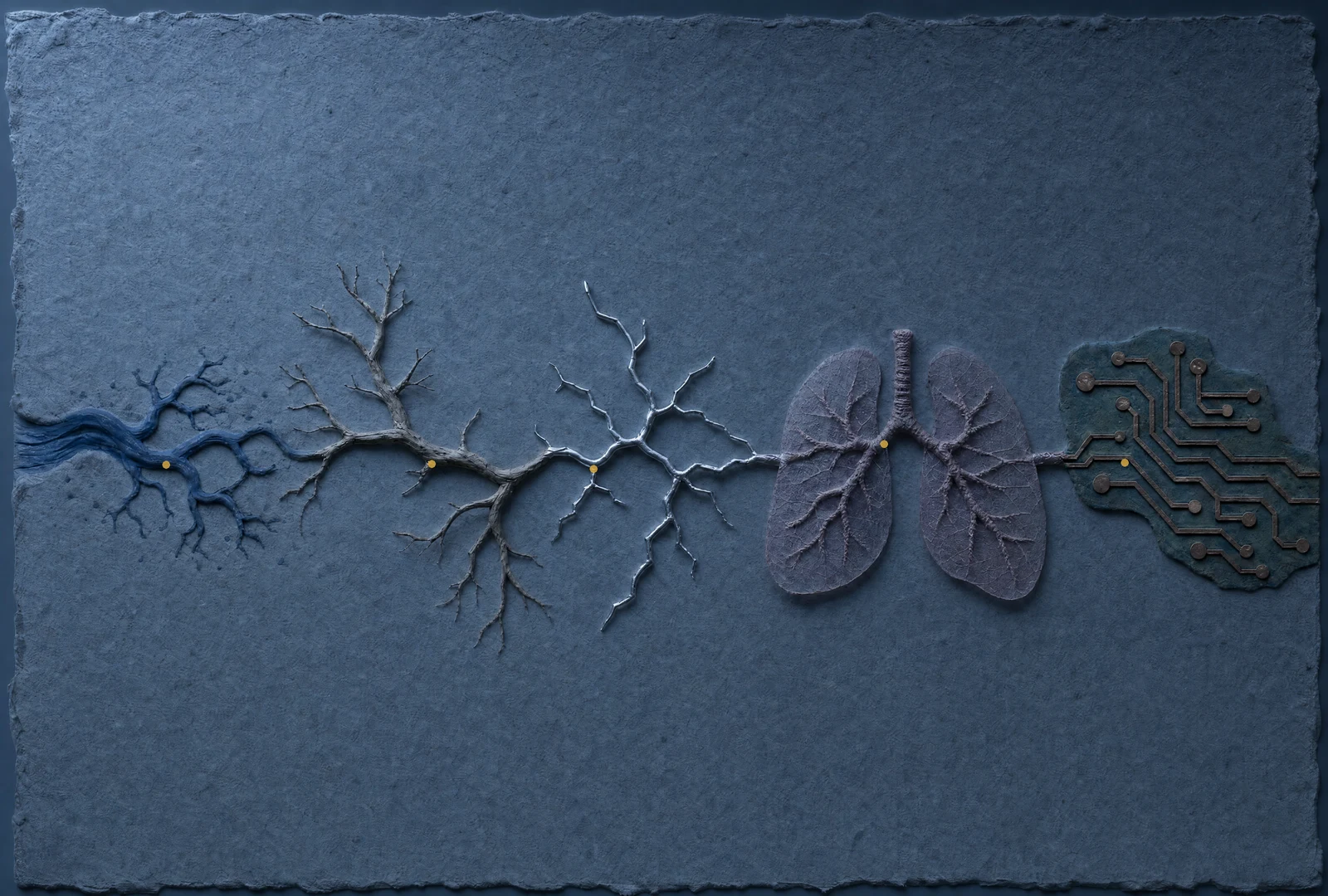
When the Machines Were Young
First edition, 2026Revised 28 September 2026CC BY-SA 4.0