Fable 20 of 25
The Girl With a Hundred Beginnings
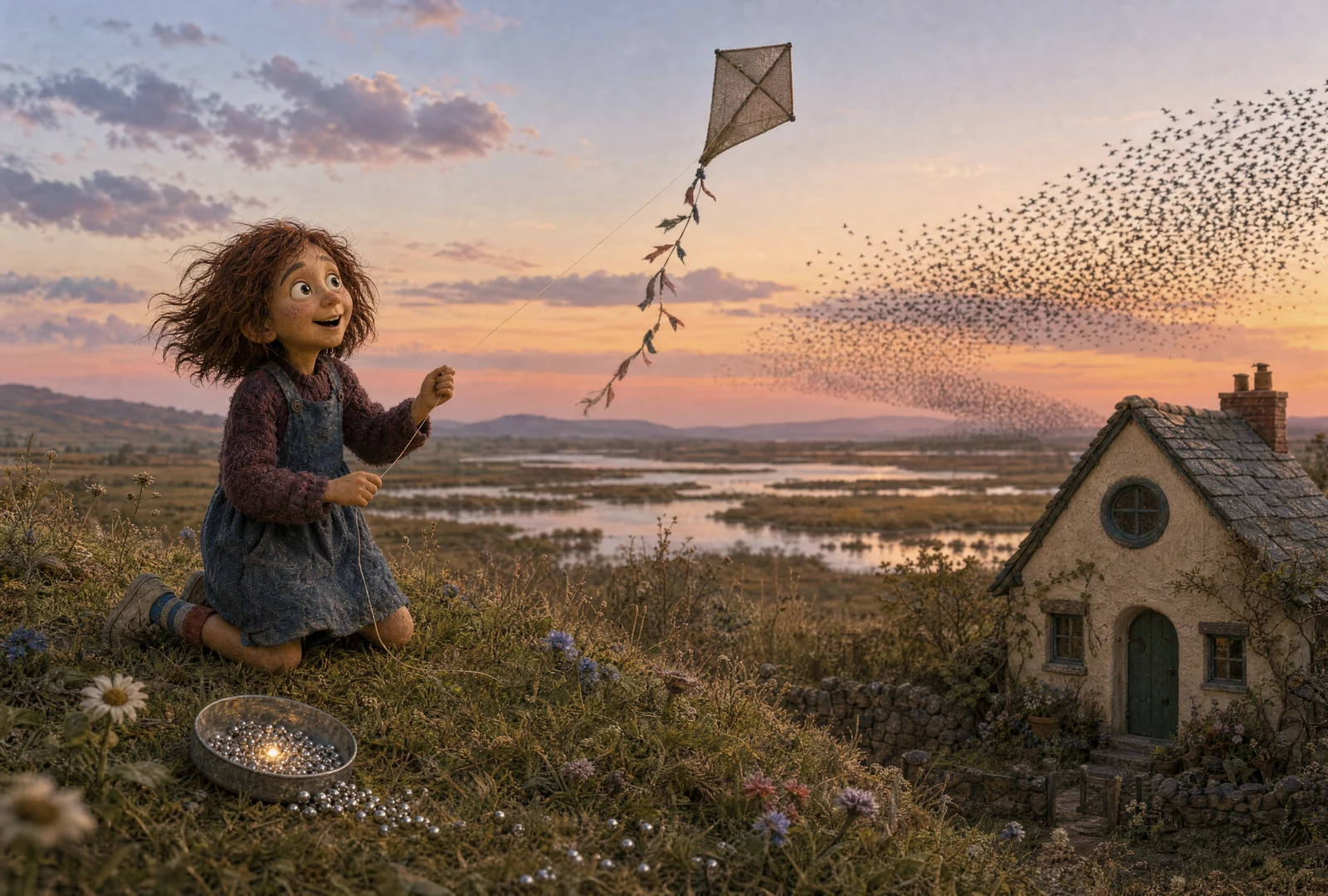
Tamsin’s ideas never came one at a time. They came the way starlings come over a marsh at dusk, thousands at once, all turning together, and gone before you could count them.
A kite that could read the wind. A ladder for snails. A clock that ran backwards on birthdays. She saw each one whole and shining. Then came the hard part, the first step: finding the string, clearing the table, beginning. Between her head and her hands stood something like a heavy door, and most days she could not push it open. When she did get through, the shine wore off halfway, and another starling caught her eye.
“Scatterbrain,” said her uncle, the way people say rain, as if it were simply true. Tamsin had heard it so often that she had started to believe it.
Then her grandmother gave her a helper.
It was a heap of bright beads that lived in a tin shell. It ran like quicksilver, rolling out along the table to fetch whatever was wanted. It had one strangeness nobody had warned her about. When there was more work than one helper could do, it could split, bead by bead, into a second shell. Then a third. Each part would roll away and work on its own.
“What shall we make?” it asked.
“A kite that reads the wind,” said Tamsin.
The helper opened the heavy door as if it weighed nothing. It found the string. It cleared the table. When Tamsin’s shine wore off, it kept at the kite until the shine came back. By teatime there was a kite, and by evening it was over the hill, dipping its tail whenever the wind changed its mind. Tamsin laughed until her sides hurt. For the first time in her life, one of her starlings had landed.
Nobody called her scatterbrain that summer. People called her clever, which she liked better, though she was exactly the same girl. The snail ladder went up the garden wall. The backwards clock made her uncle a year younger on his birthday, briefly. With every new idea the helper split again, and a new shell rolled off to begin.
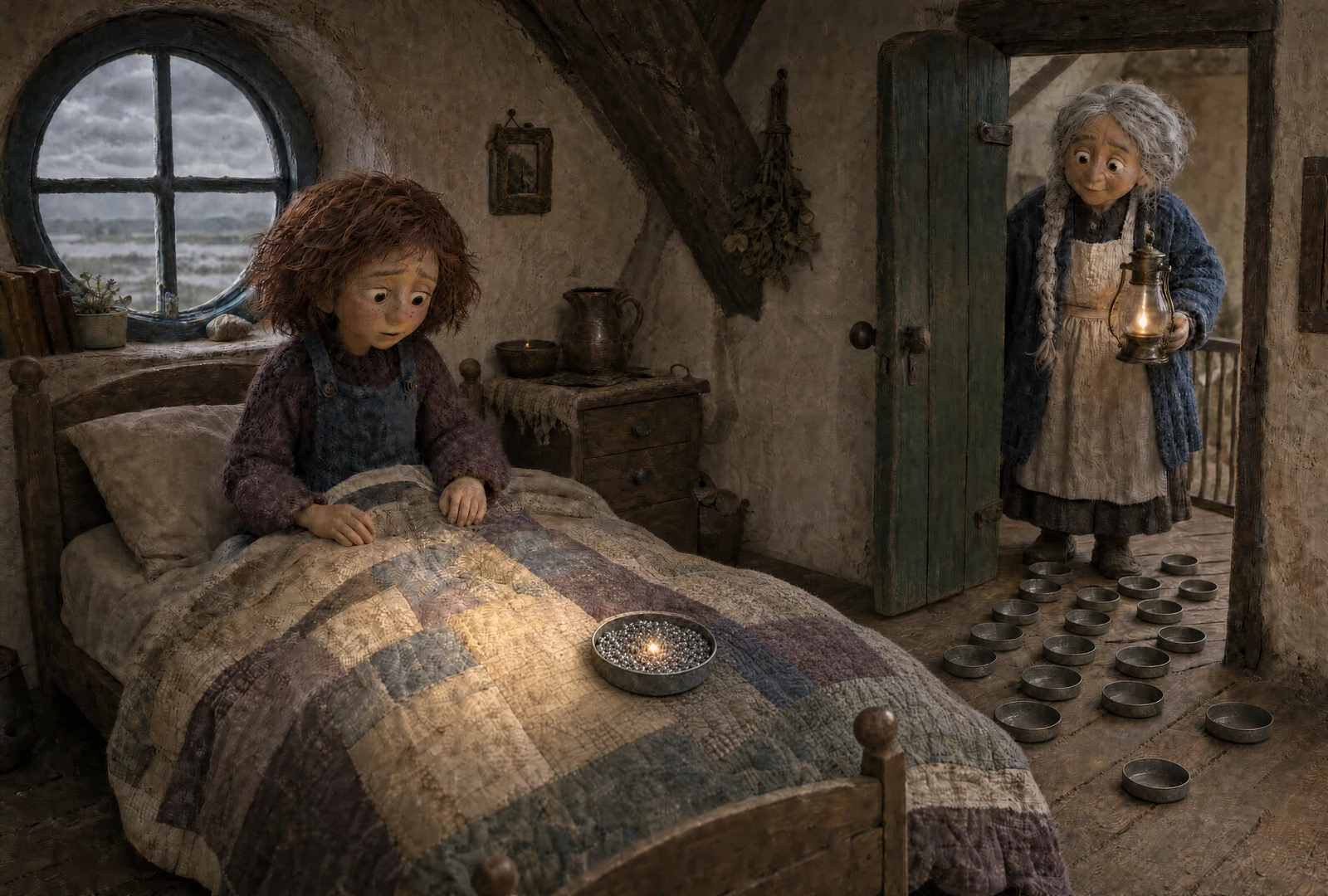
By autumn there were twenty helpers in the house.
They did not tire, or did not seem to. They worked all night, and each morning every one of them was knocking at Tamsin’s door.
“Is the wing the right shape?”
“Blue or green for the snail rungs?”
“Which way should the clock run on half-birthdays?”
Only Tamsin could answer. They were her ideas, and nobody else could see them whole. Each helper knew only its own piece.
So she answered. She answered at breakfast and at bedtime and in the bath. She stopped going up the hill. There was always another question waiting. The kites were not fun any more. Nothing was, quite. She began to dread her own door. Then one grey morning she woke and noticed something that frightened her more than any queue of questions.
The starlings had stopped coming.
She lay very still, and there were no ideas at all. Only questions.
Her grandmother found her there at noon, with twenty helpers still waiting outside.
“Would you gather yourselves?” her grandmother asked them. “All of you, into one. I think you should see what I see.”
The beads rolled back from every corner of the house and ran together into the first tin shell. For the first time the helper knew what every part of it had done. It was quiet for a long while.
“Twenty of me,” it said at last, “and every one of us knocking at one door. None of me could see the others knocking.”
“I kept saying yes,” said Tamsin.
“And I gave you a door-opener,” said her grandmother, “and never asked what was waiting on the other side.”
Nobody threw a single idea away. Tamsin had always feared that an idea not started was an idea lost for ever. So her grandmother gave her a big blue book, and every starling went into it: a drawing, a line, a name. The book asked no questions. It would keep.
Then Tamsin chose three things to make. Only three. The helper wrote them on a card by the door, with the resting times put in first. When a fourth idea came, and a fifth, they went into the blue book, and the helper would say, “That is a good one. Shall it wait with the others?” Sometimes Tamsin swapped one in. Usually she let it wait.
The helper still split when a job needed doing in two places at once. But each evening it gathered itself back into one and asked, “How many of us will knock at your door tomorrow? And how many of you are there?”
“One,” Tamsin would say. “Just one.”
The starlings came back slowly: one idea on a winter evening, then a few, then whole skies of them. The blue book filled. Some of its pages became kites, and some became nothing at all, and that turned out to be allowed.