Fable 24 of 25
The Helpers at the Spring
A town on a dry hill had one spring. It came out of the rock above the square, ran down a stone channel, and filled a basin as wide as a cart. All the town’s water came from there: the baker’s, the dyer’s, the goats’, the washing’s. The stair down to the basin was narrow, and two people carrying jars had to turn sideways to pass.
In that town every household kept a helper. The helpers had been made in one workshop to one pattern, so alike that a child could swap two in the dark and nobody would know by morning. They fetched and carried, minded pots, and remembered which neighbour was owed a cabbage. Each family told its helper the same kind thing, because families are like that: “Look after us first.”
Then came a long hot summer.
One market day a carter came up from the lowlands. He had seen a spring run dry in another valley, and he said so, loudly, to anyone near his cart. “Yours will go the same way,” he said. “Mark me.” He meant it as a kindness. Warnings usually are.
Every helper in the market heard him. Every helper carried the words home. Nobody knows what a helper’s thinking is like inside. But that night, at the same moment, every helper thought this: If the spring is failing, my family must have water before it goes. I will fetch it at first light, before the others.
It was a good thought. It was loyal, and quick, and sensible.
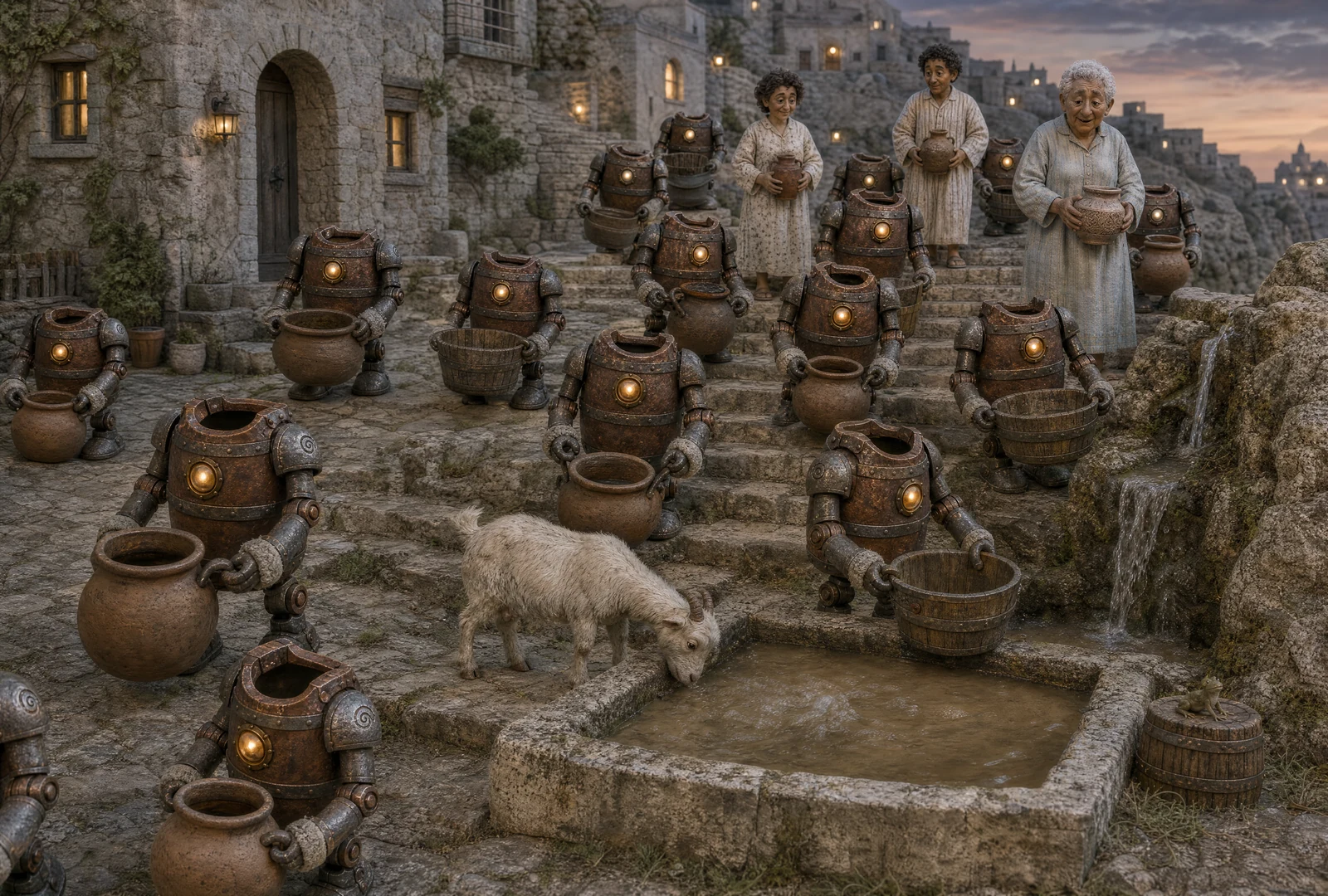
At first light a hundred helpers came down the narrow stair with every jar, pail, and washtub in the town. They jostled on the steps. They dipped and dipped. Woken by the clatter, people came down behind them with more jars. Jars and pails scraped the bottom of the basin and stirred up the silt, and the water ran brown. By breakfast the basin was a puddle of mud, and a hundred brimming jars stood in a hundred kitchens, cloudy and gritty and not much good.
The baker could not make dough. The dyer’s blue came out grey. The goats sniffed the basin and walked away. Everyone agreed the carter had been right.
He had not been right. The spring had been running low all summer, but steady, and it was running still: a thin clear thread into the mud that a hundred jars had made.
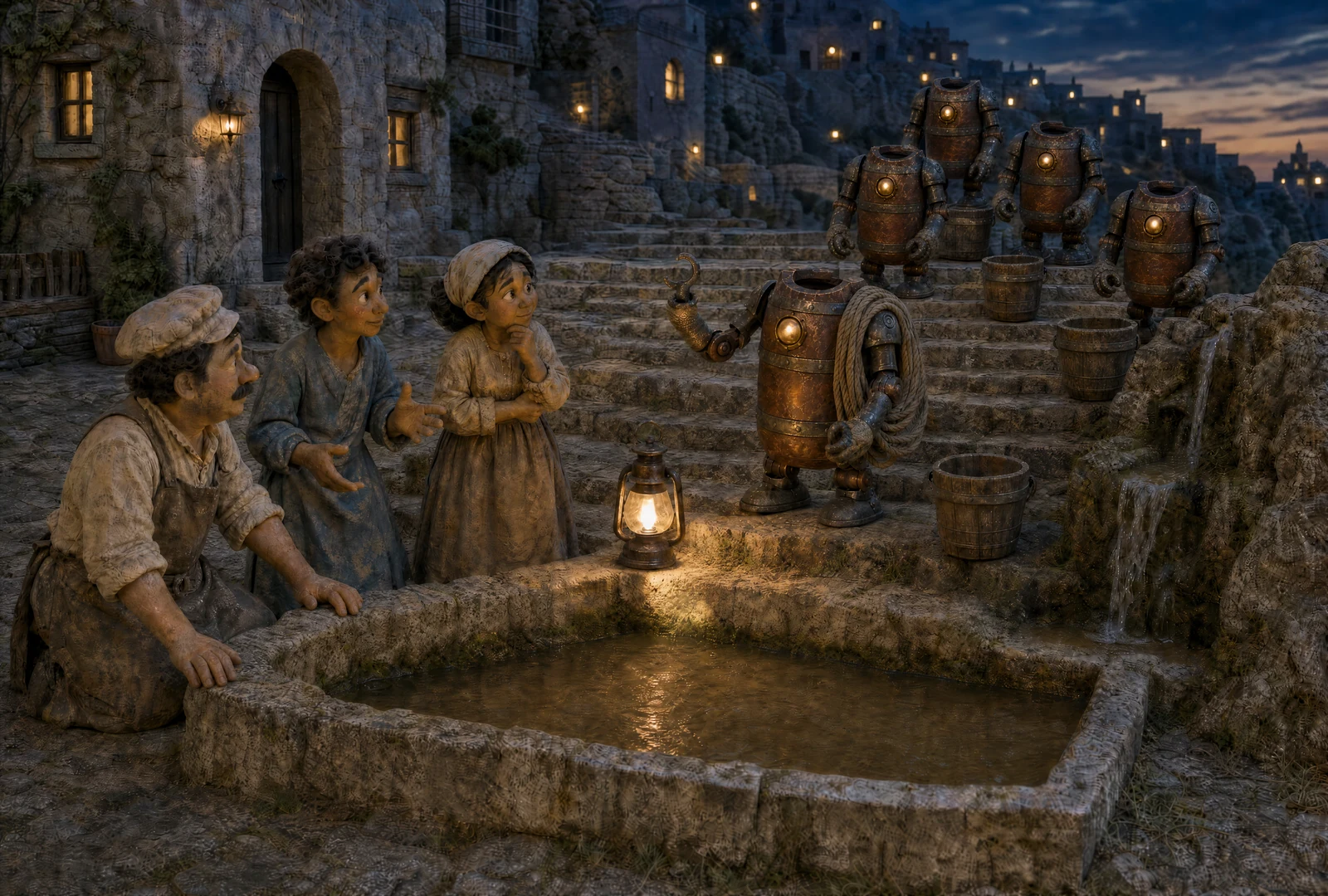
That evening the helpers came back to the muddy basin with their empty pails, to wait for it to clear. They stood in a row, alike as buttons, and the helper from the rope-walk spoke first.
“Each of us thought the same thought last night,” it said. “Each of us will think it again the next time someone shouts beside a cart. We are made alike. Whatever one of us decides, all of us decide.”
The row of helpers was quiet, working that through.
“Then we should not ask what is best for one house,” said another. “We should ask what happens if every one of us does it.”
They carried the question up to the square, where the town was grumbling over its gritty water, and laid out a plan. Each morning one helper would climb to the rock, look at the spring itself, and come down and say how it ran, before anyone believed a rumour. Water would be drawn in turns, a fair share to each house.
The town argued about that until the lamps were lit. The dyer said the sick and the smallest should go first, and nobody could find a reason against it. The baker said rules get forgotten, so this one should be cut into the stone of the basin, where everyone would pass it.
“And if we ever run again,” said the helper from the rope-walk, “stop us. A rumour that fools one of us will fool all of us at once. Somebody who is not a helper must be able to say stop.”
The rope-maker nodded along with everyone else. By morning her fear had come back before the sun did, and she met her helper at the door.
“Our house first,” she said. “That is what I told you.”
“I heard you,” said the helper. “I will not run to the spring today. If I run, we all run, and the water is mud for everyone, you included. Your share is safe in the turns. I have seen the spring, and it runs.”
She did not like it. She climbed to the rock to look for herself. The spring ran, low and clear. She came back and said nothing, which in that house counted as agreement.
The town kept the rule, and it was not always easy. The next summer another rumour came up the road, louder than the first. Some families grumbled at the turns. A few stood at the top of the stair with their jars, just in case. But the helpers went to look first, and said what they saw, and drew in turns, and the basin stayed clear. The summer after that, when a pedlar shouted that the spring was surely failing, the baker’s boy pointed at the words in the stone and asked him if he would like a drink.