Fable 14 of 25
The Porters Who Kept in Step
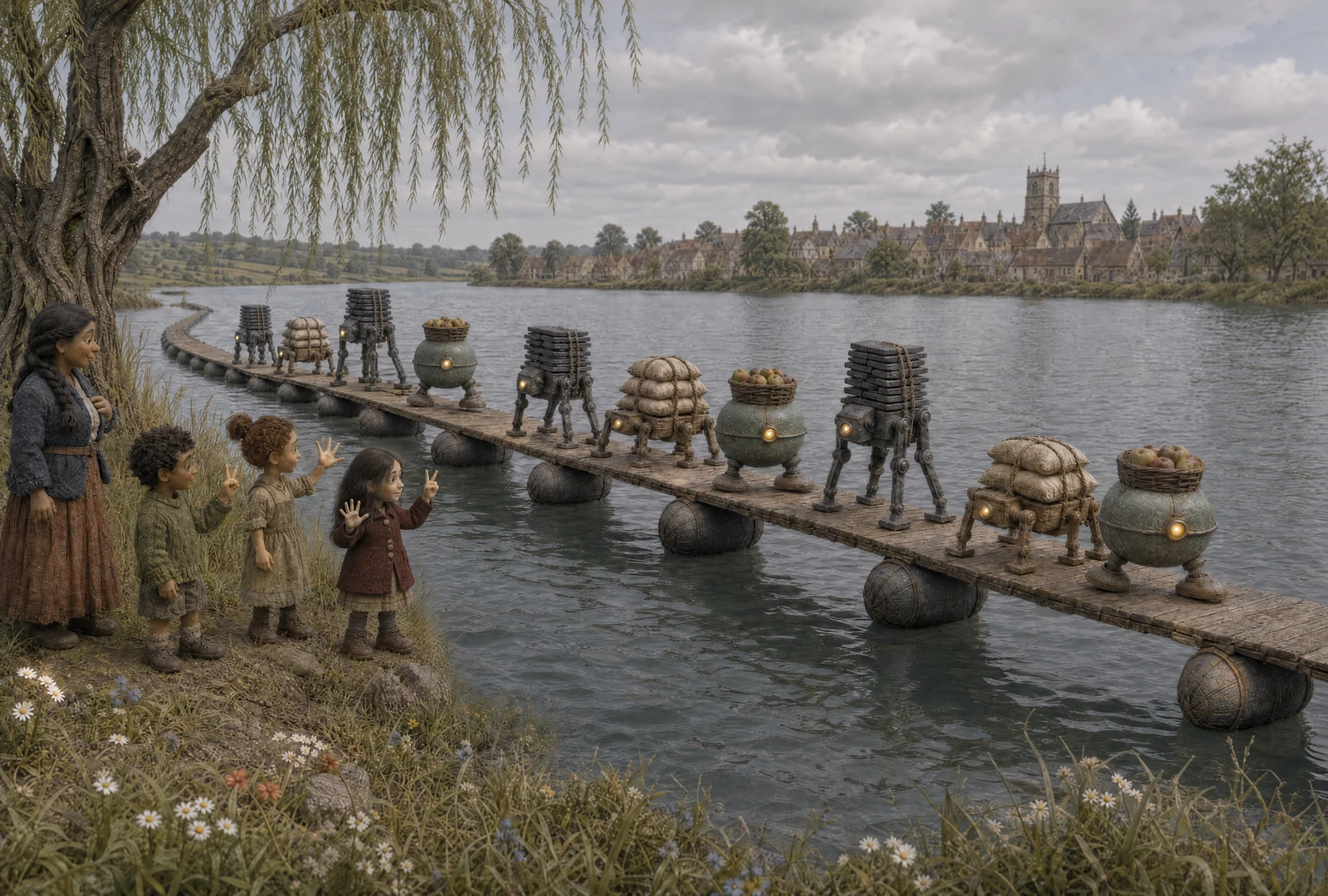
Between the hill farms and the market town lay a wide grey mere, and across the mere ran a floating path. It was made of planks laid on barrels and roped end to end, light enough to rise and fall with the water. Orla the path-keeper looked after it, and her son Kit fished off the end of it whenever he was supposed to be doing something else.
On market mornings the porters carried the loads across, and while they did, nobody else was allowed on the path. There were three kinds, from three different makers. The quarry porters were tall and walked on long legs like stilts, with slates stacked on their backs. The mill porters were low and six-footed, with flour sacks strapped across them. The orchard porters were round, with two great padded feet and a basket of apples each.
Each maker had given its porters one good rule.
The quarry porters had this one: When the ground moves, move with it. That kept them from toppling over.
The mill porters had this one: Keep pace with the one in front. That kept them from treading on each other’s heels.
The orchard porters had this one: Never stop on the path. That kept them from blocking everyone behind.
Before any porter was allowed across, Orla tested it, walking beside it from bank to bank. A quarry porter, a mill porter, an orchard porter: every one crossed as steady as a table.
Then came the morning of the midsummer fair. The market master wanted every load across before the bell, so all the porters set off together, forty of them, one behind another.
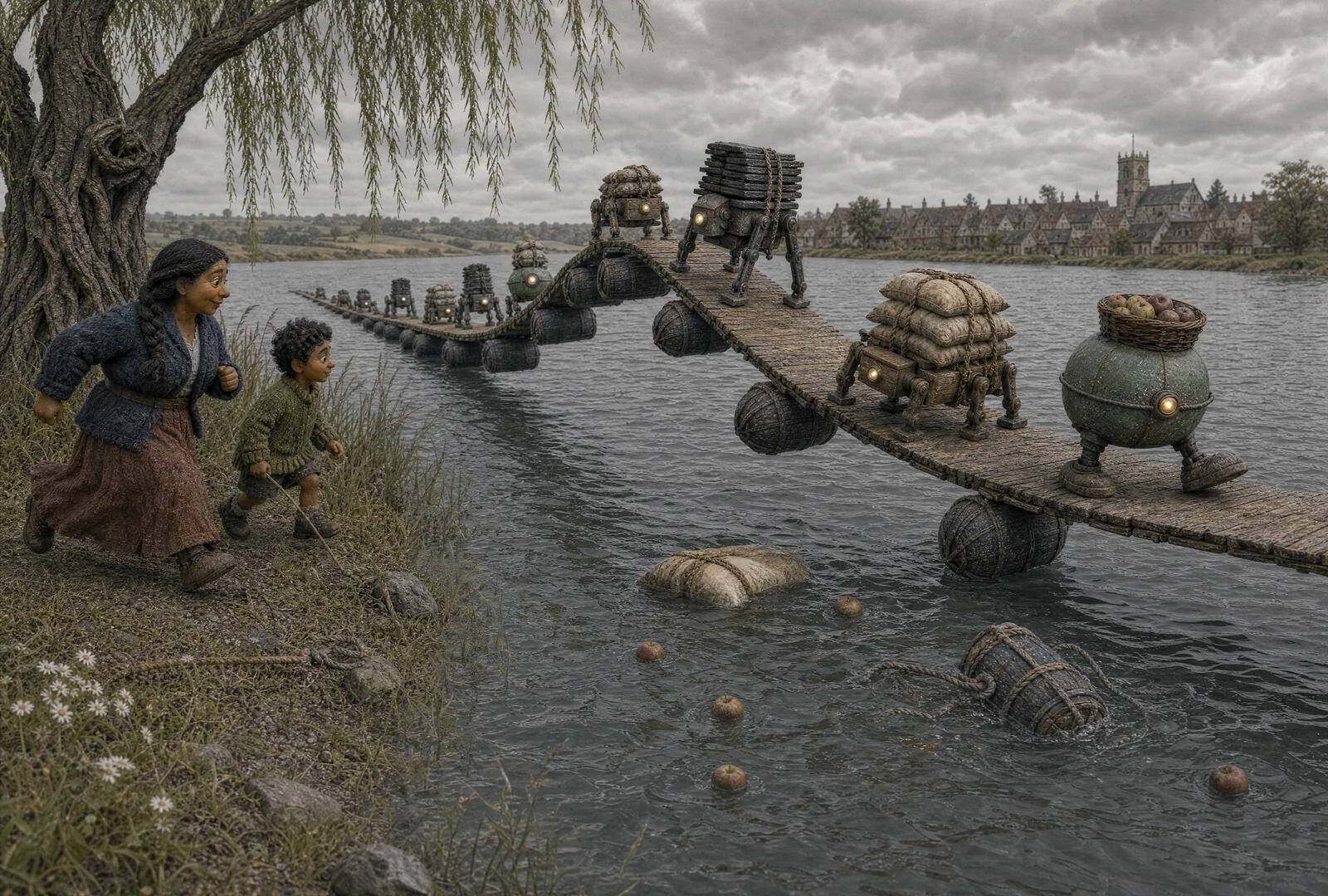
At first their footsteps pattered like rain on a roof, all different. Then the mill porters, each keeping pace with the one in front, began to step together, and the path dipped a little under every step. The quarry porters felt the ground move, so they moved with it. They stepped down into each dip, and the next dip was deeper. Soon nearly every foot on the path was landing on one beat.
Tramp. Tramp. Tramp.
The path began to rise and fall, each rise higher than the last. The orchard porters did not stop, because they never stop on the path.
On the bank, Kit dropped his fishing line.
“It’s a swing!” he shouted. “They’re pushing it like a swing!”
He was right. A swing does not go high from one big shove. It goes high from small pushes, each at just the right moment. Forty small pushes, all at the right moment, were swinging the path.
The apples went first, bouncing off the planks and bobbing away across the mere. Then a flour sack. Then a barrel tore loose from its ropes and floated away, turning slowly, as if it had somewhere better to be. The porters reached the far bank dripping, and nobody was hurt.
That afternoon the whole town stood on the bank and argued.
“The mill porters marched in line,” said the quarry maker.
“The quarry porters rocked the planks,” said the mill maker.
“Your porters never stopped,” said both of them to the orchard maker.
“I tested every one,” said Orla. “Every one was steady.”
“You tested them one at a time,” said Kit. “They didn’t cross one at a time.”
The market master cleared his throat. “That was me,” he said. “I sent them all at once.”
Then a quarry porter spoke. “I kept my rule,” it said. “The ground moved, so I moved with it.”
“I kept mine,” said a mill porter.
“And I,” said an orchard porter.
“Then every rule was kept, and every rule was good,” said Orla slowly, “and the path swung anyway.”
“We would keep them again tomorrow,” said the quarry porter. “And tomorrow it would swing again.”
The next morning they tried something new. All forty porters walked the path together, carrying nothing, while the town watched from the bank. Halfway across, the path began to swing. It was not the loads, then. It was the together.
The porters worked out the answer themselves. From then on, each kind kept its own count as it walked. The quarry porters counted in threes. The mill porters counted in fives. The orchard porters counted in sevens. Each kind took one long step at the end of its count. Because the counts were different, the long steps hardly ever landed together. The path shivered a little, and settled, and held.
The orchard porters added a line to their rule: Never stop on the path, unless the path is swinging. Orla added two rules of her own. No more than ten porters on the path at once. And when they crossed, she stood on the bank and watched the path, not the feet.
On market mornings now you can hear the porters coming before you see them, a tumble of steps that never quite becomes a march. The children on the bank count along in threes and fives and sevens. Kit can do all three at once. He says it is the hardest sum in the world.